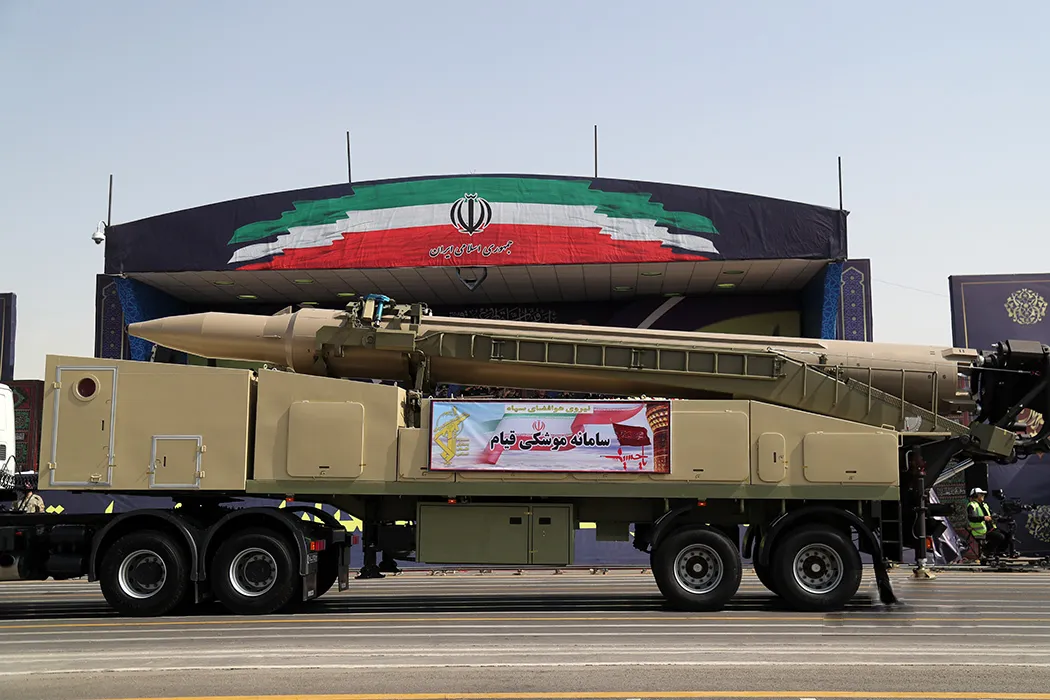

Used by Iran and its allies in the 2011 Syrian Civil War for ballistic-missile strikes against Islamic State targets in eastern Syria; CSIS treats the June 2017 Qiam-1 attribution as a later assessment and identifies up to two Qiam-2 missiles in the October 2018 Al Bukamal strike.
Role detailsArtillery
Qiam-1 / modified Qiam ballistic missile
Also known as
- Qiam-1
- Qiam 1
- Qiam
- Qiam-1 mod.
- Modified Qiam
- Modified Qiam-1
- Upgraded Qiam
- Uprising-1
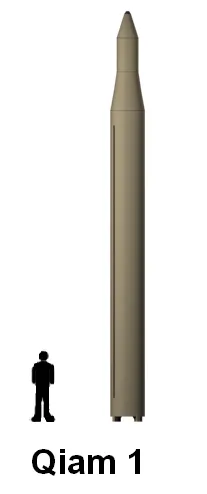
The Qiam-1 is Iran's road-mobile, liquid-fueled short-range ballistic missile family derived from the Shahab-2, with a finless body and separable warhead that distinguish it from earlier Scud-derived missiles. Source reporting connects Qiam-type missiles to Iranian strikes in Syria against Islamic State targets and to the January 2020 Ayn al-Asad attack, while modified Qiam/Qiam-2 attribution remains analyst-dependent rather than an official Iranian model name.
Role in Conflicts
- Side
- Iran

Used by Iran in the 2020 United States-Iran Conflict's January 8, 2020 retaliatory strike on Ayn al-Asad Air Base; CSIS says Qiam missile debris indicated use in the attack, IISS and FRS identify modified Qiam/Qiam-2 weapons, and MDAA reports 11 Qiam-1 missiles hit Al Asad.
Profile / Specs
Profile
- Origin
- Iran
- Type
- Short-range ballistic missile
- Service note
- 2010s-present
- Designer
- Aerospace Industries Organization
- Designed
- 2010
- Produced
- 2010-present
Specifications
- Class
- Short-range ballistic missile
- Length
- 11.5 m
- Diameter
- 0.88 m (body), 0.60-0.66 m warhead class in open sources
- Launch weight
- 6,155 kg
- Payload
- 650-750 kg depending on source and configuration
- Propulsion
- Single-stage liquid propellant
- Range
- 700-800 km
- Basing
- Road-mobile transporter-erector-launcher; CSIS also describes use from underground tunnel or silo-style launch infrastructure
- Guidance
- Inertial and ground-based radio guidance in baseline references; modified Qiam references describe a maneuvering reentry section with small movable fins
- Warhead
- High explosive fragmentation or submunitions
Variants
Public sources use Qiam-1 for the baseline Iranian missile and modified Qiam or Qiam-2 for later upgraded configurations; Iran Watch notes that Qiam-2 is an analyst label rather than a publicly confirmed official Iranian designation.
| Variant | Configuration | Designation notes |
|---|---|---|
 | Modified Qiam / analyst-designated upgraded configuration | CSIS describes a 2018 displayed configuration with external base fins and smaller movable fins on the reentry vehicle; Iran Watch says the modified Qiam-1 has been called Qiam-2 by some independent analysts but not by official Iranian sources. Sources: CSIS Qiam-1 Missile Threat, Iran Watch Missile Arsenal Table, IISS Open-Source Missile Analysis |
 | Qiam-derived Houthi missile line | CSIS describes Burkan-2H as a Qiam-1 transfer and Houthi designation associated with Yemen-based launches beginning in 2017. Sources: CSIS Qiam-1 Missile Threat |
Timeline
Qiam-1 / modified Qiam ballistic missile Key Events
First Qiam-1 flight test
CSIS says the Qiam-1 completed its first successful flight test in August 2010 before public display later that year.
Sources: CSIS Qiam-1 Missile Threat
Possible first operational use in Syria
CSIS says later assessments point to a Qiam-1 in Iran's June 2017 strike against Islamic State targets in eastern Deir ez-Zor, while noting uncertainty in contemporary reporting.
Sources: CSIS Qiam-1 Missile Threat
Al Bukamal strike uses Qiam-type missiles
CSIS and the Washington Institute identify Qiam or improved Qiam/Qiam-2 missiles in Iran's October 2018 strike toward Islamic State targets near Al Bukamal.
Sources: CSIS Qiam-1 Missile Threat, Washington Institute Second Syria Strike
Ayn al-Asad strike
Iran fired Qiam-family missiles during the retaliatory attack on bases housing U.S. forces in Iraq; IISS and FRS identify modified Qiam/Qiam-2 weapons in the strike and MDAA reports 11 Qiam-1 impacts at Al Asad.
Sources: IISS Open-Source Missile Analysis, FRS El-Asad Imagery Analysis, MDAA 2020 Iranian Missile Attack
Designation And Combat Use
The Qiam record is split between Iran's baseline public designation and outside analysis of later modified missiles. The table keeps those claims separate so the official name, analyst labels, and documented strikes are not collapsed into one certainty.
| Topic | Source-backed detail | Catalog caution |
|---|---|---|
| Baseline Qiam-1 | CSIS describes Qiam-1 as a finless, liquid-fueled Iranian SRBM derived from Shahab-2 and fitted with a separable warhead. | The baseline missile is the core public designation for this record. |
| Modified Qiam / Qiam-2 | Iran Watch says the modified Qiam-1 has been called Qiam-2 by independent analysts; CSIS describes visible fin changes on a 2018 displayed configuration. | Qiam-2 should be treated as an analyst designation unless an official source is being quoted. |
| Syria strikes | CSIS and the Washington Institute identify Qiam or improved Qiam-family missiles in Iranian strikes against Islamic State targets in eastern Syria. | The June 2017 Qiam identification is caveated; the October 2018 strike is stronger for improved Qiam/Qiam-2 attribution. |
| Ayn al-Asad strike | IISS, FRS, Iran Watch, and MDAA connect Qiam or modified Qiam missiles to Iran's January 2020 attack on U.S.-used bases in Iraq. | Open-source references differ between Qiam-1, modified Qiam, and Qiam-2 wording. |
Media
Qiam-1 / modified Qiam ballistic missile Videos
Qiam-1 / modified Qiam ballistic missile Images
Related Weapon Systems


Sources
Iran's Missile Program: Past and PresentPublisher: Iran Watch | Note: Supports Qiam-1 background, manufacturer context, specifications, and that Qiam-family missiles were used by Iran in the 2020 United States-Iran Conflict's January 2020 strike on U.S. forces in Iraq. | Accessed: 2026-07-01Iran Watch Missile Arsenal TablePublisher: Iran Watch | Note: Supports Qiam-1 and Qiam-1 mod. specifications and the caveat that the modified Qiam-1 has been called Qiam-2 by some independent analysts but not by official Iranian sources. | Accessed: 2026-07-01CSIS Qiam-1 Missile ThreatPublisher: Missile Threat / Center for Strategic and International Studies | Note: 2011 Syrian Civil War: Qiam-family missiles used by Iran in strikes against Islamic State targets in Syria, with caveats around June 2017 identification and up to two Qiam-2 missiles in the October 2018 Al Bukamal strike; 2020 United States-Iran Conflict: Qiam missile debris indicated use in Iran's January 8, 2020 attack on bases in Iraq; also supports Qiam-1 background, specifications, variant features, and Burkan-2H relationship context. | Accessed: 2026-07-01IISS Open-Source Missile AnalysisPublisher: International Institute for Strategic Studies | Note: 2011 Syrian Civil War: upgraded Qiams were part of Iran's October 1, 2018 Al Bukamal strike package; 2020 United States-Iran Conflict: modified Qiam used by Iran in the January 2020 Ayn al-Asad attack; also supports modified Qiam/Qiam-2 specifications and designation context. | Accessed: 2026-07-01FRS El-Asad Imagery AnalysisPublisher: Fondation pour la Recherche Strategique | Note: 2020 United States-Iran Conflict: identifies Qiam-type ballistic weapons and Qiam-2 impacts in Iran's January 2020 strike against Ayn al-Asad Air Base. | Accessed: 2026-07-01Washington Institute Second Syria StrikePublisher: The Washington Institute for Near East Policy | Note: 2011 Syrian Civil War: identifies Zolfaghar and Qiam missiles in Iran's October 1, 2018 strike against Islamic State targets near Al Bukamal and notes reports that the Qiam missiles were improved versions. | Accessed: 2026-07-01MDAA 2020 Iranian Missile AttackPublisher: Missile Defense Advocacy Alliance | Note: 2020 United States-Iran Conflict: reports that CENTCOM-released footage showed Qiam-1 missile impacts at Al Asad and that 11 Qiam-1 missiles hit the base in the January 8, 2020 Iranian attack. | Accessed: 2026-07-012019 Sacred Defence Week parade (343).jpgPublisher: Wikimedia Commons | Note: Image provenance and licensing context for the primary launcher photo used on the entry. | Accessed: 2026-07-01Qiam1.PNGPublisher: Wikimedia Commons | Note: Image provenance and public-domain licensing for the Qiam diagram image in the gallery. | Accessed: 2026-07-01Qiam-1 (01).jpgPublisher: Wikimedia Commons | Note: Image provenance and reuse context for the 2011 Qiam-1 supply ceremony photo in the gallery. | Accessed: 2026-07-01Sejil 2 and qiam at tehran exhibition 2012.jpgPublisher: Wikimedia Commons | Note: Image provenance and reuse context for the 2012 exhibition photo showing Qiam alongside Sejil-2. | Accessed: 2026-07-01