Munitions

WE.177

Also known as
  • WE177
  • WE 177
  • WE.177A
  • WE.177B
  • WE.177C

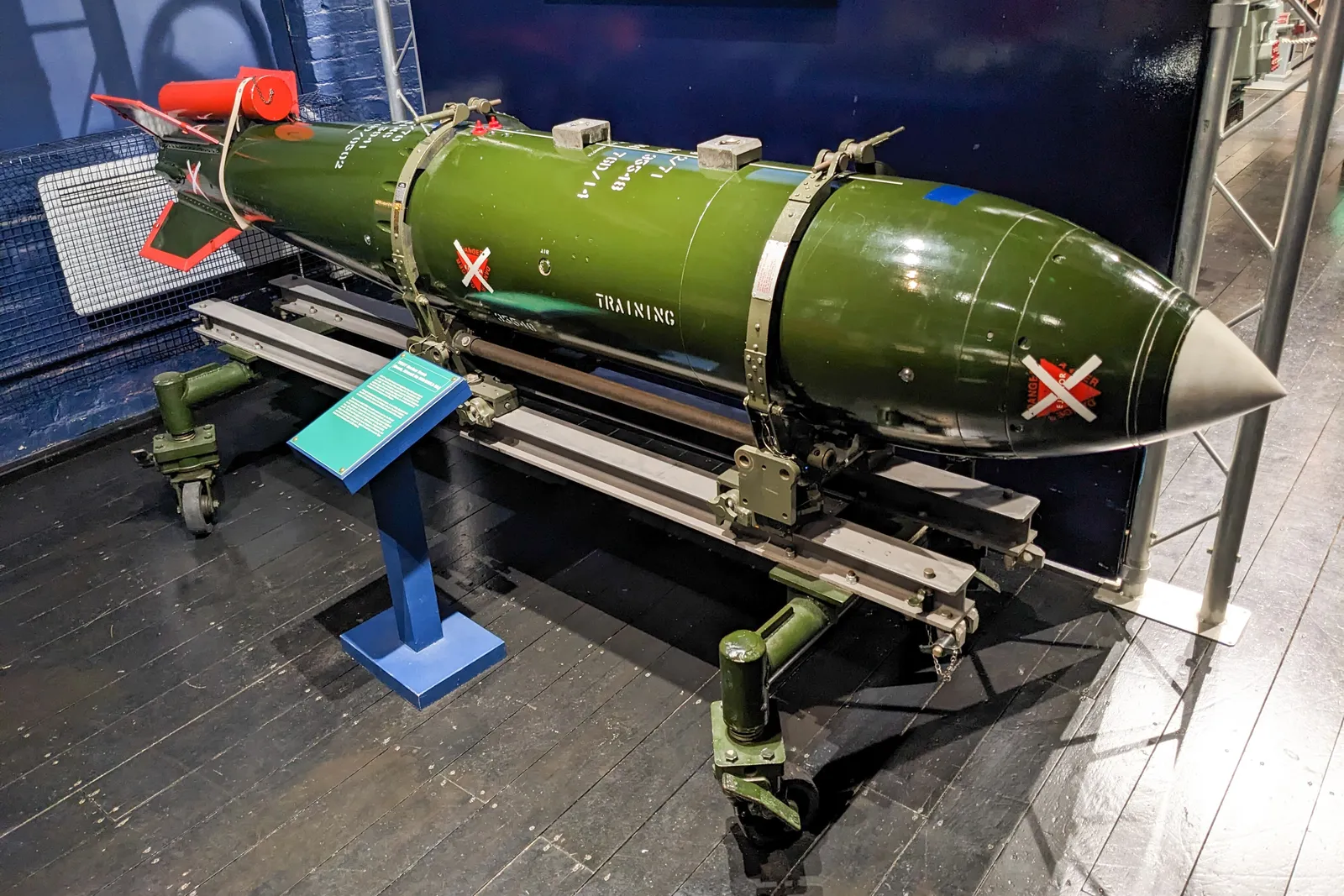
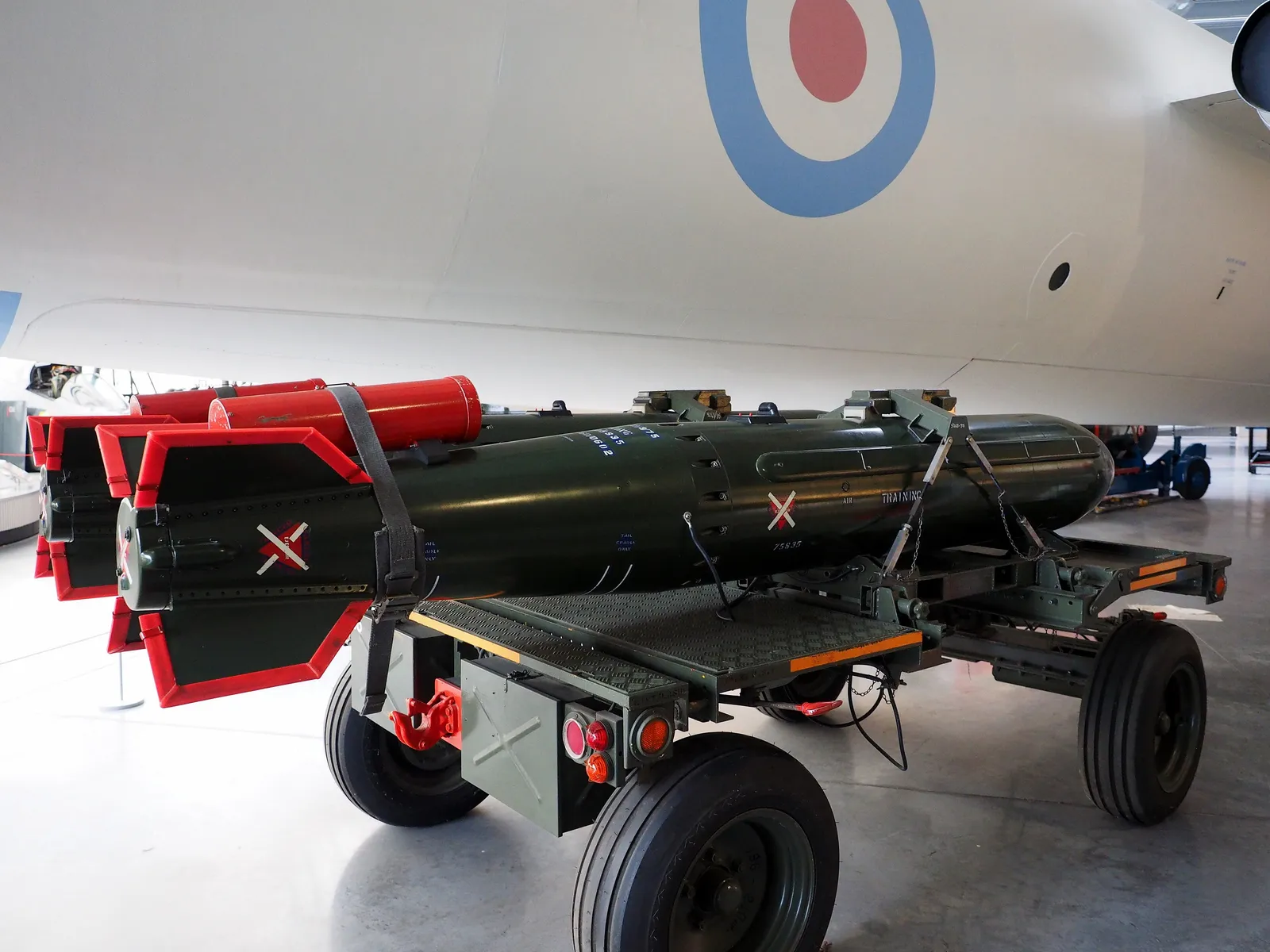
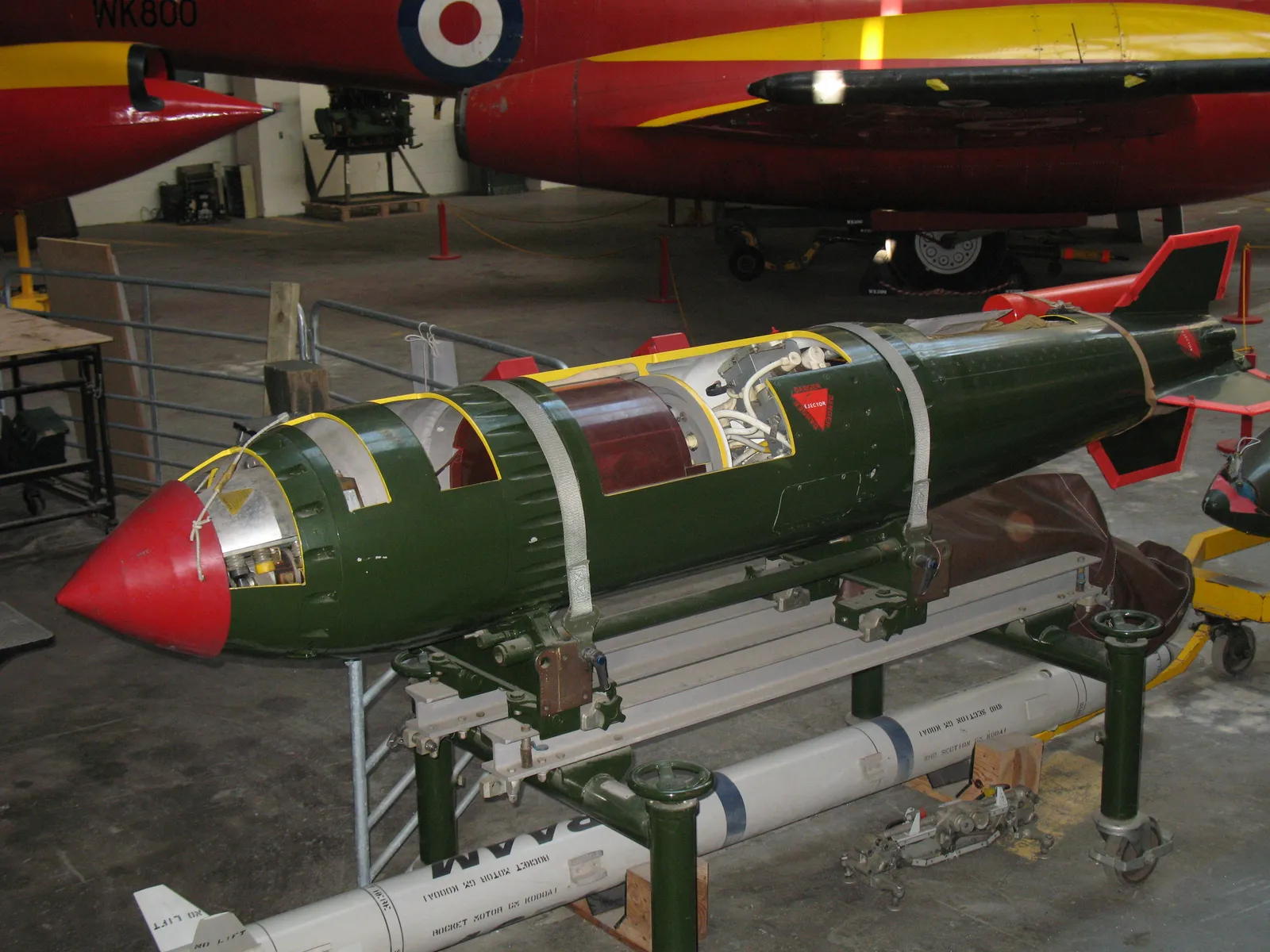
WE.177 was the United Kingdom's last air-dropped free-fall nuclear weapon family, built for RAF and Royal Navy strike aircraft and naval aviation platforms. Museum and archival sources tie the programme to Hunting Engineering Ltd's non-nuclear design-authority role, Royal Aircraft Establishment casing work, AWRE nuclear-component work, and a 1966-1998 service life that ended with the RAF's denuclearisation.

Profile / Specs

Profile

Origin
United Kingdom
Type
Air-dropped free-fall nuclear bomb family
Service note
Entered service in 1966 and retired in 1998
Designer
Royal Aircraft Establishment Farnborough led ballistic-casing design; Hunting Engineering Ltd coordinated non-nuclear components; AWRE Aldermaston manufactured radioactive components
Designed
1960s
Produced
1960s-1970s
Number built
BASIC gives a likely May 1977 stockpile of 270 weapons: 92 WE.177A, 52 WE.177B and 126 WE.177C

Specifications

Munition class
Air-dropped free-fall nuclear weapon family
Operators
Royal Air Force and Royal Navy
Service period
Introduced in 1966 and retired in 1998
Variant yields
WE.177A: 0.5/10 kilotons; WE.177B: about 420-450 kilotons; WE.177C: about 190 kilotons
Production stockpile
BASIC gives a likely May 1977 total of 270 weapons: 92 WE.177A, 52 WE.177B and 126 WE.177C
WE.177B dimensions
IWM's Type B training example is 133 in long with a 24.5 in fin span; catalogue dimensions list diameter 420 mm, length 338 cm and width 623 mm
Cleared carrier aircraft
BASIC lists Vulcan B2, Royal Navy and RAF Buccaneer, Jaguar, Tornado and Sea Harrier FRS.1 as fixed-wing WE.177 carriers, with Wasp, Wessex, Lynx and Sea King helicopters for Royal Navy rotary-wing carriage
Hunting Engineering role
Coordinating design authority for non-nuclear components, with responsibility for structural, environmental and general issues during post-design support
Variants
VariantConfigurationDesignation notes
WE.177ALow-yield fission/depth-bomb and strike variant

BASIC describes WE.177A as the 0.5/10 kiloton variant ordered for Royal Navy depth-bomb and strike roles, with production beginning in January 1969 and RAF/Royal Navy A deliveries complete by September 1972.

Sources: A History of the United Kingdom's WE 177 Nuclear Weapons Programme

WE.177BHigh-yield thermonuclear RAF variant

IWM identifies the first WE.177 delivered in 1966 as the thermonuclear Type B; BASIC places the first live WE.177B in RAF Vulcan B2 service in September 1966 and gives a completed B order of 52-53 weapons by October 1967.

Sources: WE 177 Type B training bomb, A History of the United Kingdom's WE 177 Nuclear Weapons Programme

WE.177CIntermediate-yield RAF tactical variant

BASIC says WE.177C became the single-yield intermediate variant of about 190 kilotons, finalized in 1972, ordered for RAF Buccaneer and Jaguar requirements and delivered from 1973 to May 1977.

Sources: A History of the United Kingdom's WE 177 Nuclear Weapons Programme, WE177C nuclear practice bomb

Carrier Aircraft

Public museum and archival sources identify WE.177 carriage across RAF strike aircraft and Royal Navy aviation platforms.

CarrierCarrier typeCarriage evidence
Buccaneer S2, Strike aircraft, Aircraft & UAVsBuccaneer S2Strike aircraft

BASIC identifies Royal Navy and RAF Buccaneers among fixed-wing aircraft cleared to carry WE.177, and describes a Buccaneer Mk 2 modification programme for WE.177 carriage.

Sources: A History of the United Kingdom's WE 177 Nuclear Weapons Programme

SEPECAT Jaguar, Supersonic jet attack aircraft, Aircraft & UAVsSEPECAT JaguarStrike aircraft

IWM and RAF Museum identify Jaguar as a WE.177 carrier, and BASIC describes WE.177 planning and clearance for Jaguar aircraft.

Sources: WE 177 Type B training bomb, WE177C nuclear practice bomb, A History of the United Kingdom's WE 177 Nuclear Weapons Programme

Panavia Tornado, Twin-engine variable-sweep wing multirole strike aircraft, Aircraft & UAVsPanavia TornadoStrike aircraft

IWM and RAF Museum identify Tornado as a WE.177 carrier, while BASIC says Tornado was cleared to carry WE.177 and planned to replace Vulcan and some Buccaneer units in the nuclear role.

Sources: WE 177 Type B training bomb, WE177C nuclear practice bomb, A History of the United Kingdom's WE 177 Nuclear Weapons Programme

Sea King, Multi-role maritime helicopter, Aircraft & UAVsSea KingMaritime helicopter

IWM names Sea King in the Royal Navy WE.177 carrier list, and BASIC lists Royal Navy Sea King helicopters among rotary-wing WE.177 platforms.

Sources: WE 177 Type B training bomb, A History of the United Kingdom's WE 177 Nuclear Weapons Programme

Timeline

WE.177 Key Events

  1. First WE.177 delivery

    IWM states that the first WE.177, the thermonuclear Type B, was delivered to RAF Cottesmore in 1966.

    Sources: WE 177 Type B training bomb

  2. WE.177A production begins

    BASIC records WE.177A production weapons coming off the line from January 1969, after the Royal Navy order was reduced to 43 weapons.

    Sources: A History of the United Kingdom's WE 177 Nuclear Weapons Programme

  3. Type A delivered to the Royal Navy

    IWM describes the single-stage Type A as delivered to the Royal Navy in 1972.

    Sources: WE 177 Type B training bomb

  4. WE.177C design finalized

    BASIC says the intermediate-yield WE.177C design was finalized in 1972 with the SW641 warhead designation.

    Sources: A History of the United Kingdom's WE 177 Nuclear Weapons Programme

  5. Likely WE.177 stockpile reaches 270

    BASIC's production appendix gives a likely May 1977 total of 270 WE.177 weapons across A, B and C variants.

    Sources: A History of the United Kingdom's WE 177 Nuclear Weapons Programme

  6. Withdrawal decision announced

    Ritchie and Walker record the April 1995 government announcement that WE177 would be withdrawn from service by the end of 1998.

    Sources: Denuclearising the Royal Air Force

  7. WE.177 withdrawn

    Hansard records WE177 withdrawal from service on 31 March 1998, with simulator continuation training maintained through that month.

    Sources: WE177 Bombs Hansard written answers

Media
Related Weapon Systems
AIM-9 Sidewinder missile, Short-range air-to-air missile family, MunitionsMunitionsAIM-9 Sidewinder missileShort-range air-to-air missile familyThe AIM-9 Sidewinder is a short-range infrared-guided air-to-air missile family that began at Naval Ordnance Test Station China Lake and entered service in the 1950s. The family spans early rear-aspect missiles, all-aspect AIM-9L/M models, German AIM-9L/I modernization, export P-series rounds, and the modern AIM-9X branch, with documented use from Vietnam and Middle East air wars to Falklands, Gulf War, Ukraine air-defense aid, and Red Sea operations.
Gravehawk, Containerized short-range surface-to-air missile system, Air DefenseAir DefenseGravehawkContainerized short-range surface-to-air missile systemGravehawk is a UK-designed, Denmark-backed short-range air-defense system built for Ukraine by adapting Soviet-era R-73 air-to-air missiles for ground launch from a containerized twin-rail launcher. Official UK and parliamentary statements place it in Ukraine's wartime air-defense network, with prototypes delivered and a follow-on batch intended to help protect cities, troops, infrastructure, and energy facilities from Russian aerial attacks.
W80-4 Life Extension Program, Nuclear warhead life-extension program, MunitionsMunitionsW80-4 Life Extension ProgramNuclear warhead life-extension programThe W80-4 Life Extension Program is the National Nuclear Security Administration modernization path for extending the W80-1 cruise-missile warhead into the U.S. Air Force Long Range Standoff Weapon. Official NNSA, Sandia, LLNL, GAO, and congressional-budget sources frame it as a stockpile life-extension program rather than a conflict-use weapon: the design moved into Phase 6.4 production engineering in March 2023, a first canned subassembly was certified at Y-12 in September 2025, and full-warhead first production remains scheduled for 2027.
Vanguard-class submarine, Nuclear-powered ballistic missile submarine, Naval SystemsNaval SystemsVanguard-class submarineNuclear-powered ballistic missile submarineThe Vanguard-class submarine is the Royal Navy's four-boat nuclear-powered ballistic missile submarine class for the United Kingdom's continuous at-sea nuclear deterrent. Built at Barrow-in-Furness by Vickers Shipbuilding and Engineering, the class carries Trident II D5 missiles, remains in service as the UK's single nuclear delivery platform, and is being sustained until Dreadnought-class submarines replace it in the 2030s.

Sources