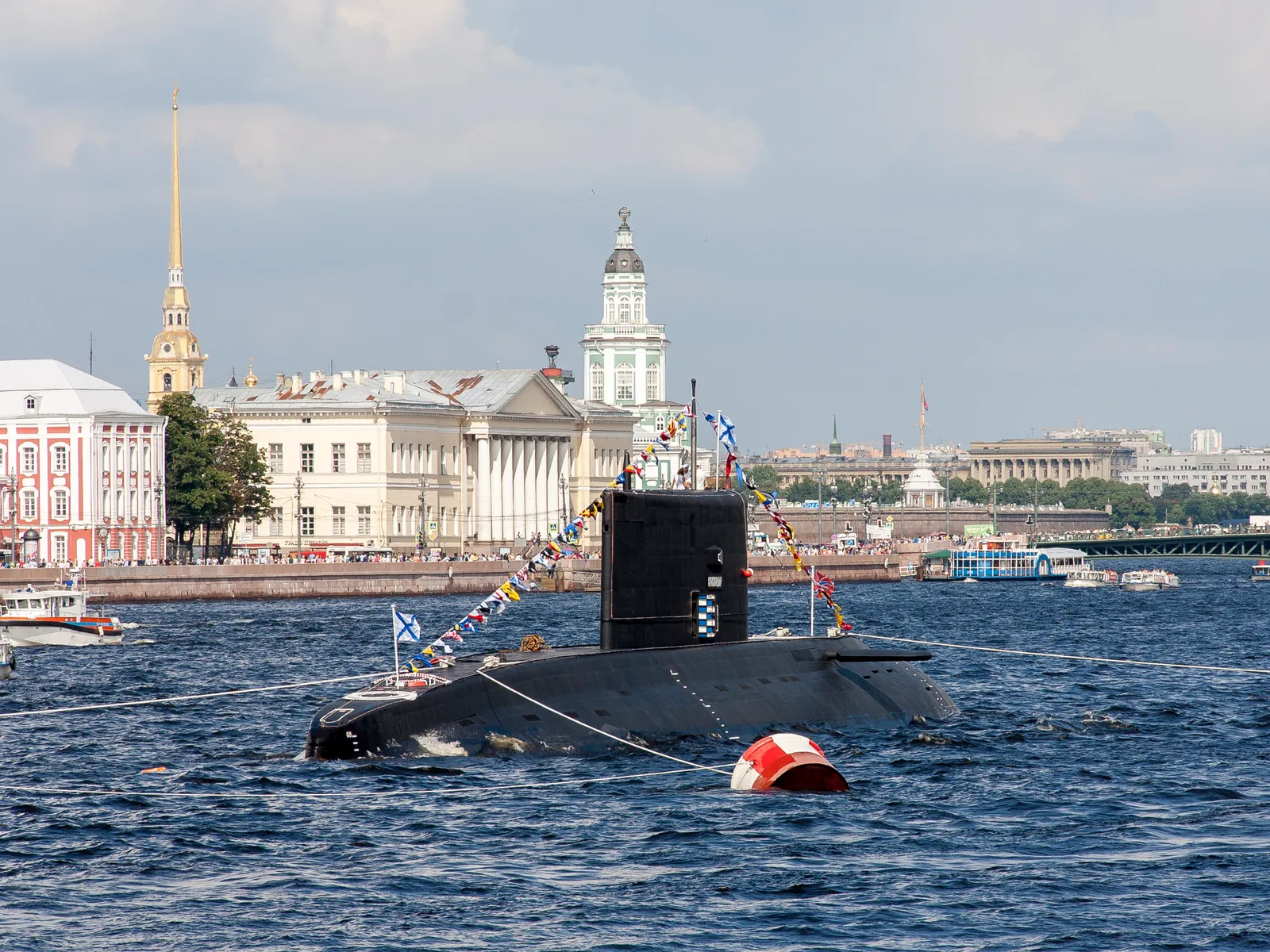

Russian Project 636.3 submarines launched Kalibr cruise missiles from the Mediterranean against targets in Syria, including Rostov-on-Don in 2015 and later Krasnodar and Veliky Novgorod in 2017.
Role detailsNaval Systems
Project 636 / 636M / 636.3 Kilo-class submarine
Also known as
- Kilo-class submarine
- Project 636.3
- Project 636
- Project 636M
- Project 636.1
- Project 06363
- Project 06361
- Project 06364
- Varshavyanka-class
- Improved Kilo II
- Kilo II
- Project 636 Varshavyanka
- Improved Kilo
- Improved Kilo-class
- Improved Kilo II-class
Project 636 is Russia's export-improved Kilo / Varshavyanka diesel-electric attack submarine line, derived from Project 877 and later split across export missile-capable variants and the Russian Navy Project 636.3 / 06363 Improved Kilo II branch. The family keeps six 533 mm bow tubes for torpedoes, mines, and tube-launched cruise missiles, while later 636.3 boats add Kalibr-PL strike capability and updated sensor, navigation, and combat-management equipment.
Role in Conflicts
- Side
- Russia

Russian Black Sea Fleet Project 636.3 submarines used Kalibr cruise missiles against Ukrainian targets during the full-scale war, with public reporting tying Kilo-class submarine launches to 2022 strikes.
Role detailsProfile / Specs
Profile
- Origin
- Russia
- Type
- Diesel-electric attack submarine
- Service note
- 1990s-present
- Designer
- Rubin Design Bureau
- Designed
- 1970s Project 877 baseline; 1990s Project 636 export upgrade; 2010s Project 636.3 Russian Navy branch
- Produced
- 1990s-present
- Number built
- More than 20 Project 636-family export and Russian Navy boats delivered across China, Vietnam, Algeria, and Russia
Specifications
- Displacement
- About 2,350 tonnes surfaced and about 3,100 tonnes submerged for Project 636 / 636.3 references
- Length
- About 73.8 metres for Project 636; about 74.5 metres listed for Project 06363
- Beam
- About 9.9 metres
- Crew
- 52
- Speed
- About 17-20 knots submerged, depending on source and variant
- Endurance
- About 45 days
- Diving depth
- About 300 metres maximum; about 240 metres operating depth in export references
- Propulsion
- Diesel-electric powerplant with quieting, automation, and machinery improvements over the Project 877 baseline
- Armament
- Six 533 mm bow tubes for torpedoes, mines, and tube-launched Club-S / Kalibr-family cruise missiles depending on variant
- Payload options
- Up to 18 torpedoes or 24 naval mines in common open references; Project 636.3 missile loads are reported with Kalibr-PL / 3M14 / 3M54 options
- Sensors and combat systems
- MGK-400-family sonar and later Project 636.3 updates including Parus-98KP, MGK-400W1, Apassionata-KM, and Lama-KM reported by Naval News
Designation And Fit Changes
Project 636 records are easiest to read as a family rather than one unchanged build standard. Export boats and Russian Navy 636.3 boats share the Kilo-derived diesel-electric layout and 533 mm bow tubes, but sources separate them by missile fit, combat-system updates, and operator-specific batches.
Export baseline
Project 636 followed Project 877/877EKM with quieter machinery, improved automation, and modernized ship systems for export customers.
Missile branches
Later export boats are tied to Club-S / 3M-54E reporting, while Russian Project 636.3 boats are tied to Kalibr-PL and Black Sea Fleet strike operations.
Russian 636.3 fit
Naval News identifies updated 636.3 systems including the Parus-98KP mast, MGK-400W1 sonar, Apassionata-KM navigation system, and Lama-KM combat management system.
Sources: Admiralty Shipyards Project 636; Russia launches Final Project 636.3 Submarine for Pacific Fleet; Large submarines - Project 877, 636.
Variants
Open sources use overlapping designations: Project 636 is the export-improved Kilo line, 636M and 06361/636.1 cover later export branches, and 06363/636.3 identifies the Russian Navy Improved Kilo II / Varshavyanka branch.
| Variant | Configuration | Designation notes |
|---|---|---|
| Project 636 | Initial export-improved Kilo / Varshavyanka | The 1990s export-improved branch followed Project 877/877EKM and introduced broader quieting, propulsion, automation, and combat-system improvements. Sources: Admiralty Shipyards Project 636, Russia's Kilo-class Submarine: Improved And More Deadly Than Ever |
| Project 636M | Missile-capable export branch | China and Algeria are commonly associated with later Project 636M-style export boats, with Club-S / Kalibr export missile compatibility reported for some deliveries. Sources: Kilo-class submarine - People's Liberation Army Navy, Algerian Navy commissions additional two Kilo-class submarines |
| Project 06361 / 636.1 | Vietnam and Algeria export branch | Reporting on Vietnam's six-boat order often describes the boats as Project 636M or 636.1; sources agree on the same broad Improved Kilo export fit with torpedo tubes, mines, and submarine-launched cruise missiles. Sources: Russian Subs in Vietnam, Black Holes in the South China Sea: Vietnam Commissions 2 New Attack Submarines, Large submarines - Project 877, 636 |
| Project 06363 / 636.3 | Russian Navy Improved Kilo II / Varshavyanka | The Russian Navy branch adds Kalibr-PL land-attack capability and updated masts, sonar, navigation, and combat-management systems; the Black Sea Fleet batch entered service in the mid-2010s. Sources: Russia launches Final Project 636.3 Submarine for Pacific Fleet, Russia's Kilo-class Submarine: Improved And More Deadly Than Ever |
Cruise Missiles Fired
Project 636 export boats can use Club-S-family missile fits, while Russian Project 636.3 boats are reported with Kalibr-PL land-attack and anti-ship missiles fired through their 533 mm tubes.
| Ammunition | Ammunition type | Firing evidence |
|---|---|---|
 | Sea-launched cruise missile family | USNI says many Kilo-class submarines have been outfitted to launch Kalibr/Klub missiles from torpedo tubes, and Naval News identifies Kalibr-PL as a defining Project 636.3 fit. Sources: Russia's Kilo-class Submarine: Improved And More Deadly Than Ever, Russia launches Final Project 636.3 Submarine for Pacific Fleet |
Torpedo And Mine Armament
The class keeps six 533 mm bow tubes, so open references describe torpedoes, naval mines, and missiles as alternative carried loads rather than a single fixed payload.
| Compatible item | Item type | Compatibility evidence |
|---|---|---|
 | 533 mm heavyweight torpedo | Naval News lists 53-65K among the weapons that Project 636.3 launchers can fire. Sources: Russia launches Final Project 636.3 Submarine for Pacific Fleet |
 | 533 mm heavyweight torpedo | RussianShips.info lists 53-65M in the Project 636-family torpedo armament data. Sources: Large submarines - Project 877, 636 |
 | Naval mine payload | Rosoboronexport and USNI describe the Kilo-family mine load as an alternative to torpedo carriage, with open references commonly giving a 24-mine load figure. Sources: Rosoboronexport Project 636, Russia's Kilo-class Submarine: Improved And More Deadly Than Ever |
Timeline
Project 636 / 636M / 636.3 Kilo-class submarine Key Events
Project 877 Kilo design work begins
USNI traces the Kilo family back to Rubin Design Bureau work on Project 877 in the Soviet Union, the baseline from which the later Project 636 family developed.
Sources: Russia's Kilo-class Submarine: Improved And More Deadly Than Ever
First Chinese Project 636 boats enter the export story
GlobalSecurity describes China as an early Project 636 export customer, after earlier Project 877 boats had already entered Chinese service.
Sources: Kilo-class submarine - People's Liberation Army Navy
China orders eight more Project 636 submarines
RUSI and GlobalSecurity describe China's 2002 contract for eight additional Kilo 636 submarines, with deliveries expected across Russian shipyards and missile-capable fit context.
Sources: The Modernization of the PLA Navy: Part II, Kilo-class submarine - People's Liberation Army Navy
Vietnam orders six Improved Kilo submarines
The Diplomat describes Vietnam's six-boat order from Admiralty Shipyards, later commissioned into the Vietnam People's Navy.
Sources: Black Holes in the South China Sea: Vietnam Commissions 2 New Attack Submarines
Russian Black Sea Fleet Project 636.3 construction starts
USNI says construction began in 2010 on Novorossiysk, the first of six Project 636.3 submarines ordered for Russia's Black Sea Fleet.
Sources: Russia's Kilo-class Submarine: Improved And More Deadly Than Ever
Rostov-on-Don fires Kalibr missiles at Syria
The Kremlin reported that Russia launched Kalibr missiles from the Rostov-on-Don submarine in the Mediterranean against targets in Syria.
Sources: Meeting with Defence Minister Sergei Shoigu
Vietnam commissions final two boats
The Diplomat reported that Vietnam commissioned the last two submarines in its six-boat Improved Kilo order.
Sources: Black Holes in the South China Sea: Vietnam Commissions 2 New Attack Submarines
Algeria commissions Ouarsenis and Hoggar
Naval Today reported Algeria's commissioning of two additional Project 636 boats, expanding an Algerian Kilo force that also included older Project 877 submarines.
Sources: Algerian Navy commissions additional two Kilo-class submarines
Black Sea Fleet 636.3 boats attack Ukraine
USNI and Naval News report that Russian Black Sea Fleet Improved Kilo / Project 636.3 submarines used Kalibr cruise missiles in the full-scale Russia-Ukraine War.
Sources: Russia's Kilo-class Submarine: Improved And More Deadly Than Ever, Sudden Increase In Russian Navy Activity In Black Sea
Yakutsk launched for the Pacific Fleet
Naval News reported that Admiralty Shipyards launched Yakutsk, the sixth Project 636.3 submarine built for Russia's Pacific Fleet.
Sources: Russia launches Final Project 636.3 Submarine for Pacific Fleet
Media
Project 636 / 636M / 636.3 Kilo-class submarine Videos
Project 636 / 636M / 636.3 Kilo-class submarine Images
Related Weapon Systems


Sources
Rosoboronexport Project 636Publisher: Rosoboronexport | Note: Supports Project 636 export mission, dimensions, displacement, depth, endurance, crew, 533 mm tubes, torpedo, missile, and mine payload context. | Accessed: 2026-07-04Admiralty Shipyards Project 636Publisher: Admiralty Shipyards | Note: Supports Admiralty Shipyards manufacturer context, Rubin designer context, Project 636 lineage from Projects 877 and 877EKM, and modernized ship-system background. | Accessed: 2026-07-04Russia's Kilo-class Submarine: Improved And More Deadly Than EverPublisher: U.S. Naval Institute | Note: Supports Kilo family design lineage, Project 636 and 636.3 designation context, Black Sea and Pacific Fleet batches, torpedo-tube missile capability, technical specifications, and direct 2011 Syrian Civil War and 2014 Russia-Ukraine War conflict use by Improved Kilo II submarines. | Accessed: 2026-07-04Meeting with Defence Minister Sergei ShoiguPublisher: President of Russia | Note: Supports 2011 Syrian Civil War direct use: Russian officials said Kalibr missiles were launched from the Rostov-on-Don submarine in the Mediterranean against targets in Syria. | Accessed: 2026-07-04Kalibr launches against ISIS targets in SyriaPublisher: President of Russia | Note: Supports 2011 Syrian Civil War direct use: Russian officials reported Kalibr launches against ISIS targets near Palmyra from the Krasnodar submarine and the Admiral Essen frigate. | Accessed: 2026-07-04Russian Sea-Based Kalibr Cruise Missiles Part of New Round of Strikes in UkrainePublisher: USNI News | Note: Supports 2014 Russia-Ukraine War direct use: USNI News reported Russian sea-based Kalibr strikes in Ukraine and cited a July 2022 strike involving a Kalibr fired from a Kilo-class attack submarine. | Accessed: 2026-07-04Sudden Increase In Russian Navy Activity In Black SeaPublisher: Naval News | Note: Supports 2014 Russia-Ukraine War direct use: Naval News reported that four Russian Improved Kilo submarines were based in the Black Sea and used to launch Kalibr cruise missiles against Ukraine. | Accessed: 2026-07-04Russia launches Final Project 636.3 Submarine for Pacific FleetPublisher: Naval News | Note: Supports Project 636.3 production context, Admiralty Shipyards as sole manufacturer for Russian 636.3 boats, Project 636.3 lineage from export 636 branches, updated sensors and systems, and Kalibr-PL / torpedo / mine armament. | Accessed: 2026-07-04Large submarines - Project 877, 636Publisher: RussianShips.info | Note: Supports Project 877, 636, 636M, 06361, and 06363 family distinctions, dimensions, electronics, torpedo and missile armament, and selected production/service chronology. | Accessed: 2026-07-04Russian Subs in VietnamPublisher: USNI News | Note: Supports Vietnam export context, Project 636MV / Improved Kilo armament with 533 mm tubes, torpedoes, mines, and anti-ship cruise missiles, and Rosoboronexport Club-S delivery context. | Accessed: 2026-07-04Kilo-class submarine - People's Liberation Army NavyPublisher: GlobalSecurity.org | Note: Supports China's Project 636 procurement context, the 2002 eight-boat order, Project 636 dimensions and performance, tube armament, crew, endurance, and Club-family weapons context. | Accessed: 2026-07-04The Modernization of the PLA Navy: Part IIPublisher: Royal United Services Institute | Note: Supports China's April 2002 contract for eight Kilo 636 submarines and the torpedo-tube anti-ship missile context. | Accessed: 2026-07-04Black Holes in the South China Sea: Vietnam Commissions 2 New Attack SubmarinesPublisher: The Diplomat | Note: Supports Vietnam's six-boat Improved Kilo order, final two boat commissioning, crew, endurance, speed, sonar, noise-reduction, torpedo, and submarine-launched cruise missile context. | Accessed: 2026-07-04Algerian Navy commissions additional two Kilo-class submarinesPublisher: Naval Today | Note: Supports Algeria's 2019 commissioning of Ouarsenis and Hoggar, Project 636 / Kilo-class export context, Admiralty Shipyard build context, and older Project 877 Algerian service context. | Accessed: 2026-07-04File:Submarine 636 (165902687).jpegPublisher: Wikimedia Commons | Note: Supports image provenance and CC BY-SA 3.0 licensing for a Project 636.3 gallery image. | Accessed: 2026-07-04File:Kolpino 2018 Tartus.jpgPublisher: Wikimedia Commons | Note: Supports image provenance and CC BY 4.0 licensing for the Tartus parade gallery image. | Accessed: 2026-07-04File:«Краснодар».jpgPublisher: Wikimedia Commons | Note: Supports image provenance and CC BY 4.0 licensing for the Krasnodar gallery image. | Accessed: 2026-07-04