

Marine Assault Breacher Vehicles fitted with M58 MICLIC line charges breached Taliban IED belts during the September 2010 Makuan operation in Afghanistan.
Role detailsMunitions
M58 Mine Clearing Line Charge
Also known as
- MICLIC
- M58 MICLIC
- M58 line charge
- Mine Clearing Line Charge
The M58 Mine Clearing Line Charge is the U.S. MICLIC rocket-projected linear demolition charge used by combat engineers to blast a vehicle-width lane through minefields, IED belts, and obstacles. It uses a MK22 5-inch rocket to pull a 350-foot C4 charge from a MICLIC launcher, and direct reporting documents combat or conflict-linked use in Afghanistan, Iraq under Operation Inherent Resolve, and Ukraine.
Role in Conflicts
Iraqi soldiers fired an M58 MICLIC during a 2016 Besmaya combat-engineer course supervised by U.S. and U.K. coalition trainers under Operation Inherent Resolve.
- Side
- Ukraine

Ukraine received U.S.-provided M58 MICLIC systems after the full-scale invasion; Ukrainian reporting later described photographs of the system in use and a truck-mounted adaptation prepared for front-line deployment.
Role detailsProfile / Specs
Profile
- Origin
- United States
- Type
- Linear demolition charge
Specifications
- Length
- 350 feet
- Explosive fill
- 700 C4 block charges
- Breach length
- About 100 meters
- Breach width
- About 8 meters
- Stand-off
- About 65-95 meters
- Complete charge weight
- About 2,800 pounds, less rocket
- Launcher
- MK155 launcher on an M200A1 trailer
- Rocket motor
- MK 22 5-inch rocket motor
Variants
The M58 designation covers the MICLIC line-charge family; launchers, trailers, rocket motors, and carrier vehicles are related launch hardware rather than variants of the charge.
| Variant | Configuration | Designation notes |
|---|---|---|
| M58A3 | Trailer-mounted MICLIC line charge | FAS describes the Army's MICLIC acquisition as adoption of the Marine Corps M58A3 trailer-mounted line charge and identifies M58A3 as the line-charge element in the system. Sources: FAS M58 MICLIC |
| M59 Mine Clearing Charge | Related MICLIC charge | American Ordnance presents the M58 and M59 together as mine-clearing charges made from 700 charge assemblies on a nylon rope. Sources: American Ordnance Energetics |
Explosive Fill
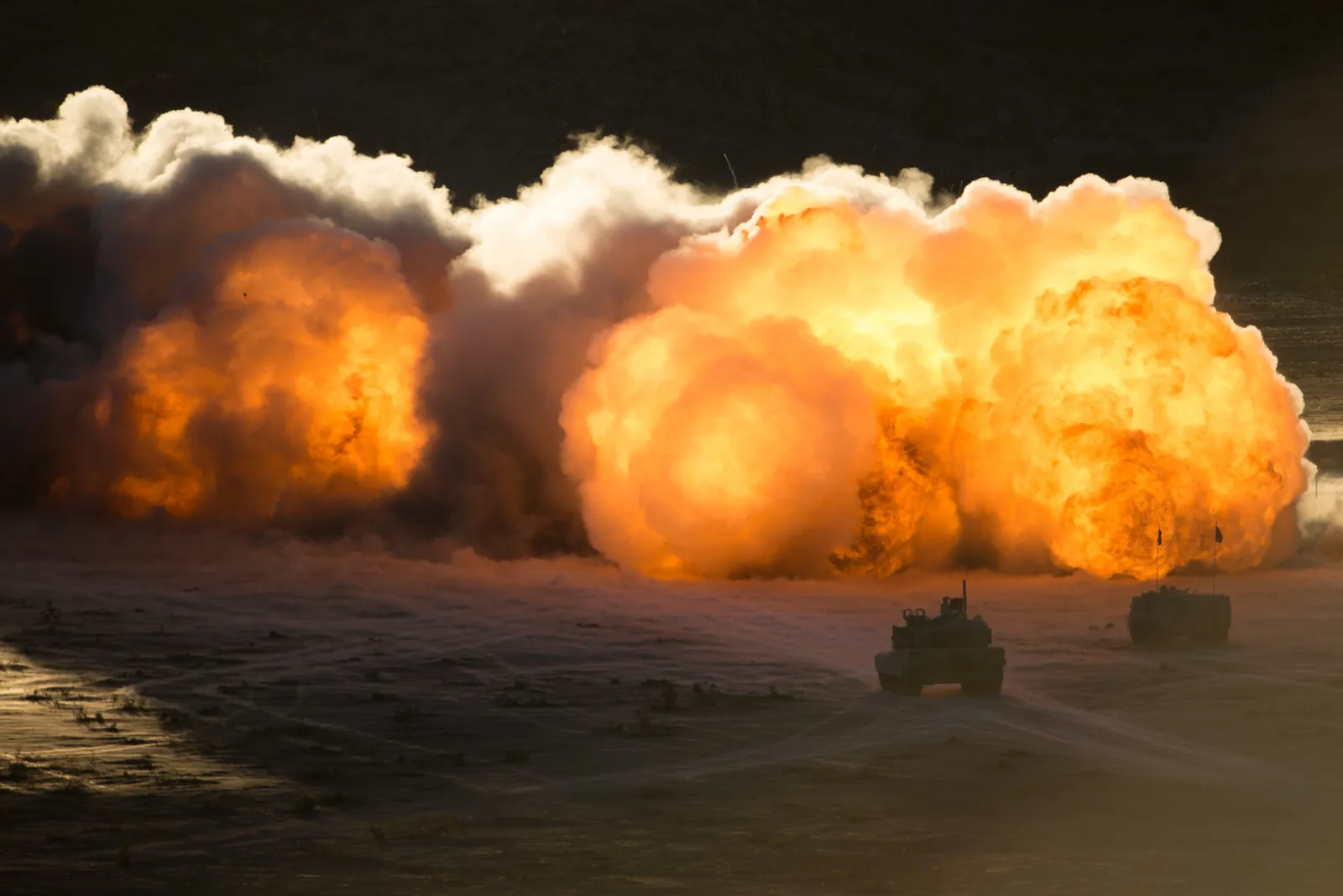
The M58 is a rocket-propelled line charge built around C4 explosive blocks carried across a minefield or obstacle before command detonation.
| Carried item | Item type | Carriage evidence |
|---|---|---|
 | Plastic demolition explosive | The Army fact sheet describes the M58 as a 350-foot charge with 700 C4 block charges in three 100-foot sections and one 50-foot section; the Marine anthology describes MICLIC delivering roughly 1,700 pounds of C4 in the Now Zad breach. Sources: MICLIC Fact Sheet, U.S. Marines in Afghanistan Anthology |
Launcher And Carrier Systems
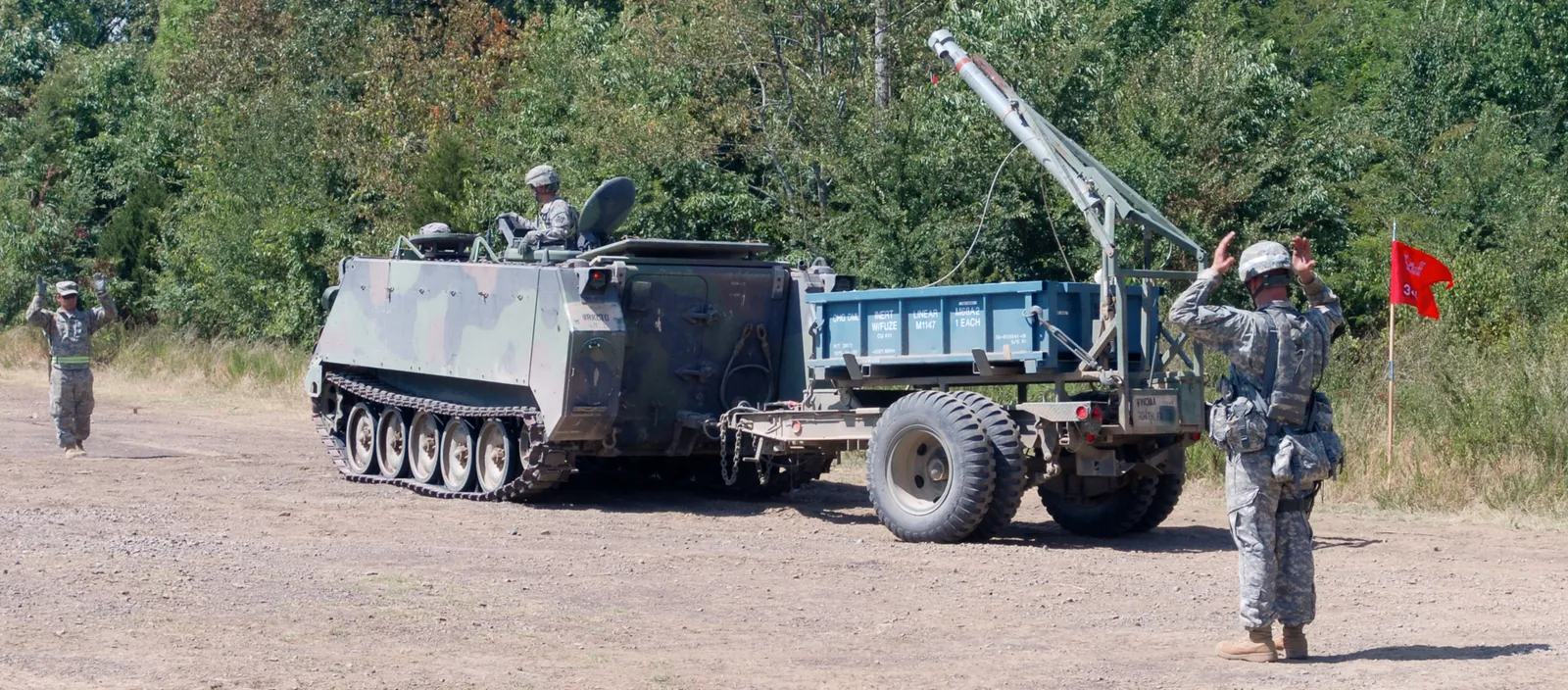
The M58 is best understood as the explosive line inside a broader MICLIC launch package rather than as a stand-alone hand-placed demolition charge. Sources describe the 350-foot C4 line in a containerized charge, pulled out by a MK22 rocket, and detonated to create a lane for vehicles and personnel.
Standard launcher
The Army fact sheet identifies a MK155 launcher mounted on an M200A1 trailer as the trailer launch arrangement.
Vehicle launcher
DVIDS documents an M1150 Assault Breacher Vehicle firing an M58 MICLIC during training in Poland.
Legacy carrier
Army reporting describes an M60 AVLM, derived from the M60 AVLB, as another MICLIC firing platform.
Timeline
M58 Mine Clearing Line Charge Key Events
Army acquisition approved
FAS reports that the U.S. Army approved acquisition of the Marine Corps M58A3 trailer-mounted line charge as a non-developmental item in December 1983.
Sources: FAS M58 MICLIC
MICLIC type classified
FAS places MICLIC type classification in August 1985.
Sources: FAS M58 MICLIC
Fielded to USAREUR
FAS reports fielding to U.S. Army Europe in fiscal year 1988.
Sources: FAS M58 MICLIC
Line charges fired at Now Zad
Marine Assault Breacher Vehicles fired line charges during Operation Cobra's Anger in Helmand Province, giving the charge a documented combat-breaching role in Afghanistan.
Sources: DVIDS Now Zad ABV
M58 MICLIC fired at Makuan
Vanguard of Valor Volume II describes Marine Corps Assault Breacher Vehicles with M58 MICLICs firing line charges through IED-strewn grape rows in Kandahar Province.
Sources: Vanguard of Valor Volume II
Iraqi soldiers conduct M58 live fire
Iraqi soldiers conducted an M58 MICLIC live-fire event at Besmaya during a coalition-led combat engineer course under Operation Inherent Resolve.
Sources: DVIDS Iraqi MICLIC Live Fire
U.S. aid includes mine-clearing systems for Ukraine
A U.S. security-assistance fact sheet listed mine-clearing equipment and systems among committed aid for Ukraine after the full-scale Russian invasion.
Sources: DOD Ukraine Security Assistance Sep 2022
Ukraine adapts MICLIC carriage
Kyiv Post reported that Ukraine's State Special Service of Transport showed a MICLIC box moved from a trailer onto a military truck platform to improve field mobility.
Sources: Kyiv Post MICLIC Ukraine Adaptation
Media
M58 Mine Clearing Line Charge Images
Related Weapon Systems



Sources
MICLIC Fact SheetPublisher: U.S. Army | Note: Supports the M58 linear demolition charge's 350-foot length, 700 C4 block charges, 100-meter breach length, 65-95 meter stand-off, MK155 launcher, M200A1 trailer, MK 22 rocket motor, and American Ordnance / NSWC Indian Head industry-partner context. | Accessed: 2026-06-27U.S. Marines in Afghanistan AnthologyPublisher: United States Marine Corps History Division | Note: Supports the Now Zad account describing MICLIC launching 1,700 pounds of C4 during the breaching operation. | Accessed: 2026-06-27SAM.gov MICLIC M58Publisher: SAM.gov | Note: Supports the M58 MICLIC use case as equipment used to clear paths for tanks, vehicles, and personnel through minefields and other obstacles. | Accessed: 2026-06-27FAS M58 MICLICPublisher: Federation of American Scientists | Note: Supports MICLIC system composition, M58A3 acquisition and fielding chronology, trailer and firing-kit context, 8-by-100-meter lane, C4 fill, and M68A2 inert training-charge context. | Accessed: 2026-07-02American Ordnance EnergeticsPublisher: American Ordnance | Note: Supports American Ordnance production context and M58/M59 mine-clearing charge details including the 8-by-100-meter lane, 350-foot length, 700 charge assemblies, 2,800-pound complete-charge weight, and C4 filler. | Accessed: 2026-07-02Vanguard of Valor Volume IIPublisher: U.S. Army Combined Arms Center / Combat Studies Institute Press | Note: Supports 2001 War in Afghanistan conflict use: Marine Corps Assault Breacher Vehicles fitted with M58 MICLICs fired line charges during the Makuan operation in Kandahar Province in September 2010. | Accessed: 2026-07-02DVIDS Now Zad ABVPublisher: DVIDS | Note: Supports Afghanistan background: Marine Assault Breacher Vehicles fired line charges during Operation Cobra's Anger at Now Zad in December 2009. | Accessed: 2026-07-02DVIDS Iraqi MICLIC Live FirePublisher: DVIDS | Note: Supports 2014 War Against the Islamic State direct conflict use under Operation Inherent Resolve: Supports 2014 Operation Inherent Resolve conflict use: Iraqi soldiers fired an M58 MICLIC during coalition-supervised combat engineer training at Besmaya in June 2016. | Accessed: 2026-07-02Kyiv Post MICLIC Ukraine AdaptationPublisher: Kyiv Post | Note: Supports 2014 Russia-Ukraine War conflict use: Ukraine had U.S.-provided M58 MICLIC systems, photographs showed the system in use in Ukraine, and Ukrainian transport troops demonstrated a truck-mounted adaptation for front-line deployment. | Accessed: 2026-07-02DVIDS MICLIC B-RollPublisher: DVIDS | Note: Supports M1150 Assault Breacher Vehicle context: an M1150 fired an M58 MICLIC during training near Boleslawiec, Poland, in August 2023. | Accessed: 2026-07-02Army Idaho MICLIC TrainingPublisher: U.S. Army | Note: Supports MICLIC carrier-platform context, including Assault Breacher Vehicle firing and the M60 Armored Vehicle Launched Mine Clearing Line Charge platform. | Accessed: 2026-07-02DOD Ukraine Security Assistance Sep 2022Publisher: U.S. Department of Defense | Note: Supports U.S. security-assistance context listing mine-clearing equipment and systems, C-4 explosives, and demolition equipment committed to Ukraine after the full-scale Russian invasion. | Accessed: 2026-07-02M58 MICLIC photo - Fort ChaffeePublisher: Wikimedia Commons | Note: Image provenance for an M58 MICLIC launch photo at Fort Chaffee. | Accessed: 2026-06-27M58 MICLIC photo - NTC Fort IrwinPublisher: Wikimedia Commons | Note: Image provenance for an M58 MICLIC detonation photo at the National Training Center. | Accessed: 2026-06-27