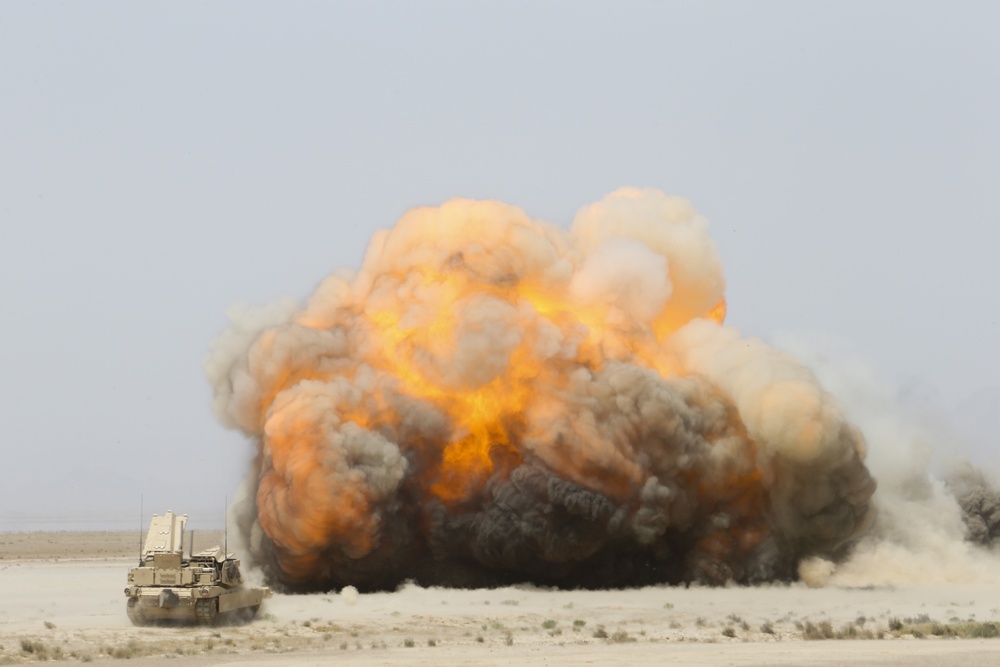
Direct proof of use
U.S. military sources directly document M58 Mine Clearing Line Charge use in Afghanistan during the 2001 War in Afghanistan. Army University Press describes the September 2010 Makuan operation in Kandahar Province, where three U.S. Marine Corps Assault Breacher Vehicles fitted with mine plows and M58 MICLICs breached Taliban defensive lines and IED-strewn grape rows ahead of Bravo Company.
DVIDS separately reported that Marine Assault Breacher Vehicles fired line charges during Operation Cobra's Anger at Now Zad, Helmand Province, on December 3, 2009. Marine Corps reporting later described 2nd Combat Engineer Battalion firing 35 mine-clearing line charges in the Ladar Bazaar area of Musa Qala District in August 2011 after inhabitants were relocated from an IED-laden marketplace.
Sources: Vanguard of Valor Volume II, DVIDS Now Zad ABV, 2nd Marine Division MCLC
Timeline
The public record shows repeated Marine combat-engineer use rather than a single isolated event. The earliest source in this record is the December 2009 Now Zad operation, where DVIDS said the ABV fired its first line charge during Operation Cobra's Anger and that ABVs led the route because roadside bombs were expected around the Taliban-held area.
On September 15, 2010, Army University Press records an ABV firing a MICLIC at Makuan as the operation began. The line charge detonated over an IED-strewn grape field, cut an approximately eight-meter-wide path through IEDs in grape rows, and was followed by additional MICLIC shots as the vehicle moved through the breach. In August 2011, Marine Corps reporting described a larger clearance episode in Ladar Bazaar, where engineers used 35 MCLCs to clear a marketplace described as heavily laden with IEDs.
Sources: DVIDS Now Zad ABV, Vanguard of Valor Volume II, 2nd Marine Division MCLC
Operational role
The documented Afghanistan role was combat-engineer mobility support: opening lanes, reducing explosive hazards, and enabling infantry or vehicle movement through mined or IED-contaminated terrain. At Makuan, the MICLICs were part of an armored breach package with Marine ABVs, M88 recovery vehicles, MRAPs, and infantry security on the flanks.
At Now Zad and Ladar Bazaar, the sources tie line-charge use to route clearance and IED reduction in Taliban-held or Taliban-contested terrain. The 2014 DVIDS image record adds later Afghanistan documentation from Camp Leatherneck, where Marines with 2nd Combat Engineer Battalion used M1 Assault Breacher Vehicles to employ M58 MICLIC rockets with C4 explosive to prematurely detonate emplaced mines.
Sources: Vanguard of Valor Volume II, DVIDS Now Zad ABV, 2nd Marine Division MCLC, DVIDS Camp Leatherneck MICLIC
Users and evidence limits
The documented users in these sources were U.S. Marine Corps combat-engineer units on the United States, NATO, and Afghan government forces side of the war. The Afghanistan sources identify Marine Assault Breacher Vehicles and 2nd Combat Engineer Battalion in combat-engineer breaching and route-clearance contexts.
The cited sources support use, location, timing, and role for several U.S. Marine Corps episodes. They do not support Taliban use of the M58, a complete incident count for the war, or an assessment of individual strike legality or proportionality.
Sources: Vanguard of Valor Volume II, DVIDS Now Zad ABV, 2nd Marine Division MCLC, DVIDS Camp Leatherneck MICLIC