Munitions

M183 Demolition Charge Assembly

Also known as
  • M757
  • M183 satchel charge
  • M757 charge assembly
  • Charge, Demolition: Assembly M183
  • Charge, Demolition: Assembly M757

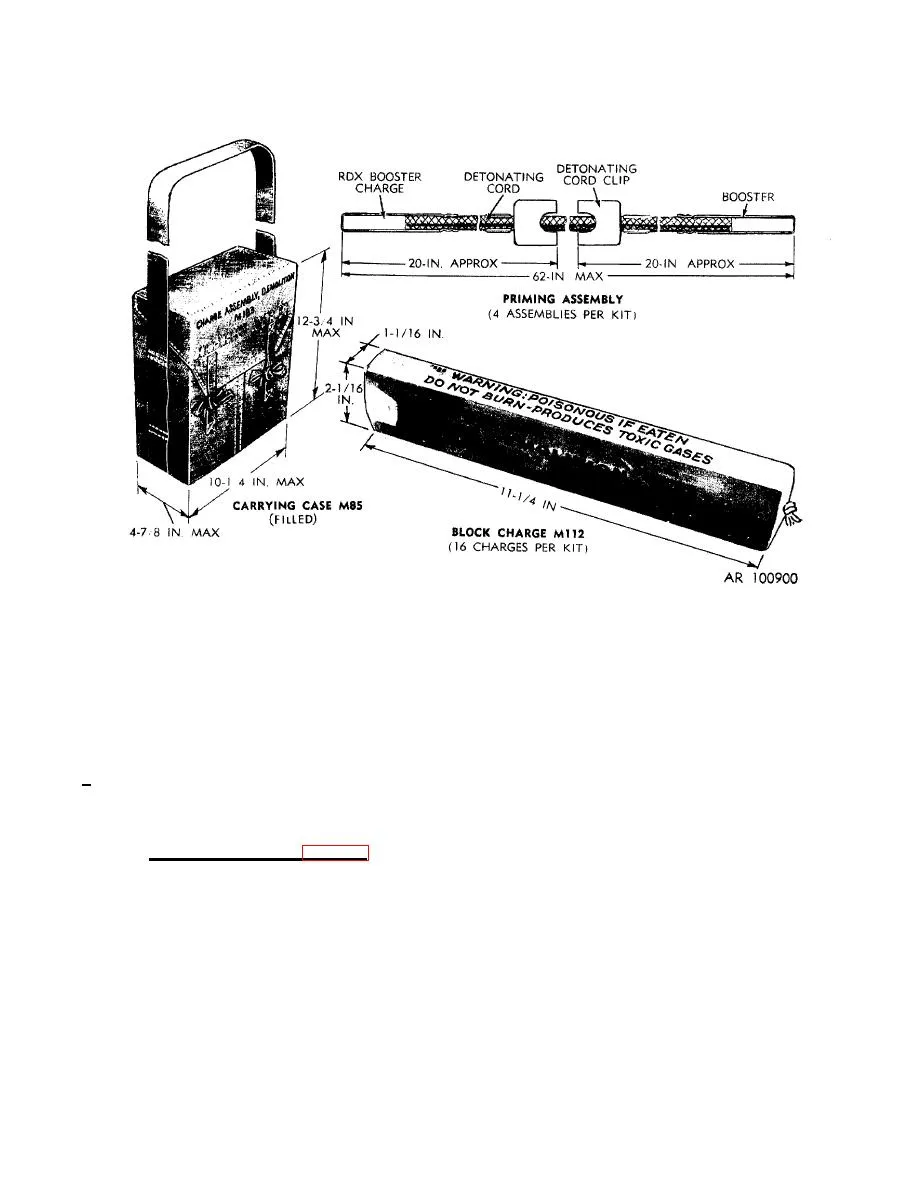
The M183 Demolition Charge Assembly is a U.S. satchel-charge kit for obstacle breaching and structure demolition. Army manuals describe it as a 23 lb canvas M85 carrying case containing 16 M112 C-4 blocks, four priming assemblies, and 20 lb of total explosive weight, while later ammunition records kept DODIC M757 tied to Army and Marine Corps inventory management.

Profile / Specs

Profile

Origin
United States
Type
Satchel charge assembly
Service note
Standardized in 1967 and still listed in U.S. ammunition records through the 2010s
Designed
1967 standard type classification; August 1986 MR date in Army portfolio records
Unit cost
$650 in FY2011 Air Force budget materials

Specifications

Designation
M183 / DODIC M757
Contents
16 M112 C-4 demolition charges
Total explosive weight
20 lb
Complete assembly weight
23 lb
Priming assemblies
4
Priming assembly details
5 ft detonating cord with detonating-cord clips and booster charges
Carrying case
M85 carrying case
Case material
Canvas, olive drab with yellow markings
Assembled case dimensions
10-1/4 in. x 4-7/8 in. x 12-3/4 in.
Filler
Composition C-4
Method of actuation
Military blasting cap or detonating cord
Role
Satchel charge assembly for obstacle breaching and demolition
Packaging
One assembly per canvas carrying case; two cases per wooden box
Prime contractor
Crane Army Ammunition Activity, Crane, Indiana
Carried Explosive

Army records place sixteen M112 C-4 demolition charges inside the M183 demolition charge assembly.

Carried itemItem typeCarriage evidence
C4, Plastic demolition explosive, MunitionsC4Plastic demolition explosive

Army demolition manuals and portfolio records describe the M183 as a case-carried assembly built around 16 M112 C-4 demolition blocks.

Sources: TM 43-0001-38 Demolition Materials Data Sheets, PEO Ammunition 2017 Portfolio Book

Kit Composition

The M183 is best read as a packaged demolition assembly: it does not introduce a new explosive fill, but bundles standard M112 C-4 blocks, priming assemblies, and a canvas carrier into one satchel-charge issue item.

ComponentQuantity or detailWhy it matters
C4, Plastic demolition explosive, MunitionsM112 C-4 demolition block16 blocks, split into two bags of eightProvides 20 lb of total explosive weight for larger breaching or demolition targets.
Priming assemblyFour assemblies, each with a 5 ft detonating-cord length and boosters at both endsAllows the satchel charge to be initiated by blasting cap or by a detonating-cord main.
M85 carrying caseOne canvas case with shoulder strap and tiesKeeps the charge portable and lets the case be tied to the target before firing.
Timeline

M183 Demolition Charge Assembly Key Events

  1. Standard type classification

    TM 43-0001-38 lists the M183 with standard type classification under AMCTCM 5263 dated 1967 and notes that it replaced the earlier M37 charge assembly when M37 stocks were exhausted.

    Sources: TM 43-0001-38 Demolition Materials Data Sheets

  2. Army portfolio records the assembly

    The Army Program Executive Office Ammunition portfolio book lists the M183 demolition charge assembly with an August 1986 MR date and describes it as 16 M112 C-4 demolition charges with four priming assemblies in an M85 carrying case.

    Sources: PEO Ammunition 2017 Portfolio Book

  3. Marine Corps ammunition shortfall appears in appropriations record

    A Department of Defense appropriations hearing record identified the Charge, Demolition Assembly M183 under DODIC M757 as one of the Marine Corps ammunition items below its approved acquisition objective.

    Sources: Department of Defense Appropriations for 1998

  4. Air Force budget line prices M757 assemblies

    FY2011 Air Force procurement materials listed M757 charge assemblies at a $650 unit cost.

    Sources: FY11 Air Force Procurement Program

  5. Marine Corps order covers partial M757 returns

    Marine Corps ammunition-management procedures directed how to receipt M183/M757 assemblies returned with one or more of their 16 M112 blocks removed.

    Sources: MCO 8010.13 Marine Corps Ammunition Management
Related Weapon Systems
Door-breaching explosive charge, Explosive breaching charge, Infantry WeaponsInfantry WeaponsDoor-breaching explosive chargeExplosive breaching chargeA door-breaching explosive charge is a portable combat-engineering entry device used by assault teams and sappers to defeat doors, locks, hardware, walls, or light obstacles with a controlled blast. Military training sources describe task-specific charge patterns such as donut, linear, silhouette, and water-impulse charges, while conflict reporting documents explosive entry use in Afghanistan, Iraq, and Gaza urban operations.
M1150 Assault Breacher Vehicle, Armored combat-engineering breaching vehicle, Support EquipmentSupport EquipmentM1150 Assault Breacher VehicleArmored combat-engineering breaching vehicleThe M1150 Assault Breacher Vehicle is a U.S. armored combat-engineering vehicle built around an M1 Abrams-derived hull, two linear demolition-charge launchers, a lane-marking system, and interchangeable mine-plow or dozer-blade breaching gear. U.S. Marine Corps use in Afghanistan showed the vehicle clearing routes through IED and obstacle belts under armor, while Ukrainian service in the Russia-Ukraine War made the system part of the Western mine-clearing aid lane for armored maneuver.
Cartridge, 105 mm, Illuminating, M314, 105 mm howitzer-fired illuminating cartridge with parachute-retarded canister, MunitionsMunitionsCartridge, 105 mm, Illuminating, M314105 mm howitzer-fired illuminating cartridge with parachute-retarded canisterThe M314 is a U.S. 105 mm howitzer illumination cartridge family that ejects a flare canister under parachute for battlefield lighting. Army ammunition manuals list earlier M314-series rounds for M101/M102-era howitzers, while Army portfolio material identifies the M314A3 visible-light round as a 105 mm M119-series illumination cartridge with a semi-fixed case, time fuze, expelling charge, illuminant canister, and parachute assembly.

Sources