Ukraine accepted the foreign-made 120 mm M/41D mortar into Armed Forces service by an August 28, 2023 defense-minister order during the full-scale war, with reporting tying the order to foreign equipment provided through international technical assistance.
Role detailsM/41D 120 mm mortar
- M/41D 120mm
- 120 mm M/41D mortar
- 120mm M/41D mortar
- 120 Krh/40
- 12 cm granatkastare m/41
- Grk m/41D
- 120 mm miinipilduja m/41D
The M/41D is the Swedish-service branch of the Finnish Tampella 120 Krh/40 heavy mortar family, a Stokes-Brandt-pattern 120 mm weapon built for mobile indirect fire. Ukraine accepted the Swedish 120 mm M/41D into service during the full-scale Russia-Ukraine War, while open sources also document its older Finnish design base, Swedish licensed production, Baltic holdings, and continued relevance as a compact fire-support mortar.
Role in Conflicts
Profile / Specs
Profile
- Origin
- Finland / Sweden
- Built by
- TampellaBofors Defence AB
- Type
- 120 mm towed heavy mortar
- Service note
- 1940s design with continued Baltic and Ukrainian wartime service
- Designer
- Tampella
- Designed
- Tampella development ran from 1935 to 1939; accepted into Finnish service in 1940
- Produced
- Finnish production from 1940, Swedish exports from 1941-1944, and later Swedish licensed production
- Number built
- 596 Tampella-built mortars in the Finnish and Swedish wartime accounting when using the 377 Finnish-delivery and 219 Sweden-export figures; Jaeger Platoon notes small published discrepancies of 371 and 215
Specifications
- Caliber
- 120 mm
- Weapon class
- Towed heavy mortar with fixed firing pin
- Barrel length
- 189 cm for 120 Krh/40
- Weight in action
- 260 kg for 120 Krh/40
- Transport breakdown
- Barrel, bipod, and baseplate groups
- Component weights
- Barrel 85 kg; bipod 68 kg; baseplate 100 kg
- Transport weight
- About 390 kg with equipment
- Muzzle velocity
- 116-290 m/s for 120 Krh/40
- Rate of fire
- Up to 20 rounds per minute for 120 Krh/40
- Range
- 600 m minimum and 5,300 m maximum for 120 Krh/40; STRIX context reported separately around 7 km
- Ammunition
- High-explosive, smoke, illumination, and propaganda mortar bombs reported for the family
- Guided munition context
- Swedish STRIX psvinggr 94 was introduced for 12 cm mortars in the late 1990s as an autonomous terminal-guided IR round
- Manufacturing context
- Finnish Tampella design; Swedish m/41D production associated with Bofors Defence AB
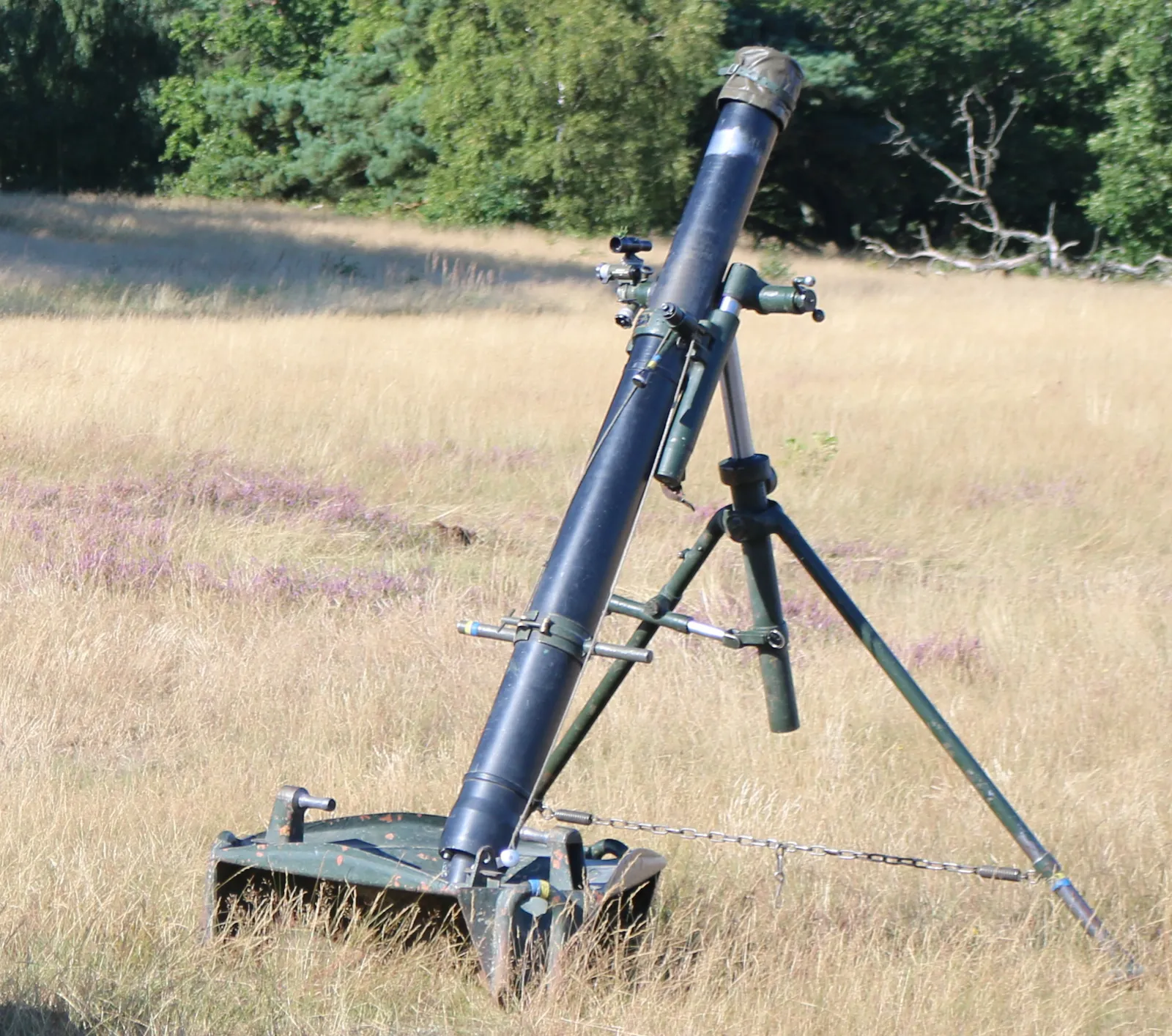
Design And Service Notes
The mortar follows the Stokes-Brandt pattern and breaks into barrel, bipod, and baseplate groups for transport.
Sources: ArmyInform M/41D profile; Jaeger Platoon 120 mm mortars.
Jaeger Platoon describes the wartime mortar as carried on a one-axle limber, with about 390 kg total transport weight with equipment and suitability for motor or horse towing.
Source: Jaeger Platoon 120 mm mortars.
Open reporting lists high-explosive, smoke, illumination, and propaganda mortar bombs for the family; the Swedish museum handbook separately describes STRIX as a late-1990s terminally guided 12 cm mortar round with autonomous IR homing.
Sources: ArmyInform M/41D profile; Swedish Artillery Handbook.
Variants
The M/41D designation sits inside the Finnish 120 Krh/40 and Swedish 12 cm granatkastare m/41 family. Sources describe Finnish-built weapons, Swedish licensed production, standard and long-range configurations, and later Swedish baseplate modernization.
| Variant | Configuration | Designation notes |
|---|---|---|
| 120 Krh/40 | Finnish original family designation | Jaeger Platoon identifies 120 Krh/40 as the Finnish Army name for Tampella's 120 Krh/35/39 production design, accepted as the 120 mm mortar model 1940. Sources: ArmyInform M/41D profile, Jaeger Platoon 120 mm mortars |
| 12 cm granatkastare m/41 | Swedish service designation | Jaeger Platoon reports Swedish wartime exports and a Swedish manufacturing license, with the Swedish military naming the mortar 120 mm granatkastare m/41. Sources: ArmyInform M/41D profile, Jaeger Platoon 120 mm mortars |
| Standard and long-range configurations | Mortar-system variants | ArmyInform describes the mortar system as having standard and long-range variants. Sources: ArmyInform M/41D profile |
| M-56 baseplate modernization | Swedish modernization | ArmyInform describes a Swedish 1950s modernization using a new baseplate attributed to Hotchkiss. Sources: ArmyInform M/41D profile |
Timeline
M/41D 120 mm mortar Key Events
Prototype work completed
Jaeger Platoon describes Tampella development of the 120 mm mortar as running from 1935 to 1939 before the production design entered Finnish service as 120 Krh/40.
Sources: ArmyInform M/41D profile, Jaeger Platoon 120 mm mortars
Finnish service acceptance
Jaeger Platoon reports that the Finnish Army received its first Tampella 120 Krh/40 mortars in late 1940.
Sources: ArmyInform M/41D profile, Jaeger Platoon 120 mm mortars
Exports to Sweden begin
Jaeger Platoon records 120 Krh/40 exports to Sweden during 1941-1944 and says Sweden also acquired a manufacturing license.
Sources: ArmyInform M/41D profile, Jaeger Platoon 120 mm mortars
Lithuanian holdings reported
The UN Register report for 2015 lists 28 Lithuanian 120 mm M 41D mortars among large-calibre artillery systems.
Sources: UN Register A/70/168
Accepted for Ukrainian service
Ukraine accepted the 120 mm M/41D mortar into Armed Forces service by defense-minister order during the full-scale war.
Sources: ArmyInform Ukrainian adoption notice, Defense Express Ukrainian adoption report
Media
M/41D 120 mm mortar Videos
Related Weapon Systems


