- Side
- Coalition forces

During the 1990 Gulf War, U.S. F-111F crews used GBU-15 glide bombs in Desert Storm attacks on Kuwaiti oil manifolds sabotaged by Iraqi forces.
Role detailsThe GBU-15 Guided Bomb Unit is a U.S. electro-optical glide bomb built around a 2,000-pound Mk 84 or BLU-109 bomb body, with television or imaging-infrared guidance and a man-in-the-loop data link. U.S. Air Force, museum, and Air University sources document F-111F use in Desert Storm, F-15E drops during Operation Deliberate Force, enhanced GPS/INS-equipped GBU-15 combat employment in Operation Enduring Freedom, and current deployment only from the F-15E Strike Eagle.
During the 1990 Gulf War, U.S. F-111F crews used GBU-15 glide bombs in Desert Storm attacks on Kuwaiti oil manifolds sabotaged by Iraqi forces.
Role detailsDuring Operation Deliberate Force in the 1992 Bosnian War, USAF F-15Es dropped nine infrared GBU-15 variants against Bosnian Serb air-defense targets around Banja Luka.
The Air Force fact sheet says the enhanced GBU-15 entered service in 2001 and was successfully employed in combat directly supporting Operation Enduring Freedom.
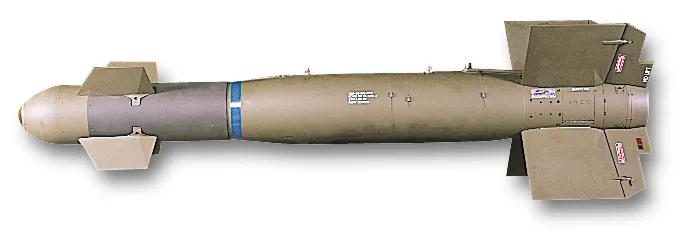
Role detailsThe GBU-15 family combined modular guidance, warhead, control-airfoil, and data-link components; the enhanced EGBU-15 added GPS/INS guidance to the electro-optical glide-bomb family.
| Variant | Configuration | Designation notes |
|---|---|---|
| GBU-15(V)1/B | Television-guided Mk 84 configuration | Designation-Systems identifies the (V)1/B as the initial daylight television-seeker model using the 2,000-pound Mk 84-class warhead, with full operational status in 1983. |
| GBU-15(V)2/B | Imaging-infrared Mk 84 configuration | Designation-Systems identifies the (V)2/B as the imaging-infrared seeker version, with the same basic warhead and control components as the (V)1/B. |
| GBU-15(V)31/B | Television-guided BLU-109 configuration | Designation-Systems describes the BLU-109 versions as short-chord-wing configurations and identifies the (V)31/B as the television-guided BLU-109 variant. |
| GBU-15(V)32/B | Imaging-infrared BLU-109 configuration | Designation-Systems identifies the (V)32/B as the imaging-infrared BLU-109 configuration in the GBU-15 family. |
| EGBU-15 | GPS/INS-enhanced GBU-15 | The Air Force fact sheet says many legacy GBU-15 weapons received GPS/INS guidance upgrades in 1999-2000, and Designation-Systems treats EGBU-15 as the enhanced designation. Sources: GBU-15 Guided Bomb Unit Fact Sheet, Rockwell GBU-15(V)/B Designation-Systems |
The Air Force identifies the F-15E, F-111F, and F-4 as design aircraft for the GBU-15, while noting that current Air Force deployment is only from the F-15E Strike Eagle.
| Carrier | Carrier type | Carriage evidence |
|---|---|---|
 | Strike fighter | The Air Force fact sheet says the GBU-15 is currently deployed only from the F-15E Strike Eagle. Sources: GBU-15 Guided Bomb Unit Fact Sheet |
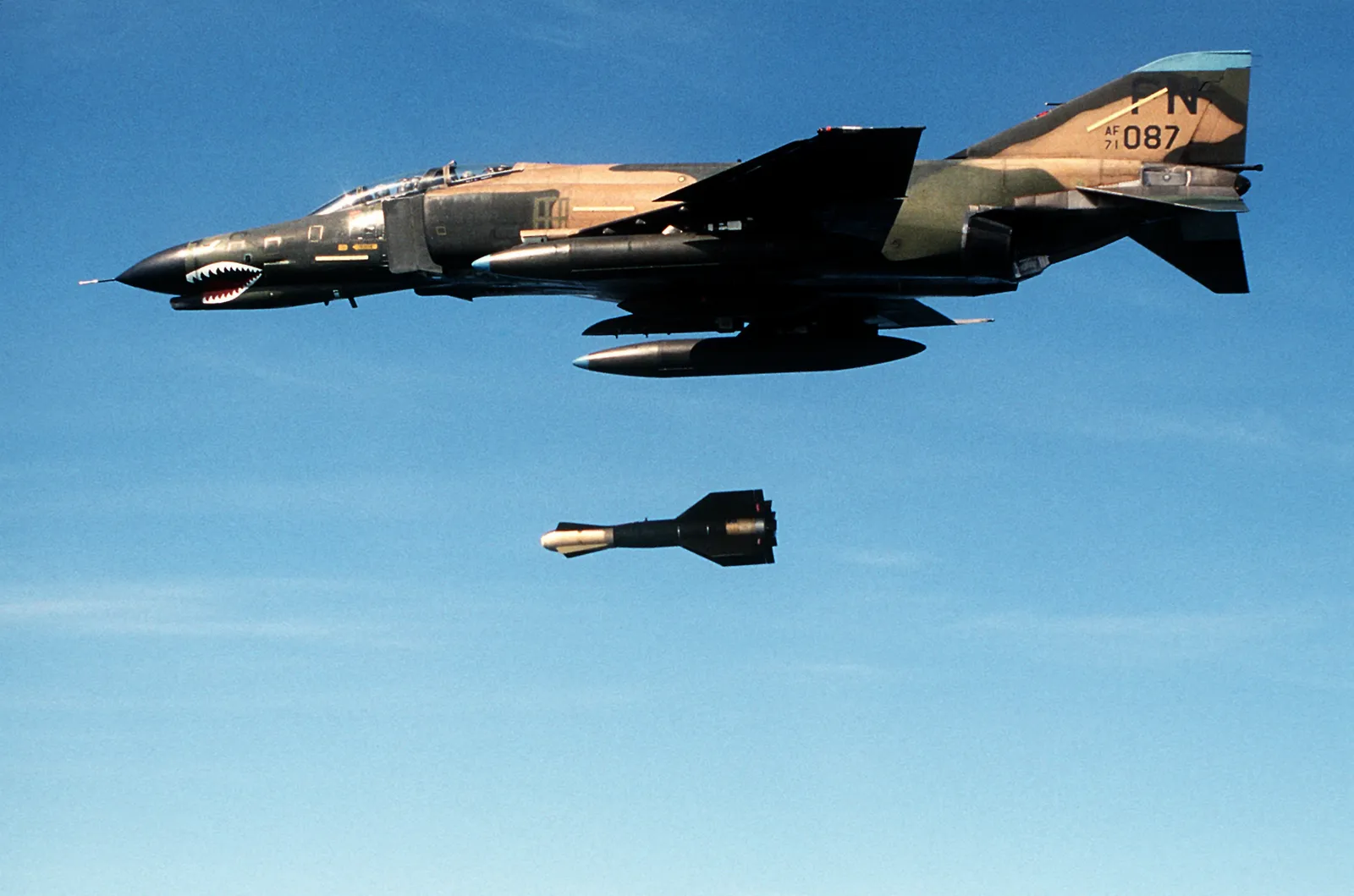
 | Fighter-bomber | The Air Force fact sheet lists the F-4 among the aircraft for which the GBU-15 was designed, and the gallery includes a 1985 F-4E GBU-15 drop image. Sources: GBU-15 Guided Bomb Unit Fact Sheet, F-4E 3rd TFW dropping GBU-15 1985.JPEG |
GBU-15 kits were built as modular guidance and control assemblies attached to a 2,000-pound general-purpose or penetrator bomb body.
| Compatible item | Item type | Compatibility evidence |
|---|---|---|
 | 2,000-pound general-purpose bomb body | The Air Force fact sheet says the GBU-15's modular components attach to a Mk 84 general-purpose bomb option. Sources: GBU-15 Guided Bomb Unit Fact Sheet |
 | 2,000-pound penetrating bomb body | The Air Force fact sheet identifies BLU-109 penetrating bombs as the alternate GBU-15 warhead option. Sources: GBU-15 Guided Bomb Unit Fact Sheet |
The Air Force Development Test Center at Eglin Air Force Base began GBU-15 development as an improved follow-on to earlier electro-optical guided bombs.
Sources: GBU-15 Guided Bomb Unit Fact Sheet, Rockwell GBU-15(V)/B Designation-Systems
The Air Force fact sheet says GBU-15 flight testing started in 1975.
Sources: GBU-15 Guided Bomb Unit Fact Sheet
The legacy television-guided GBU-15 completed full-scale operational test and evaluation in 1983.
Sources: GBU-15 Guided Bomb Unit Fact Sheet, Rockwell GBU-15(V)/B Designation-Systems
The Air Force fact sheet says initial operational test and evaluation of the imaging-infrared seeker was completed in February 1985.
Sources: GBU-15 Guided Bomb Unit Fact Sheet
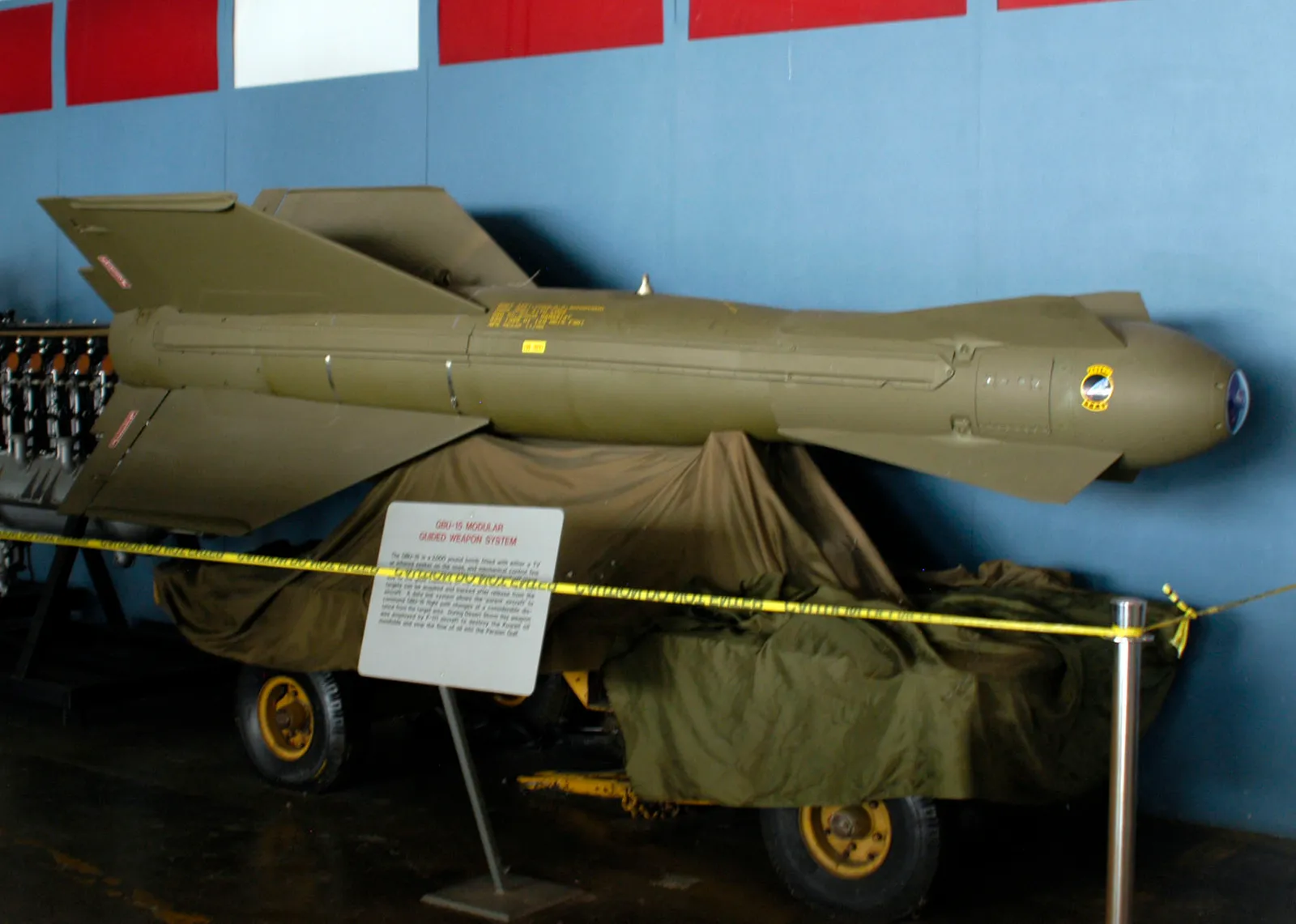
Air Force and museum sources document F-111F employment of GBU-15 glide bombs against Kuwaiti oil manifolds during Operation Desert Storm.
Sources: GBU-15 Guided Bomb Unit Fact Sheet, GBU-15 Modular Guided Weapon System Museum Fact Sheet
Air University Press records F-15E drops of nine infrared GBU-15 variants against air-defense targets around Banja Luka during Operation Deliberate Force.
Sources: Deliberate Force Air University Press
A large number of legacy weapons began receiving GPS/INS guidance upgrades in 1999-2000, creating the enhanced GBU-15 capability for adverse-weather attacks.
Sources: GBU-15 Guided Bomb Unit Fact Sheet, Rockwell GBU-15(V)/B Designation-Systems
The Air Force fact sheet says the enhanced GBU-15 entered service in 2001 and was successfully employed in combat supporting Operation Enduring Freedom.
Sources: GBU-15 Guided Bomb Unit Fact Sheet