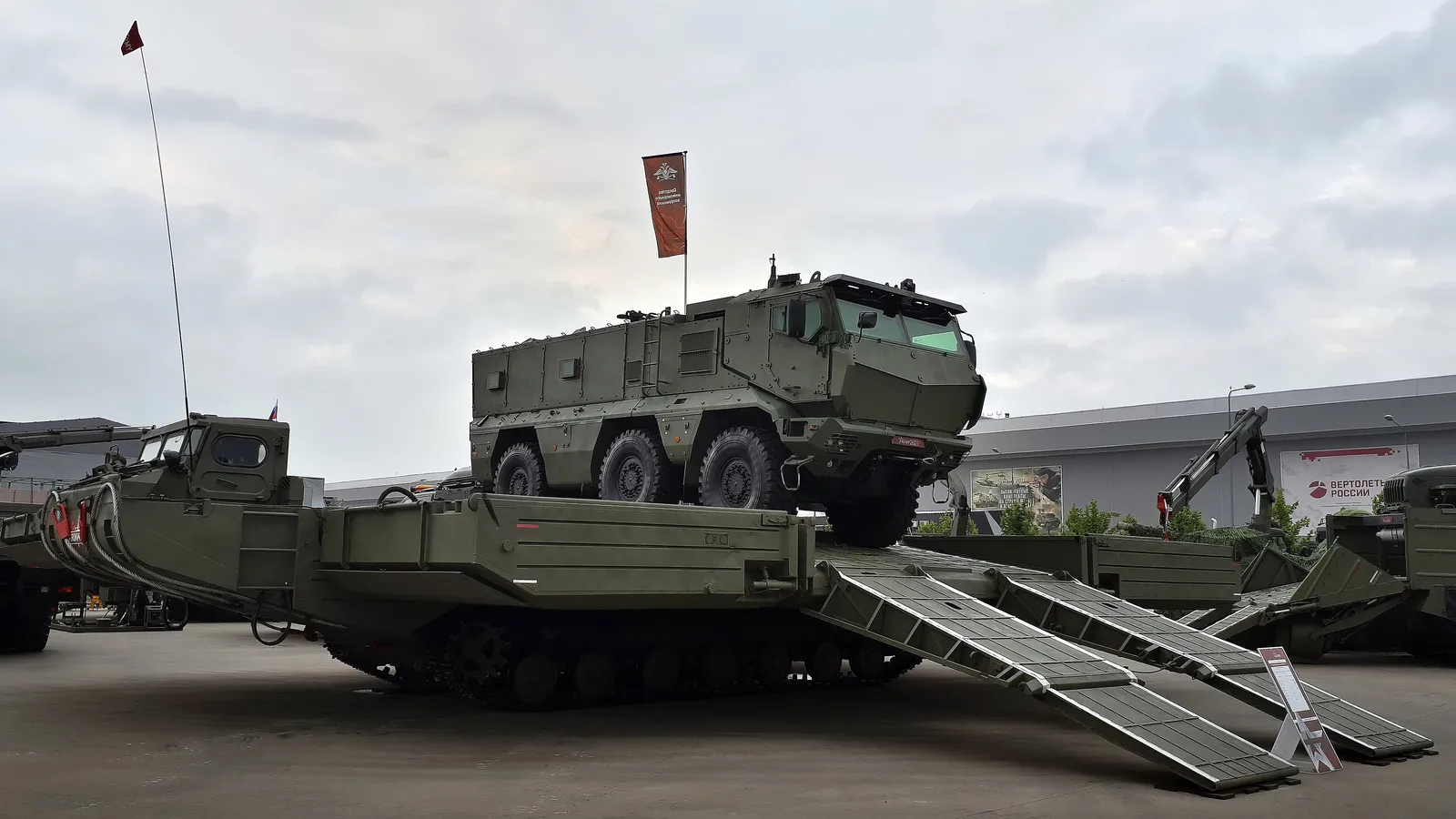

Russian military engineers deployed PMM-2M ferries in September 2017 to support the Deir ez-Zor Euphrates crossing and move Syrian government forces, heavy equipment, and aid to the eastern bank.
Support Equipment
PMM-2 / PMM-2M
Also known as
- PMM-2
- PMM-2M
- ПММ-2
- ПММ-2М
- Paromno-mostovaya mashina-2
- PMM 2
- PMM 2M
- ferry-bridge vehicle PMM-2
- self-propelled ferry PMM-2M
The PMM-2 is a Soviet tracked amphibious ferry-bridge vehicle built to carry tanks and other heavy equipment across water obstacles, with fold-out side pontoons that let a single vehicle operate as a ferry or several vehicles link into a larger crossing. The PMM-2M modernization appears in Russian service coverage, including the 2017 Syrian Civil War Euphrates crossing near Deir ez-Zor.
Role in Conflicts
Profile / Specs
Profile
- Origin
- Soviet Union
- Built in
- Soviet UnionUkraine
- Type
- Amphibious ferry-bridge vehicle
- Service note
- Late Cold War-present
- Designer
- Kryukiv Railway Car Building Works engineering crossing-equipment design bureau
- Designed
- 1970s
- Produced
- Late Cold War production; no longer in production in public references
Specifications
- Crew
- 3
- Role
- Tracked amphibious ferry and floating bridge element
- Single-ferry capacity
- 40 tonnes for PMM-2 in surplus specifications; 42.5 tonnes for PMM-2M in reference coverage
- Linked-ferry capacity
- Two vehicles about 80-85 tonnes; three vehicles about 120-127.5 tonnes
- Dimensions
- About 13.35-13.38 m long, 3.3-3.36 m wide, and 3.8-3.85 m high in transport configuration
- Weight
- About 36 tonnes
- Engine
- V-46-5 / W-46-5 multi-fuel diesel family, about 522 kW / 710 hp in reference specifications
- Speed
- 55 km/h on road; about 10 km/h in water
- Range
- About 500-520 km by road
- Protection
- Unarmed; public references describe no general armor beyond a protected cab in some descriptions
Ferry And Bridge Configuration
The PMM-2 family is built around a tracked floating hull with hinged side pontoons and ramps. In road order the pontoons fold onto the vehicle; at a water obstacle the vehicle deploys them to create a ferry deck that can load and unload vehicles from either bank.
Single ferry
German Wikipedia lists a 42.5-tonne PMM-2M load rating, while surplus-specification sources list 40 tonnes for PMM-2.
Linked ferry
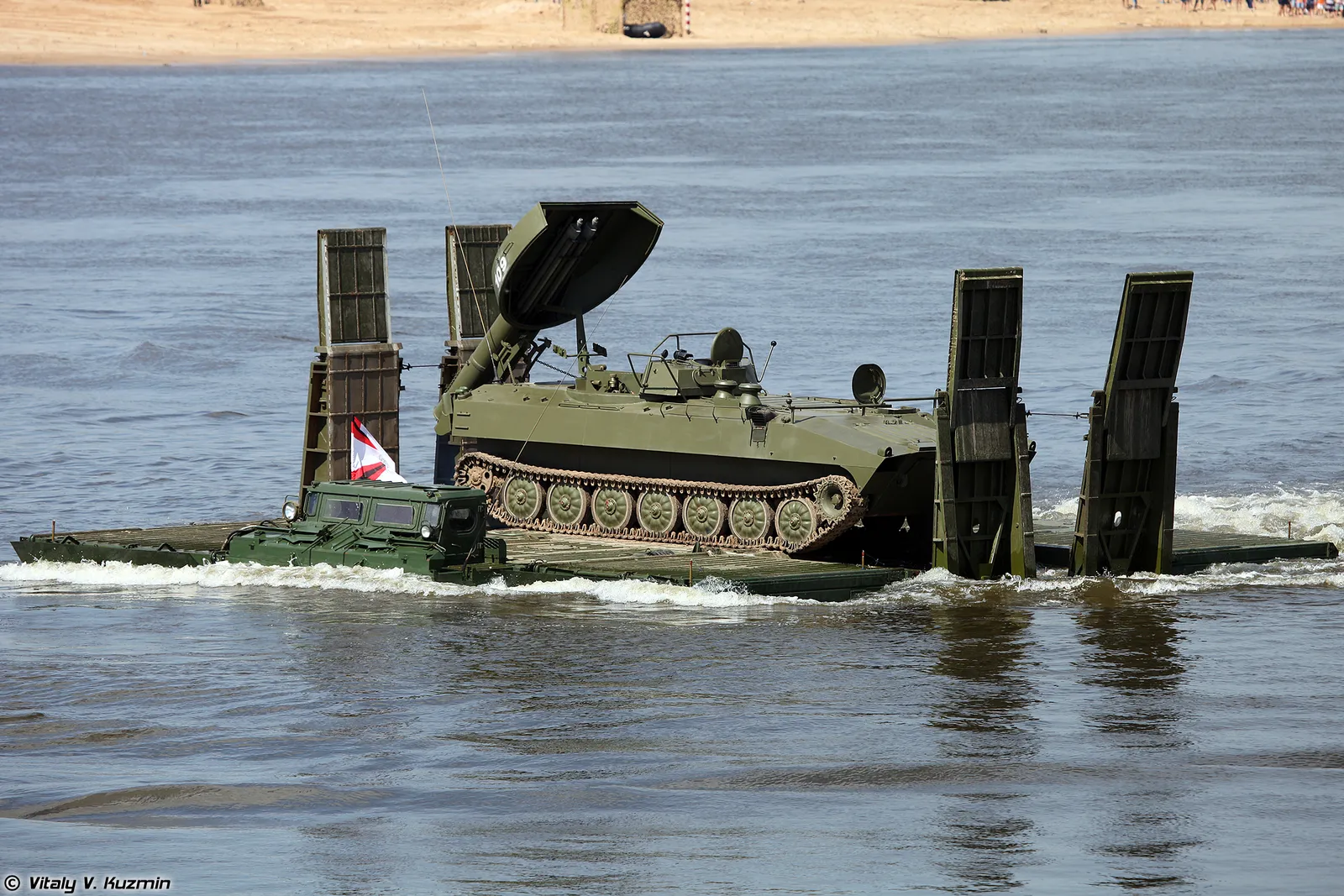
Two or three PMM vehicles can be joined for heavier loads; public references list roughly 80-85 tonnes for two vehicles and 120-127.5 tonnes for three.
Bridge role
Army Recognition says PMM-2 units can be connected into floating bridges and describes the PMM-2M as part of Russia's 2017 Euphrates crossing package in Syria.
Variants
Public sources usually discuss PMM-2 and PMM-2M as the same tracked ferry-bridge family. The PMM-2M raised the ferry load rating to handle heavier tanks, while keeping the same basic folding-pontoon layout.
| Variant | Configuration | Designation notes |
|---|---|---|
| PMM-2M | Improved ferry-bridge vehicle | Army Recognition described PMM-2M as a floating bridging and ferry system that can connect multiple PMM-2 units into floating bridges and was sent by Russian forces to Syria in 2017. Sources: Army Recognition Syria PMM-2M |
Timeline
PMM-2 / PMM-2M Key Events
Kryukiv crossing-equipment design bureau formed
LB.ua reports that Kryukiv Railway Car Building Works created a main Soviet engineering landing and crossing-equipment design bureau in 1954.
Sources: LB.ua Kryukov dossier
PMM-2 developed
Reference coverage places PMM-2 development in the 1970s as a tracked successor to earlier Soviet ferry and pontoon-crossing equipment.
Sources: PMM-2 - German Wikipedia
Russian bridge reported near Deir ez-Zor
TASS reported that Russian road-service military experts erected a bridge across the Euphrates near Deir ez-Zor to move military equipment, troops, and aid to the eastern bank.
Sources: TASS Euphrates bridge
PMM-2M identified in Syria crossing
Army Recognition identified PMM-2M amphibious bridging ferries among the Russian systems used for the Euphrates crossing operation.
Sources: Army Recognition Syria PMM-2M
Media
PMM-2 / PMM-2M Images
Related Weapon Systems


Sources
Army Guide PMM-2Publisher: Army Guide | Note: Supports PMM-2 identity as a floating bridging and ferry system and the armored-vehicle-launched bridge classification. | Accessed: 2026-07-06ODIN PMM-2Publisher: U.S. Army ODIN Worldwide Equipment Guide | Note: Supports PMM-2 identity as a Russian self-propelled amphibious floating bridging and ferry system, replacement context for earlier ferry systems, and multi-vehicle ferry/bridge configuration claims. | Accessed: 2026-07-06PMM-2 - German WikipediaPublisher: Wikipedia | Note: Used as baseline terminology and leads for PMM-2 development period, PMM-2M variant distinction, dimensions, weight, engine, road/water speed, range, and linked-ferry capacity figures. | Accessed: 2026-07-06Mortar Investments PMM-2 specificationsPublisher: Mortar Investments | Note: Supports PMM-2 ferry mission, 36-tonne vehicle weight, 40-tonne single-ferry carrying capacity, crew of three, road speed, road range, dimensions, and two- or three-vehicle ferry capacities. | Accessed: 2026-07-06LB.ua Kryukov dossierPublisher: LB.ua | Note: Supports Kryukiv Railway Car Building Works engineering crossing-equipment design bureau context and PMM-1, PMM-2, PMM-2M development attribution. | Accessed: 2026-07-06Army Recognition Syria PMM-2MPublisher: Army Recognition | Note: Supports 2011 Syrian Civil War direct use: Russian forces sent PMM-2M amphibious bridging ferries to Syria for the Deir ez-Zor Euphrates crossing, and identifies PMM-2M as a floating bridging and ferry system. | Accessed: 2026-07-06TASS Euphrates bridgePublisher: TASS | Note: Supports 2011 Syrian Civil War direct operational context: Russian military road-service specialists erected a Euphrates bridge near Deir ez-Zor to move military equipment, troops, and aid to the eastern bank. | Accessed: 2026-07-06Defence Blog Syria engineering vehiclesPublisher: Defence Blog | Note: Supports 2011 Syrian Civil War direct use: PMM-2M self-propelled ferry vehicles were used by Russian-supported Syrian government operations to cross the Euphrates near Deir ez-Zor; also gives a 42.5-ton loaded-vehicle crossing figure for PMM-2M. | Accessed: 2026-07-06Wikimedia Commons Armiya 2021 PMM-2M imagePublisher: Wikimedia Commons | Note: Supports the primary PMM-2M image provenance and CC BY-SA 4.0 licensing. | Accessed: 2026-07-06Wikimedia Commons Openwater 2016 PMM-2M imagePublisher: Wikimedia Commons | Note: Supports gallery image provenance for a PMM-2M ferry carrying a UR-77 mine-clearing vehicle. | Accessed: 2026-07-06