Support Equipment

BMK-130M towing motor boat

Also known as
  • BMK-130M
  • BMK-130
  • BMK-130ML
  • БМК-130М
  • Buksirno-motorny kater BMK-130M

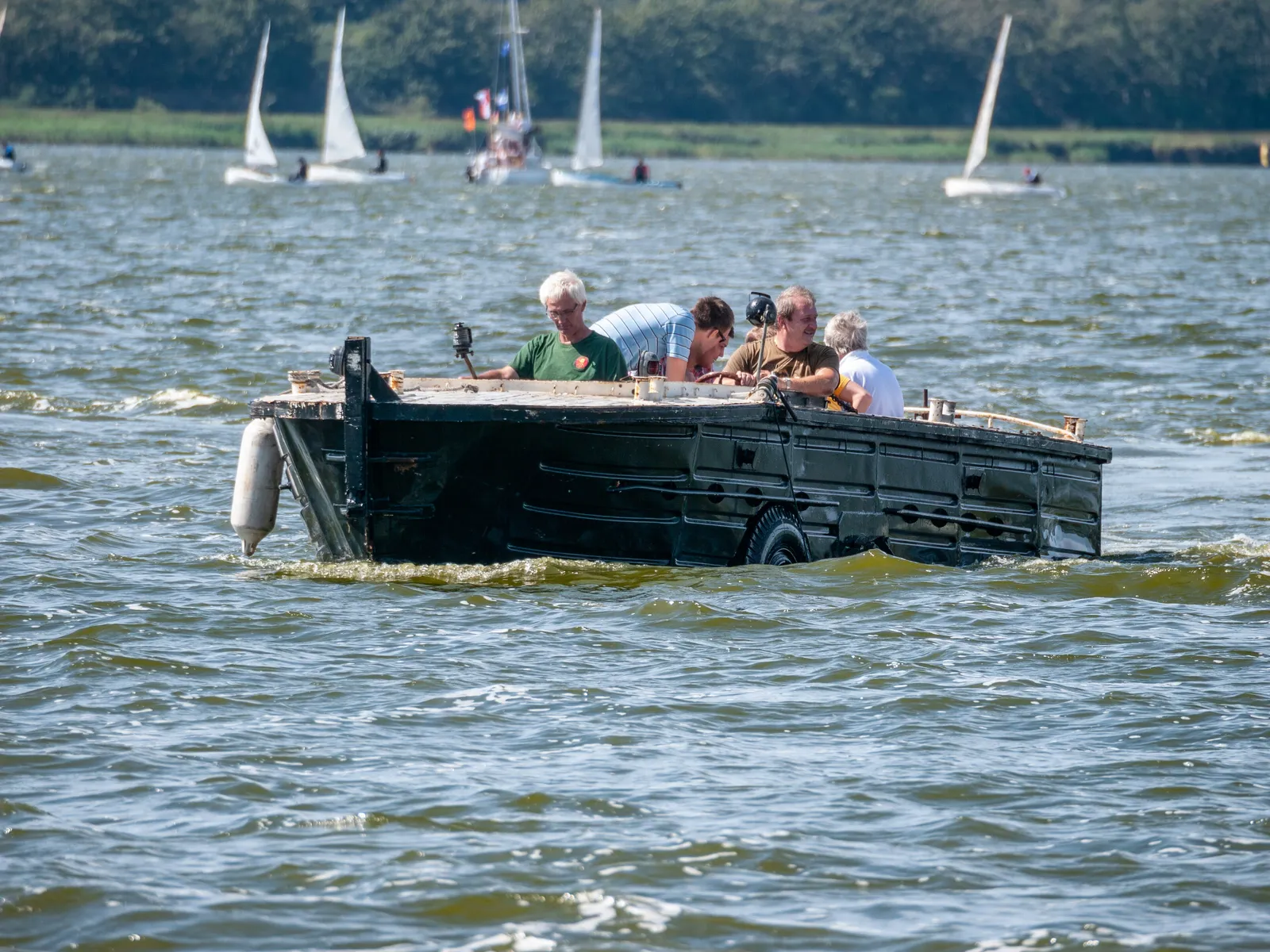
The BMK-130M is a Soviet steel-hulled towing motor boat for engineer river-crossing units, used to move pontoon ferries, bridge elements, anchors, and small craft rather than to fight as an armed boat. Vessel references place it in the BMK-130 family built at Vympel's Rybinsk yard, Russian patent literature cites a 1990 Vympel BMK-130M technical manual, and Russia-Ukraine War loss tracking records a Russian BMK-130M/BMK-150-family boat as captured.

Role in Conflicts

Profile / Specs

Specifications

Crew
2
Length
7.85 m
Beam
2.1 m
Loaded displacement
3.66 t
Draft
0.58-0.62 m in BMK-130M references
Speed
19.5-21.5 km/h / about 11.3 knots, depending on source
Engine
YaAZ/YaMZ-204-SR family diesel; 73.6 kW / 100 hp in manual-derived tables, while FleetPhoto reports 130 hp for BMK-130M
Bollard pull
1450 kg in a BNTU engineer-command training table
Endurance
About 11 hours / 0.5 days in open vessel references
Crossing Support Role

The BMK-130M is useful to a bridge or ferry unit because it moves floating bridge equipment rather than acting as an armed combat craft. FleetPhoto describes the steel-hulled diesel boat as a tug for small craft and towing crossings, while Russian patent literature cites a Vympel BMK-130M manual and describes the baseline boat with an engine, reverse-reduction gear, one propeller in a nozzle, and a rudder.

Primary task

Tow small craft, ferry elements, and bridge-crossing equipment during river-crossing work.

Handling limit

The patent source treats limited side thrust and reverse thrust as BMK-130M shortcomings when ferry crews must hold a shuttle ferry against current.

Identification limit

The conflict-use source groups the loss as BMK-130M/BMK-150, so the row records family-level wartime documentation rather than a separated hull-level BMK-130M identification.
Variants

Open vessel references treat BMK-130, BMK-130M, BMK-130MA, and BMK-130ML as closely related tug-motor-boat variants within the same family.

VariantConfigurationDesignation notes
BMK-130Earlier family member

RussianShips.info lists BMK-130 as the earlier family member and gives the BMK-130M as a later related model in the same Rybinsk-built tugboat family.

Sources: RussianShips.info BMK-130 Type

BMK-130MARelated family member

RussianShips.info lists BMK-130MA between BMK-130M and BMK-130ML in the BMK-130 tugboat type family, but open sources reviewed here do not give a separate public conflict-use record for it.

Sources: RussianShips.info BMK-130 Type

BMK-130MLLater/related family member

FleetPhoto lists BMK-130, BMK-130M, and BMK-130ML together, with BMK-130M identified as the main model in the type page.

Sources: FleetPhoto BMK-130 Type

Timeline

BMK-130M towing motor boat Key Events

  1. BMK-130 family listed from Rybinsk production

    RussianShips.info lists BMK-130-family tugboats from 1960 and attributes the type to Rybinsk Shipyard No. 341, the Vympel Shipyard production lineage used by vessel references.

  2. BMK-130M listed as a family model

    RussianShips.info lists BMK-130M as a later model within the BMK-130 family, with BMK-130MA and BMK-130ML as adjacent designations.

  3. Vympel BMK-130M technical manual cited

    Russian patent RU2120881C1 cites a 1990 Vympel technical description and maintenance manual for the BMK-130M while describing the baseline boat's hull, engine, reverse-reduction gear, propeller in nozzle, and rudder arrangement.

  4. Full-scale Russia-Ukraine War loss tracking begins

    Oryx's Russian equipment-loss list for the invasion later included one captured BMK-130M/BMK-150 towing motor boat among Russian engineering equipment losses.

Media

BMK-130M towing motor boat Videos

Training And Modernization Context

Hungarian military and industry sources show the BMK-130M remaining relevant as bridge-support equipment outside the original Soviet production context. Honvedelem reported BMK-130M operator training for Hungarian engineer troops moving PMP bridge and ferry elements, and HM Currus published material on a modernized BMK-130M motor boat variant fitted for winter operation.

Training role

Hungarian engineer training used BMK-130M boats to move PMP elements and practice 20- and 80-ton ferry handling.

Modernization lane

HM Currus identifies a BMK-130M modernization with a Volvo Penta D5 engine for winter-capable service.

Related Weapon Systems
BK-10 family high-speed assault boats, High-speed transport-assault rigid inflatable boat family, Naval SystemsNaval SystemsBK-10 family high-speed assault boatsHigh-speed transport-assault rigid inflatable boat familyThe BK-10 family is a Russian line of high-speed assault boats developed by Rybinsk Shipyard under Kalashnikov Concern for littoral transport, shore landing, patrol, and fire-support missions. The family centers on the 10-person BK-10 baseline and extends to larger BK-10M, BK-10M1, and BK-10D/DE variants; Russian-source reporting cited in 2024 placed BK-10 boats in Black Sea force-protection tasks against Ukrainian unmanned surface and landing threats.
152 mm ML-20, 152 mm towed gun-howitzer, ArtilleryArtillery152 mm ML-20152 mm towed gun-howitzerThe 152 mm ML-20 is a Soviet heavy towed gun-howitzer designed at Plant No. 172 in Motovilikha under F. F. Petrov and adopted in 1937. It combined a 152.4 mm barrel, split-trail carriage, large muzzle brake, separate-loading ammunition, and a 17.2 km high-explosive range in a weapon built for corps and army artillery. Its modern catalog relevance comes from residual stock use: Ukrainian reporting in October 2025 documented Russian forces towing and losing an ML-20 in Donetsk region during the 2014 Russia-Ukraine War.
2S5 Giatsint-S, 152 mm tracked self-propelled gun, ArtilleryArtillery2S5 Giatsint-S152 mm tracked self-propelled gunThe 2S5 Giatsint-S is a Soviet 152 mm tracked self-propelled gun built for long-range corps- and army-level fire support. Its open rear-mounted 2A37 gun gives it greater reach than many older Soviet 152 mm systems, while its tracked chassis and stabilizing rear spade support shoot-and-move artillery work. Sources document 2S5 use or fielding context from Afghanistan and Chechnya through the 2014 Russia-Ukraine War, with additional wartime transfer evidence for Ethiopia during the Eritrean-Ethiopian War.
BK-16 high-speed assault / landing craft (Project 02510), High-speed assault and landing craft, Naval SystemsNaval SystemsBK-16 high-speed assault / landing craft (Project 02510)High-speed assault and landing craftThe BK-16 is a Russian high-speed assault and landing craft of Project 02510, developed by Kalashnikov Concern's Rybinsk Shipyard for coastal, river-mouth, and unequipped-shore operations. Public sources distinguish domestic Project 02510 craft from the BK-16E export model, with both centered on troop transport, landing support, patrol, and modular fire-support or specialist mission fits; Russian craft are documented in wartime use or losses in the Black Sea and occupied Crimea during the Russia-Ukraine war.

Sources