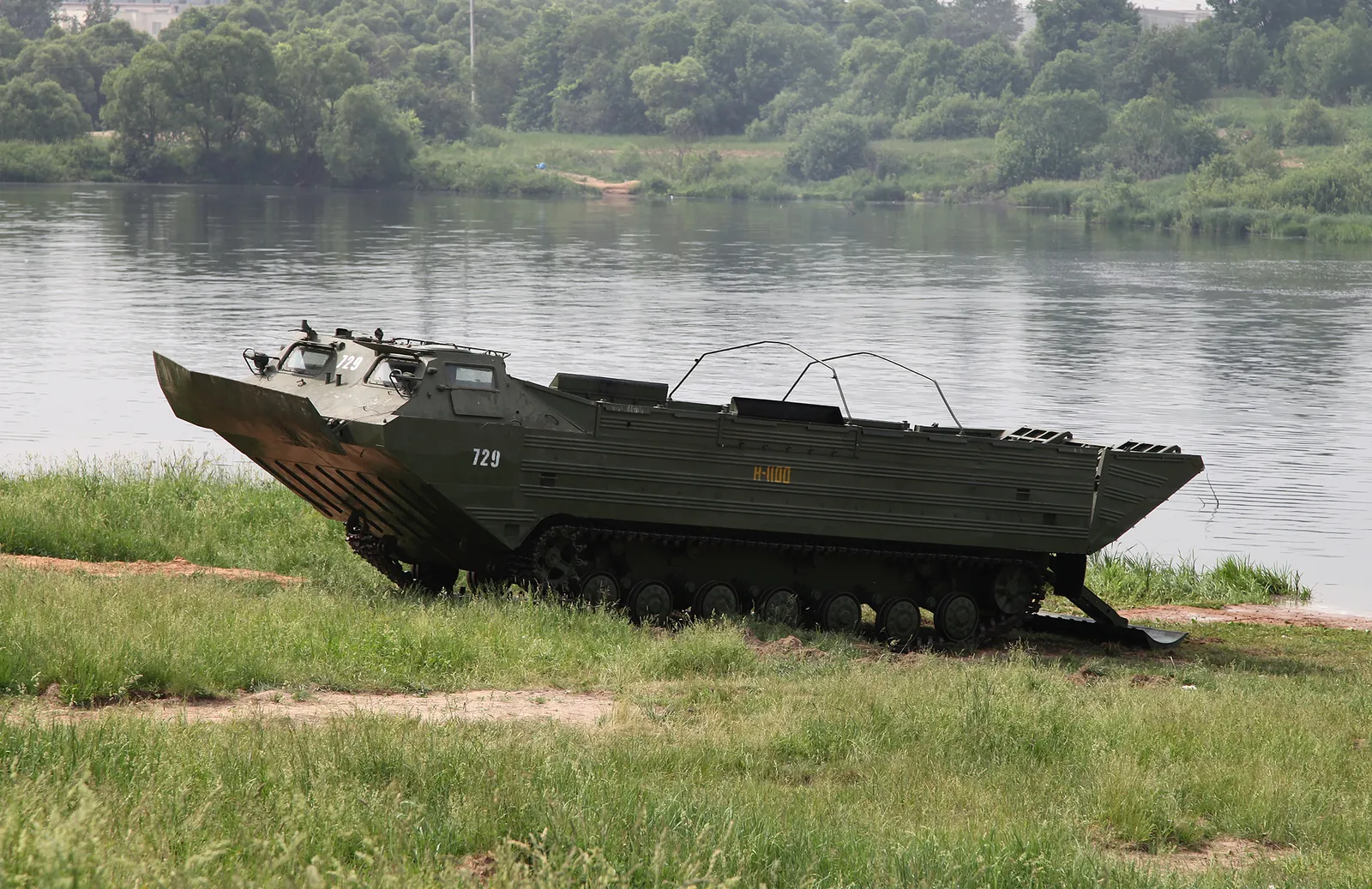


Reporting documents PTS-2 amphibious transporters with Ukrainian, Russian, and Russian-backed forces in Ukraine, including 2014 Donbas/Mariupol context, Russian river-crossing use, captured Russian vehicles, and later Russian vehicles modified into makeshift assault transports near the front.
Role detailsSupport Equipment
PTS-2
Also known as
- Plavayushchij Transportyer Sryednyj-2
- Plavayushchiy Transportyor Sredniy-2
- PTS 2
- PTS-2 amphibious transporter
- PTS-2 floating tracked transporter
The PTS-2 is a Soviet amphibious tracked transporter developed from the PTS family for moving troops, vehicles, casualties, and cargo across rivers, flooded ground, and rough approaches where wheeled logistics vehicles cannot operate.
Role in Conflicts
Profile / Specs
Profile
- Origin
- Soviet Union
- Built by
- Soviet defense industry
- Type
- Amphibious tracked transporter
- Service note
- Late Cold War Soviet amphibious-engineering vehicle
- Designed
- Development reported from 1973
- Produced
- Reported from 1985; related Lugansk-built PTS-2/PTS-3 production is also described broadly in the 1970s-1980s
Specifications
- Crew
- 2
- Payload
- 12 tonnes on water; sources also describe carriage of up to 75 troops or 12 stretcher casualties
- Dimensions
- About 11.99 m long, 3.30 m wide, and 3.17 m high in PTS-2 reference data
- Weight
- About 24.2-24.4 tonnes empty, with maximum loaded weight described around 36-38 tonnes depending on source
- Engine
- V-46-5 liquid-cooled V12 diesel, about 710 hp
- Mobility
- Tracked amphibious cargo carrier with rear ramp, 10-tonne winch, twin water propulsors, and reported 60 km/h road speed with about 12-13 km/h water speed
- Chassis
- Based on the MT-T tracked transport family using T-64-derived running gear; PTS-2 has seven road wheels per side
- Protection
- Lightly armored crew cab with NBC/ABC protection; the open cargo bed is not an infantry fighting compartment
Variants
PTS-family designations track successive Soviet and Russian amphibious tracked transporters; the PTS-2 sits between the smaller PTS-M predecessor and later PTS-3/PTS-4 replacement efforts.
| Variant | Configuration | Designation notes |
|---|---|---|
| PTS-M | Earlier PTS-family transporter | The PTS-M used a smaller cargo area and lower payload than the later PTS-2, which carried the family onto a larger MT-T/T-64-derived tracked base. Sources: PTS-2, PTS-10, PTS-2 and PTS-M |
| PTS-3 | Later Lugansk-built family member | Open reporting groups PTS-3 with PTS-2 as aging Lugansk-built amphibious transporters that PTS-4 was intended to replace. |
| PTS-4 | Russian successor | The PTS-4 is a later Omsktransmash/Uralvagonzavod design with heavier payload on water, better protection, and T-80/T-72-derived automotive components. Sources: Russian Defense Ministry plans to buy new amphibious tracked armoured vehicle PTS-4 in 2014, Novyy plavayushchiy transporter proshel ispytaniya |
Transport Family And River-Crossing Role
The PTS-2 sits between the earlier PTS-M and later PTS-3/PTS-4 line in published descriptions of the Soviet PTS amphibious transporter family. Its main value is functional rather than tactical: it is a tracked river-crossing cargo vehicle for moving trucks, troops, stretchers, and other loads across water obstacles.
Chassis family
WeaponSystems.net describes the PTS-2 as a development of the PTS-M built around the newer MT-T tracked chassis, with T-64 running gear and a more powerful T-72-derived engine.
Transport load
Published descriptions give the PTS-2 a 12-ton cargo capacity, enough for a light truck, about 75 troops, or stretchers, with loading through a rear ramp and support from a winch.
Successor context
Mortar Investments identifies PTS-3 as a small-production successor and PTS-4 as a later Russian replacement program, while the PTS-2 remained the practical Cold War-era transporter in this family context.
Sources: PTS-2; PTS-10, PTS-2 and PTS-M.
Timeline
PTS-2 Key Events
PTS-2 development date reported
WeaponSystems.net lists 1973 as the PTS-2 development date while separately placing service entry and production in the mid-1980s.
Sources: PTS-2
Mid-1980s service and production reporting
WeaponSystems.net reports mid-1980s service entry and production from 1985 for the PTS-2, while other reporting groups Lugansk-built PTS-2/PTS-3 vehicles broadly in the 1970s-1980s.
Sources: PTS-2, Novyy plavayushchiy transporter proshel ispytaniya
PTS-4 qualification tests
Army Recognition reported that the PTS-4 passed qualification tests in 2011 as the Russian successor family moved toward procurement.
Sources: Russian Defense Ministry plans to buy new amphibious tracked armoured vehicle PTS-4 in 2014
PTS-4 factory trials reported
N+1 reported Omsktransmash factory tests of the PTS-4 and described it as intended to replace aging PTS-2 and PTS-3 transporters.
Sources: Novyy plavayushchiy transporter proshel ispytaniya
Modified Russian PTS-2 reported in Ukraine
United24 Media reported imagery of Russian PTS-2 transporters modified with improvised protection and pushed into assault-support use in Ukraine.
Sources: When You're Out of IFVs: Russia Sends Modified PTS-2s Into Assaults
Related Weapon Systems


Sources
PTS-2Publisher: WeaponSystems.net | Note: Supports PTS-2 origin, development date, mid-1980s service entry, reported production from 1985, Voroshilovgrad locomotive plant developer, MT-T/T-64-derived chassis context, and general technical description. | Accessed: 2026-07-13PTS-10, PTS-2 and PTS-MPublisher: Mortar Investments | Note: Supports PTS-2 cargo-area, payload, troop-capacity, rear-ramp, and winch details. | Accessed: 2026-07-13Sravnitelnyy analiz PTS-2 s analogichnymi obraztsami tekhnikiPublisher: Belarusian National Technical University | Note: Supports PTS-2 mission, two-person crew, 75-person troop carriage, 12-tonne land/water payload, 60 km/h road speed, water speed, 710 hp diesel power, NBC/ABC protection, self-entrenching equipment, radio, intercom, and night-vision equipment. | Accessed: 2026-07-13Novyy plavayushchiy transporter proshel ispytaniyaPublisher: N+1 | Note: Supports PTS-4 development and test context, T-80/T-72 component lineage, PTS-4 replacement role for aging Lugansk-built PTS-2 and PTS-3 transporters, and broad 1970s-1980s Lugansk production context. | Accessed: 2026-07-13Russian Defense Ministry plans to buy new amphibious tracked armoured vehicle PTS-4 in 2014Publisher: Army Recognition | Note: Supports PTS-4 successor-family context, 2011 qualification testing, planned 2014 procurement, 12.7 mm remote weapon station, 840 hp engine, 12-tonne land payload, 18-tonne water payload, and T-80/T-72-derived automotive lineage. | Accessed: 2026-07-13When You're Out of IFVs: Russia Sends Modified PTS-2s Into AssaultsPublisher: United24 Media | Note: Supports direct 2014 Russia-Ukraine War use by Russian forces, including images of a modified PTS-2 used as a makeshift assault vehicle in Ukraine. | Accessed: 2026-07-13PTS-2: Ukrainian Amphibious Transporter, History and Current UsePublisher: Fraza | Note: Supports direct 2014 Russia-Ukraine War use by Russian-backed formations in Donbas, including PTS-2 vehicles seized in Luhansk in 2014 and later PTS vehicles supplied from Russia to armed formations in occupied Donetsk and Luhansk. | Accessed: 2026-07-13Ukrainian Forces Captured a PTS-2 Transporter in Kharkiv RegionPublisher: StopCor | Note: Supports direct 2014 Russia-Ukraine War use by Russian forces, reporting a captured Russian PTS-2 in Kharkiv region and Russian use of similar PTS-2 vehicles for river-crossing work in Kherson and on the Siverskyi Donets. | Accessed: 2026-07-13PTS-2 - RaceofHeroes-part2-35.jpgPublisher: Wikimedia Commons | Note: Supports the primary PTS-2 image attribution and licensing context. | Accessed: 2026-07-13