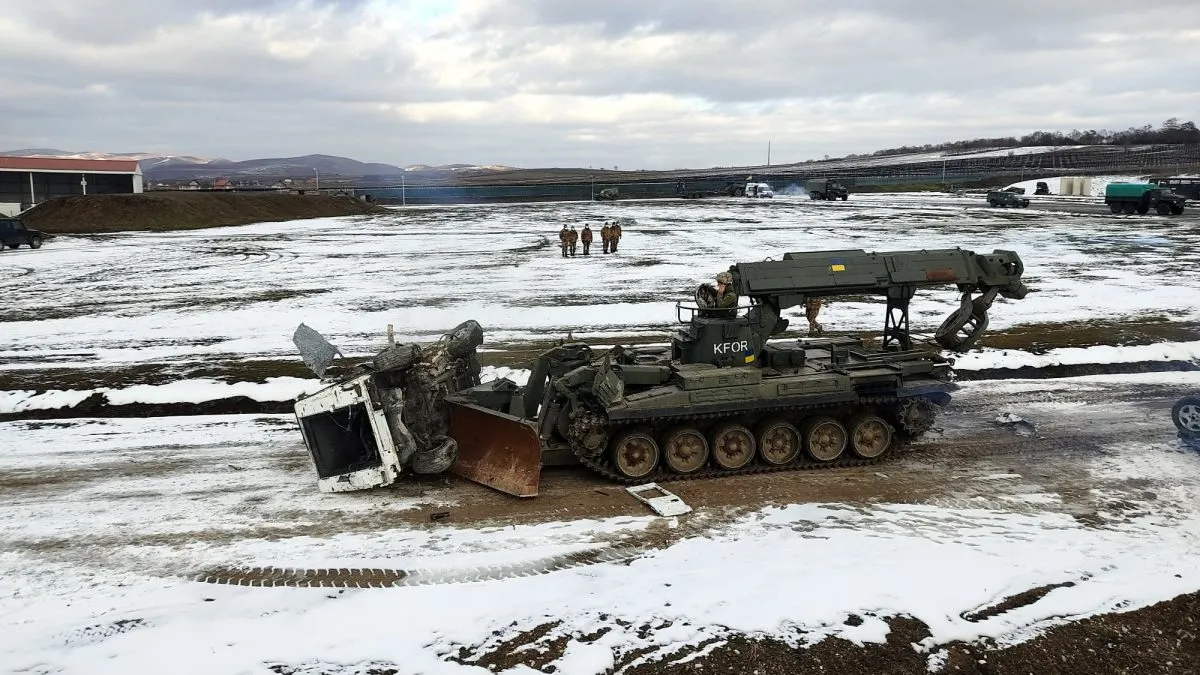


Photo- and video-backed loss inventories document Russian IMR-2(M) and Ukrainian IMR-2 combat engineering vehicles in the full-scale phase of the war, with additional Ukrainian reporting identifying Russian IMR-2 losses in armored-column fighting.
Role detailsSupport Equipment
IMR-2
Also known as
- IMR-2M
- IMR-2M1
- IMR-2M2
- IMR-2MA
- Inzhenernaya Mashina Razgrazhdeniya-2
- Inzhenernaya Mashina Razgrazhdeniya 2
- ИМР-2
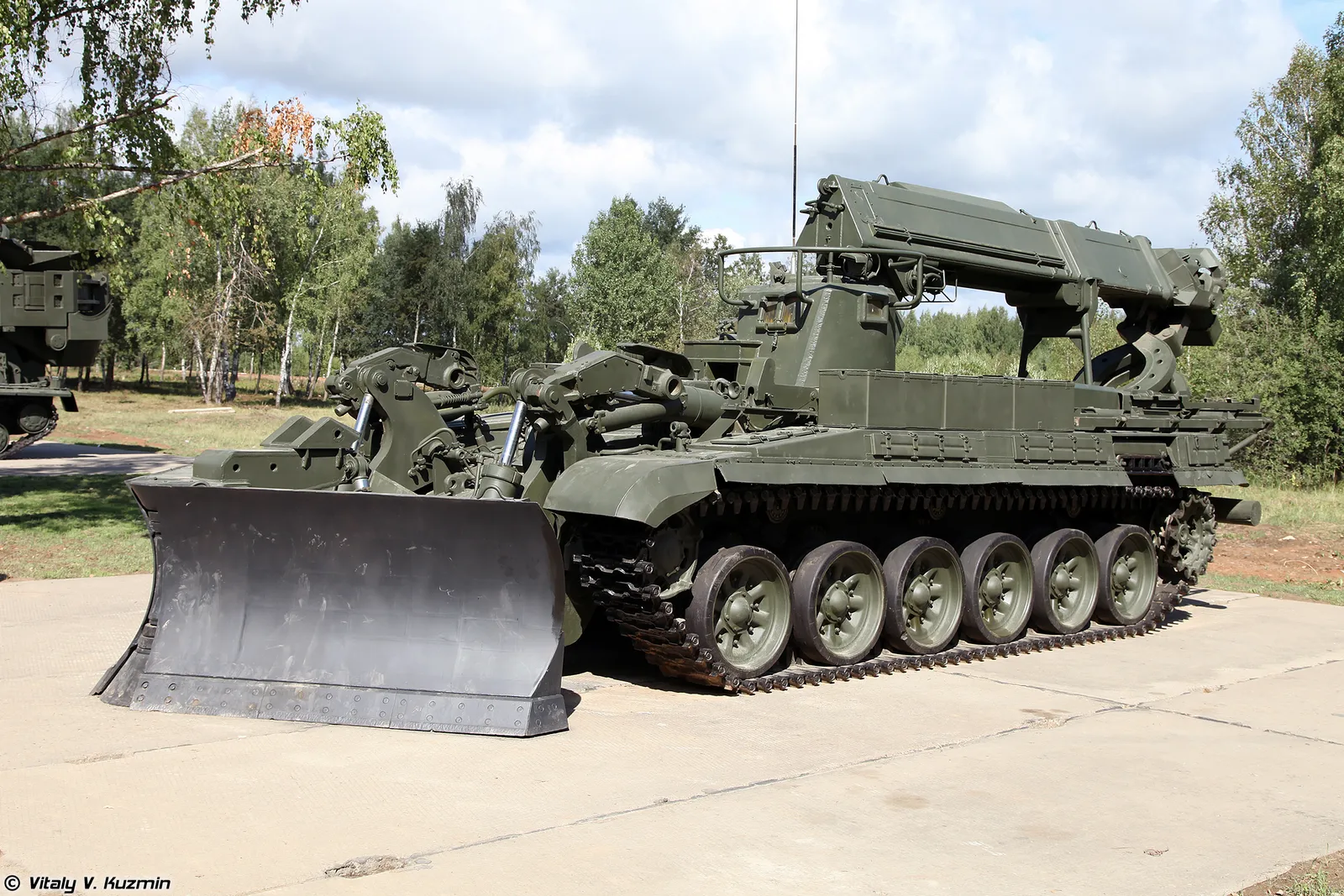
The IMR-2 is a Soviet T-72-derived armored engineering vehicle built for route clearance, obstacle reduction, and work in contaminated or high-risk terrain. Its turret is replaced by engineering equipment such as a dozer blade, telescoping boom, and mine-clearing gear on IMR-2M configurations, while public Ukraine-war reporting documents IMR-2-family vehicles in Russian and Ukrainian service.
Role in Conflicts
Profile / Specs
Profile
- Origin
- Soviet Union / Russia
- Built by
- Uralvagonzavod
- Type
- Tracked combat engineering obstacle-clearing vehicle
- Service note
- Introduced in the 1980s; still documented in Russian and Ukrainian service contexts in the 2020s.
- Designer
- Uralvagonzavod design lineage
- Designed
- Developed in the 1970s and early 1980s
- Produced
- 1980s baseline production; later IMR-2M-family modernization references appear in open sources
- Developed from
- T-72
Specifications
- Crew
- 2 soldiers
- Base chassis
- T-72 / T-72A main battle tank family
- Primary equipment
- Versatile dozer blade, telescoping boom with multipurpose attachment, and KMT-type mine-clearing equipment on IMR-2M references
- Armament
- 12.7 mm machine gun for local self-defense
- Weight
- About 44.5 tonnes in Army Recognition's IMR-2M data sheet
- Dimensions
- Length 9.55 m; width 4.35 m; height 3.68 m
- Speed
- Up to 60 km/h road speed in Army Recognition's IMR-2M data sheet
- Range
- About 500 km on road
- Protection
- Armor protection against small arms and shell splinters; NBC protection listed among accessories
Engineering Layout
The IMR-2 family trades tank armament for route-opening equipment. Its battlefield value is the ability to move with armored formations while clearing physical obstacles, reducing debris, and supporting movement through damaged or contaminated terrain.
Chassis
T-72/T-72A-derived tracked armored base with tank-style mobility and a two-person crew in open references.
Tools
Dozer blade, telescoping boom with multipurpose attachment, and IMR-2M-family mine-clearing equipment are described in public technical profiles.
Protection role
The vehicle is protected against small arms and shell splinters and is designed to let engineers work close to hazardous battlefield obstacles.
Sources: ODIN IMR-2 profile; Army Recognition IMR-2M data sheet.
Variants
Open references use IMR-2 for the T-72-based family and distinguish later IMR-2M variants by mine-clearing fit, contaminated-area improvements, operator cabin changes, or remote-control adaptation.
| Variant | Configuration | Designation notes |
|---|---|---|
| IMR-2M1 | Simplified IMR-2M variant | Army Recognition describes the IMR-2M1 as a simplified model without the mine-clearing system. Sources: Army Recognition IMR-2M data sheet |
| IMR-2M2 | Improved contaminated-area configuration | Army Recognition identifies the IMR-2M2 as an improved version for dangerous or contaminated-area work, with a modified crane arm and bucket. Sources: Army Recognition IMR-2M data sheet |
| IMR-2MA | Later cabin and armament configuration | Army Recognition lists IMR-2MA as a later version with a larger operator cabin and 12.7 mm NSV machine gun. Sources: Army Recognition IMR-2M data sheet |
| Klin-1 | Remote-controlled IMR-2 derivative | Army Recognition lists Klin-1 as a remote-controlled IMR-2 branch. Sources: Army Recognition IMR-2M data sheet |
Base Vehicle Lineage
The IMR-2 is best read as an engineering conversion of the T-72 tank chassis rather than as a tank itself.
| Compatible item | Item type | Compatibility evidence |
|---|---|---|
 | Main battle tank chassis family | ODIN and Army Recognition describe the IMR-2 / IMR-2M family as T-72 or T-72A based, with the tank turret replaced by engineering equipment. Sources: ODIN IMR-2 profile, Army Recognition IMR-2M data sheet |
Timeline
IMR-2 Key Events
T-72-based IMR-2 family enters service
Open technical references place the IMR-2 family in the Soviet/Russian obstacle-clearing vehicle line that followed earlier T-54/T-55-based IMR vehicles.
Sources: Army Recognition IMR-2M data sheet, ODIN IMR-2 profile
Russian IMR-2 documented in destroyed column
Militarnyi reported that Ukraine's 58th Brigade destroyed a Russian column around 20 March 2022 and listed an IMR-2 tracked military engineering vehicle among the recorded losses.
Sources: Militarnyi 58th Brigade column report
Novomykhailivka loss reporting cites IMR-2
Militarnyi's Novomykhailivka report cited earlier 79th Brigade reporting that Russian armored losses in the area included an IMR-2 engineering vehicle.
Sources: Militarnyi Novomykhailivka road report
Media
IMR-2 Images
Related Weapon Systems



Sources
ODIN IMR-2 profilePublisher: U.S. Army ODIN | Note: Supports IMR-2 identity, T-72-based combat engineering role, development background, mobility, engine, crew, and dimensional specifications. | Accessed: 2026-07-06Army Recognition IMR-2M data sheetPublisher: Army Recognition | Note: Supports IMR-2M family specifications, T-72A chassis context, engineering equipment, variants, crew, protection, speed, range, dimensions, and accessories. | Accessed: 2026-07-06Oryx Russian equipment lossesPublisher: Oryx | Note: Supports 2014 Russia-Ukraine War direct conflict-use by listing Russian engineering-vehicle losses from photo or video evidence, including IMR-2-family entries in the Ukraine war loss inventory. | Accessed: 2026-07-06Oryx Ukrainian equipment lossesPublisher: Oryx | Note: Supports 2014 Russia-Ukraine War direct conflict-use by listing Ukrainian IMR-2 combat engineering vehicles in a photo- and video-backed Ukraine war loss inventory. | Accessed: 2026-07-14Militarnyi 58th Brigade column reportPublisher: Militarnyi | Note: Supports 2014 Russia-Ukraine War direct conflict-use by reporting a Russian column destroyed around 20 March 2022 with an IMR-2 tracked military engineering vehicle among the recorded losses. | Accessed: 2026-07-06Militarnyi Novomykhailivka road reportPublisher: Militarnyi | Note: Supports 2014 Russia-Ukraine War direct conflict-use by citing 79th Brigade reporting that Russian armored losses near Novomykhailivka included an IMR-2 engineering vehicle. | Accessed: 2026-07-06Commons IMR-2 Ukraine imagePublisher: Wikimedia Commons / ArmyInform | Note: Supports image provenance and CC BY 4.0 licensing for the IMR-2 photograph of a Ukrainian peacekeeping-contingent vehicle in Kosovo. | Accessed: 2026-07-06Commons TankBiathlon IMR-2 imagePublisher: Wikimedia Commons / Vitaly V. Kuzmin | Note: Supports gallery image provenance and CC BY-SA 4.0 licensing for an IMR-2 photographed during Tank Biathlon 2014. | Accessed: 2026-07-06