- Side
- Coalition forces

Marine Corps AV-8 Harriers delivered most of the roughly 500 Mk-77s documented in Desert Storm, including attacks on Iraqi oil-filled fire trenches in southern Kuwait.
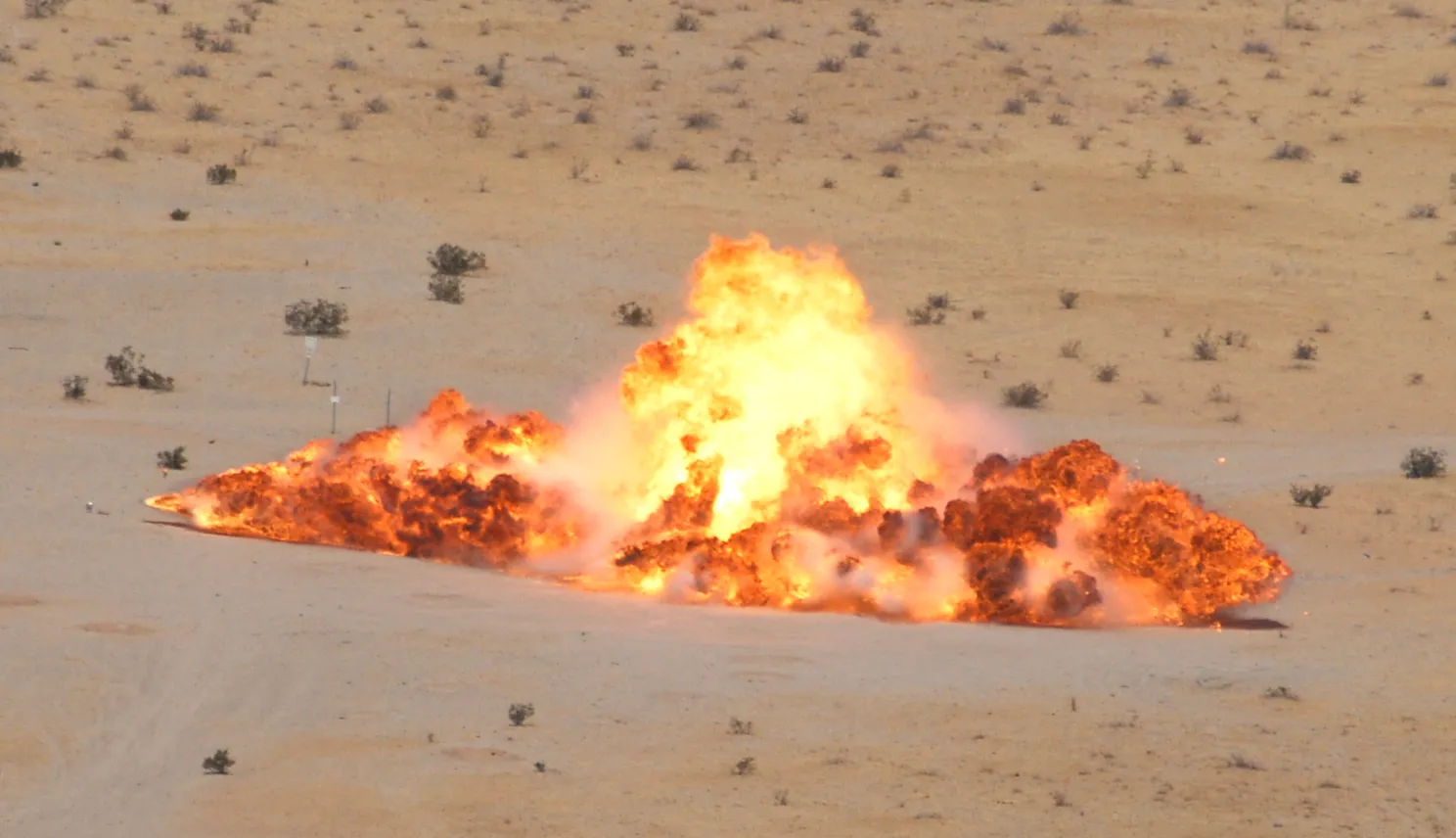
Role detailsThe Mk-77 firebomb is a U.S. air-dropped incendiary bomb family used by Marine Corps aviation for low-altitude incendiary attack. Training references describe the later 75-gallon, roughly 520-pound firebomb as the primary U.S. firebomb, while direct public sources document Mk-77 use by coalition forces in the 1990 Gulf War and by I Marine Expeditionary Force during the 2003 Iraq invasion.
Marine Corps AV-8 Harriers delivered most of the roughly 500 Mk-77s documented in Desert Storm, including attacks on Iraqi oil-filled fire trenches in southern Kuwait.
Role detailsU.S. and UK public accounts later confirmed that I Marine Expeditionary Force used 30 Mk-77 firebombs in Iraq between 31 March and 2 April 2003 against military targets away from civilian areas.
Role detailsThe Mk-77 is a thin-skinned fuel-gel bomb rather than a guided blast-fragmentation weapon. Marine Corps fire-support references emphasize low-altitude delivery, erratic free-fall behavior, and a broad fuel spread after impact.
| Context | Documented detail | Why it matters |
|---|---|---|
| Training profile | 75 gallons of fuel-gel mixture, about 520 lb, and a typical elliptical ground pattern around 215 ft by 75 ft. | Explains why the munition is treated as an area incendiary weapon rather than a precision bomb. |
| Designation references | AV-8B tables list Mod 2/4 fire bombs; later sources distinguish Mod 4 and kerosene-based Mod 5 context. | Gives readers the mod structure without treating the family page as a separate variant of itself. |
| Desert Storm | Marine Corps AV-8 Harriers delivered Mk-77s primarily from low altitude against Iraqi oil-filled trenches. | Links the weapon's delivery profile to a directly sourced combat role. |
| Operation Iraqi Freedom | Public U.S. and UK accounts describe 2003 use against enemy positions or military targets, while denying Fallujah employment. | Separates confirmed 2003 Iraq War use from later disputed claims about other operations. |
Marine Corps references connect the Mk-77 to low-altitude close-air-support aircraft, with AV-8B loadout tables and F/A-18 training media giving specific carrier examples.
| Carrier | Carrier type | Carriage evidence |
|---|---|---|
 | V/STOL attack aircraft | The Navy fact file lists Mk-77 Mod 2/4 fire bombs among the AV-8B's air-to-ground stores, and GlobalSecurity describes AV-8 Harriers as the primary delivery aircraft for Desert Storm Mk-77 use. Sources: NHHC AV-8B PDF Fact File, GlobalSecurity MK-77 Fire Bomb |
 | Carrier-capable strike fighter | A Marine Corps video page for a VMFA-314 live-fire exercise tags the event with F-18, Hornet, fire bomb, and Mk77 metadata. Sources: VMFA-314 Fire Exercise Video |
Marine Corps aircraft used Mk-77 firebombs during Desert Storm, including attacks on Iraqi oil-filled fire trenches in southern Kuwait.
The last filled Mk 77 Mod 4 napalm canister from the Fallbrook stockpile was destroyed in March 2001.
UK reporting on ministerial correspondence recorded 30 Mk-77 firebombs used by I Marine Expeditionary Force in Iraq between 31 March and 2 April 2003.
A Marine Corps video page tags a VMFA-314 F/A-18 live-fire exercise at Twentynine Palms with Mk77, fire bomb, Hornet, and ordnance metadata.


