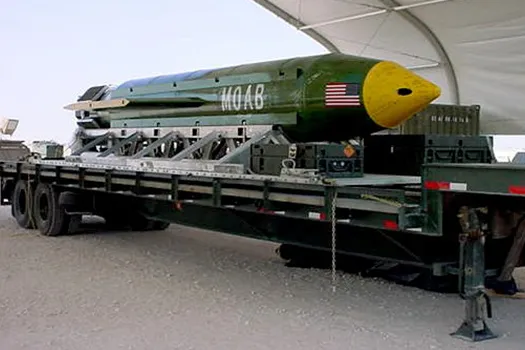


U.S. Forces Afghanistan used a GBU-43/B MOAB on April 13, 2017 against an ISIS-K cave and tunnel complex in Achin district, Nangarhar Province, to reduce bunkers, tunnels, and improvised obstacles during Afghan and U.S. clearing operations.
Role detailsMunitions
GBU-43/B MOAB
Also known as
- GBU-43/B
- MOAB
- Massive Ordnance Air Blast
- Mother of All Bombs
- GBU-43/B Massive Ordnance Air Blast
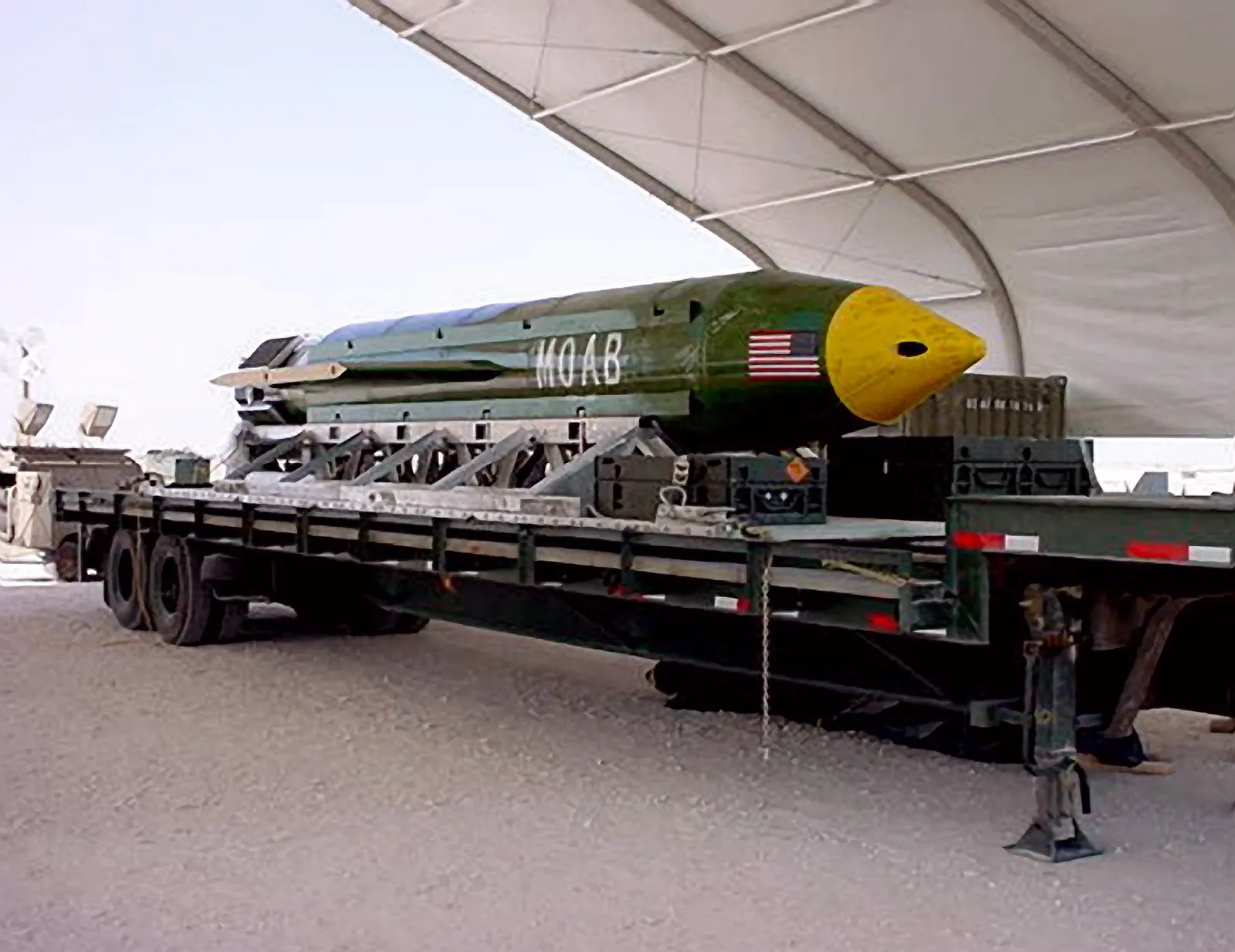
The GBU-43/B Massive Ordnance Air Blast, widely known as MOAB or the "Mother of All Bombs," is a very large U.S. GPS/INS-guided conventional bomb developed rapidly by the Air Force Research Laboratory with Dynetics support. It uses a BLU-120/B high-explosive body, tail and grid-fin control, and cargo-aircraft ramp deployment rather than fighter carriage. Its only documented combat use was the April 13, 2017 U.S. strike on an ISIS-K tunnel complex in Afghanistan, where commanders selected its blast effect to reduce obstacles facing Afghan and U.S. clearing forces.
Role in Conflicts
Profile / Specs
Profile
- Origin
- United States
- Type
- GPS/INS-guided massive ordnance air blast bomb
- Service note
- Developed in 2002-2003; delivered to the operational theater in 2003; first used in combat in Afghanistan in 2017
- Designer
- Air Force Research Laboratory Munitions Directorate
- Designed
- 2002-2003
- Produced
- 2003
Specifications
- Weight
- About 21,000-21,600 lb
- Bomb body
- BLU-120/B high-explosive body with about 18,700 lb of H6 explosive fill
- Guidance kit
- KMU-593/B GPS/INS guidance with fixed wings, tail control, and grid fins
- Dimensions
- About 30 ft long and 40.5 in / 3.3 ft in diameter
- Casing and effect
- Thin aluminum casing intended for surface burst and large blast effect rather than penetration
- Release method
- Carried on a cradle or platform and extracted from C-130/MC-130 cargo aircraft by drogue parachute before separation
- Delivery platform
- Designed for ramp deployment from MC-130/C-130 aircraft
Design And Delivery Logic
The MOAB was designed as a very large blast weapon that could be launched from cargo aircraft rather than from a bomber weapons bay. Air Force and DVIDS sources describe a thin aluminum casing, GPS guidance, stabilizing fins, inertial gyro control, and a cradle/platform extraction sequence that separates the bomb from a C-130-family aircraft after a drogue parachute pulls the platform from the ramp.
Guidance package
The munition combines GPS/INS guidance with fins and gyro-controlled pitch and roll, giving the large bomb a guided release profile instead of the unguided BLU-82 approach it was intended to supersede.
Blast body
The BLU-120/B body carries about 18,700 pounds of H6 explosive in a thin casing intended to produce a large surface blast rather than deep penetration.
Cargo-aircraft release
The bomb rides on an airdrop platform inside the aircraft, is extracted by a drogue parachute, then separates so its fins can stabilize the weapon toward the target.
Launch Aircraft
The MOAB's documented ramp-deployment history ties it to the MC-130J Commando II.
| Launcher | Launcher type | Launch evidence |
|---|---|---|
 | Special operations transport aircraft | DVIDS coverage identifies the MC-130J Commando II as the first aircraft to ever drop the GBU-43/B MOAB, and the MC-130J training manual includes GBU-43 airdrop procedures. Sources: Behind the Boom, AFMAN 11-2MC-130J, Vol 1 |
Carrier Aircraft
The MOAB was loaded into a C-130 Hercules during its documented test-drop sequence.
| Carrier | Carrier type | Carriage evidence |
|---|---|---|
 | Transport aircraft | Air Force reporting says the MOAB was loaded into a C-130 Hercules and dropped from the aircraft during the test sequence. Sources: What to Know About the GBU-43/B, ‘Mother of all Bombs’, Bombs away |
Timeline
GBU-43/B MOAB Key Events
AFRL technology project begins
Defense imagery released for the 2003 test described the MOAB effort as an AFRL technology project that began in fiscal year 2002 and was planned for completion in 2003.
Sources: MOAB prepared for Eglin test
Rapid prototype request
Air Force reporting says the request arrived around Thanksgiving 2002 and the AFRL Munitions Directorate moved quickly from concept to a full-scale operational munition prototype.
Sources: Five years later, it's still known as 'Mother of all bombs'
First live test at Eglin
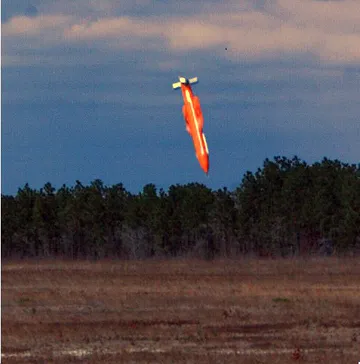
The Air Force tested the MOAB at Eglin Air Force Base on March 11, 2003, dropping the 21,500-pound precision-guided munition from a C-130 Hercules.
Sources: Bombs away
Delivered to operational theater
A 2008 Air Force feature said the first MOAB was delivered to the operational theater for the war on terrorism on April 1, 2003, though it was not used in combat at that time.
Sources: Five years later, it's still known as 'Mother of all bombs'
First combat use in Afghanistan
U.S. Forces Afghanistan used a GBU-43/B MOAB against an ISIS-K cave and tunnel complex in Achin district, Nangarhar Province.
Sources: U.S. Bombs, Destroys Khorasan Group Stronghold in Afghanistan, Aerial Footage of MOAB Bomb Striking Cave, Tunnel System
Media
Related Weapon Systems


Sources
Air & Space Forces Magazine GBU-43 MOABPublisher: Air & Space Forces Magazine | Note: Supports GBU-43/B specifications, AFRL and Dynetics contractor background, GPS/INS guidance, BLU-120/B warhead, dimensions, MC-130H integration, active GBU-43/B designation, and first operational use context. | Accessed: 2026-07-04Five years later, it's still known as 'Mother of all bombs'Publisher: U.S. Air Force | Note: Supports Air Force development background, GPS-guided munition description, AFRL Munitions Directorate role, rapid prototype timeline, BLU-82 replacement intent, delivery to the operational theater, and public-domain Air Force imagery. | Accessed: 2026-07-04What to Know About the GBU-43/B, ‘Mother of all Bombs’Publisher: DVIDS | Note: Supports MOAB specifications, H6 explosive fill, thin aluminum casing, stabilizing fins, GPS guidance, and the C-130 cradle/platform extraction sequence. | Accessed: 2026-07-04Bombs awayPublisher: U.S. Air Force | Note: Supports the March 11, 2003 Eglin test, the MOAB being dropped from a C-130 Hercules during the test, and the 21,500-pound precision-guided munition description. | Accessed: 2026-07-04U.S. Bombs, Destroys Khorasan Group Stronghold in AfghanistanPublisher: U.S. Department of Defense | Note: Supports 2001 War in Afghanistan direct use: U.S. Forces Afghanistan used a GBU-43/B MOAB against an ISIS-K tunnel complex in Achin district, Nangarhar Province on April 13, 2017, to reduce obstacles facing Afghan and U.S. clearing forces. | Accessed: 2026-07-04Aerial Footage of MOAB Bomb Striking Cave, Tunnel SystemPublisher: DVIDS | Note: Supports 2001 War in Afghanistan direct use: a GBU-43/B MOAB struck ISIS-K cave and tunnel systems in Achin district, Nangarhar Province, with public-domain DoD video context. | Accessed: 2026-07-04Mother of all BombsPublisher: U.S. Department of Defense | Note: Supports image provenance for the primary GBU-43/B MOAB photograph, credited as a courtesy photo with Defense Department VIRIN 170414-D-XT155-002. | Accessed: 2026-07-04Behind the BoomPublisher: Defense Visual Information Distribution Service | Note: Supports MC-130J launch context because the article identifies the MC-130J Commando II as the first aircraft to ever drop the GBU-43/B MOAB. | Accessed: 2026-07-04AFMAN 11-2MC-130J, Vol 1Publisher: U.S. Air Force | Note: Supports MC-130J GBU-43 airdrop procedures and training context. | Accessed: 2026-07-04MOAB prepared for Eglin testPublisher: U.S. Department of Defense | Note: Supports March 11, 2003 Eglin preparation imagery, the 21,500-pound precision-guided munition description, C-130 test plan, and AFRL technology-project timing. | Accessed: 2026-07-04Air Force Armament Museum GBU-43/B MOABPublisher: Air Force Armament Museum Foundation | Note: Supports BLU-120/B, H6 explosive fill, KMU-593/B GPS/INS guidance, fixed wings and grid fins, dimensions, MC-130/C-130 launch platform, and major test and combat-use timeline points. | Accessed: 2026-07-04GlobalSecurity MOABPublisher: GlobalSecurity.org | Note: Supports specialist secondary context for the surface-burst blast design, H6 composition, and C-130 extraction and separation sequence. | Accessed: 2026-07-04MOAB Southwest Asia photoPublisher: U.S. Air Force | Note: Supports image provenance for gallery image 031108-F-1111S-101.JPG, showing a GBU-43/B MOAB at an air base in Southwest Asia. | Accessed: 2026-07-04MOAB prototype impact photoPublisher: U.S. Air Force | Note: Supports image provenance for gallery image 031108-F-1111S-102.JPG, showing the GBU-43/B MOAB prototype moments before impact during the March 11, 2003 test. | Accessed: 2026-07-04