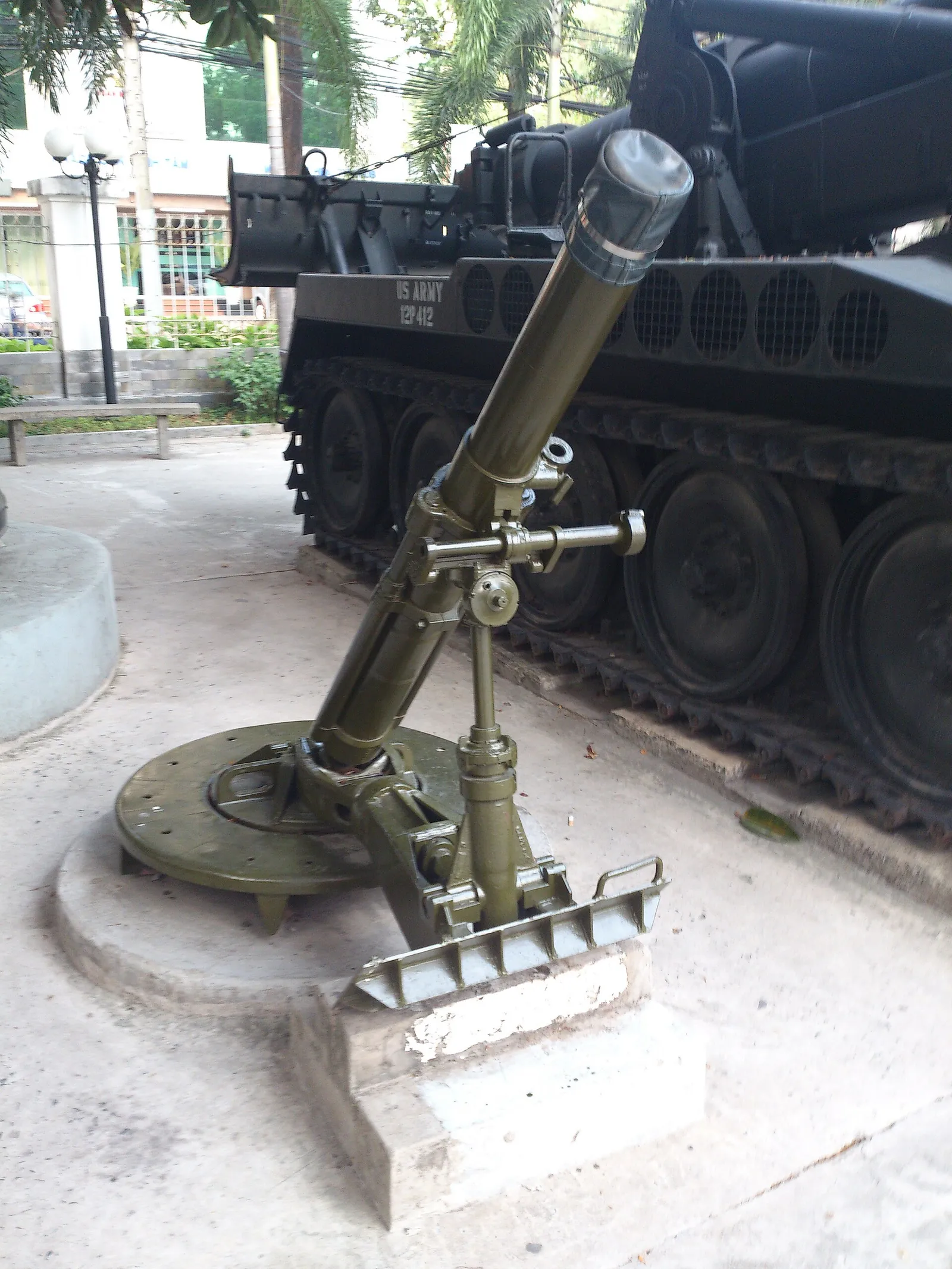
Museum and Korean War photo-caption sources identify American troops using the M30 4.2-inch mortar during the Korean War, including a U.S. 2d Infantry Division heavy mortar company firing an M30 near Yanggu in August 1951.
Artillery
M30 107 mm mortar
Also known as
- 107mm M30
- 107 mm M30
- M30 mortar
- M30 4.2-inch mortar
- 4.2-inch mortar M30
- Four-Deuce
- M-30 107mm heavy mortar
The M30 is a U.S. 107 mm / 4.2-inch rifled heavy mortar adopted after the M2 chemical-mortar lineage to give infantry units longer-range high-angle fire. It was much heavier than the earlier M2, so sources commonly connect it with prepared ground positions, the M106 tracked mortar carrier, and Marine Corps 4.2-inch mortar batteries; direct-source coverage now documents U.S. Korean War and Vietnam War fire-support use.
Role in Conflicts
- Side
- United States and South Vietnam


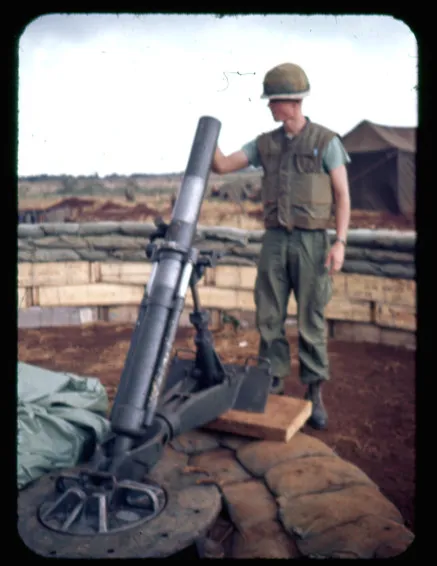
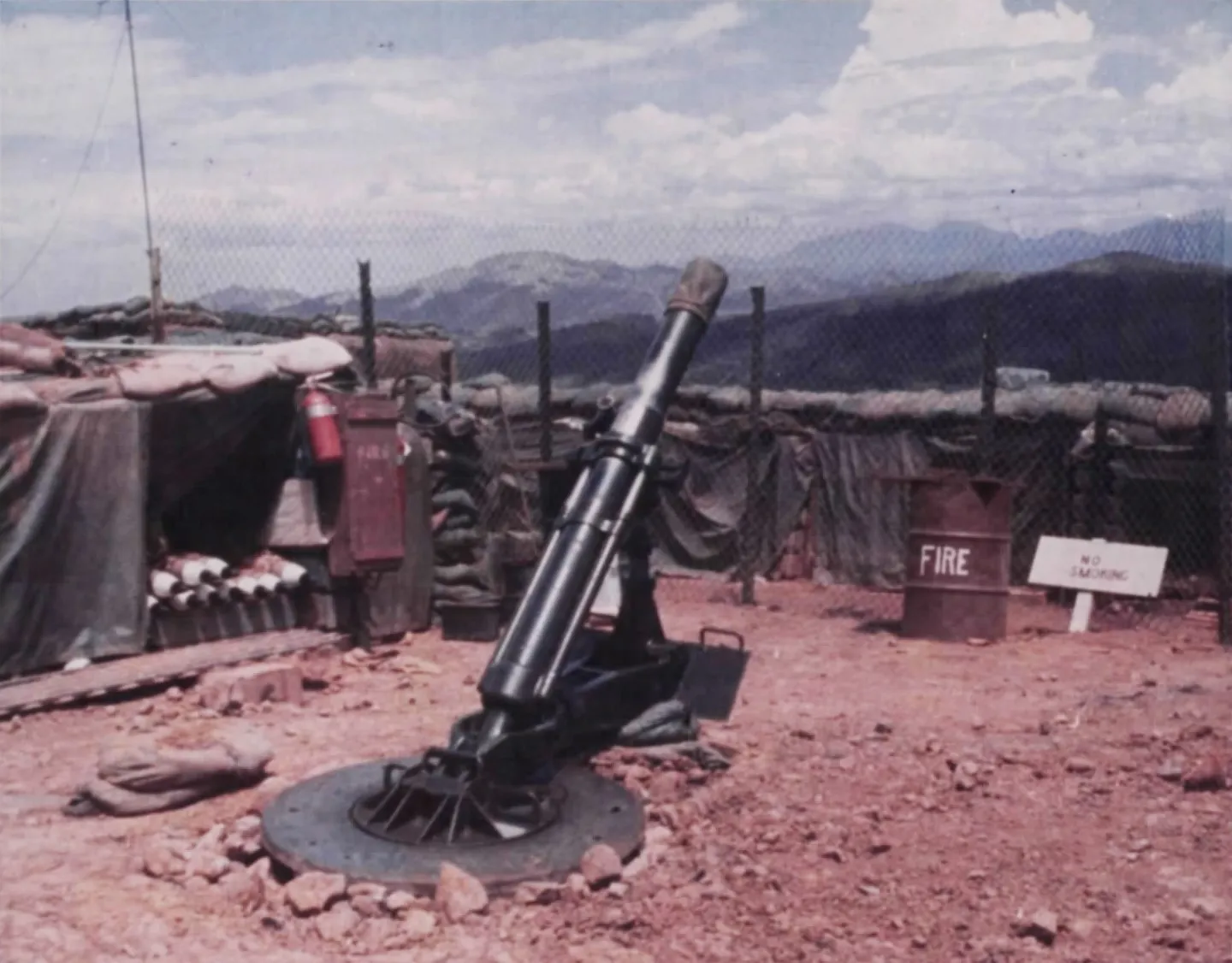
Official Marine Corps histories identify the 107 mm M30 / 4.2-inch mortar as division-level light artillery providing direct support to infantry units in I Corps, and describe Marine 4.2-inch mortar batteries repulsing attacks during 1967 operations.
Profile / Specs
Profile
- Origin
- United States
- Built by
- U.S. government production
- Type
- Rifled 107 mm heavy mortar
- Service note
- Cold War service from 1951, with later reserve, export, and vehicle-mounted use
- Designer
- U.S. Army ordnance and chemical-mortar lineage
- Designed
- Early Cold War; entered U.S. Army service in 1951
- Produced
- 1950s Cold War production; no longer in U.S. active-duty production
- Developed from
- 107 mm M2 Chemical Mortar
Specifications
- Caliber
- 106.7 mm / 4.2 in, commonly rounded to 107 mm
- Configuration
- Rifled, muzzle-loaded, high-angle indirect-fire mortar
- Complete weight
- 672.25 lb / about 305 kg with welded steel rotator and M53 sight in FM 23-90 data
- Cannon weight
- 156.5 lb for the M30 cannon in FM 23-90 tabulated data
- Crew portability
- Can be hand-carried for short distances when disassembled into five loads
- Maximum range
- About 6.8 km with high-explosive shells in Weaponsystems.net data; FM 23-90 lists 7,200 m for later M933/M934 HE cartridges
- Rate of fire
- 18 rounds per minute for the first minute, 9 rpm for the next five minutes, then 3 rpm sustained with M329A2 ammunition
- Ammunition
- High-explosive, smoke/white phosphorus, illumination, and subcaliber training ammunition
Design And Firing System
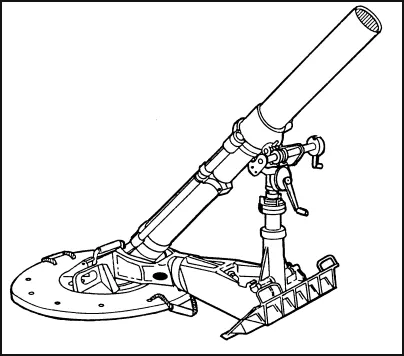
The M30 combined a rifled 4.2-inch barrel with a muzzle-loading mortar workflow. Its ammunition used an expanding ring to take the rifling after firing, giving spin-stabilized high-angle fire but adding drift and gunnery considerations that smoothbore mortar crews did not handle in the same way.
Rifled mortar
FM 23-90 describes the M30 as a rifled, muzzle-loaded weapon for high-angle indirect fire.
Heavy ground mount
The complete system weighed about 672 lb with welded steel rotator and M53 sight, making ground emplacement slow compared with lighter mortars.
Carrier use
Because of that weight, references commonly connect the weapon to M106/M106A1 tracked mortar carriers based on the M113 family.
Ammunition roles
Sources identify high-explosive, white-phosphorus smoke, illumination, and training/subcaliber ammunition paths for the 4.2-inch system.
Variants
The M30 kept the U.S. 4.2-inch rifled-mortar concept but was a heavier, longer-ranged successor to the M2. Vehicle-mounted use is covered in the carrier relationship section, while the Marine Corps M98 howtar is retained here as an M30-related carriage adaptation.
| Variant | Configuration | Designation notes |
|---|---|---|
 | Earlier 4.2-inch rifled mortar | UDC describes the M30 as the 1951 U.S. Army replacement for the earlier M2 mortar, with greater range but substantially greater system weight. Sources: Ultra Defense M30 107mm Mortar |
| M98 howtar | Marine Corps carriage adaptation | Marine Corps and reference material identify the M98 howtar as a 107 mm mortar arrangement associated with Marine Vietnam-era artillery; this record treats it as an M30-related configuration rather than a separate public entry. Sources: USMC An Expanding War 1966, Ultra Defense M30 107mm Mortar |
Carrier Platforms
The M30's weight made vehicle-mounted use important in mechanized units and later service contexts.
| Carrier | Carrier type | Carriage evidence |
|---|---|---|
 | Tracked mortar carrier | The M106A2 manual identifies the carrier as a platform for the 4.2-inch / 107 mm M30 mortar, with firing from the carrier turntable or from a portable off-vehicle mount. Sources: TM 9-2350-261-10 M106A2 carrier |
Timeline
M30 107 mm mortar Key Events
M30 enters U.S. service
UDC describes the M30 as entering U.S. Army service in 1951 as the M2 mortar replacement, trading higher range for much greater weight.
Sources: Ultra Defense M30 107mm Mortar
M30 fire support photographed in Korea
Korean War Online captions a U.S. 2d Infantry Division heavy mortar company firing an M30 4.2-inch mortar near Yanggu, Korea.
Sources: Korean War Online M30 mortar
Marine Corps M30 fire-support role documented in Vietnam
The Marine Corps 1967 history identifies the 4.2-inch mortar or 107 mm M30 as division-level light artillery that provided direct support to infantry units in I Corps.
Sources: USMC Fighting the North Vietnamese 1967
Army replacement program recorded
The Army's fiscal year 1987 historical summary states that the 120 mm mortar program was fielded to replace the obsolete M30 4.2-inch mortar system.
Sources: Department of the Army Historical Summary FY 1987
M30 photographed during Operation Joint Endeavor
A released NARA/DVIDS photograph shows U.S. soldiers adjusting an M-30 107 mm heavy mortar during a live-fire exercise at Glamoc, Bosnia-Herzegovina, in support of Operation Joint Endeavor.
Sources: NARA Joint Endeavor M30 image
Media
M30 107 mm mortar Videos
Related Weapon Systems


Sources
FM 23-90 MortarsPublisher: U.S. Marine Corps | Note: Supports M30 configuration, component weights, five-load disassembly, firing-rate data, carrier firing-table references, and later 4.2-inch ammunition range data. | Accessed: 2026-07-13TM 9-2350-261-10 M106A2 carrierPublisher: Department of the Army / Integrated Publishing mirror | Note: Supports the M106A2 carrier relationship by identifying the 4.2-inch / 107 mm M30 mortar as the carrier's mortar and describing turntable or ground-baseplate firing. | Accessed: 2026-07-13107mm M30Publisher: Weaponsystems.net | Note: Supports M30 identity, 107 mm / 4.2-inch caliber, high-explosive and smoke/illumination range bands, rate-of-fire summary, heavy ground-emplacement context, and M106 carrier background. | Accessed: 2026-07-13Ultra Defense M30 107mm MortarPublisher: Ultra Defense Corp | Note: Supports M30 background as a 1951 U.S. Army replacement for the M2 mortar, its rifled muzzle-loading design, M113-family carrier context, and complete-system weight. | Accessed: 2026-07-13RCA Museum M30 mortarPublisher: The Royal Canadian Artillery Museum | Note: Supports Korean War direct-use context by stating that American troops used the M30 during the Korean War before Canadian Army M30 service. | Accessed: 2026-07-13Korean War Online M30 mortarPublisher: Korean War Online | Note: Supports Korean War direct use by captioning a U.S. 2d Infantry Division heavy mortar company firing an M30 4.2-inch mortar near Yanggu, Korea, on August 13, 1951. | Accessed: 2026-07-13USMC Fighting the North Vietnamese 1967Publisher: History and Museums Division, Headquarters, U.S. Marine Corps | Note: Supports 1955 Vietnam War direct use by identifying the 4.2-inch mortar / 107 mm M30 as Marine division-level light artillery providing direct support to infantry units in I Corps. | Accessed: 2026-07-13USMC An Expanding War 1966Publisher: History and Museums Division, Headquarters, U.S. Marine Corps | Note: Supports Vietnam-era M30 identity, U.S.-built attribution, and specifications by defining the 4.2-inch M30 as a U.S.-built rifled, muzzle-loaded, drop-fired mortar with tube, baseplate, and standard, and by indexing 107 mm howtar context. | Accessed: 2026-07-13USMC High Mobility and Standown 1969Publisher: History and Museums Division, Headquarters, U.S. Marine Corps | Note: Supports continued Vietnam-era Marine Corps M30 identity and specification context for the 4.2-inch M30. | Accessed: 2026-07-13Department of the Army Historical Summary FY 1987Publisher: U.S. Army Center of Military History | Note: Supports U.S. Army replacement context by stating that the 120 mm mortar program was fielded to replace the obsolete M30 4.2-inch mortar system. | Accessed: 2026-07-13Wikimedia Commons M30 mortar categoryPublisher: Wikimedia Commons | Note: Supports M30 category identity and helps verify that selected gallery images depict 4.2-inch Mortar M30 media. | Accessed: 2026-07-13M30 mortar at the War Remnants Museum imagePublisher: Wikimedia Commons | Note: Supports primary image provenance for a CC BY-SA 3.0 photograph of an M30 mortar at the War Remnants Museum. | Accessed: 2026-07-13Mortar Khe Sanh 1966 imagePublisher: Wikimedia Commons | Note: Supports gallery image provenance for an official USMC Archives photograph from Khe Sanh in 1966, licensed CC BY 2.0 on Commons. | Accessed: 2026-07-134.2 inch mortar at Firebase Center imagePublisher: Wikimedia Commons | Note: Supports gallery image provenance for a public-domain U.S. Army photograph of a 4.2-inch mortar at Firebase Center in Vietnam in 1970. | Accessed: 2026-07-13M30 mortar schematic imagePublisher: Wikimedia Commons | Note: Supports gallery image provenance for a public-domain U.S. Army field-manual schematic of the M30 4.2-inch mortar. | Accessed: 2026-07-13NARA Joint Endeavor M30 imagePublisher: NARA and DVIDS Public Domain Archives / GetArchive | Note: Supports post-Vietnam service-context timeline by documenting a released public photograph of soldiers adjusting an M-30 107 mm heavy mortar during an Operation Joint Endeavor live-fire exercise in Bosnia-Herzegovina. | Accessed: 2026-07-13