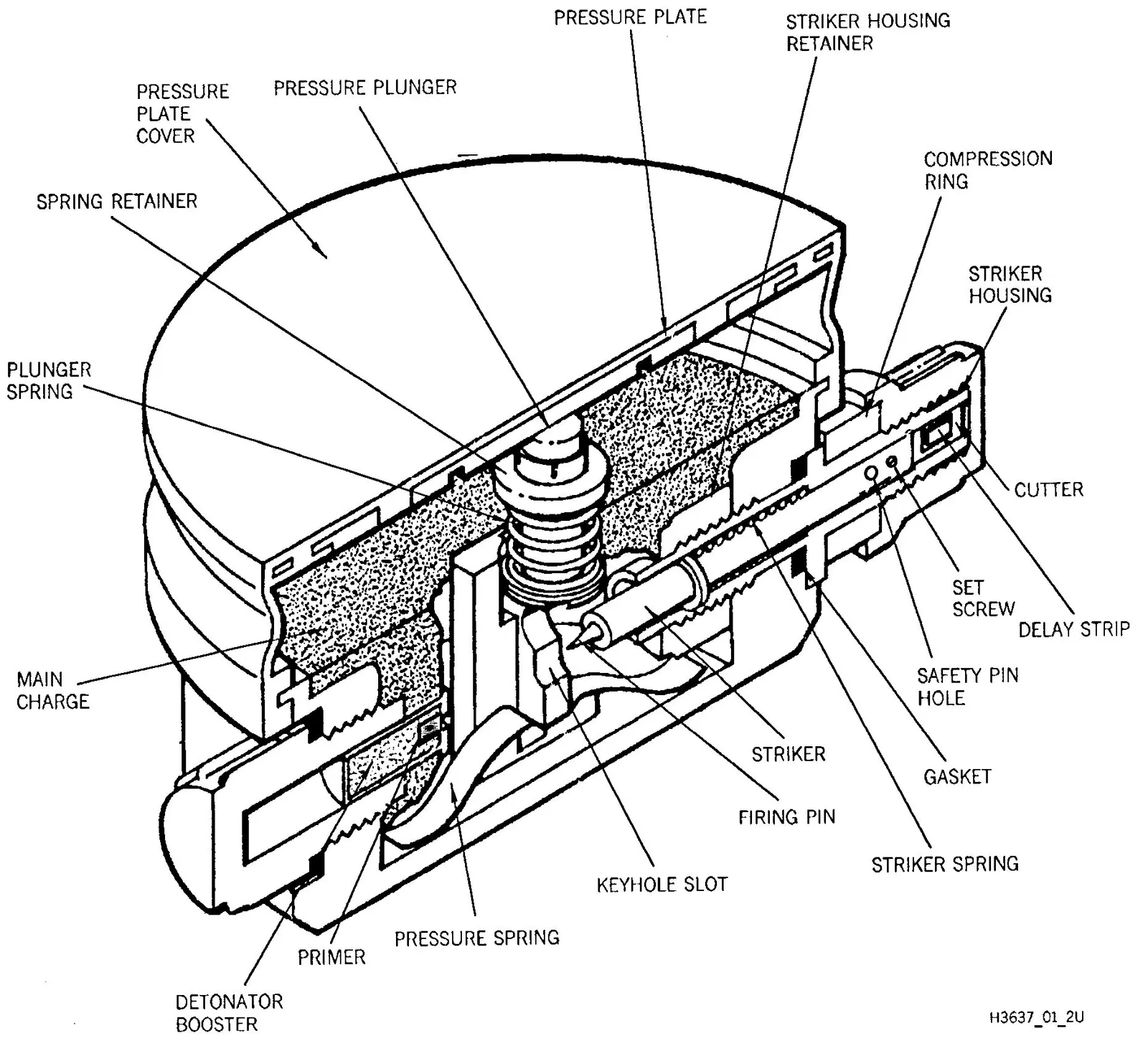

Human Rights Watch documented GYATA-64 antipersonnel mines cleared from Bab al-Mandeb in 2015 and Aden in 2017 after Houthi-aligned forces withdrew from those areas.
Munitions
GYATA-64 antipersonnel mine
Also known as
- GYATA-64
- GYATA 64
- Hungarian GYATA-64 mine
The GYATA-64 is a Hungarian pressure-operated antipersonnel blast mine made by Mechanikai Művek and later destroyed from Hungarian stockpiles under Mine Ban Treaty reporting. Human Rights Watch documented GYATA-64 mines cleared from Yemen during the 2014 Yemen Civil War, including examples associated with Houthi-aligned withdrawals from Bab al-Mandeb and Aden.
Role in Conflicts
Profile / Specs
Profile
- Origin
- Hungary
- Built by
- Mechanikai Művek
- Type
- Pressure-operated antipersonnel blast mine
- Produced
- Produced before Hungary reported ending antipersonnel-mine production and export in 1995
Specifications
- Mine class
- Pressure-operated antipersonnel blast mine
- Country of manufacture
- Hungary
- Explosive charge
- 300 g TNT
- Body
- Brown plastic/bakelite body with black rubber pressure cap
- Dimensions
- 106 mm diameter; 61 mm height
- Weight
- 520 g
- Detectability
- Contains enough metal to be easily detected
- Design comparison
- Similar in design and appearance to the Russian PMN
- Estimated hazard radius
- 10 m
- Treaty status
- Hungary reported ending antipersonnel-mine production and export in 1995 and completed stockpile destruction in June 1999
Design And Stockpile Context
The GYATA-64 belongs to the pressure-fired antipersonnel blast-mine class. Public ordnance references describe a brown body, black pressure plate, side plugs, and a large TNT charge for a small victim-activated mine.
Construction
Brown plastic or bakelite body with a black rubber pressure cap and side-mounted striker and detonator plugs.
Hungarian stockpile
Landmine Monitor reported that Hungary ended antipersonnel-mine production and export in 1995 and completed stockpile destruction in June 1999.
Yemen evidence
Human Rights Watch documented cleared GYATA-64 mines in Yemen in 2015 and 2017, tying the type to Houthi-aligned mine use in the civil war.
Variants
Public ordnance references compare the Hungarian GYATA-64 with the Soviet/Russian PMN antipersonnel blast-mine family, but the catalog keeps the Hungarian mine as a separate national design.
| Variant | Configuration | Designation notes |
|---|---|---|
 | Related pressure-operated antipersonnel blast-mine family | JMU CISR and Landmine Monitor describe the GYATA-64 as similar in design or appearance to the PMN family while distinguishing it as a Hungarian-produced mine. Sources: JMU CISR Munitions Reference Guide - GYATA-64, The Monitor Hungary Mine Ban Policy |
Timeline
GYATA-64 antipersonnel mine Key Events
Hungary reports AP mine production ended
Landmine Monitor says Hungary informed the United Nations in 1995 that it no longer produced or exported antipersonnel mines.
Hungarian stockpile destruction
Landmine Monitor reports that Hungary destroyed its antipersonnel-mine stockpile in 1998 and 1999, including GYATA-64 mines identified in Article 7 reporting and Mechanical Works destruction accounts.
GYATA-64 mines cleared near Bab al-Mandeb
Human Rights Watch published evidence of GYATA-64 antipersonnel mines cleared from Bab al-Mandeb in Taizz governorate during the Yemen war.
Aden clearance documented
Human Rights Watch showed GYATA-64 antipersonnel mines cleared by YEMAC from Aden city and nearby suburbs after Houthi-Saleh forces withdrew.
Related Weapon Systems


Sources
Landmine Monitor Report 2000 - HungaryPublisher: Human Rights Watch / International Campaign to Ban Landmines | Note: Supports Hungarian Mechanical Works/Magyar Mechanikai Művek as Hungary's long-running sole antipersonnel-mine producer, GYATA-64 as one of its listed products, the 1995 production/export end statement, and 1998-1999 stockpile-destruction context. | Accessed: 2026-07-13The Monitor Hungary Mine Ban PolicyPublisher: Landmine and Cluster Munition Monitor | Note: Supports Hungary's former antipersonnel-mine producer/exporter status, state-facility production of the GYATA-64 blast mine, PMN similarity, and 1998-1999 stockpile destruction. | Accessed: 2026-07-13JMU CISR Munitions Reference Guide - GYATA-64Publisher: James Madison University Center for International Stabilization and Recovery | Note: Supports pressure-operated antipersonnel blast mine classification, PMN design similarity, detectability, dimensions, weight, TNT charge, and hazard-radius reference value. | Accessed: 2026-07-13HRW Yemen New Houthi Landmine UsePublisher: Human Rights Watch | Note: Supports 2014 Yemen Civil War direct-use context: documents Houthi forces using antipersonnel landmines and identifies GYATA-64 mines cleared by deminers from Bab al-Mandeb in Taizz governorate in October 2015. | Accessed: 2026-07-13HRW Yemen Houthi-Saleh Forces Using LandminesPublisher: Human Rights Watch | Note: Supports 2014 Yemen Civil War direct-use context: reports Houthi-Saleh antipersonnel landmine use since the 2015 coalition intervention and identifies GYATA-64 mines cleared by YEMAC from Aden after Houthi-Saleh withdrawal. | Accessed: 2026-07-13The Monitor Yemen Mine Ban PolicyPublisher: Landmine and Cluster Munition Monitor | Note: Supports Yemen Mine Ban Treaty context, stockpile-destruction caveats, and the broader record of Gyata-64 mines used in Yemen. | Accessed: 2026-07-13GYATA-64Publisher: METIS by Fenix Insight | Note: Supports Hungarian manufacture and pressure-operated antipersonnel blast mine classification. | Accessed: 2026-07-13GYATA-64 minePublisher: Wikipedia | Note: Provides open reference context for dimensions, weight, explosive charge, visible construction, and comparison to the PMN mine; used only as corroborating technical context. | Accessed: 2026-07-13GYATA-64 cutawayPublisher: Wikimedia Commons | Note: Supports public-domain image provenance for the GYATA-64 cutaway drawing, credited to the U.S. Army as a U.S. military work. | Accessed: 2026-07-13Landmine, APERS, Gyata-64Publisher: Ordnance, Explosives, and Related Items | Note: Supports pressure-fired antipersonnel mine description and visible body/pressure-plate details. | Accessed: 2026-07-13