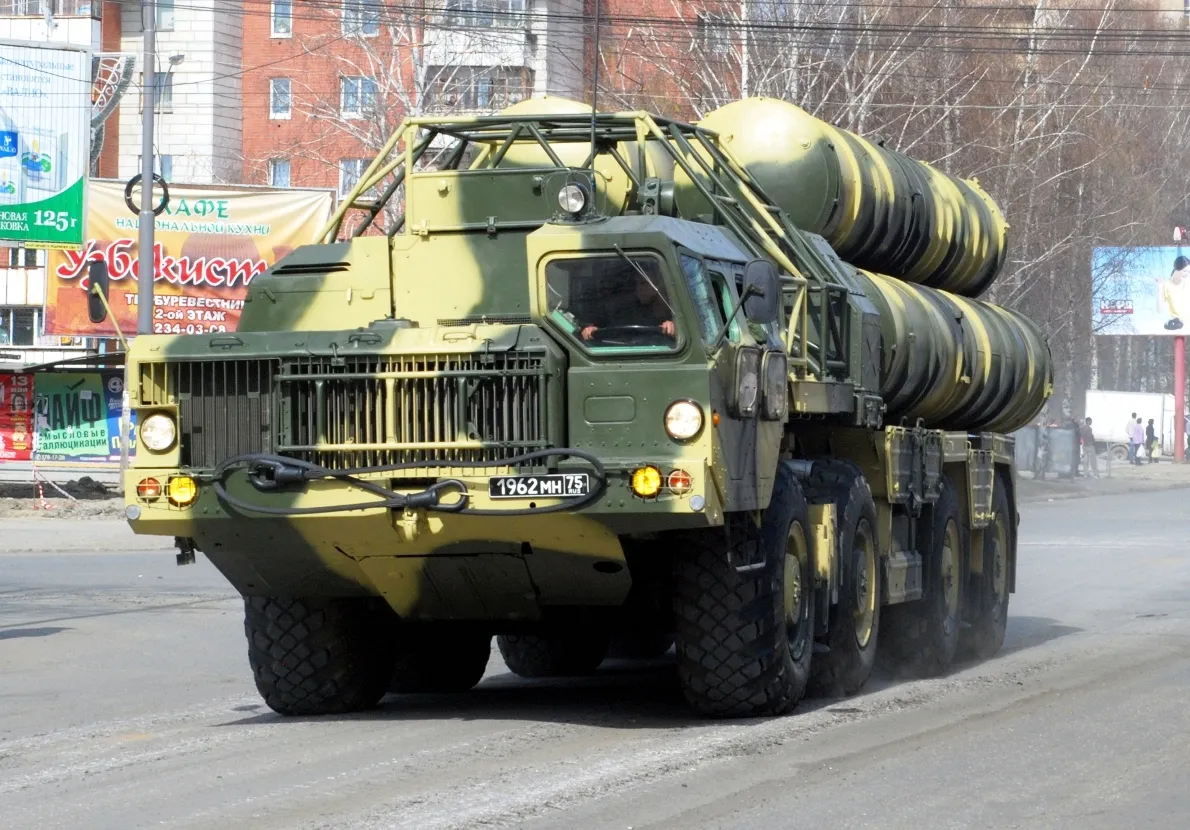
- Side
- Ukraine

Oryx's Ukrainian equipment-loss list separately records two 5P85D launchers for S-300PS during Russia's full-scale invasion, one destroyed and one captured.
Role detailsThe 5P85D is a Soviet road-mobile transporter-erector-launcher associated with S-300PS and early S-300PMU air-defense batteries. It is the additional slave launcher in a 5P85SD launcher group, normally controlled by a 5P85S master TEL, carries four S-300 missile canisters on a MAZ-543M-family 8x8 chassis, and has been separately identified in Ukrainian and Armenian/Artsakh visual-loss records.
Oryx's Ukrainian equipment-loss list separately records two 5P85D launchers for S-300PS during Russia's full-scale invasion, one destroyed and one captured.
Role detailsOryx's 2020 Nagorno-Karabakh loss list records an Armenian 5P85D launcher for S-300PS destroyed by a loitering munition during the fighting.
Open sources describe 5P85D as part of the 5P85 launcher family rather than a standalone missile system. The key distinction is command autonomy: S-series TELs carried the master electronics, while D-series launchers depended on a master vehicle.
| Variant | Configuration | Designation notes |
|---|---|---|
 | Master TEL | The 5P85S carried control logic and datalink equipment for the 5P85SD launcher group, normally controlling paired 5P85D launchers. Sources: Air Power Australia S-300P TEL Vehicles, Army Recognition 5P85S |
| 5P85T / 5P85TE | Towed launcher line | The towed branch provided trailer launchers for S-300PMU family systems, separate from the self-propelled 5P85S/D launcher group. |
| 5P85SE | Later autonomous TEL | Later self-propelled export launchers moved toward autonomous TEL electronics instead of the master-slave arrangement used by the 5P85S and 5P85D group. |
The launcher is useful as a catalog component because its role is defined by the S-300PS battery rather than by independent fire-control or conflict-use reporting.
| Compatible item | Item type | Compatibility evidence |
|---|---|---|
 | Long-range surface-to-air missile system | The 5P85D works inside S-300PS / early S-300PMU launcher groups, normally as an additional TEL controlled by a 5P85S master launcher and associated fire-control radar. Sources: Army Recognition 5P85D, Missilery S-300PS |
| Master S-300PS launcher | The 5P85D depends on the 5P85S master launcher in the 5P85SD group; sources describe the master launcher as the vehicle carrying the control equipment for up to two 5P85D launchers. Sources: Air Power Australia S-300P TEL Vehicles, Army Recognition 5P85S |
 | S-300PS engagement radar | S-300PS battery references place the 5N63S/30N6 Flap Lid B engagement radar in the same fire-unit architecture as the 5P85S and 5P85D launchers. Sources: Army Recognition S-300PS, Missilery S-300PS |
The 5P85D should be read as a launcher component within an S-300PS fire unit, not as a self-contained air-defense system. Sources distinguish it from the 5P85S master launcher by the missing equipment cabin behind the driver's compartment and by its dependence on the master TEL for control, while visual-loss records identify exact 5P85D launchers in Ukraine and Nagorno-Karabakh.
The 5P85SD launcher complex is described with one 5P85S master launcher and up to two additional 5P85D launchers.
Four containerized 5V55-series missiles, one per launch canister.
The 5P85D is controlled through the F3S preparation-and-launch container on the 5P85S master launcher.
Sources: Army Recognition 5P85D; Missilery S-300PS; Air Power Australia S-300P TEL Vehicles; Oryx Ukrainian Equipment Losses; Oryx Nagorno-Karabakh Losses.
S-300P development began under Almaz Central Design Bureau, creating the air-defense family for which 5P85-series launchers later served as mobile TELs.
Sources: CSIS S-300
CSIS places S-300P operational service entry in 1978; later S-300PS mobility improvements produced the 5P85S and 5P85D launcher group.
Sources: CSIS S-300, Air Power Australia S-300P TEL Vehicles
Open references describe the S-300PS generation as the point where road-mobile 5P85S master and 5P85D additional TELs became central to the launcher-complex layout.
Sources: Missilery S-300PS, Air Power Australia S-300P TEL Vehicles
Oryx's Armenian/Artsakh loss list for the 2020 fighting separately records one 5P85D launcher for S-300PS destroyed by a loitering munition.
Sources: Oryx Nagorno-Karabakh Losses
Oryx's Ukrainian equipment-loss list for Russia's full-scale invasion separately records two 5P85D launchers for S-300PS, one destroyed and one captured.
Sources: Oryx Ukrainian Equipment Losses


