Aircraft & UAVs

30 mm ADEN cannon

Also known as
  • ADEN
  • Aden cannon
  • ADEN Mk 4

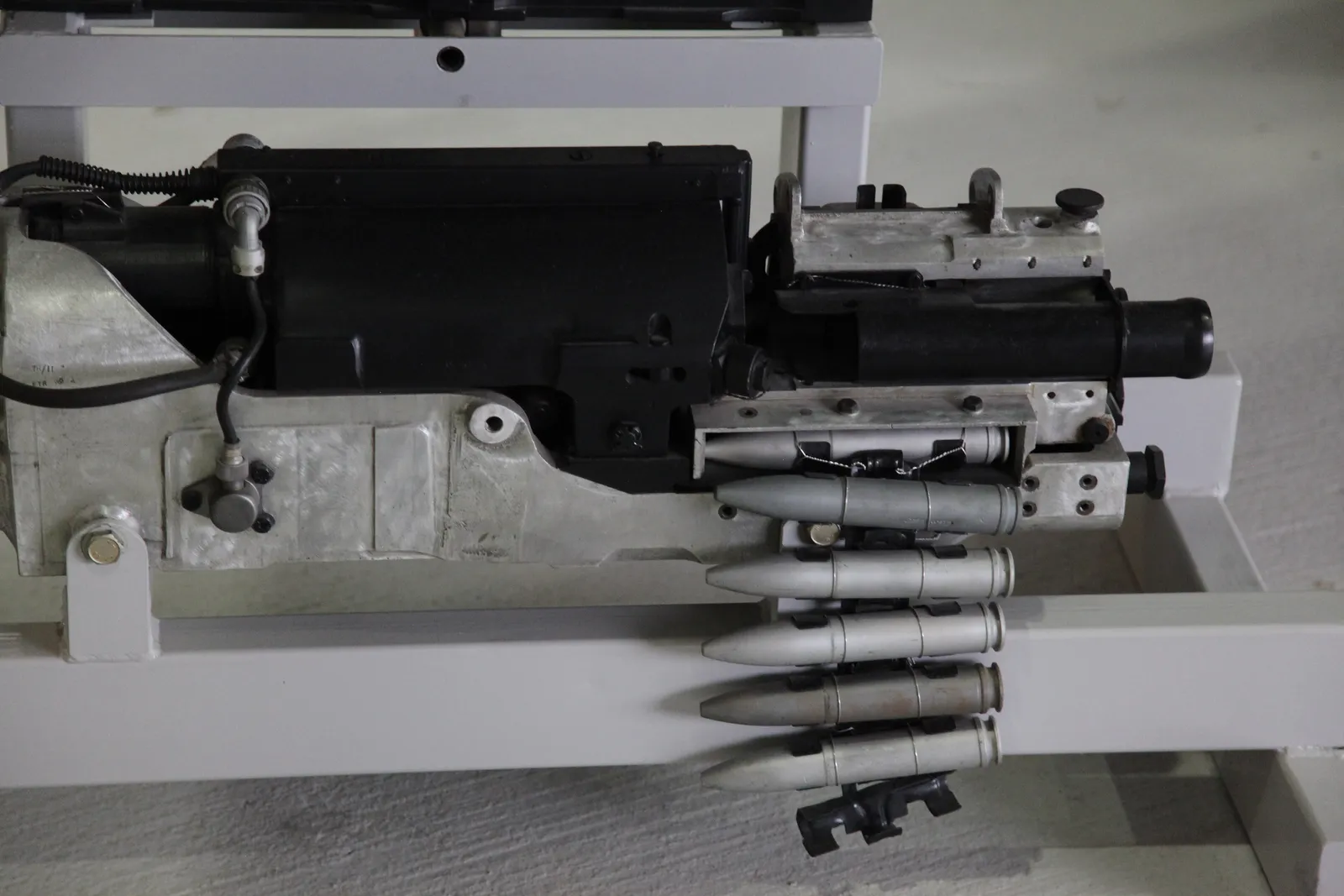
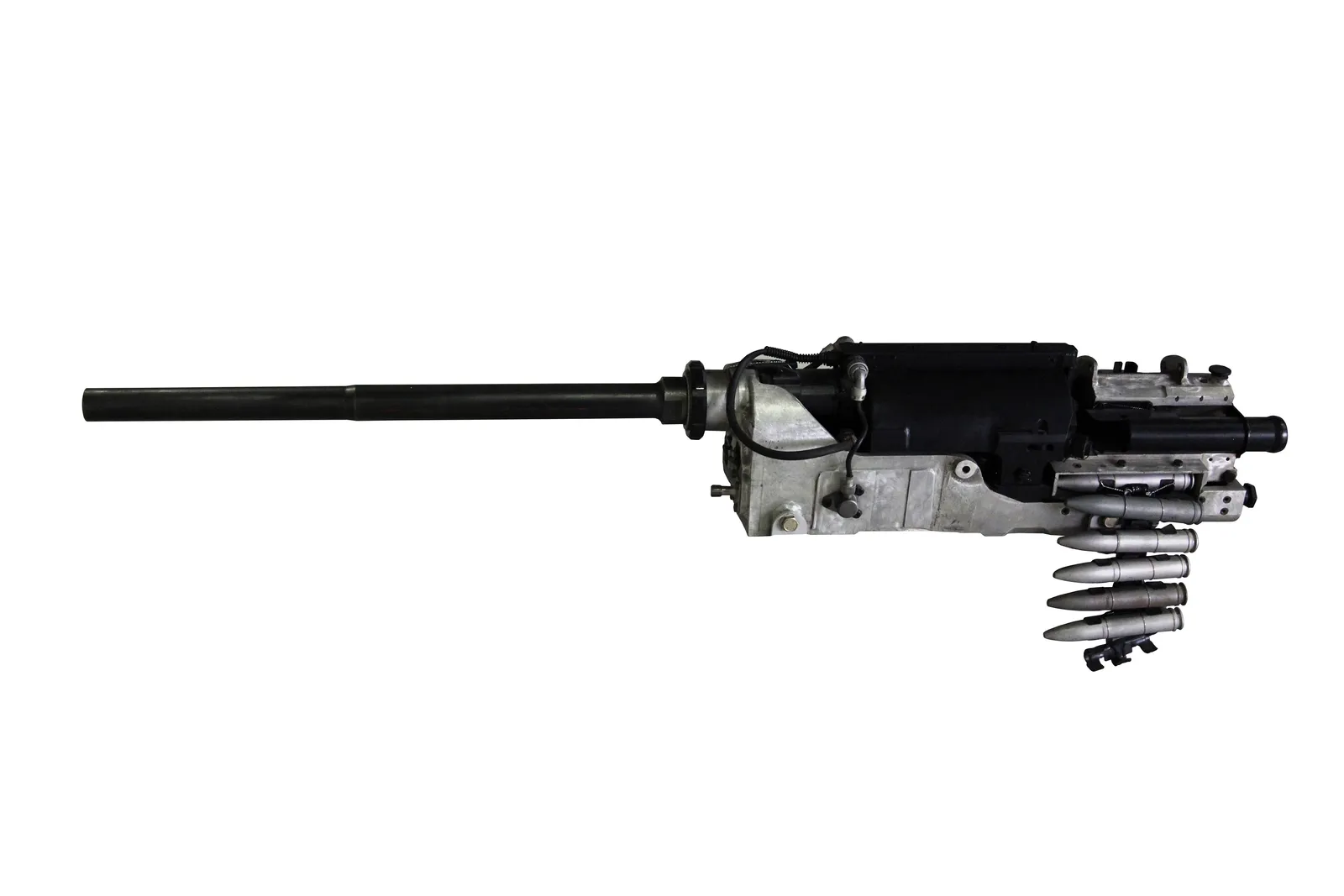
The 30 mm ADEN cannon is a British aircraft revolver cannon developed from the German MG 213 concept and built by Royal Small Arms Factory in Enfield. Museum, military, and specialist records tie the gun to post-war British fighters, Falklands War Harrier operations, Indian Hunter cannon attacks in 1971, and later Hawk 127 gunpod use.

Role in Conflicts

Side
India

Times of India reporting on an IAF Longewala history describes the first Indian Hunter pair at Longewala as loaded with T-10 rockets and 30 mm ADEN guns; Bharat Rakshak's battle account describes Hunter rocket passes followed by 30 mm cannon attacks against Pakistani armor.

Side
United Kingdom

Sea Harriers in Operation Corporate carried twin 30 mm ADEN cannon, and Royal Navy reporting credits a 1 June 1982 Argentine C-130 kill to Sidewinder and cannon fire; IWM also identifies an ADEN Mk4 removed from a Harrier GR3 that saw action in the conflict.

Profile / Specs

Profile

Origin
United Kingdom
Type
30 mm aircraft cannon
Service note
Post-World War II / Cold War
Unit cost
US$111,420 (reported, 2015 dollars for the ADEN Mk 4)

Specifications

Caliber
30 mm
Cartridge
30x113 mm
Weight
87 kg cannon weight; 158 kg with 130 rounds
Overall length
1,590 mm
Barrel length
1,080 mm
Action
Gas-operated revolver cannon
Feed
Rotary feed mechanism
Firing system
Electrical firing
Rate of fire
1,200-1,400 rounds per minute
Muzzle velocity
790 m/s
Ammunition
30x113 mm HEI, HEIT, AP, TP, TPT, and APT types listed by AEI
Installation And Ammunition

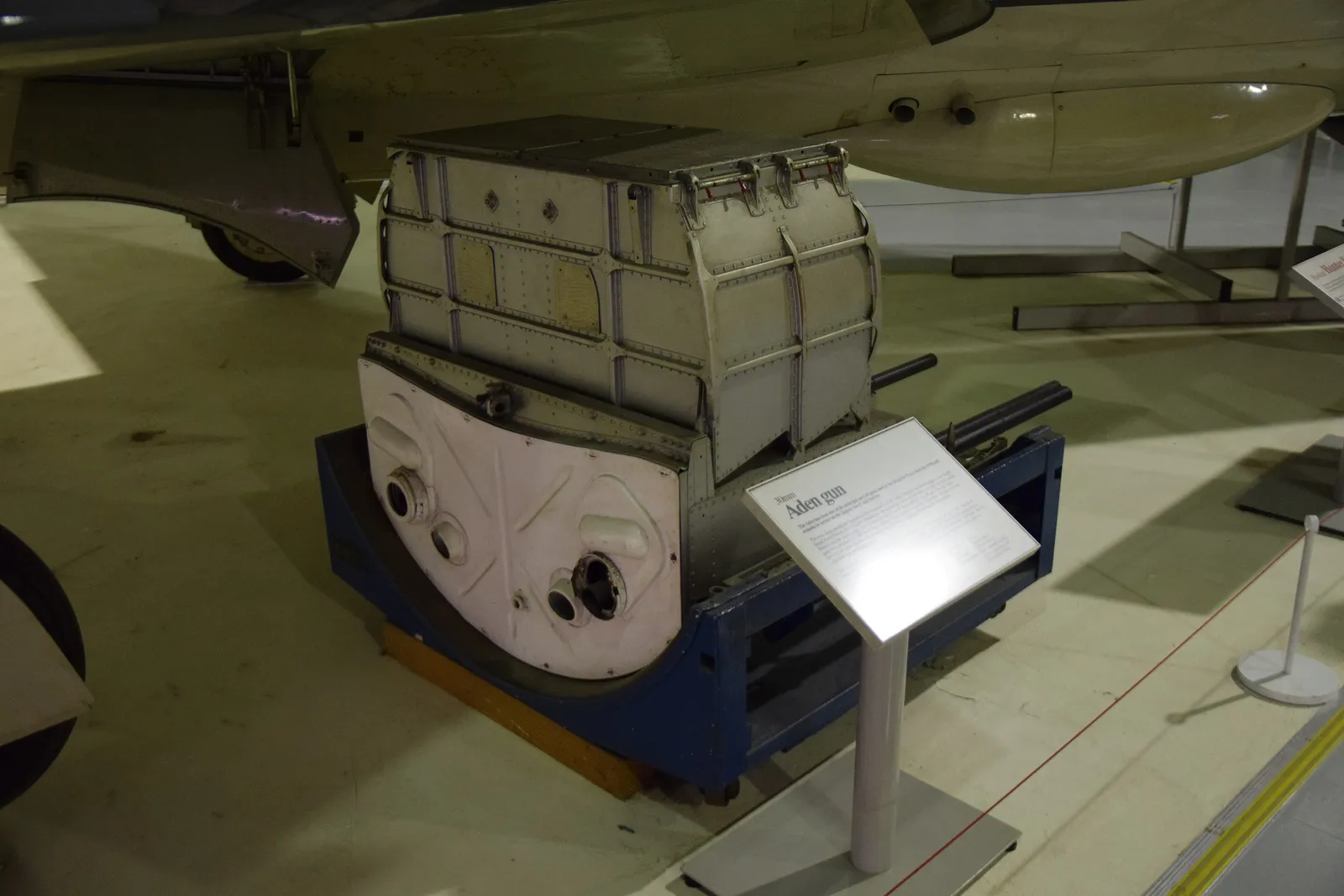
AEI's ADEN 30 mm data sheet describes the gun as a compact self-powered revolver cannon suited to under-slung pods, under-fuselage blisters, or internal fuselage mounting. It also notes left- and right-hand feed options, which explains why the same gun family appears both as built-in aircraft armament and as podded Harrier or Hawk equipment.

Cartridge family

30x113 mm ADEN ammunition.

AEI lists high-explosive incendiary, tracer, armour-piercing, practice, and armour-piercing tracer types.

Mounting options

Under-slung pod, under-fuselage blister, or internal fuselage mounting.

The data sheet says the gun can be mounted around the longitudinal axis to suit aircraft installation requirements.
Variants

ADEN records distinguish the production 30 mm Mk 4 family from the later ADEN 25 attempt to adapt the design to 25x137 mm NATO ammunition.

VariantConfigurationDesignation notes
ADEN Mk 430 mm production standard

Forecast International treats the Mk 4 as the production-standard 30 mm ADEN cannon and lists it across aircraft including Harrier, Sea Harrier, Hunter, Hawk, Jaguar, Lightning, and Gnat applications; IWM identifies its Aden Mk4 object as a standard 30 mm Aden cannon.

Sources: ARCHIVED REPORT ADEN Aircraft Cannon - Forecast International, Aden Mk4 - Imperial War Museums

ADEN Mk 5 / Mk 6Later 30 mm marks

AEI groups Mk4, Mk5, and Mk6 under its 30 mm ADEN product line, but the available sheet does not separate feature changes between the later marks.

Sources: ADEN 30 mm Cannon - AEI Systems

ADEN 2525 mm derivative

The ADEN 25 used 25x137 mm NATO ammunition and was selected for the Harrier GR Mk 5, but Forecast International says integration problems led the Ministry of Defence to remove it from Harrier GR Mk 5 and Mk 7 aircraft in 1999.

Sources: ARCHIVED REPORT ADEN Aircraft Cannon - Forecast International

Carrier Aircraft

ADEN carrier documentation includes built-in fighter installations and podded carriage on trainer or strike aircraft.

CarrierCarrier typeCarriage evidence
Harrier GR3, Strike aircraft, Aircraft & UAVsHarrier GR3V/STOL strike aircraft

IWM identifies its Aden Mk4 as a standard 30 mm Aden cannon removed from the museum's Harrier GR3.

Sources: Aden Mk4 - Imperial War Museums

BAE Hawk, Advanced jet trainer and light attack aircraft family, Aircraft & UAVsBAE HawkLead-in fighter trainer

The Hawk 127 armament table lists one 30 mm Aden cannon, and ADM says the cannon can be installed in a gunpod on the centreline station.

Sources: A27 – BAE Systems Hawk – pp518-521, Maintenance upgrade ahead for Hawk 127 Lead in Fighter - ADM September 2013

SEPECAT Jaguar, Supersonic jet attack aircraft, Aircraft & UAVsSEPECAT JaguarStrike and reconnaissance aircraft

RAF Museum Jaguar GR1 display text lists the aircraft armament as two 30 mm Aden guns.

Sources: SEPECAT Jaguar GR1 - RAF Museum Age of Uncertainty

Timeline

30 mm ADEN cannon Key Events

  1. First major Hawker Hunter application

    Forecast International places Royal Ordnance's first major ADEN application for the Hawker Hunter in 1950.

    Sources: ARCHIVED REPORT ADEN Aircraft Cannon - Forecast International

  2. Air Ministry instructional film produced

    IWM records an Air Ministry-sponsored 16 mm instructional film explaining the ADEN 30 mm aircraft gun's gas action, electrical firing, and 1,200-1,400 rounds-per-minute rate of fire.

    Sources: THE ADEN 30MM GUN [Main Title] - Imperial War Museums

  3. ADEN 25 selected for Harrier GR Mk 5

    The British Ministry of Defence selected the ADEN 25 as the primary armament for the Harrier GR Mk 5.

    Sources: ARCHIVED REPORT ADEN Aircraft Cannon - Forecast International

  4. ADEN 25 removed from Harrier GR Mk 5 and Mk 7

    Forecast International reports that unresolved pod and integration problems led the Ministry of Defence to remove ADEN 25 cannon from Harrier GR Mk 5 and Mk 7 aircraft.

    Sources: ARCHIVED REPORT ADEN Aircraft Cannon - Forecast International

  5. Hawk 127 enters RAAF service with ADEN armament

    The RAAF Hawk 127 history states that the type was formally taken into RAAF service in November 2000 and lists one 30 mm Aden cannon in its armament table.

    Sources: A27 – BAE Systems Hawk – pp518-521

Media
Related Weapon Systems
2A72 30 mm automatic cannon, 30 mm dual-feed automatic cannon, ArtilleryArtillery2A72 30 mm automatic cannon30 mm dual-feed automatic cannonThe 2A72 is a Russian 30x165 mm dual-feed automatic cannon designed by KBP Instrument Design Bureau and manufactured by Tulamashzavod Joint Stock Company. It is a lighter, recoil-operated 2A42-family gun used as a coaxial cannon on BMP-3 and BMD-4M-type turrets and as the main weapon on 30 mm BTR-80A/BTR-82A installations, with direct open-source reporting tying BTR-82A 2A72 fire to fighting near Latakia during the 2011 Syrian Civil War.

Sources