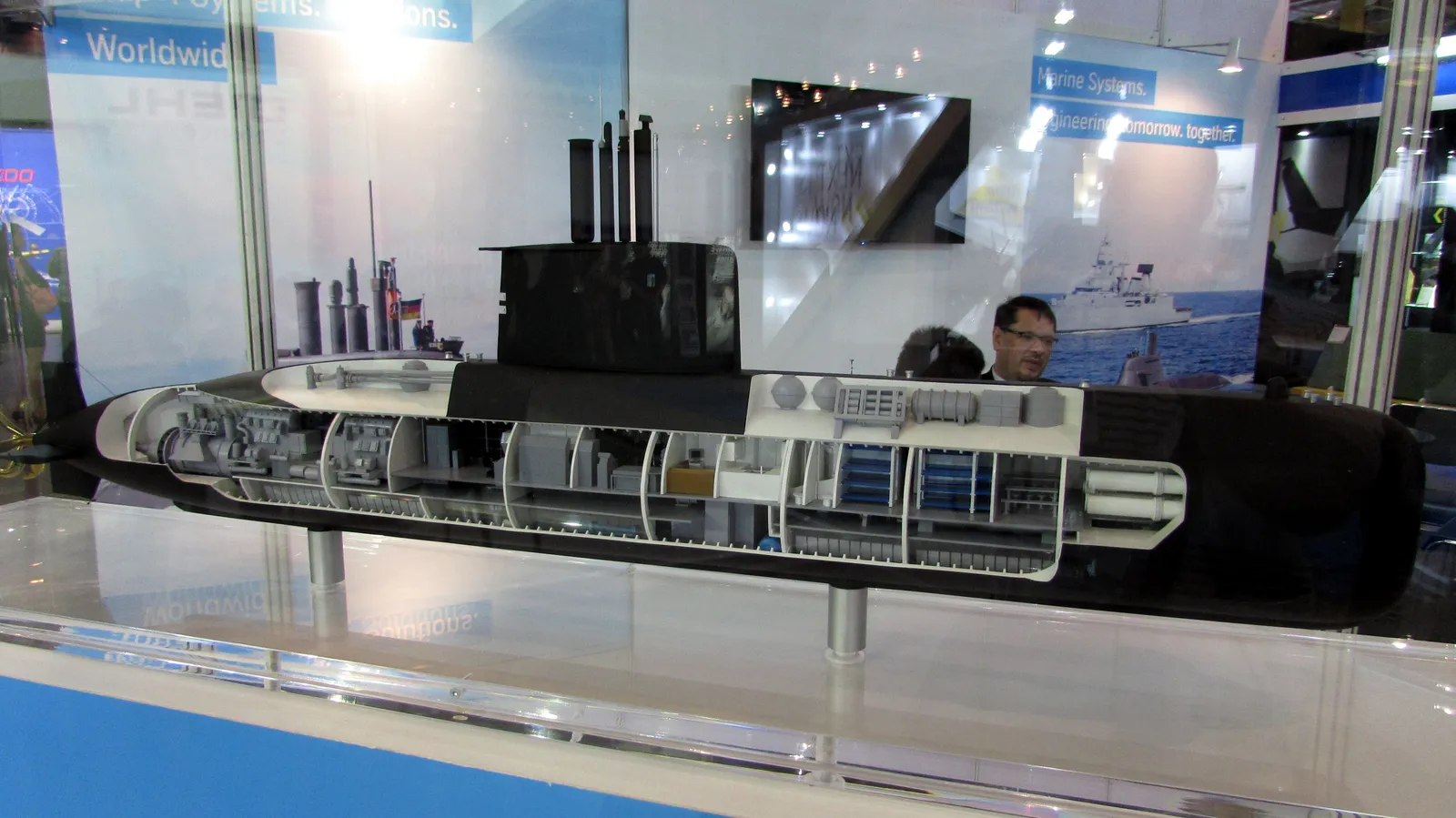
- Side
- Argentina

ARA San Luis, an Argentine Type 209 submarine, conducted a Falklands War patrol and made torpedo attacks against British warships, forcing sustained anti-submarine responses despite scoring no confirmed hit.
The Type 209 is Germany's long-running export diesel-electric attack-submarine family, developed through the HDW lineage and continued in modern TKMS material as the HDW Class 209NG. Public sources tie the family to coastal sea denial, anti-submarine and anti-surface warfare, mine-laying, intelligence collection, special-operations support, and documented combat use by Argentina's ARA San Luis during the 1982 Falklands War.
ARA San Luis, an Argentine Type 209 submarine, conducted a Falklands War patrol and made torpedo attacks against British warships, forcing sustained anti-submarine responses despite scoring no confirmed hit.
ARA San Luis gives the Type 209 family a directly documented combat entry. USNI describes the Argentine boat as a West German-built Type 209 and records three claimed torpedo attacks during its South Atlantic patrol. The attacks produced no confirmed British ship loss, but the patrol forced repeated anti-submarine searches and kept a quiet diesel-electric submarine threat inside the Royal Navy's campaign planning.
The Type 209 is best read as an export family rather than one immutable submarine class. Early rows such as 209/1100 and 209/1200 established the HDW export line, while later 209/1400mod and 209NG material shows how TKMS continued to market updated sensors, propulsion, battery, combat-system, and customer-option packages around the same broad conventional-submarine niche.
NTI's chronology starts the family with Greece's 1967 Glavkos Type 209/1100 order and records early follow-on 209/1200 customers including Argentina.
Source: NTI German Submarine Exports.
Egypt's 209/1400mod program gives a recent TKMS-built example, with the fourth boat launched in 2020 and handed over in 2021.
Sources: Naval News Egypt S44 Launch; Naval News Egypt S44 Handover.
TKMS frames 209NG as a redesign that preserves the older family qualities while adding ORCCA, low-signature features, selectable battery options, and optional countermeasure or special-forces systems.
Source: TKMS HDW Class 209.
The Type 209 family spans early export-displacement groups, customer-specific national classes, and newer 209/1400mod and 209NG material. Public sources differ by customer fit, so these rows identify source-backed variant lines rather than a single fixed standard.
| Variant | Configuration | Designation notes |
|---|---|---|
| Type 209/1100 | Early export baseline | NTI's German submarine export chronology lists Greece's 1967 Glavkos-class Type 209/1100 order as the first Type 209 export line. Sources: NTI German Submarine Exports |
| Type 209/1200 | Early export attack-submarine variant | NTI lists Argentine Salta-class and other 209/1200 orders in the early export chronology; USNI identifies ARA San Luis as the Type 209 boat that patrolled against the British task force in 1982. Sources: NTI German Submarine Exports, USNI ARA San Luis Falklands War Patrol |
| Type 209/1400 Mod | Export diesel-electric submarine variant | GlobalSecurity identifies the 209/1400 Mod as the submarine model supplied by the German Submarine Consortium for South Africa, with construction in Kiel involving HDW, Thyssen Nordseewerke, and Ferrostaal. Sources: GlobalSecurity South Africa Type 209 |
| HDW Class 209/1400mod | Recent TKMS export configuration | Naval News, using TKMS press-release details, describes Egypt's 209/1400mod boats as the latest HDW Type 209 version at launch, with over 60 Type 209 boats built or under contract. Sources: Naval News Egypt S44 Launch |
| Type 209/1500 | Larger export variant | NTI lists India's 1981 Shishumar Type 1500 order in the German submarine export chronology. Sources: NTI German Submarine Exports |
| HDW Class 209NG | Modernized export submarine design | TKMS describes the 209NG as a redesign of the HDW Class 209 with ORCCA combat-system integration, selectable lead-acid or lithium-ion battery options, low-signature design features, and optional systems for torpedo countermeasures or special-forces support. Sources: TKMS HDW Class 209 |
Type 209 customer fits vary by navy. The links below cover weapons directly tied to Type 209 variants by government or manufacturer sources.
| Carried item | Item type | Carriage evidence |
|---|---|---|
 | Submarine-launched anti-ship missile family | The U.S. Defense Security Cooperation Agency described UGM-84L Harpoon Block II Encapsulated missiles as submarine-launched missiles supporting Egypt's Type 209 submarines. Sources: DSCA Egypt UGM-84L Harpoon |
 | 533 mm heavyweight torpedo | Lockheed Martin reported that the Brazilian Navy's SS Tapajo, a U209/Tupi-class submarine, detected, tracked, and launched Mark 48 Mod 6AT torpedoes during combat-system sea trials. |
NTI lists Greece ordering the Glavkos-class Type 209/1100 in 1967, starting the export chronology for the family.
Sources: NTI German Submarine Exports
USNI says ARA San Luis opened its Falklands War attack sequence against HMS Yarmouth and HMS Brilliant, then survived a prolonged British anti-submarine response.
Sources: USNI ARA San Luis Falklands War Patrol
GlobalSecurity records South Africa's contract for three Type 209 1400 Mod submarines from the German Submarine Consortium.
Sources: GlobalSecurity South Africa Type 209
Naval News reports that Egypt's first two 209/1400mod submarines were contracted in 2011, followed by an option for two additional units in 2015.
Sources: Naval News Egypt S44 Launch
TKMS named and launched the fourth Egyptian 209/1400mod submarine, S44, at its Kiel shipyard.
Sources: Naval News Egypt S44 Launch
Naval News reports that S44 was handed over as the fourth and final submarine in Egypt's 209/1400mod program.
Sources: Naval News Egypt S44 Handover


