Profile
- Origin
- United States
- Type
- Proliferated LEO communications and missile-tracking satellite architecture
- Service note
- 2022-present
Transport and Tracking Layer covers the Space Development Agency's proliferated low-Earth-orbit satellite architecture for resilient military data transport, tactical links, missile warning, and missile tracking. Publicly documented activity centers on launches, demonstrations, contractor awards, and planned warfighter integration rather than confirmed conflict employment.
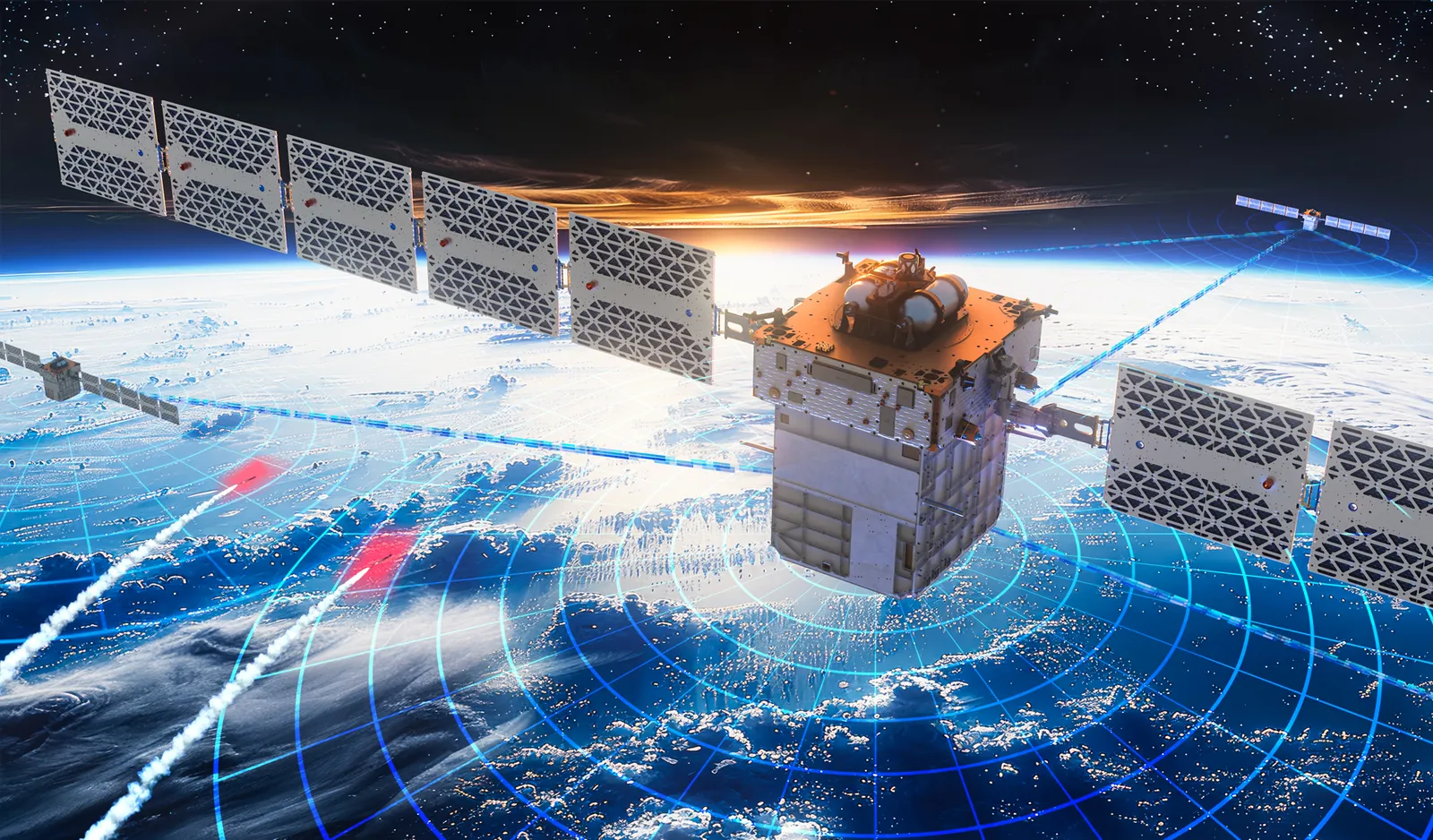
The architecture combines two linked satellite functions rather than a single vehicle model: Transport Layer satellites move mission data through optical, RF, and tactical data links, while Tracking Layer satellites sense missile launches and pass mission data into the same mesh and ground system.
| Layer | Primary role | Documented payloads or interfaces |
|---|---|---|
| Transport Layer | Low-latency communications backbone for Joint All-Domain Command and Control and tactical satellite communications. | Optical communication terminals, Link 16, Ka-band RF payloads, BMC3 module, NEBULA-compatible networking. |
| Tracking Layer | Missile warning, missile tracking, and later missile-defense fire-control sensing from proliferated LEO satellites. | Infrared sensing payloads, optical communication terminals, Ka-band links, S-band backup telemetry, and interfaces with the Transport Layer mesh. |
| Ground and user links | Operations, tasking, and tactical data delivery to warfighter platforms and external mission partners. | Space Operations Centers, global ground entry points, optical ground terminals, tactical data links, and mission-partner nodes. |
SDA organizes the architecture into functional layers and two-year acquisition tranches. Transport Layer rows describe data-relay and tactical-communications satellites; Tracking Layer rows describe infrared missile-warning, missile-tracking, and missile-defense sensing satellites.
| Variant | Configuration | Designation notes |
|---|---|---|
| Transport Layer | Data transport and tactical communications layer | SDA describes the Transport Layer as the PWSA mesh backbone for low-latency data transport, sensor-to-shooter connectivity, and tactical satellite communications direct to platforms. Sources: SDA Transport Layer fact sheet |
| Tracking Layer | Missile-warning and missile-tracking layer | SDA describes the Tracking Layer as a proliferated LEO constellation of infrared-sensing satellites for detecting and tracking conventional and advanced missile threats, including hypersonic systems. Sources: SDA Tracking Layer fact sheet |
| Tranche 1 Transport Layer | Initial operational data-transport tranche | The 2022 Tranche 1 Transport Layer awards covered 126 space vehicles in six near-polar planes, with York Space Systems, Lockheed Martin Space, and Northrop Grumman each building 42 satellites. Sources: SDA awards Tranche 1 Transport Layer prototype agreements |
| Tranche 2 Transport Layer Alpha | Global communications variant | SDA awarded 100 Alpha-variant Tranche 2 Transport Layer satellites to York Space Systems and Northrop Grumman for global communications and persistent encrypted connectivity. Sources: SDA awards Tranche 2 Transport Layer Alpha satellites |
| Tranche 2 Transport Layer Beta | Advanced tactical communications variant | SDA awarded the Beta variant first to Northrop Grumman and Lockheed Martin and then added Rocket Lab, bringing the Beta constellation to 90 space vehicles. Sources: SDA awards Tranche 2 Transport Layer Beta satellites, SDA awards additional Tranche 2 Transport Layer Beta satellites |
| Tranche 2 Transport Layer Gamma | TACSATCOM demonstration variant | The Gamma variant adds 20 Tranche 2 Transport Layer space vehicles from York Space Systems and Tyvak to expand advanced tactical satellite communications demonstrations. Sources: SDA awards Tranche 2 Transport Layer Gamma satellites |
| Tranche 2 Tracking Layer | Global missile-tracking and preliminary fire-control tranche | SDA awarded 54 Tranche 2 Tracking Layer satellites to L3Harris, Lockheed Martin, and Sierra Space, with each vendor providing wide-field missile-warning/missile-tracking vehicles and two missile-defense infrared-sensor vehicles. Sources: Space Development Agency Makes Awards to Build 54 Tranche 2 Tracking Layer Satellites |
| Tranche 3 Tracking Layer | Expanded missile-warning, tracking, and defense tranche | SDA's Tranche 3 Tracking Layer awards cover 72 satellites from Lockheed Martin, Rocket Lab, Northrop Grumman, and L3Harris, with fiscal-year 2029 launches planned. |
The Space Development Agency awarded prototype agreements for a 126-space-vehicle Tranche 1 Transport Layer mesh network built by York Space Systems, Lockheed Martin Space, and Northrop Grumman.
Sources: SDA awards Tranche 1 Transport Layer prototype agreements
SDA selected Northrop Grumman and Lockheed Martin for 72 Beta-variant Tranche 2 Transport Layer satellites that add advanced tactical communications to the PWSA.
Sources: SDA awards Tranche 2 Transport Layer Beta satellites
SDA awarded 100 Alpha-variant Tranche 2 Transport Layer satellites to York Space Systems and Northrop Grumman, expanding the Transport Layer's global communications role.
Sources: SDA awards Tranche 2 Transport Layer Alpha satellites
SDA awarded 54 Tranche 2 Tracking Layer satellites to L3Harris, Lockheed Martin, and Sierra Space for missile warning, missile tracking, and preliminary missile-defense fire-control sensing.
Sources: Space Development Agency Makes Awards to Build 54 Tranche 2 Tracking Layer Satellites
A Falcon 9 launched 21 York Space Systems-built Tranche 1 Transport Layer satellites from Vandenberg Space Force Base for SDA's first operational PWSA Tranche 1 launch.
Sources: SDA completes first Tranche 1 satellite launch
SDA reported that the second Tranche 1 orbital-plane launch delivered another 21 Transport Layer satellites provided by Lockheed Martin.
Sources: ON ORBIT - Space Development Agency
SDA awarded four Tranche 3 Tracking Layer agreements for 72 satellites, split among Lockheed Martin, Rocket Lab, Northrop Grumman, and L3Harris.
Sources: SDA awards Tranche 3 Tracking Layer satellites