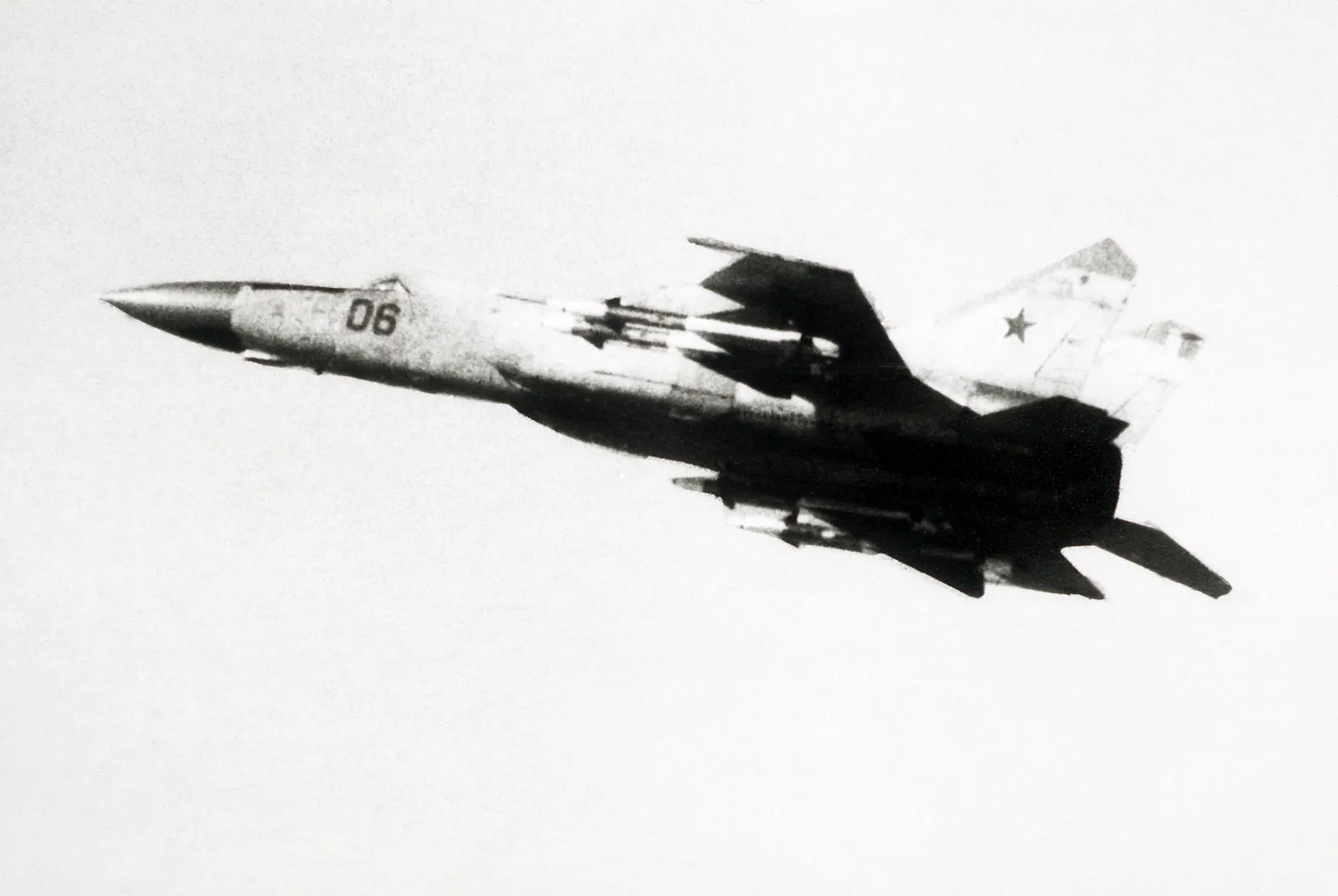
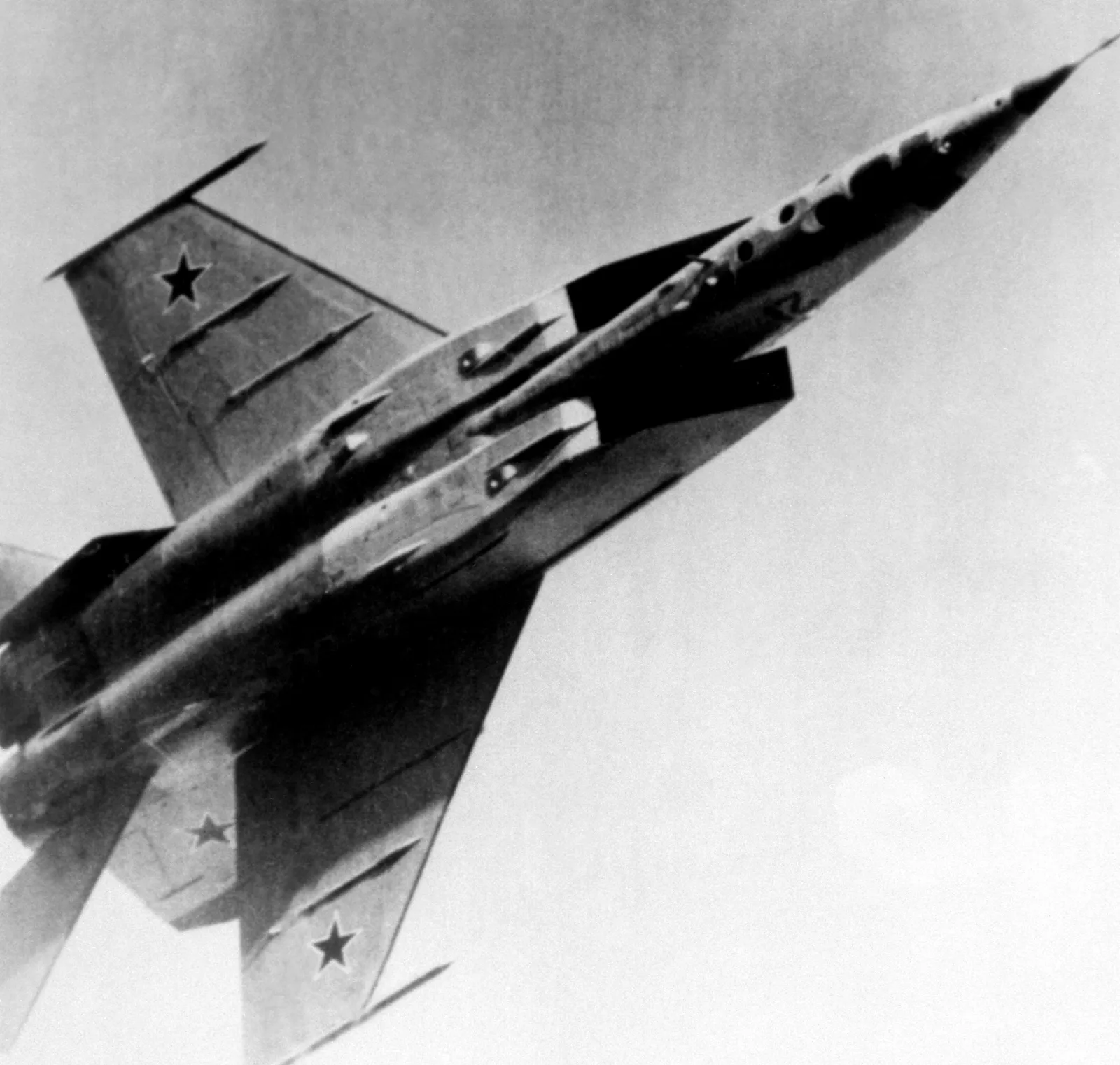
Iraq fielded its first MiG-25s during the 1980 Iran-Iraq War; this row treats the aircraft as an Iraqi wartime interceptor and reconnaissance platform without relying on individual kill claims.
MiG-25 fighter aircraft
- MiG-25
- MiG-25 Foxbat
- Mikoyan-Gurevich MiG-25
- Foxbat
- NATO reporting name Foxbat
The MiG-25 Foxbat is a Soviet high-speed interceptor and reconnaissance aircraft built by Mikoyan-Gurevich around speed, altitude, heavy air-to-air missiles, and reconnaissance-bomber variants rather than close-in maneuvering. Iraq fielded the type during the 1980 Iran-Iraq War and 1990 Gulf War, Syria used a small surviving fleet during the 2011 Syrian Civil War, and Azerbaijan later kept MiG-25s in reserve during the 2020 Nagorno-Karabakh stand-off.
Role in Conflicts
Iraqi MiG-25s appeared in Desert Storm air combat; a CIA assessment of the Speicher case said the U.S. Navy F/A-18 was most likely hit by a missile fired from an Iraqi MiG-25 on 17 January 1991.
Role detailsBellingcat reported that some Syrian MiG-25s still appeared operational in 2012 and that a MiG-25PD(S) fired two R-40TD missiles at Aqaribat in Hama Governorate in 2014.
Role detailsReported in Azerbaijani reserve service during the 2020 Karabakh stand-off; treated here as a reserve air-defense and reconnaissance aircraft, not as a documented 2020 combat sortie or shootdown.
Profile / Specs
Profile
- Origin
- Soviet Union
- Built by
- Mikoyan-GurevichMikoyan
- Built in
- Soviet UnionRussia
- Type
- High-speed interceptor and reconnaissance aircraft
- Service note
- Cold War design; export and inherited fleets remained visible in Middle Eastern and South Caucasus conflicts into the 2010s and 2020s
- Designer
- Mikoyan-Gurevich Design Bureau
- Designed
- 1959-1960s development; first flight in 1964
- Produced
- 1964-1984
- Number built
- About 1,186 aircraft
Specifications
- Crew
- 1 in operational interceptor and reconnaissance variants; 2 in trainer variants
- Role
- High-speed interceptor, reconnaissance aircraft, and reconnaissance-bomber variants
- Maximum speed
- Mach 2.83 operational limit cited by the National Museum of the U.S. Air Force
- Armament
- Up to four long-range air-to-air missiles on interceptor variants; sources also list R-60 carriage on some MiG-25 configurations
- Powerplant
- Two Tumansky R-15-series afterburning turbojets
- Maximum takeoff weight
- About 36,720 kg for MiG-25P/PDS-class data
- Ceiling
- About 20,700 m service ceiling in commonly cited MiG-25PDS data
- Family branches
- Interceptor, reconnaissance, reconnaissance-bomber, and two-seat trainer variants
Mission Variant Split
The MiG-25 page is best read as a family record: the same airframe supported high-speed air defense, reconnaissance, and limited strike missions depending on suffix and operator.
| Branch | Typical suffixes | Catalog relevance |
|---|---|---|
| Interceptor | P, PD, PDS | Air-defense aircraft associated with R-40 missile carriage and the 1990 Gulf War Speicher-case assessment. |
| Reconnaissance-strike | R, RB, RBT | High-speed reconnaissance and reconnaissance-bomber roles explain the page's reconnaissance and strike tags. |
| Conversion trainer | PU, RU | Two-seat trainer branch supports fleet transition but is not treated as separate combat employment here. |
Variants
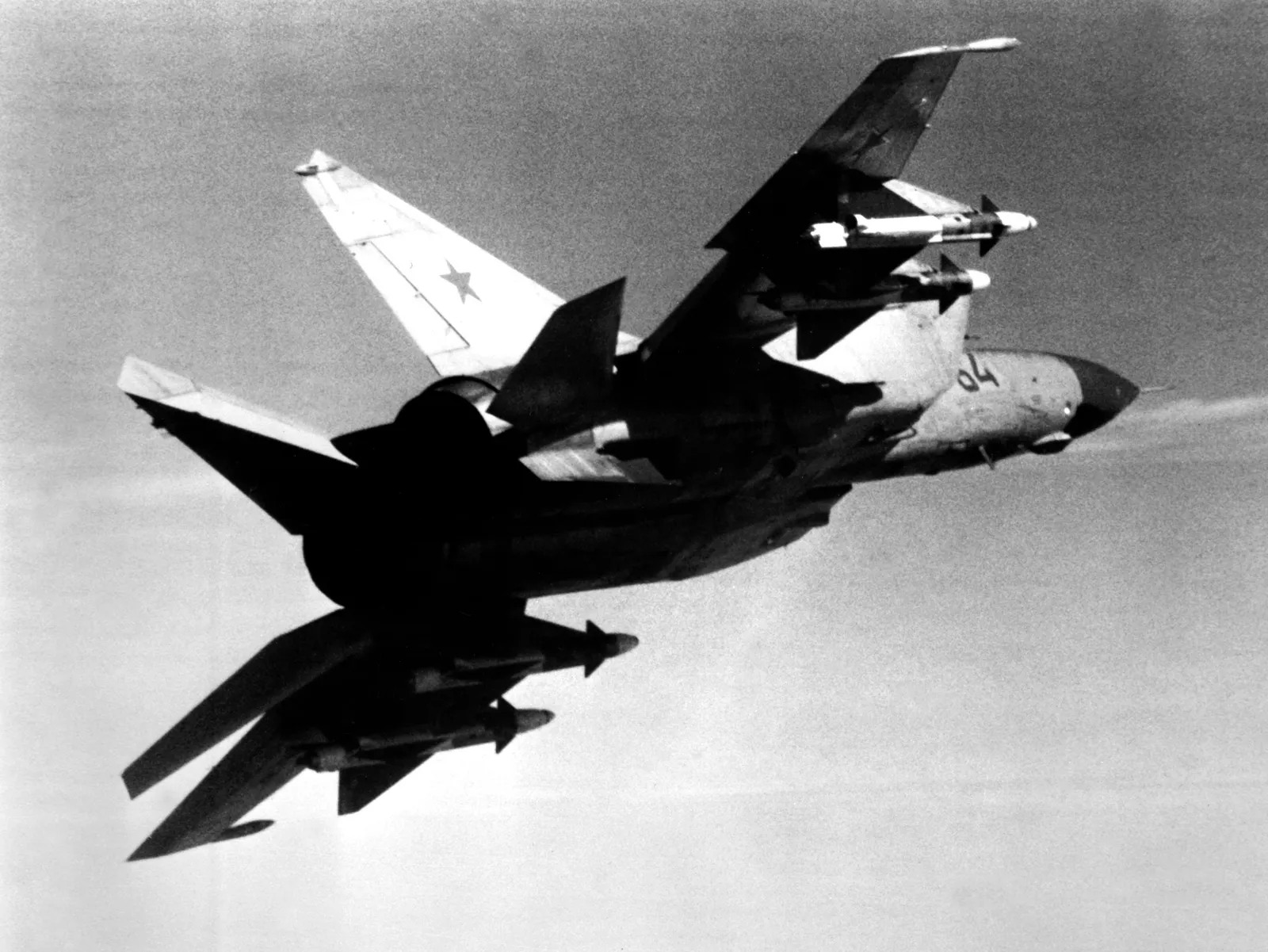
The MiG-25 family split into interceptor, reconnaissance-strike, and conversion-trainer branches; export and upgraded aircraft often carried suffixes that identify radar, reconnaissance, or trainer configuration changes.
| Variant | Configuration | Designation notes |
|---|---|---|
| MiG-25P | Original interceptor branch | Single-seat air-defense variant built around high speed, radar intercepts, and long-range air-to-air missiles. Sources: Mikoyan-Gurevich MiG-25, MiG-25 Foxbat |
| MiG-25PD / MiG-25PDS | Upgraded interceptor branch | Later interceptor configurations appear in Iraqi and Syrian service accounts, including 1990 Gulf War and 2011 Syrian Civil War missile-use reporting. Sources: CIA Speicher Case Assessment, The Syrian Arab Air Force, Beware of its Wings |
| MiG-25R / MiG-25RB / MiG-25RBT | Reconnaissance and reconnaissance-bomber branch | Reconnaissance and reconnaissance-bomber variants gave the family a strike and high-speed intelligence role beyond pure interception. Sources: MiG-25 Foxbat, The Syrian Arab Air Force, Beware of its Wings |
| MiG-25PU / MiG-25RU | Two-seat conversion trainers | Trainer variants used a second cockpit for conversion training rather than the single-seat operational layout. Sources: MiG-25 Foxbat |
Carried Air-To-Air Missiles
Interceptor variants are documented with long-range air-to-air missile carriage; where the catalog has a separate missile record, the link is kept to the supported compatible item.
| Carried item | Item type | Carriage evidence |
|---|---|---|
![]() | Short-range infrared-guided air-to-air missile | Global Aircraft lists the R-60 among MiG-25 armament options, complementing the larger long-range missile fit associated with interceptor variants. Sources: MiG-25 Foxbat |
Timeline
MiG-25 fighter aircraft Key Events
First flight
The MiG-25 first flew in 1964 during Soviet development of a very high-speed interceptor and reconnaissance aircraft.
Soviet service entry
The National Museum of the U.S. Air Force describes the MiG-25 as entering Soviet service in 1970.
Belenko defection exposed the aircraft
Viktor Belenko's defection to Japan in a MiG-25 allowed Western analysts to examine the aircraft's structure, engines, and electronics.
Iraq receives wartime MiG-25s
The first Iraqi Air Force MiG-25s entered service in 1980 during the 1980 Iran-Iraq War.
Desert Storm air-combat loss assessment
A CIA assessment of the Speicher case concluded that the U.S. Navy F/A-18 loss was most likely caused by a missile fired from an Iraqi MiG-25.
Syrian wartime reappearance
Bellingcat reported renewed Syrian MiG-25 activity in 2014, including a MiG-25PD(S) firing R-40TD missiles at Aqaribat.
Media
MiG-25 fighter aircraft Videos
Related Weapon Systems