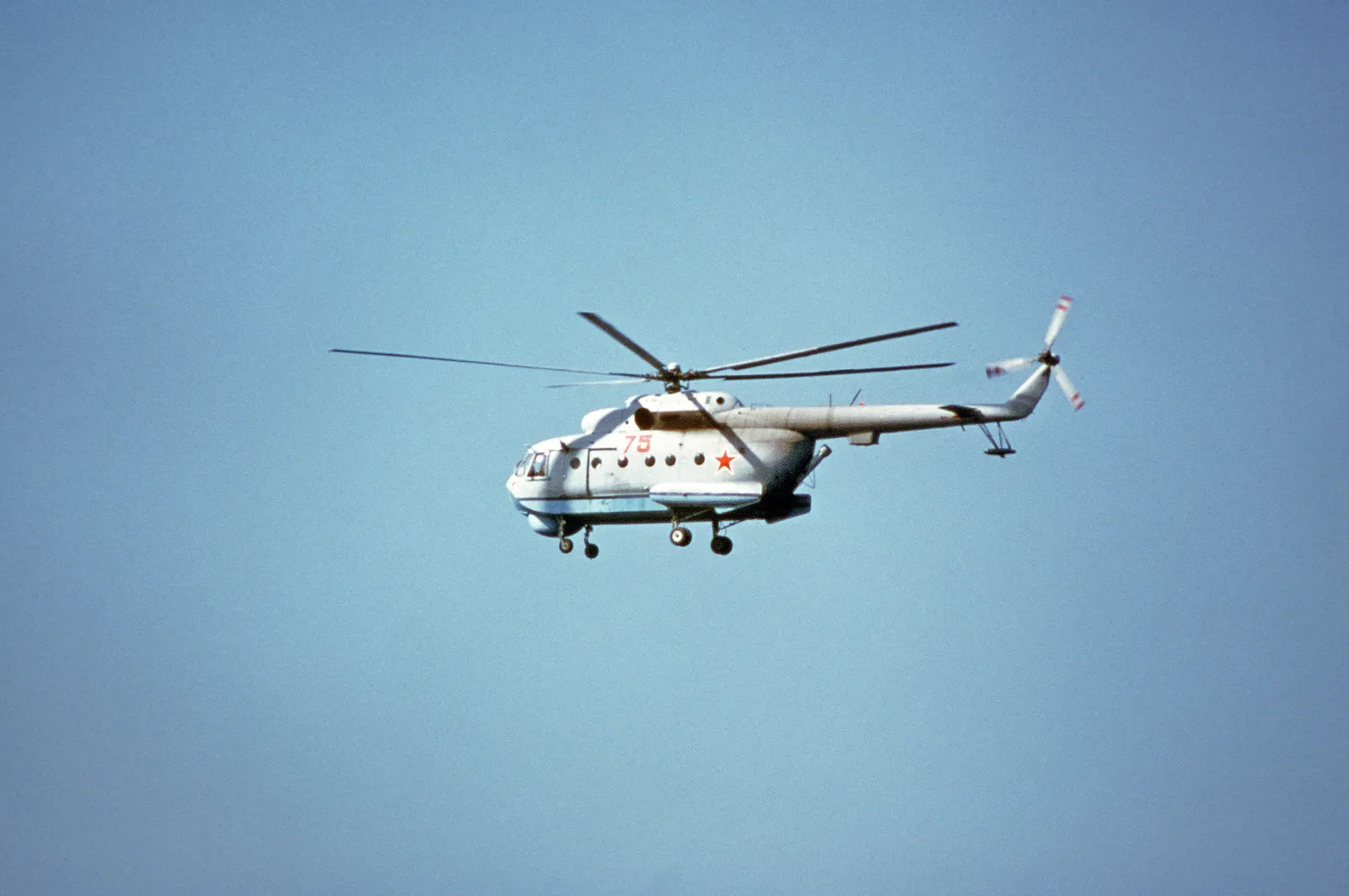
Ukrainian Naval Aviation operated Mi-14PS helicopters during the full-scale invasion; Ukraine's Crimea presidential mission says Colonel Ihor Bedzai's Mi-14 was shot down by a Russian missile on May 7, 2022 while he was conducting search-and-rescue operations near the Danube River mouth.
Role detailsMi-14
- Mil Mi-14
- Mi-14 Haze
- Mil Mi-14 Haze
- V-14
- Haze
- Mi-14PL
- Mi-14PL Haze
- Mi-14PS
- Mi-14BT
- Mi-14PLM
- Mi-14GP
The Mi-14 is a Soviet Mil/Kazan amphibious maritime helicopter derived from the Mi-8 but rebuilt around a boat-like hull, retractable landing gear, naval sensors, and anti-submarine, minesweeping, or search-and-rescue configurations. Its modern conflict record is narrow but direct: Ukrainian Naval Aviation lost a Mi-14PS during a May 2022 search-and-rescue mission in the 2014 Russia-Ukraine War, and Syrian government forces used Mi-14s for improvised mine and bombing roles in the Syrian Civil War.
Role in Conflicts
Oryx reported limited Syrian Civil War use of Mi-14s, including SADAF-02 naval-mine drops and later village-bombing missions, while The Aviationist separately documented a Syrian Navy Mi-14PL crash near Idlib on March 22, 2015.
Profile / Specs
Profile
- Origin
- Soviet Union
- Built in
- Soviet UnionRussia
- Type
- Amphibious anti-submarine helicopter
- Service note
- Introduced in the 1970s and retained in limited naval aviation service into the 2020s
- Designer
- Mil Moscow Helicopter Plant
- Designed
- 1960s development; prototype first flew in 1967
- Produced
- 1973-1986
- Number built
- Nearly 300 produced at Kazan Helicopters, with the common published count around 273
- Developed from
- Mil Mi-8
Specifications
- Crew / capacity
- 4 crew plus up to 10 passengers in Helis data
- Powerplant
- Two Klimov TV3-117-family turboshaft engines
- Maximum speed
- About 230 km/h
- Range
- About 1,100 km
- Service ceiling
- About 3,500 m
- Dimensions
- 18.38 m fuselage length, 21.3 m rotor diameter, about 6.9 m height
- Weight
- About 8,500 kg empty and 13,000 kg maximum in Helis data
- Mission equipment
- Mi-14PL anti-submarine version with maritime sensors and an internal weapons bay for one torpedo or depth-charge class stores; GDR Mi-14PL examples carried PLAB depth-charge or RGBN/M buoy loads
Maritime Configuration
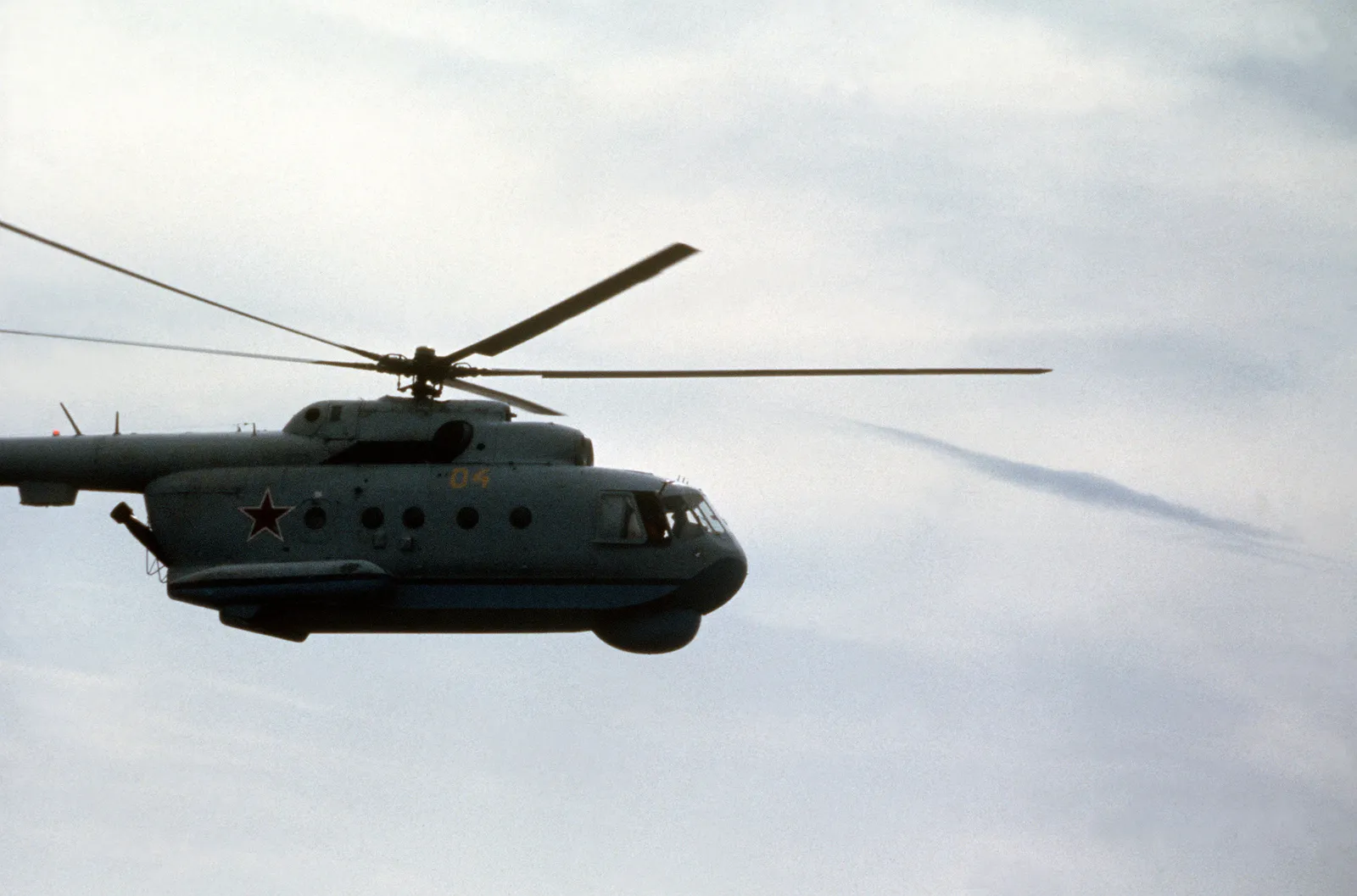
The Mi-14 is not a utility Mi-8/Mi-17 with naval markings. Public reference sources describe a land-based maritime helicopter with amphibious shaping, retractable landing gear, naval sensors, and specialized mission branches for anti-submarine warfare, minesweeping, and rescue work.
A boat-like hull and retractable landing gear let the aircraft operate off water, while the design remained mainly a shore-based naval aviation helicopter.
The Mi-14PL branch combined maritime sensors with an internal weapons bay for torpedo or depth-charge class anti-submarine stores; GDR Mi-14PL aircraft used OKA-2 dipping sonar, APM-60 magnetic detection, and an Initsiativa-2M search radar.
The Mi-14BT branch was built around towing mine-countermeasures sleds, with GDR service pairing it with modernized Project 89.2 MCM ships and GKT-3W or AT-2M sleds.
The family split into anti-submarine, mine-countermeasures, search-and-rescue, and civil conversion branches rather than one common combat configuration.
Modern open-source conflict evidence centers on legacy aircraft in Ukrainian search-and-rescue service and Syrian improvised mine or bombing use.
Variants
The Mi-14 family separates the baseline anti-submarine Haze-A branch from mine-countermeasures and search-and-rescue configurations.
| Variant | Configuration | Designation notes |
|---|---|---|
| V-14 | Prototype and development designation | The V-14 was the development designation for the amphibious Mi-8-derived helicopter that became the Mi-14. Sources: ODIN Mi-14 Haze |
| Mi-14PL | Anti-submarine warfare variant | The Haze-A configuration is the basic land-based anti-submarine version with naval sensors and internal weapons carriage; GDR Mi-14PL examples carried the KALMAR suite with OKA-2 dipping sonar and APM-60 magnetic-anomaly detector. |
| Mi-14PLM | Improved anti-submarine warfare variant | Reference sources distinguish the Mi-14PLM as an improved anti-submarine branch; public conflict evidence in this record does not identify PLM use. Sources: ODIN Mi-14 Haze |
| Mi-14BT | Mine-countermeasures variant | The Haze-B branch is identified as the airborne mine-countermeasures version; GDR Mi-14BT aircraft were equipped to tow mine-countermeasures sleds such as GKT-3W and AT-2M from cooperating MCM ships. |
| Mi-14PS | Search-and-rescue variant | The Haze-C branch is the search-and-rescue configuration; the Ukrainian loss in May 2022 involved a Mi-14PS. Sources: Helis Mi-14 Haze, ASN Mi-14PS 34 Yellow |
| Mi-14GP | Civil transport conversion | The Mi-14GP designation is listed in public references as a passenger or transport conversion branch rather than a combat configuration. Sources: ODIN Mi-14 Haze |
Timeline
Mi-14 Key Events
V-14 prototype first flight
Reference sources place the first Mi-14/V-14 prototype flight on August 1, 1967, during development of a navalized Mi-8 derivative.
Sources: ODIN Mi-14 Haze
Kazan production begins
Helis records Mi-14 production at Kazan Helicopters from 1973 through 1986.
Sources: Helis Mi-14 Haze
Soviet naval aviation service entry
Helis states that the Mi-14 entered service in 1976 with Soviet naval aviation.
Sources: Helis Mi-14 Haze
Syrian Navy Mi-14 crashes near Idlib
The Aviationist reported that a Syrian Navy Mi-14 crashed in northwestern Syria and that surviving crew were captured near the wreckage.
Sources: Syrian Navy Mi-14 crash near Idlib
Ukrainian Mi-14PS shot down near the Danube
Ukraine's Crimea presidential mission says Colonel Ihor Bedzai was flying a Mi-14 during search-and-rescue operations when it was shot down by a Russian missile.
Sources: PPU Ihor Bedzai, ASN Mi-14PS 34 Yellow
Media
Mi-14 Images
Related Weapon Systems