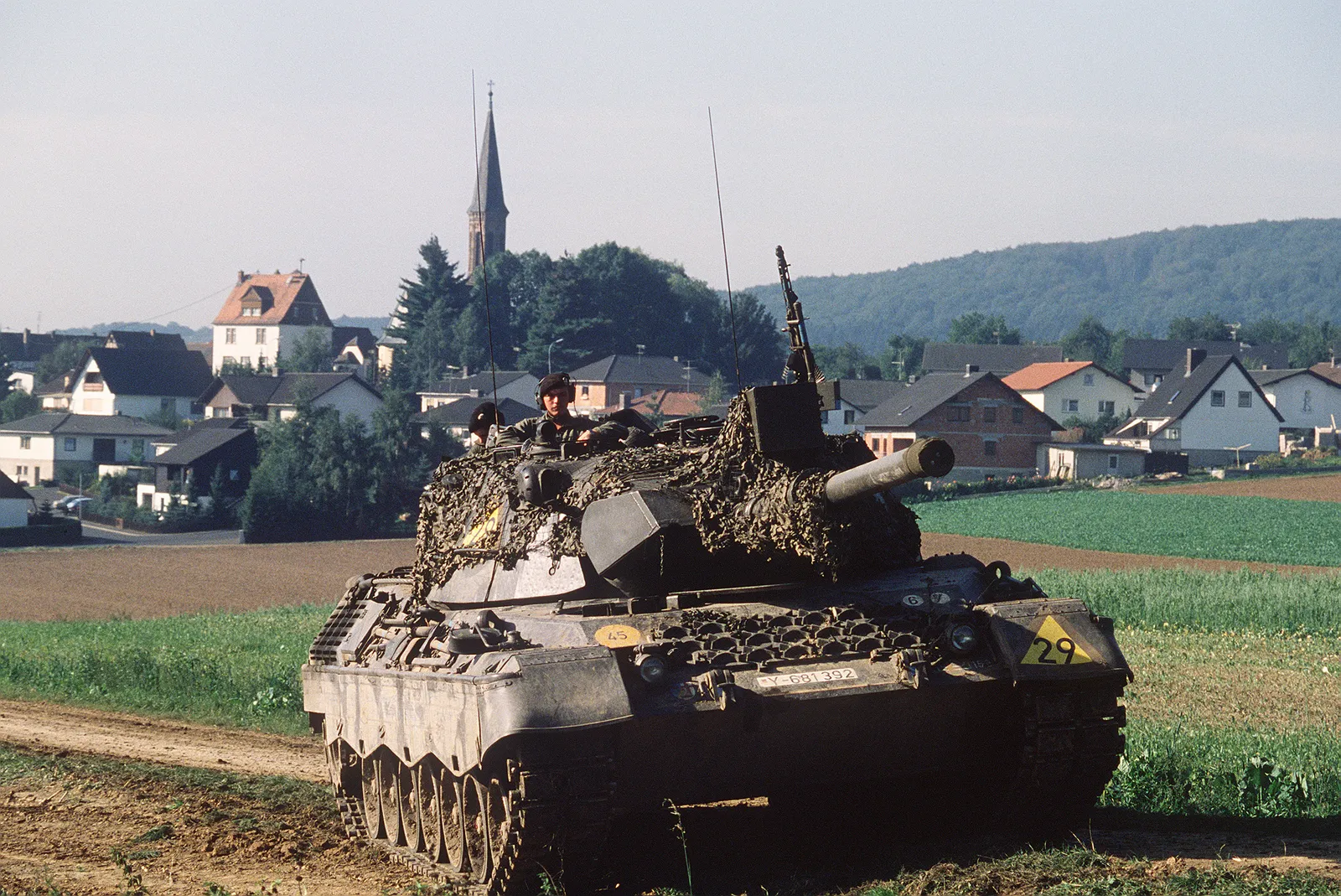

Danish Leopard 1A5 DK tanks deployed to Bosnia with the UN mission; Danish defence history connects the Leopard 1 force with Operation Bollebank, where Danish crews used the tank's firepower during the war.
Tanks
Leopard 1
Also known as
- Kampfpanzer Leopard
- Kampfpanzer Leopard 1
- Leopard I
- Leo 1
- Leopard 1A1
- Leopard 1A2
- Leopard 1A3
- Leopard 1A4
- Leopard 1A5
The Leopard 1 is West Germany's first postwar main battle tank family, built around a 105 mm L7-series gun, high mobility, and upgradeable fire-control equipment rather than heavy passive armor. The family became a long-running NATO and export tank line, with A5-family vehicles documented in Danish Bosnia service and later refurbished for Ukraine as easier-to-maintain mobile direct-fire tanks.
Role in Conflicts
- Side
- Ukraine

Denmark, Germany, and the Netherlands organized refurbished Leopard 1A5 transfers for Ukraine with training, spare parts, and ammunition; Germany's delivery list records 103 Leopard 1A5 tanks delivered with another 22 in preparation.
Role detailsProfile / Specs
Profile
- Origin
- West Germany
- Built by
- Krauss-Maffei Wegmann
- Built in
- Germany
- Type
- Main battle tank
- Service note
- Cold War main battle tank with late-service A5 upgrades used into the 2020s
- Designer
- Porsche development team selected for the Bundeswehr Leopard program
- Designed
- 1956-1961 development program; production design selected before mid-1960s service entry
- Produced
- 1965-1984 main production; later A5 upgrade and refurbishment programs
- Number built
- More than 4,700 Leopard 1 main battle tanks according to KNDS; broader family totals include utility and anti-aircraft vehicles
Specifications
- Crew
- 4
- Main armament
- 105 mm L7A3 rifled gun on the A5 specification
- Secondary armament
- Two 7.62 mm machine guns
- Combat weight
- 42.2 t in KNDS A5 specification; Danish A5 DK-1 museum example listed at 42.4 t fully loaded
- Engine
- MTU MB 838 CaM 500 multifuel V10 family; KNDS lists 610 kW (830 hp)
- Maximum speed
- 65 km/h
- Range
- 550 km in KNDS A5 specification; Danish museum example lists 450 km on road
- Dimensions
- 9.54 m length with gun at 12 o'clock, 3.37 m width, 2.39 m turret-roof height in KNDS A5 specification
- A5 fire-control features
- Thermal sighting, laser rangefinding, and ballistic-computer fire-control improvements documented for Danish A5 DK vehicles
Design Emphasis
The Leopard 1 family is best read as a mobility-and-fire-control tank line. KNDS lists the A5 at 42.2 t with an 830 hp engine, 65 km/h maximum speed, 550 km range, and a 105 mm L7A3 main gun; Bundeswehr material separately emphasizes a stabilized weapon system and accurate firing while moving.
Firepower
105 mm L7-series rifled gun with two 7.62 mm machine guns in KNDS's A5 specification.
Mobility
A relatively light main battle tank layout using the MTU MB 838 engine family and road speeds around 65 km/h.
Upgrade logic
A5 and A5 DK packages kept the older gun and hull useful by adding thermal imaging, laser rangefinding, and ballistic-computer fire control.
Variants
Leopard 1 designations mark successive national and upgrade packages. The A5 family is the most conflict-visible late upgrade because it added modern fire-control and night-fighting equipment to older hulls.
| Variant | Configuration | Designation notes |
|---|---|---|
| Leopard 1A1 | Early stabilized-gun upgrade | Early Leopard 1 upgrades improved firing on the move and added side-skirt/protection changes before later fire-control packages. Sources: Bundeswehr Leopard 1 Classix |
| Leopard 1A3 | Welded-turret export and national-service variant | Danish service began with Leopard 1A3 tanks in the late 1970s before the fleet was later rebuilt to A5 DK standard. Sources: Pansermuseet Leopard 1 |
 | Late fire-control modernization | A5-family vehicles retained the 105 mm gun while adding thermal sighting, laser rangefinding, and ballistic-computer improvements; this is the variant documented in Danish Bosnia service and in Ukraine transfers. Sources: Pansermuseet Leopard 1, Danish Leopard Initiative, German Military Support for Ukraine |
| Leopard 1A5 DK | Danish A5 service configuration | Denmark upgraded its Leopard 1 fleet to A5 DK standard in the early 1990s, and 10 updated vehicles deployed to Bosnia under the UN mission. Sources: FMI Leopard 1 History |
Family Boundary
This entry covers the Leopard 1 tank family as a parent record. The separate Leopard 1A5 page is the variant-specific conflict record for the late fire-control upgrade, while the Leopard 2 page covers the heavier successor family rather than a Leopard 1 variant.
Timeline
Leopard 1 Key Events
Leopard 1 enters West German service
Bundeswehr and manufacturer sources place Leopard 1 service entry and production in the mid-1960s, with the type built as a mobile 105 mm main battle tank.
Sources: KNDS Leopard 1 A5, Bundeswehr Leopard 1 Classix
Danish fleet reaches A5 DK standard
Pansermuseet and FMI describe Denmark's Leopard 1 fleet being upgraded with EMES-18 fire control, thermal sights, laser rangefinding, and ballistic-computer equipment.
Sources: Pansermuseet Leopard 1, FMI Leopard 1 History
Danish Leopard 1 tanks in Operation Bollebank
Danish defence history links the Bosnia deployment of Leopard 1A5 DK tanks to Operation Bollebank, making Bosnia the clearest source-backed pre-Ukraine conflict-use lane for the family.
Sources: FMI Leopard 1 History, Danish Snow Leopards in Bosnia
Leopard 1 initiative for Ukraine announced
Denmark, Germany, and the Netherlands announced a project to refurbish at least 100 Leopard 1A5 tanks for Ukraine with logistics support, training, spare parts, and ammunition.
Sources: Danish Leopard Initiative
Germany lists continuing Leopard 1A5 support
Germany's military-support list recorded 103 Leopard 1A5 tanks delivered to Ukraine with spare parts and another 22 Leopard 1A5 tanks in preparation or execution.
Sources: German Military Support for Ukraine
Related Weapon Systems


Sources
KNDS Leopard 1 A5Publisher: KNDS | Note: Supports manufacturer background, production-volume context, and A5 specifications including weight, dimensions, engine output, speed, range, and armament. | Accessed: 2026-07-06Bundeswehr Leopard 1 ClassixPublisher: Bundeswehr | Note: Supports Bundeswehr background on the Leopard 1 stabilized weapon system, 105 mm gun, and firing while moving. | Accessed: 2026-07-06Pansermuseet Leopard 1Publisher: Pansermuseet Oksbol | Note: Supports Danish Leopard 1A3, A5 DK, and A5 DK-1 variant context, EMES-18 thermal-sight and laser-rangefinder upgrade details, museum specifications, and Operation Bollebank vehicle context. | Accessed: 2026-07-06FMI Leopard 1 HistoryPublisher: Danish Ministry of Defence Acquisition and Logistics Organisation | Note: Supports Danish Leopard 1 service history, A5 DK upgrade details, 1992 Bosnian War direct conflict-use context for 10 Leopard 1A5 DK tanks sent to Bosnia, and Ukraine refurbishment context. | Accessed: 2026-07-06Danish Snow Leopards in BosniaPublisher: Jydske Dragonregiment | Note: Supports 1992 Bosnian War direct conflict-use context by identifying Danish Leopard tank operations in Bosnia and Operation Bollebank coverage. | Accessed: 2026-07-06Danish Leopard InitiativePublisher: Danish Ministry of Defence | Note: Supports 2014 Russia-Ukraine War direct conflict-use context: Denmark, Germany, and the Netherlands announced refurbished Leopard 1A5 tanks for Ukraine with training, spare parts, and ammunition. | Accessed: 2026-07-06German Military Support for UkrainePublisher: Federal Government of Germany | Note: Supports 2014 Russia-Ukraine War direct conflict-use context: the German federal delivery list records Leopard 1A5 tanks delivered to Ukraine and additional Leopard 1A5 tanks in preparation. | Accessed: 2026-07-06Leopard1 Bundeswehr 1983.jpgPublisher: Wikimedia Commons | Note: Primary image provenance; Commons identifies a Bundeswehr Leopard 1 photographed during REFORGER/AUTUMN FORGE 1983 and sourced from U.S. military imagery. | Accessed: 2026-07-06West German Leopard 1 tanks and Gepard ADA moving.jpgPublisher: Wikimedia Commons | Note: Gallery image provenance; Commons lists West German Leopard 1 tanks and Gepard vehicles during REFORGER 1985 as public-domain U.S. military imagery. | Accessed: 2026-07-06UA Leopard 1A5 01.jpgPublisher: Wikimedia Commons | Note: Gallery image provenance; Commons identifies Ukrainian Leopard 1A5 training imagery and lists the file under CC BY 4.0. | Accessed: 2026-07-06