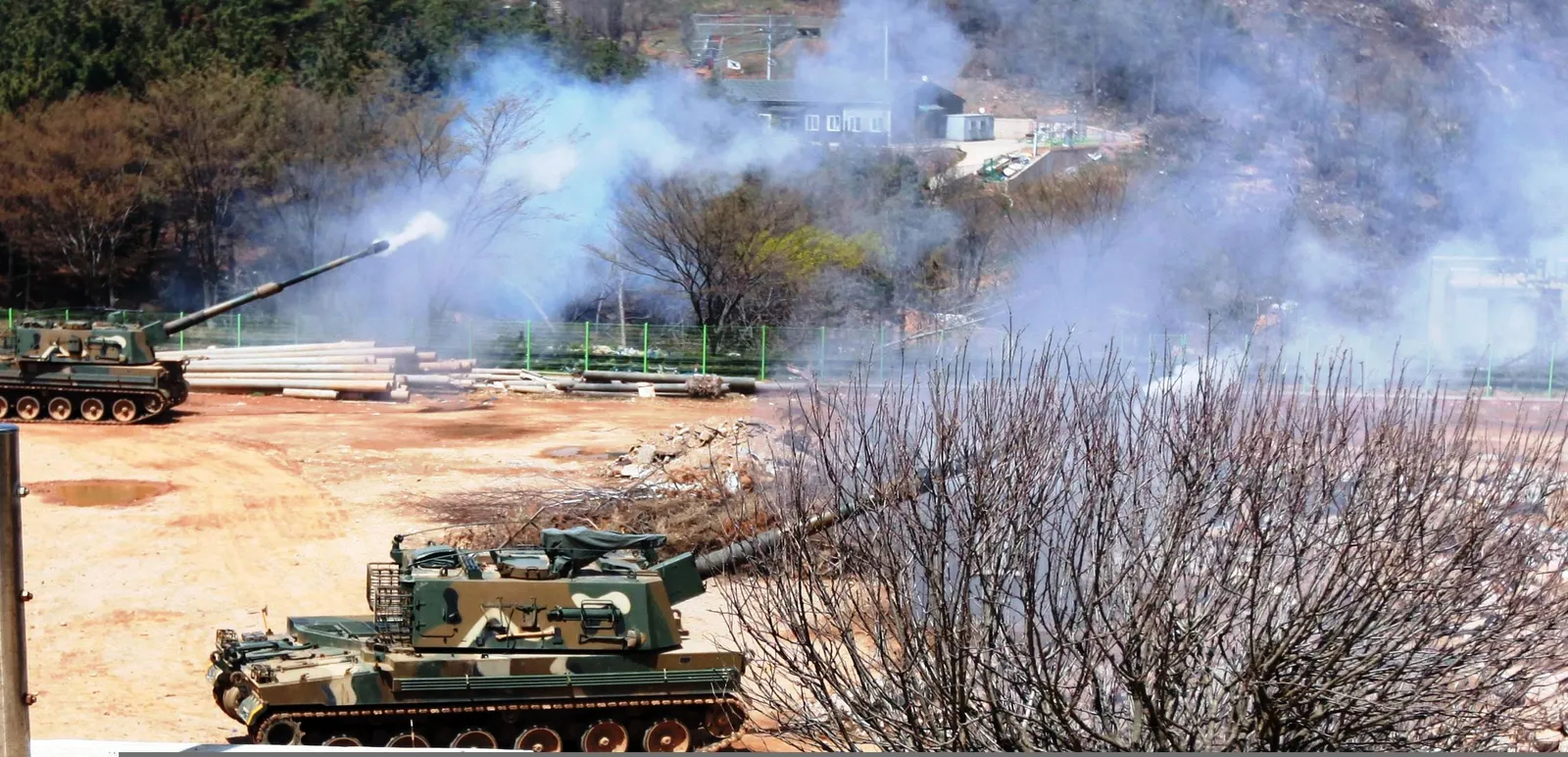
South Korean forces used K9 Thunder 155 mm self-propelled howitzers to return fire after North Korean artillery struck Yeonpyeongdo on November 23, 2010.
Artillery
K9 Thunder
Also known as
- K-9
- K9
- K-9 Thunder
- K9A1
- K9 Thunder self-propelled howitzer
- 155 PSH K9 FIN
The K9 Thunder is a South Korean 155 mm / 52-caliber tracked self-propelled howitzer built around protected mobility, rapid displacement, and high-rate indirect fire. Hanwha markets the family through K9A1 and K9A2 modernization paths, while Finnish Army data, Hanwha material, and U.S. Army Yuma Proving Ground reporting document its 47-ton tracked chassis, five-person baseline crew, 40 km-plus range class, burst-fire capability, K10 resupply link, and U.S. 155 mm munition compatibility work. Its directly sourced combat-use row here is the South Korean K9 response during the 2010 Yeonpyeongdo artillery exchange; Russia-Ukraine War links are treated as export and backfill context, not as Ukrainian K9 fielding.
Role in Conflicts
Profile / Specs
Profile
- Origin
- South Korea
- Built by
- Hanwha Aerospace
- Type
- 155 mm tracked self-propelled howitzer
- Service note
- Modern self-propelled artillery, in service from 1999
- Designer
- Agency for Defense Development with South Korean industry production and integration led through the Samsung Techwin to Hanwha Aerospace corporate line
- Designed
- Late Cold War and 1990s development; Finnish Army procurement history describes the K9 as a South Korean 155 mm tracked self-propelled artillery system selected after field testing in 2016
- Produced
- In service from 1999; K9A1 and K9A2 modernization and export production continued through the 2020s
Specifications
- Caliber
- 155 mm / 52-caliber cannon
- Crew
- 5 on baseline Finnish Army K9; K9A2 upgrade path reduces crew to 3
- Combat mass
- 47 tonnes in Finnish Army service data
- Dimensions
- 12 m long, 3.4 m wide, 2.73 m high
- Engine
- 1,000 hp class engine
- Road speed
- 67 km/h maximum speed
- Operating range
- 480 km in Finnish Army service data
- Firing range
- Primary armament range greater than 40 km; Hanwha material describes 40 km-plus for K9A1 and more than 40 km for K9 export context
- Burst fire
- 3 rounds in 15 seconds in Finnish Army data; Hanwha Defense USA describes 3 rounds in under 15 seconds for K9A1
- Maximum rate of fire
- 6-8 rounds per minute for 3 minutes in Hanwha Defense USA K9A1 data
- Sustained rate of fire
- 2-3 rounds per minute for 1 hour in Hanwha Defense USA K9A1 data
- Fire-control feature
- Multiple-round simultaneous-impact capability documented by the Finnish Army
- Displacement
- Finnish Army data gives firing readiness in under 60 seconds from stopping; Hanwha markets shoot-and-scoot displacement for K9-family systems
- US munition demonstration
- U.S. Army Yuma Proving Ground reported K9A1 firing XM1113 and M795 155 mm rounds after loading from K10 during a 2022 CRADA demonstration
K9 Family Logistics
Hanwha presents K9 as a system family rather than only a gun vehicle. Its K10 ammunition resupply vehicle is designed to reload K9 variants under protected conditions, while the K9A2 path adds a more automated turret and reduces crew workload.
K10 resupply link
Hanwha says K10 can carry two turret loads for K9-family vehicles and fully reload a K9 in 18 minutes.
K9A2 automation
Hanwha describes a fully automated turret, 9-10 rounds-per-minute rate of fire, and a reduced three-person crew for the K9A2 upgrade path.
Source: Hanwha Defense USA Land Systems.
Variants
Public sources distinguish the baseline K9 from K9A1 digital/fire-control upgrades, the more automated K9A2, and national variants or derivatives using K9-family technology.
| Variant | Configuration | Designation notes |
|---|---|---|
| K9A1 | Modernized tracked self-propelled howitzer | Hanwha Defense USA describes K9A1 as a combat-proven 155 mm / 52-caliber system with digital fire control, NATO interoperability, 40 km-plus range, and burst fire of three rounds in under 15 seconds. Sources: Hanwha Defense USA Land Systems |
| K9A2 | Automated turret upgrade path | Hanwha Defense USA describes K9A2 as an upgrade-ready variant with an automated turret, a 9-10 rounds-per-minute rate-of-fire goal, and a reduced three-person crew. Sources: Hanwha Defense USA Land Systems |
| K9PL | Polish K9-family variant | SIPRI describes rapid Polish deliveries of K9 self-propelled howitzers after 2022 as part of South Korea's expanded European arms-export role and Poland's post-Ukraine-aid rearmament. |
| 155 PSH K9 FIN | Finnish Army service designation | The Finnish Army identifies its K9 Thunder as a 155 mm self-propelled howitzer acquired from South Korea for a heavy armoured howitzer battery role. Sources: Finnish Army K9 Thunder |
Ammunition Resupply Vehicle
K9-family artillery packages often pair the gun vehicle with a protected tracked resupply vehicle so crews can reload under armor and sustain firing missions.
| Compatible item | Item type | Compatibility evidence |
|---|---|---|
 | Tracked automated ammunition resupply vehicle | Hanwha describes K10 as the automated ammunition resupply vehicle for K9-family howitzers, and U.S. Army Yuma Proving Ground reporting documented a K9A1 being loaded from a K10 during 155 mm munition compatibility demonstrations. Sources: Hanwha Defense USA Land Systems, U.S. Army Yuma K9A1 K10 Demonstration |
Ammunition Demonstrated
Open compatibility evidence should be tied to the projectile actually named with K9-family firing, not generalized to every 155 mm munition.
| Ammunition | Ammunition type | Firing evidence |
|---|---|---|
 | 155 mm high-explosive projectile | U.S. Army Yuma Proving Ground reported that the K9A1 fired M795 155 mm rounds during the 2022 CRADA demonstration after loading from the K10 resupply vehicle. |
Timeline
K9 Thunder Key Events
K9s used during Yeonpyeongdo exchange
Wired reported that South Korean troops returned fire with K9 Thunder howitzers after North Korean artillery struck Yeonpyeongdo.
Finland signs K9 procurement
The Finnish Defence Forces signed a 146-million-euro agreement for 48 surplus South Korean K9 howitzers, after tests at Rovajarvi in November 2016.
Finnish deliveries begin
The Finnish Army states K9 acquisition deliveries began in February 2018, with conscript training planned for 2019 and the first wartime unit in operational use from 2020.
US munition compatibility publicized
Hanwha Aerospace and U.S. Army Yuma Proving Ground reporting described K9A1 and K10 live-fire testing that included K10 loading, shoot-and-scoot fire missions, and XM1113 and M795 155 mm rounds.
Romanian K9 and K10 contract signed
Hanwha Aerospace signed a contract with Romania for 54 K9 self-propelled howitzers and 36 K10 ammunition resupply vehicles, including local industrial participation.
Export And Ukraine-War Backfill Context
SIPRI links South Korea's recent arms-export surge to European states replacing materiel sent to Ukraine and modernizing against the Russian threat, and cites a first Polish batch of K2 tanks and K9 self-propelled howitzers delivered three months after contract signature. That supports K9 relevance to European rearmament after Russia's full-scale invasion, but it does not by itself document K9 Thunder transfer to or battlefield use by Ukraine.
The related AHS Krab record covers the Ukrainian 155 mm howitzer that uses a K9-derived tracked chassis path and has direct Ukraine-war firing evidence.
Sources: SIPRI South Korean Arms Industry 2025; Hanwha Romania K9 K10 Contract.
Related Weapon Systems



Sources
Wired Koreas Clash 2010Publisher: Wired | Note: Supports 2010 Yeonpyeongdo Bombardment direct conflict use: South Korean troops returned fire with K9 Thunder howitzers after North Korean shelling of Yeonpyeongdo. | Accessed: 2026-07-13CBS News Yeonpyeong K-9 ResponsePublisher: CBS News | Note: Supports 2010 Yeonpyeongdo Bombardment direct conflict use: South Korea responded by firing K-9 155 mm self-propelled howitzers and dispatching fighter jets. | Accessed: 2026-07-13Finnish Army K9 ThunderPublisher: Finnish Army | Note: Supports K9 procurement background and technical data including dimensions, 47-ton mass, crew of five, 1,000 hp engine, operating range, maximum speed, 155 mm armament, rate of fire, MRSI capability, and firing readiness. | Accessed: 2026-07-13Hanwha Defense USA Land SystemsPublisher: Hanwha Defense USA | Note: Supports K9A1, K9A2, K10, rate-of-fire, range-class, digital fire-control, automation, resupply, manufacturer, and K9-family background. | Accessed: 2026-07-13Hanwha Romania K9 K10 ContractPublisher: Hanwha Group | Note: Supports Hanwha Aerospace manufacturer context, K9 Thunder naming, K9/K10 export package, Romanian contract date, user-nation context, and 40 km-plus range claim. | Accessed: 2026-07-13U.S. Army Yuma K9A1 K10 DemonstrationPublisher: U.S. Army | Note: Supports K9A1 and K10 compatibility work at Yuma Proving Ground, including K10 loading, shoot-and-scoot missions, burst-fire demonstration, and firing XM1113 and M795 155 mm rounds. | Accessed: 2026-07-13SIPRI South Korean Arms Industry 2025Publisher: Stockholm International Peace Research Institute | Note: Supports South Korean arms-industry and export context, including Europe and Poland demand after Ukraine-related transfers and rapid K9 delivery to Poland; it does not support direct Ukrainian K9 use. | Accessed: 2026-07-13K-9 Thunder SPGs are firing.jpgPublisher: Wikimedia Commons | Note: Image provenance and public-domain licensing for the primary gallery image of Republic of Korea Marines firing K-9 Thunder systems at Yeonpyeong-do in 2011. | Accessed: 2026-07-13Polish army K9 Thunder 2.webpPublisher: Wikimedia Commons | Note: Image provenance and public-domain licensing for the gallery image of a Polish K9 howitzer maneuvering during a 2023 firing-range demonstration. | Accessed: 2026-07-13