Armored Vehicles

BRDM-2MS

Also known as
  • BRDM 2MS
  • BRDM-2 MS
  • BRDM-2MS Strizh
  • BRDM-2MS armored reconnaissance vehicle
  • БРДМ-2МС

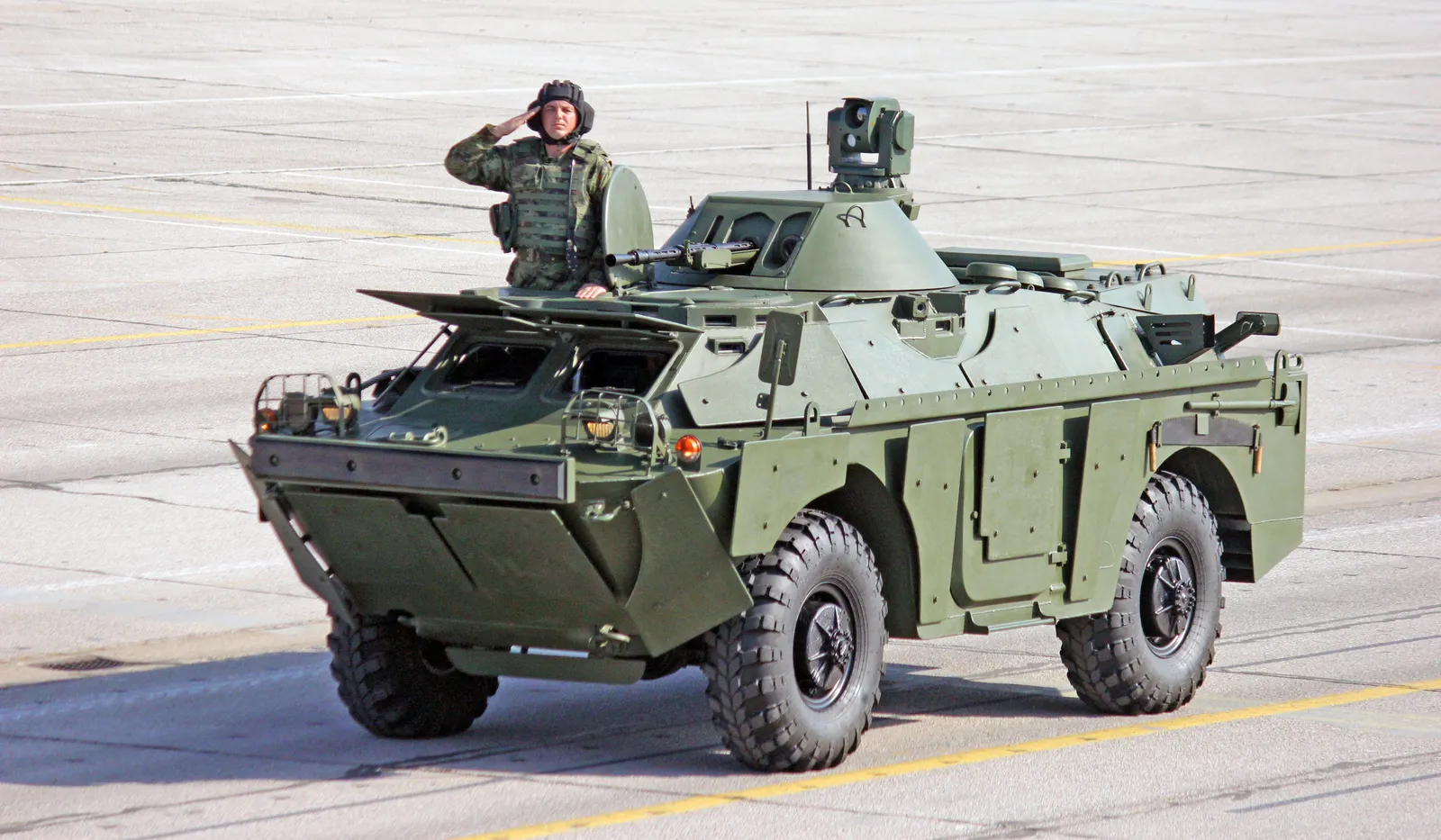
The BRDM-2MS is a Russian modernization of the Soviet BRDM-2 armored scout car, retaining the 14.5 mm KPVT and 7.62 mm PKT armament while adding a diesel engine, applique armor, side access, thermal and laser-rangefinding sights, GPS-linked navigation, and multiple observation cameras. Russian BRDM-2MS vehicles have been documented in the 2014 Russia-Ukraine War, including at least one visually confirmed Russian loss.

Role in Conflicts

Profile / Specs

Profile

Origin
Russia / Soviet BRDM-2 modernization
Built in
Russia
Type
Modernized armored reconnaissance vehicle
Service note
Late-2010s modernization of a Cold War BRDM-2 hull
Designer
B-Arms modernization project / 103rd Armored Repair Plant conversion reported in open sources
Designed
2016 modernization project reported by Russian-language references
Produced
Late 2010s-present modernization batches
Developed from
BRDM-2

Specifications

Crew
5: commander, driver, gunner/marksman, and two scouts
Armament
14.5 mm KPVT heavy machine gun and coaxial 7.62 mm PKT machine gun
Engine
150 hp diesel engine replacing the original petrol engine
Road speed
90-100 km/h on asphalt roads; 40-50 km/h on dirt roads
Range
About 1,500 km radius of travel reported by Serbian Armed Forces sources
Protection
14 mm front hull, 7 mm side armor, 8 mm floor, plus twenty 6 mm applique armor panels
Observation and fire control
Stabilized commander's sight, gunner device, thermal camera, laser range finder, GPS/electronic map, rear cameras, and six television cameras
Mobility limits
30 degree vertical slope and 25 degree side slope
Modernization Package

The BRDM-2MS modernization is centered on keeping an older BRDM-2 reconnaissance hull useful for observation, patrol, and security work. Official Serbian descriptions emphasize a new diesel engine, side doors, a modern fire-control system, thermal and television observation aids, GPS navigation, rear-view cameras, additional armor plates, and improved floor protection.

Observation

A stabilized commander's device, gunner sight, thermal camera, laser range finder, and six television cameras improve day, night, and all-around awareness.

Protection

Additional 6 mm armor panels and floor reinforcement raise protection over the basic BRDM-2, with Serbian sources describing all-aspect 7.62 mm and 12.7 mm protection and frontal 14.5 mm protection at 300 m.

Mobility

The modernization replaces the petrol engine with a 150 hp diesel and is reported with a road radius of about 1,500 km, while keeping a 90-100 km/h asphalt-road speed range.
Variants

The BRDM-2MS is one branch of the wider BRDM-2 modernization family rather than a newly designed vehicle.

VariantConfigurationDesignation notes
BRDM-2, Amphibious armored scout car, Armored VehiclesBRDM-2Base Soviet scout car

The MS modernization keeps the BRDM-2 hull concept and turret armament while changing mobility, protection, access, and sighting systems.

Sources: Serbian Armed Forces Presentation

BRDM-2MB BekasFollow-on Russian modernization

Defense reporting describes the BRDM-2MB Bekas as a later B-Arms modernization related to the BRDM-2MS line, with revised protection and crew-compartment changes.

Sources: Army Recognition BRDM-2MS Myanmar

Firing Weapons

The MS modernization keeps the BRDM-2 turret weapon set, pairing the vehicle with the KPV/KPVT heavy machine-gun family.

AmmunitionAmmunition typeFiring evidence
KPV, 14.5 mm heavy machine gun, Infantry WeaponsKPV14.5 mm heavy machine gun

Serbian official descriptions identify the BRDM-2MS main armament as a 14.5 mm KPVT machine gun paired with a 7.62 mm PKT coaxial gun.

Sources: Serbian MoD BRDM-2MS Enhancement

Timeline

BRDM-2MS Key Events

  1. First Serbian batch delivered

    Serbia reported that the first 10 of 30 donated BRDM-2MS vehicles arrived in July 2019.

    Sources: Serbian MoD BRDM-2MS Enhancement

  2. Serbia details modernization package

    The Serbian Ministry of Defence described the BRDM-2MS package as adding a diesel engine, new fire-control and observation equipment, additional armor panels, GPS navigation, side doors, and improved crew protection.

    Sources: Serbian MoD BRDM-2MS Enhancement

  3. Russian wartime supply reported

    Defense Express reported Russian BRDM-2MS vehicles moving through Ulan-Ude and linked the type to Russian airborne-unit use during the full-scale invasion period.

    Sources: Defense Express BRDM-2MS Supply

Related Weapon Systems
BRDM-2, Amphibious armored scout car, Armored VehiclesArmored VehiclesBRDM-2Amphibious armored scout carThe BRDM-2 is a Soviet amphibious armored scout car built for reconnaissance, patrol, liaison, and specialist battlefield-support tasks. Its family includes radiological and chemical reconnaissance versions such as BRDM-2RKh and BRDM-2RKhb, which add contamination-detection and marking equipment to the scout-car chassis. Oryx loss records keep both base and chemical reconnaissance variants visible in the Russia-Ukraine War, while older export fleets appear in Nagorno-Karabakh, Yemen, and other post-Soviet or Soviet-supplied conflicts despite the vehicle's light armor.
BRM-1 / BRM-1KM 675-sb3KDZ, Up-armored tracked reconnaissance vehicle, Armored VehiclesArmored VehiclesBRM-1 / BRM-1KM 675-sb3KDZUp-armored tracked reconnaissance vehicleThe BRM-1 / BRM-1KM 675-sb3KDZ is a Russian battlefield configuration of the BRM-1K/BRM-1KM reconnaissance-vehicle family fitted with the 675-sb3KDZ additional-protection package. Open-source loss records separately list BRM-1 and BRM-1KM 675-sb3KDZ vehicles among Russian reconnaissance-vehicle losses in Ukraine, while Russian modernization reporting and reference sources describe the BRM-1KM pattern as a BMP-1-derived armored reconnaissance platform with updated sensors, radios, navigation equipment, and 30 mm 2A72 armament.
BRM-1K, Tracked armored reconnaissance vehicle, Armored VehiclesArmored VehiclesBRM-1KTracked armored reconnaissance vehicleThe BRM-1K is a Soviet tracked armored reconnaissance vehicle derived from the BMP-1 chassis, combining amphibious mobility with battlefield surveillance equipment and a 73 mm 2A28 cannon. Russia later modernized the type as the BRM-1KM/BRM-1K Model 2021 with a BTR-82A-style combat compartment, 30 mm 2A72 armament, updated communications, and newer reconnaissance equipment; both legacy and modernized vehicles are visually documented in post-Soviet conflicts.
PRP-4 Nard / PRP-4M Deyteriy, Artillery reconnaissance vehicle, Armored VehiclesArmored VehiclesPRP-4 Nard / PRP-4M DeyteriyArtillery reconnaissance vehicleThe PRP-4 Nard and PRP-4M Deyteriy are BMP-1-derived Soviet artillery reconnaissance vehicles built to find targets, determine coordinates, and support artillery fire direction from a protected tracked platform. The family trades the BMP-1 infantry role for radar, optical, night-vision, navigation, data-link, and laser ranging equipment, with later PRP-4A Argus vehicles continuing the same artillery-observation line in Russian service.
1K148 Yastreb-AV, Self-propelled counter-battery artillery reconnaissance radar complex, Electronic WarfareElectronic Warfare1K148 Yastreb-AVSelf-propelled counter-battery artillery reconnaissance radar complexThe 1K148 Yastreb-AV is a Russian self-propelled counter-battery radar complex attributed to the Almaz-Antey industrial group and Tula-based NPO Strela. Open reporting describes it as a phased-array artillery reconnaissance system on a BAZ-6910-025 8x8 chassis, built to track incoming shells or rockets and calculate artillery firing positions for counter-battery fire. Russian state-linked reporting announced its use with Russian artillery units in Ukraine in January 2024, while Ukrainian military, government-linked, and independent news coverage later documented the destruction of multiple Russian Yastreb-AV systems.

Sources