Munitions

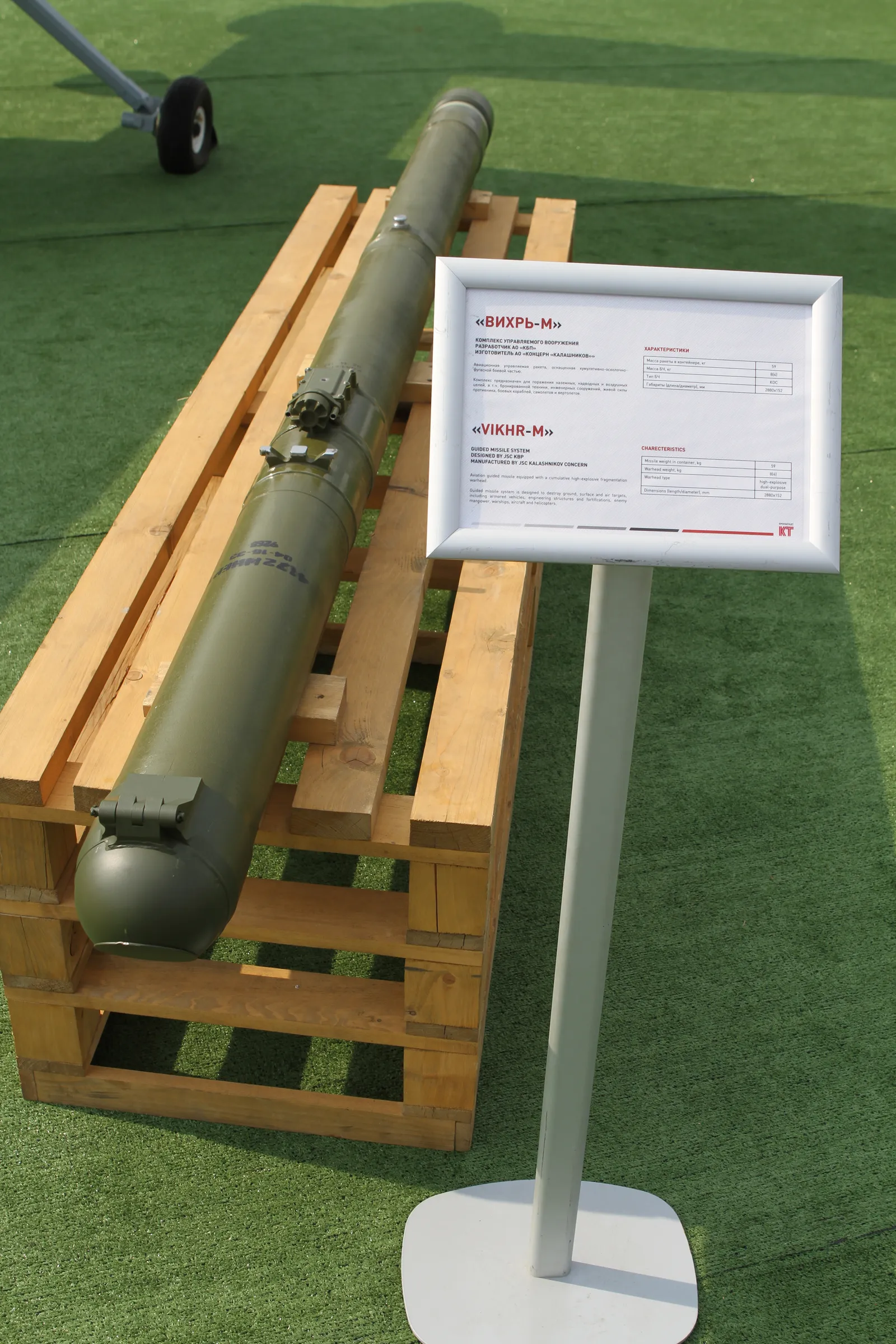
9M127 Vikhr-1

Also known as
  • Vikhr-1
  • Vikhr
  • Vikhr-M
  • 9K121 Vikhr
  • 9K121M Vikhr-M
  • 9M127
  • 9M127-1
  • AT-16 Scallion
  • Whirlwind

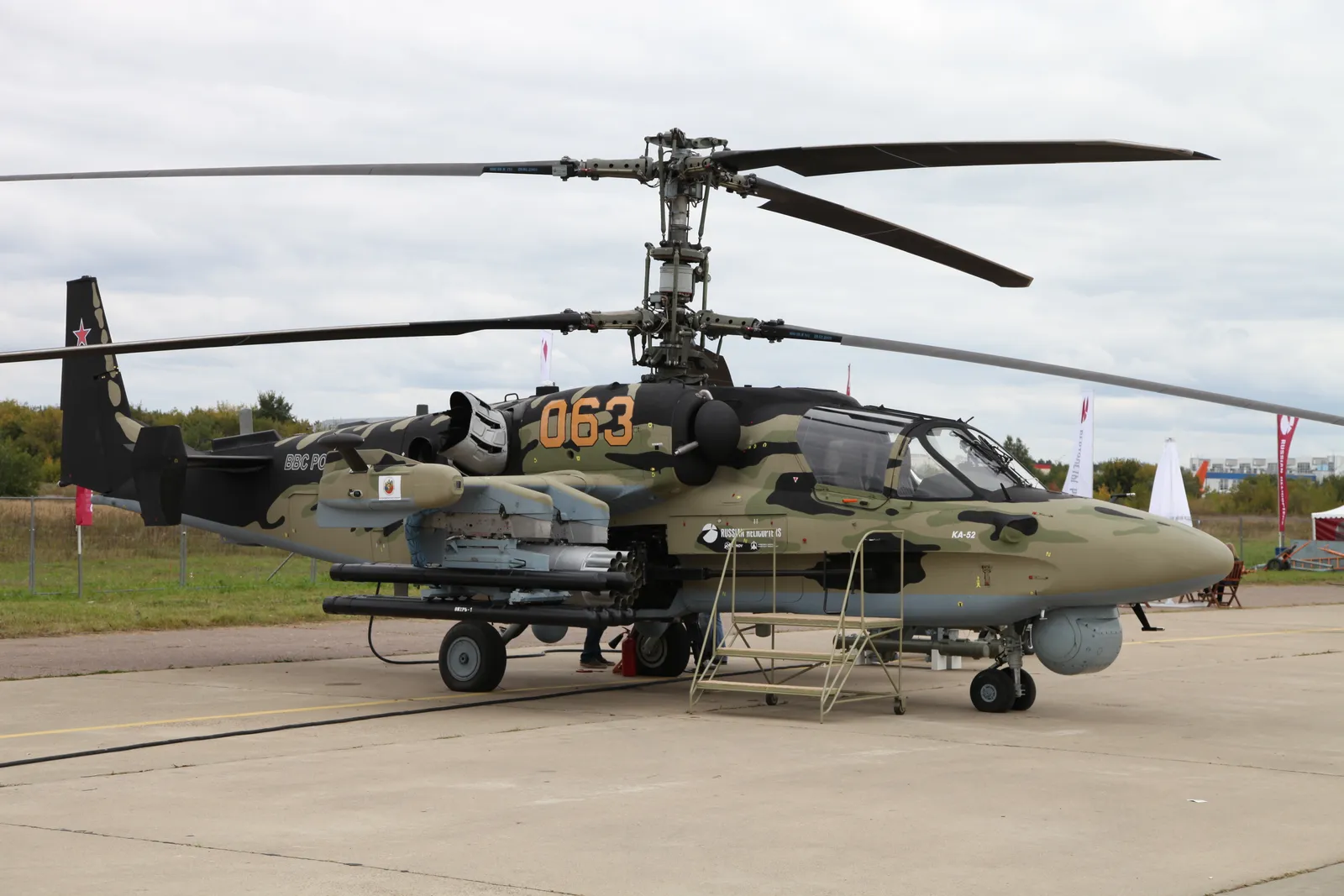
The 9M127 Vikhr-1 is a Russian air-launched anti-tank guided missile in the Vikhr/Vikhr-M family, associated with KBP development and Kalashnikov production. It uses laser beam-riding guidance, a tandem shaped-charge/fragmentation warhead, and attack-helicopter launch platforms such as the Ka-52, giving Russian aviation a standoff anti-armor weapon documented in the 2014 Russia-Ukraine War.

Role in Conflicts

Side
Russia

Russian forces are documented using Vikhr-1/Vikhr-family missiles from attack helicopters in Ukraine. EU Council sanctions documentation identifies Kalashnikov-produced Vikhr-1 missiles as used by Russian forces in the war, while TASS and defense reporting tie the missile to Ka-52 anti-armor loads and Russian MoD deliveries.

Role details
Profile / Specs

Profile

Origin
Soviet Union / Russia
Built in
Russia
Type
Air-launched anti-tank guided missile
Service note
Late Cold War missile family with Russian Vikhr-1 production and upgrades in the 2010s-2020s
Designer
KBP Instrument Design Bureau
Designed
1980s for the Vikhr family; Vikhr-1 modernization and procurement accelerated in the 2010s
Produced
1985-present for the broader Vikhr family; Vikhr-1 deliveries documented from 2015 onward

Specifications

Guidance
Laser beam-riding guidance with automatic target tracking in the Vikhr-M system
Range
Up to 10 km; Kalashnikov lists an 800-10,000 m engagement envelope for Vikhr-1
Flight time
About 23 seconds at 8 km, according to Kalashnikov's product data
Missile speed
More than 600 m/s; open references list about 610 m/s
Warhead
Tandem shaped-charge/fragmentation/high-explosive warhead
Warhead weight
8 kg class, with Kalashnikov listing 8(4) kg in product data
Penetration
Up to 750 mm behind explosive reactive armor in Kalashnikov/derived product descriptions
Launch platforms
Ka-52 attack helicopter; Vikhr-family sources also describe Ka-50, Su-25T/Su-25TM, Mi-28 adaptation, and unmanned-aircraft adaptation work
Guidance And Carrier Context

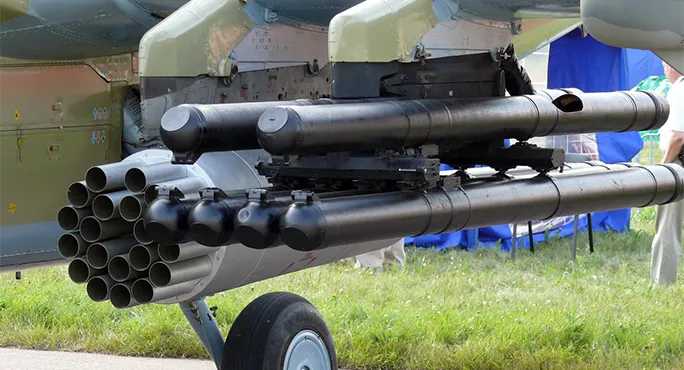
The missile is best understood as part of a sighting, launcher, and carrier-aircraft package rather than as a hand-launched round. Sources consistently describe laser beam-riding guidance, automatic target tracking in the Vikhr-M system context, and Ka-52 carriage as central to the Vikhr-1 role.

ElementSourced detailReader value
GuidanceLaser beam-riding missile control with automatic target tracking described for the Vikhr-M/Vikhr-1 system.Explains why the munition stays tied to the launching aircraft's sighting and control channel.
Engagement envelopeKalashnikov lists an 800-10,000 m range envelope, and defense reporting repeats a more than 600 m/s missile-speed class.Frames the missile as a standoff anti-armor weapon for attack-helicopter crews.
Carrier integrationKa-52 carriage is documented by Kalashnikov, Army Recognition, and WeaponSystems.net; Mi-28 and UAV adaptation work is reported separately.Separates documented Ka-52 carriage from broader integration or adaptation claims.

Sources: Vikhr-1 Guided Aircraft Missile; Kalashnikov delivers Vikhr-1 missiles to Russian MoD; Kamov Ka-52 Alligator; Mi-28N to be armed with improved Vikhr-1; Kalashnikov Group could use Vikhr missiles on UAVs and helicopters.
Launch Platforms

The Vikhr-1 is an air-launched missile, so its battlefield role depends on attack-helicopter and aircraft integration rather than a standalone ground launcher.

LauncherLauncher typeLaunch evidence
Ka-52, Attack and reconnaissance helicopter, Aircraft & UAVsKa-52Attack helicopter

Kalashnikov and Army Recognition identify the Ka-52 as a Vikhr-1 carrier, and WeaponSystems.net describes Ka-52 hardpoints carrying Vikhr anti-tank missiles on UPP-800 racks.

Sources: Vikhr-1 Guided Aircraft Missile, Kalashnikov delivers Vikhr-1 missiles to Russian MoD, Kamov Ka-52 Alligator

Mi-28, Attack helicopter, Aircraft & UAVsMi-28Attack helicopter

Russian defense-industry reporting described adaptation of the Vikhr-1 missile for Mi-28N/Mi-28NM-family attack helicopters, broadening the missile beyond its core Ka-52 carriage.

Sources: Mi-28N to be armed with improved Vikhr-1, Kalashnikov Group could use Vikhr missiles on UAVs and helicopters

Su-25, Ground-attack aircraft, Aircraft & UAVsSu-25Close-air-support aircraft

Open reference sources list Su-25T/Su-25TM carriage for the wider Vikhr family; this relationship is retained as family context rather than a documented Vikhr-1 combat-use claim.

Sources: 9K121 Vikhr

Designation And Role Map

The Vikhr family is often described through overlapping missile, launcher, and system designations. The table below keeps those names separate so the record can be read as a munition page rather than a helicopter page.

DesignationWhat it describesCatalog use
9K121 VikhrBaseline Soviet/Russian laser beam-riding missile systemFamily background and alias coverage.
9K121M Vikhr-MModernized aviation missile system branchSystem context for the upgraded 9M127-1 missile.
9M127 / 9M127-1 Vikhr-1Guided aircraft missile carried in launch containersPrimary munition represented by this page.
AT-16 ScallionNATO reporting name used in reference sourcesSearch alias and cross-reference term.

Sources: 9K121 Vikhr; Vikhr-1 Guided Aircraft Missile; Kalashnikov delivers Vikhr-1 missiles to Russian MoD; Egypt first international customer for Vikhr-1.

Timeline

9M127 Vikhr-1 Key Events

  1. Baseline Vikhr family enters service

    Open reference and defense-industry reporting describe the original Vikhr anti-tank guided missile family as entering Soviet service in the mid-1980s.

    Sources: 9K121 Vikhr, Egypt first international customer for Vikhr-1

  2. Farnborough public showing

    The 9K121 Vikhr family was publicly shown at the 1992 Farnborough Airshow, helping establish the system's export-facing identity.

    Sources: 9K121 Vikhr

  3. Russian MoD procurement contract reported

    Airforce Technology reported a Russian Ministry of Defence contract with Izhmash for Vikhr-1 laser-guided anti-tank missile-system deliveries, with completion scheduled by 2015.

    Sources: Izhmash to supply Vikhr-1 missiles to Russian military

  4. Vikhr-1 supplies begin

    Defense reporting says upgraded Vikhr-1 supplies to Russian forces began in 2015 after the family had not been mass-produced in the same way during the Soviet period.

    Sources: Egypt first international customer for Vikhr-1, Kalashnikov delivers Vikhr-1 missiles to Russian MoD

  5. Egypt export customer identified

    Army Recognition, citing SIPRI transfer data, reported Egypt as the first international customer for the 9A1472 Vikhr-1 missile for its Ka-52 helicopter fleet.

    Sources: Egypt first international customer for Vikhr-1

  6. Ka-52 training launches documented

    A Russian Ministry of Defence video file hosted on Wikimedia Commons describes Vikhr-1 missile tests by a Ka-52 from roughly 300 m altitude against targets about 8 km away.

    Sources: File:Testing of Vikhr-1 missiles (28-10-2020).webm

  7. Ukraine-war anti-armor role reported

    TASS reported Russian expert commentary on Vikhr missiles in the context of Western tanks supplied to Ukraine and identified the missile as part of the Ka-52 assault helicopter ammunition load; later sanctions documentation also tied Vikhr-1 missiles to Russian use in the war.

    Sources: Vikhr air-launched missile can smash any Western tank transferred to Ukraine, EU Council Decision 2026 Vikhr-1 Ukraine sanctions

  8. Improved Vikhr-1 shipments announced

    Kalashnikov and TASS reported that a modified Vikhr-1 missile with improved combat capabilities had entered production and shipment, without disclosing detailed performance changes.

    Sources: Kalashnikov releases updated Vikhr-1 missile, Kalashnikov improves Vikhr-1 aviation missile

Media
Related Weapon Systems
9M311 surface-to-air missile, Two-stage command-guided surface-to-air missile, MunitionsMunitions9M311 surface-to-air missileTwo-stage command-guided surface-to-air missileThe 9M311 is a Soviet two-stage, radio-command guided surface-to-air missile family developed for the Tunguska gun-missile air-defense system and adapted for naval Kortik/Kashtan installations. Sources describe a detachable booster, an unpowered missile stage guided by radio commands, and a continuous-rod warhead. Open reporting also documents Ukrainian Tunguska use with a 9M311-series missile firing during the 2014 Russia-Ukraine War.
Izdeliye 305 (LMUR), Helicopter-launched air-to-surface guided missile, MunitionsMunitionsIzdeliye 305 (LMUR)Helicopter-launched air-to-surface guided missileIzdeliye 305, commonly called LMUR, is a Russian helicopter-launched air-to-surface guided missile developed by KB Mashinostroyeniya for long-range precision attacks from Mi-8, Mi-28, and Ka-52 family helicopters. The missile combines inertial/satellite navigation with an electro-optical seeker and operator-in-the-loop terminal control, giving Russian crews a standoff weapon documented in Ukraine against vehicles, bridges, buildings, and other point targets.
9M133 Kornet, Laser beam-riding anti-tank guided missile system, Infantry WeaponsInfantry Weapons9M133 KornetLaser beam-riding anti-tank guided missile systemThe 9M133 Kornet is a Russian heavy anti-tank guided missile system using laser beam-riding guidance and tandem HEAT or thermobaric warheads. Developed by KBP as a portable, vehicle-integrated, and self-propelled ATGM family, it appears in recent conflicts as a Russian-origin anti-armor weapon documented with state forces and non-state armed groups, including captured launchers and destroyed 9P163M-1 Kornet-T vehicles in Ukraine.

Sources