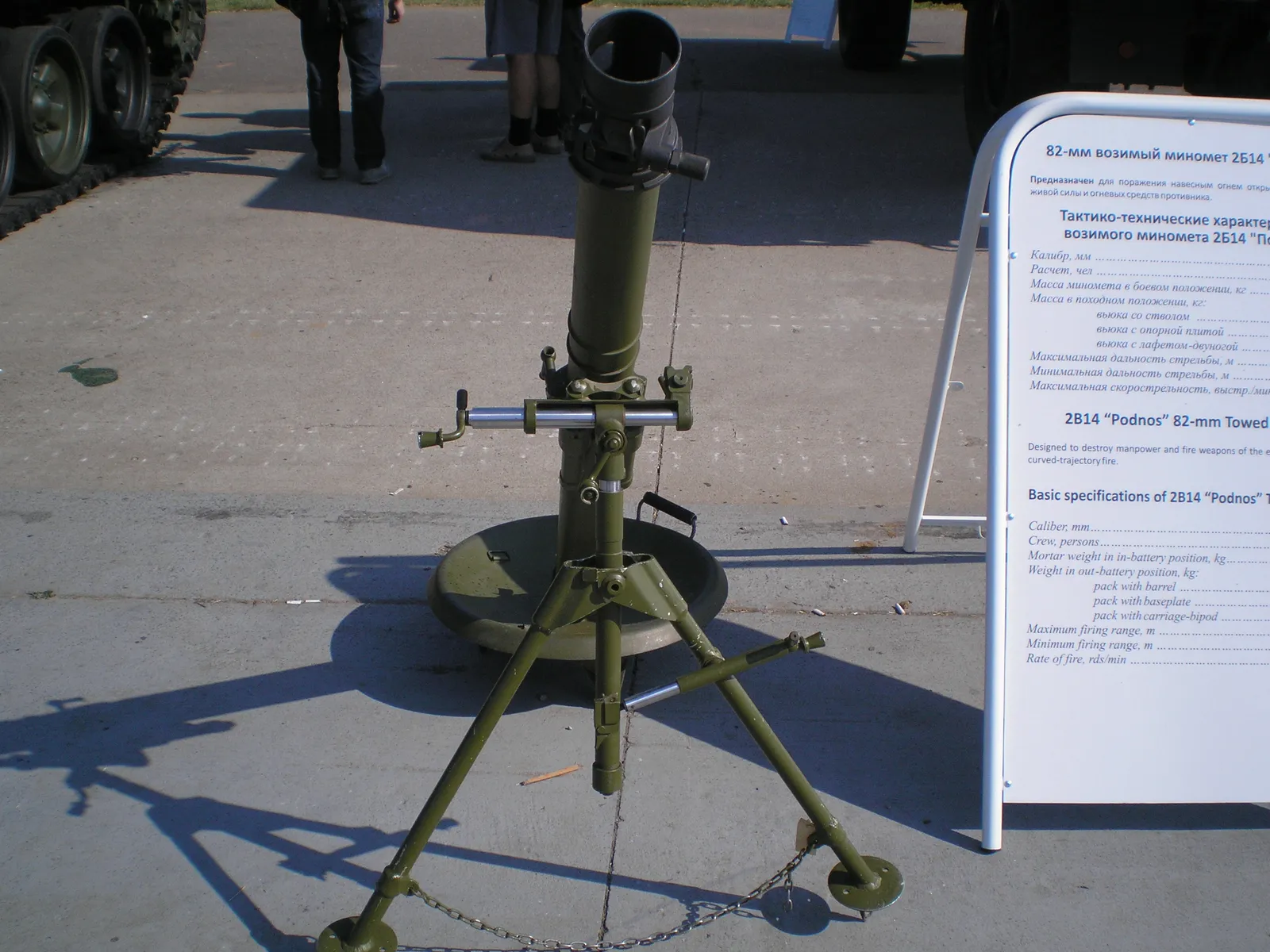


OSCE reporting tied the 2B14 Podnos to Ukrainian storage-site monitoring in 2016, spotted 2B14 or probable 2B14 mortars in government- and non-government-controlled areas in 2019, and recorded a 2B14 in a non-government-controlled area in 2020. Open-license Russian Ministry of Defence footage hosted by Wikimedia Commons identifies Russian VDV troops using 2B14 Podnos mortar support in Ukraine on 2023-02-23; that source supports Russian-side fielding, not independent verification of the video's tactical claims.
Role detailsArtillery
2B14 Podnos
Also known as
- 2B14
- 2B14-1
- 2Б14
- 2Б14-1
- Podnos
- 2B14 Podnos 82 mm mortar
- 82 mm mortar 2B14
- 82mm 2B14 Podnos
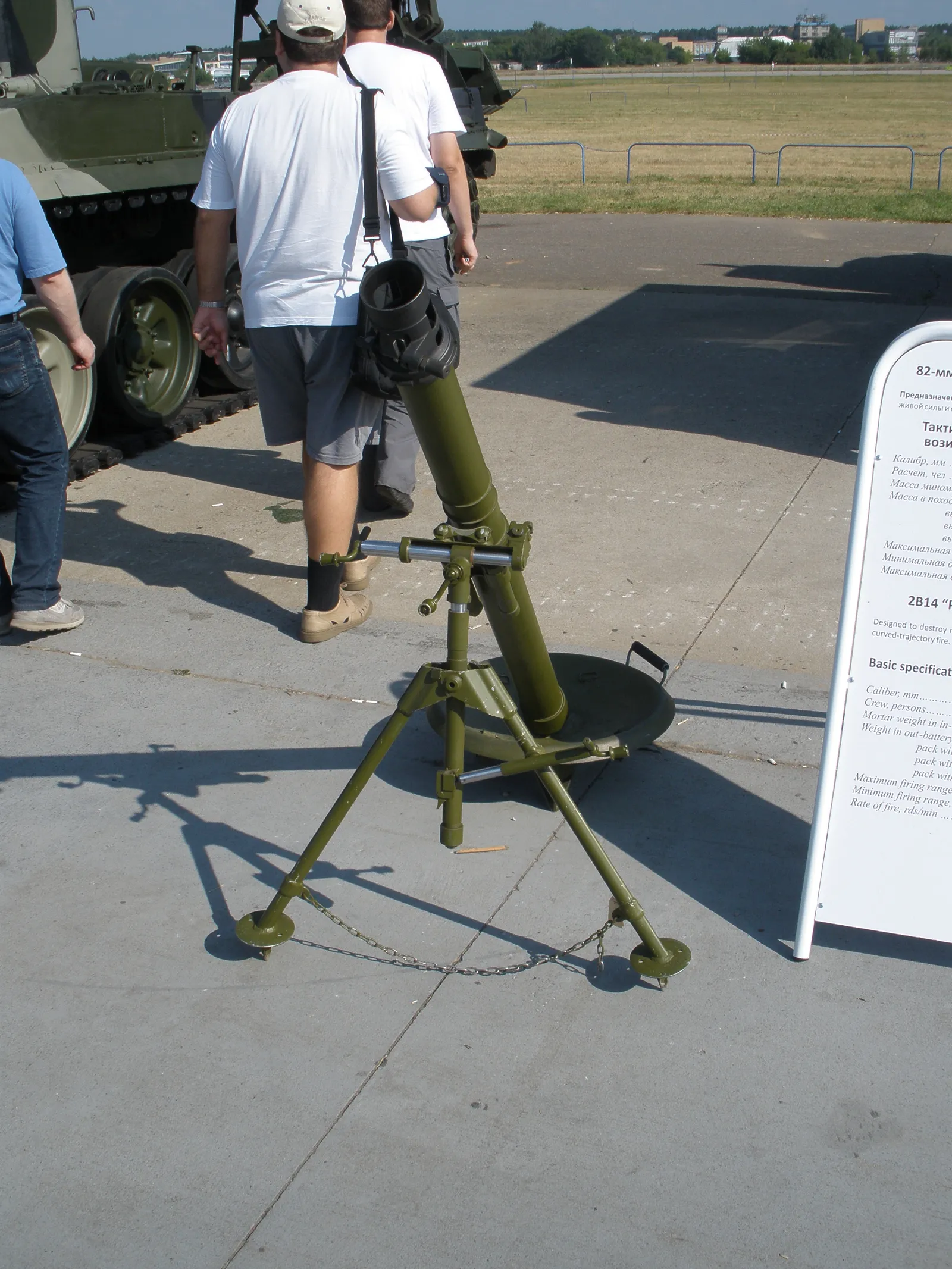
The 2B14 Podnos is a Soviet 82 mm smoothbore mortar developed in the early 1980s as a lighter, longer-ranged replacement for older battalion mortars. Its barrel, baseplate, and bipod can be broken into infantry-portable loads, while OSCE and open-license Russian Ministry of Defence media document Podnos mortars on both sides of the 2014 Russia-Ukraine War.
Role in Conflicts
Profile / Specs
Profile
- Origin
- Soviet Union
- Built in
- Soviet UnionRussia
- Type
- 82 mm smoothbore mortar
- Service note
- Entered Soviet service in 1984; still fielded by post-Soviet forces
- Designer
- Soviet design bureau associated with Gorky Engineering Plant
- Designed
- 1983
- Unit cost
- About $15,000 in 1992
- Produced
- 1984-present
- Number built
- Over 3,000 reported by WeaponSystems.net
Specifications
- Caliber
- 82 mm smoothbore mortar
- Crew
- 4-5 personnel, depending on source and operating practice
- Weight
- About 42 kg in firing position
- Pack loads
- About 16.2 kg barrel assembly, 17 kg baseplate, and 13.9 kg bipod loads
- Maximum range
- About 4.0-4.27 km, depending on ammunition and source
- Rate of fire
- Up to 24-30 rounds per minute maximum
- Elevation
- 45 to 85 degrees
- Mobility
- Breaks down into barrel, baseplate, and bipod loads; optional 2F510 two-wheel carriage
Variants
The page keeps 2B14 and 2B14-1 as core Podnos designations in aliases and prose. The visible variant row is limited to an externally named production designation supported by the cited source.
| Variant | Configuration | Designation notes |
|---|---|---|
| M82 | Bulgarian production designation | WeaponSystems.net lists M82 as a Bulgarian production designation in the 2B14 Podnos family. Sources: 82mm 2B14 Podnos |
Ammunition Fired
The 2B14 Podnos is documented by two independent product pages as a launcher for the VO-832DU 82 mm high-explosive mortar bomb.
| Ammunition | Ammunition type | Firing evidence |
|---|---|---|
 | 82 mm high-explosive mortar bomb | Arcus and BULCOMERS both list the VO-832DU as compatible with the 2B14 Podnos and other 82 mm smooth-bore mortars. Sources: 82mm HE Mortar Bomb VO-832DU, 82mm Mortar Round VO-832DU |
Design, Ammunition, And Successor Context
The Podnos sits in the light-infantry mortar role: a smoothbore 82 mm tube, round baseplate, and bipod/sight assembly that can be broken into crew-carried loads for short moves.
| Context | Sourced detail | Catalog treatment |
|---|---|---|
| Portable mortar layout | WeaponSystems.net describes the 2B14 as a lighter PM-37 replacement with a barrel, muzzle safety device, round baseplate, bipod, and sight assembly; it lists separate barrel, baseplate, and bipod pack weights. | Used for the mobility and pack-load specification fields. |
| Firing envelope | WeaponSystems.net and Army Recognition give an 82 mm smoothbore mortar with roughly 4.0-4.27 km maximum range and up to 24-30 rounds per minute maximum fire rate. | Kept as source-bounded specification ranges because ammunition and reference conventions differ. |
| Ammunition compatibility | Arcus and BULCOMERS list the VO-832DU 82 mm high-explosive mortar bomb as compatible with the 2B14 Podnos and other smooth-bore 82 mm mortars. | Rendered as a linked ammunition relationship to the published VO-832DU record. |
| Successor context | Rosoboronexport and EDR describe the 2B24 as a newer 82 mm mortar with greater range and quick disassembly; EDR frames its 6,000 m range as nearly 50 percent more than the in-service 2B14-1. | Used as lineage context, not merged into the 2B14 Podnos specifications. |
Sources: 82mm 2B14 Podnos; Analysis: Russian Defense Industry Promotes Modern Artillery Systems on Global Military Market; 82mm HE Mortar Bomb VO-832DU; 82mm Mortar Round VO-832DU; Rosoboronexport 2B24 Mortar; EDR New Mortars for the Russian Army.
Timeline
2B14 Podnos Key Events
2B14 development recorded
WeaponSystems.net places 2B14 Podnos development in 1983 as a Soviet 82 mm mortar program intended to replace older PM-37-family mortars.
Sources: 82mm 2B14 Podnos
Entered service and production
The same reference lists 1984 as the service-entry and production-start year for the Podnos mortar, with Burevestnik production in the Soviet Union and Russia.
Sources: 82mm 2B14 Podnos
OSCE storage-site record names Podnos
OSCE monitoring reported a 2B14 Podnos 82 mm mortar in Ukrainian Armed Forces permanent storage-site monitoring during the Donbas phase of the 2014 Russia-Ukraine War.
Sources: Latest from OSCE Special Monitoring Mission to Ukraine, 9 September 2016
OSCE reports Podnos sightings on both sides
An OSCE daily report described probable or confirmed 2B14 Podnos mortars in both government-controlled and non-government-controlled areas of Donbas.
Sources: Latest from the OSCE Special Monitoring Mission to Ukraine, 15 April 2019
Russian VDV footage identifies 2B14 support
A Wikimedia Commons-hosted Russian Ministry of Defence video file identifies Russian VDV troops using 2B14 Podnos mortar support in northeastern Ukraine.
Sources: Russian VDV 2B14 Podnos Mortar Footage
Media
2B14 Podnos Images
Related Weapon Systems


Sources
82mm 2B14 PodnosPublisher: WeaponSystems.net | Note: Supports background, development, producer, service-entry, production, user, mobility, and technical specification context. | Accessed: 2026-06-30Analysis: Russian Defense Industry Promotes Modern Artillery Systems on Global Military MarketPublisher: Army Recognition | Note: Supports Podnos role and Rosoboronexport-reported specifications including range, rate of fire, elevation, traverse, weight, and crew. | Accessed: 2026-06-30Latest from OSCE Special Monitoring Mission to Ukraine, 9 September 2016Publisher: Organization for Security and Co-operation in Europe | Note: Directly documents a 2B14 Podnos mortar in Ukrainian Armed Forces permanent storage-site monitoring during the 2014 Russia-Ukraine War. | Accessed: 2026-06-30Latest from the OSCE Special Monitoring Mission to Ukraine, 15 April 2019Publisher: Organization for Security and Co-operation in Europe | Note: Directly documents probable and confirmed 2B14 Podnos 82 mm mortars in government- and non-government-controlled areas of Donbas during the 2014 Russia-Ukraine War. | Accessed: 2026-06-30OSCE SMM Daily Report, 19 October 2020Publisher: Organization for Security and Co-operation in Europe | Note: Directly documents a 2B14 Podnos 82 mm mortar near Peremozhne in a non-government-controlled area during the 2014 Russia-Ukraine War. | Accessed: 2026-07-01Russian VDV 2B14 Podnos Mortar FootagePublisher: Wikimedia Commons | Note: Directly supports 2014 Russia-Ukraine War Russian-side fielding context: the file description identifies Russian VDV troops in Ukraine using support from a 2B14 Podnos mortar on 2023-02-23; because the underlying source is Russian Ministry of Defence media, it is not used for independent tactical-outcome claims. | Accessed: 2026-06-302B14 Podnos at Engineering Technologies 2010 ForumPublisher: Wikimedia Commons | Note: Primary image provenance; the file page lists James Robert Nockson as author and Creative Commons Attribution-Share Alike 3.0 Unported licensing. | Accessed: 2026-06-302B14 Podnos at Engineering Technologies 2010 Forum (2)Publisher: Wikimedia Commons | Note: Gallery image provenance; the file page lists James Robert Nockson as author and Creative Commons Attribution-Share Alike 3.0 Unported licensing. | Accessed: 2026-06-3082mm HE Mortar Bomb VO-832DUPublisher: Arcus JSC | Note: Supports the VO-832DU compatibility listing for the 2B14 Podnos and other 82 mm smooth-bore mortars. | Accessed: 2026-06-3082mm Mortar Round VO-832DUPublisher: BULCOMERS KS Ltd. | Note: Supports the VO-832DU compatibility listing for the 2B14 Podnos and other 82 mm smooth-bore mortars. | Accessed: 2026-06-30Rosoboronexport 2B24 MortarPublisher: Rosoboronexport | Note: Supports successor-system context for the 2B24 82 mm mortar, including range, crew, rate of fire, disassembly, and traverse data used only for contrast with the 2B14 family. | Accessed: 2026-06-30EDR New Mortars for the Russian ArmyPublisher: EDR Magazine | Note: Supports Burevestnik 2B24 successor context and the comparison that its 6,000 m maximum range is nearly 50 percent more than the in-service 2B14-1. | Accessed: 2026-06-30