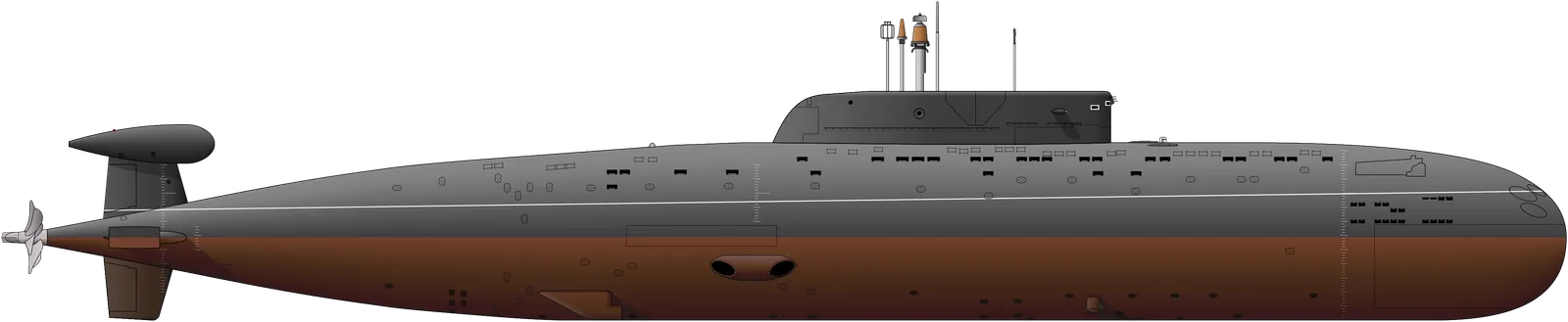

Russian and Norwegian-area reporting documents Project 945A boats Pskov and Nizhny Novgorod in Northern Fleet service, including 2019 Norwegian Sea deep-diving, equipment checks, and torpedo exercise activity. Available sources do not tie Sierra II boats to a named armed conflict, so the entry remains in the holding archive.
Naval Systems
Sierra II
Also known as
- Project 945A
- Project 945A Kondor
- Project 945A Condor
- Condor
- Kondor
- Sierra II class
- B-336 Pskov
- K-336 Pskov
- B-534 Nizhny Novgorod
- K-534 Nizhny Novgorod
Sierra II is the NATO reporting name for Project 945A Kondor, Lazurit's improved titanium-hulled Soviet nuclear attack submarine design built by Krasnoye Sormovo. The two completed boats, K-534/B-534 Nizhny Novgorod and K-336/B-336 Pskov, entered service in 1990 and 1993 and are documented as Northern Fleet submarines, with Russian reporting in February 2024 placing both at Nerpa awaiting repair and modernization.
Role in Conflicts
Profile / Specs
Profile
- Origin
- Soviet Union
- Built by
- Krasnoye Sormovo Shipyard
- Type
- Nuclear-powered attack submarine
- Service note
- Nizhny Novgorod accepted in 1990 and Pskov accepted in 1993; both reported at Nerpa awaiting repair and modernization in February 2024
- Designer
- Lazurit Central Design Bureau
- Designed
- Project 945A Kondor developed in the 1980s as the improved Project 945 titanium-hulled attack submarine variant
- Produced
- 1986-1993
- Number built
- 2 completed Project 945A boats
Specifications
- Displacement
- Reported values vary: RussianShips lists 6,466 tons surfaced and 8,500 tons submerged; Deepstorm lists 6,466/10,412 tons; Mil.Press FLOT lists Pskov at 6,300/9,100 tons
- Length
- About 110.5-110.62 m depending on source
- Beam
- 12.2-12.28 m hull beam; Deepstorm separately reports 16.7 m across stabilizers
- Draft
- About 9.4-9.5 m in RussianShips/Deepstorm; Mil.Press FLOT lists 8.8 m for Pskov
- Propulsion
- One OK-650B/OK-650M-series pressurized-water reactor, one 50,000 hp turbine unit, single shaft, auxiliary electric motors and thrusters
- Speed
- About 32.8-35 knots submerged; 14-19 knots surfaced depending on source
- Diving depth
- 520 m working and 600 m maximum per TASS; RussianShips lists 480 m operational and 600 m maximum
- Endurance
- 100 days
- Crew
- 65 normally cited; some sources list later complement around 70-71 or Pskov at 59
- Armament
- Six 533 mm bow torpedo tubes for torpedoes and tube-launched missiles including 3K10 Granat and URPK-6 Vodopad; Russian references also list Igla/Strela-type MANPADS for self-defense
- Sensors
- MGK-540 Skat-3 sonar fit is reported by RussianShips/Deepstorm; Covert Shores describes the enlarged Sierra II bow sonar as a major reason for the all-533 mm tube layout
Design Notes
Hull and signature
Project 945A carried forward the Project 945 titanium-hull approach, with Russian references describing the class around deep-diving performance and reduced acoustic or magnetic signatures.
Sail and escape pods
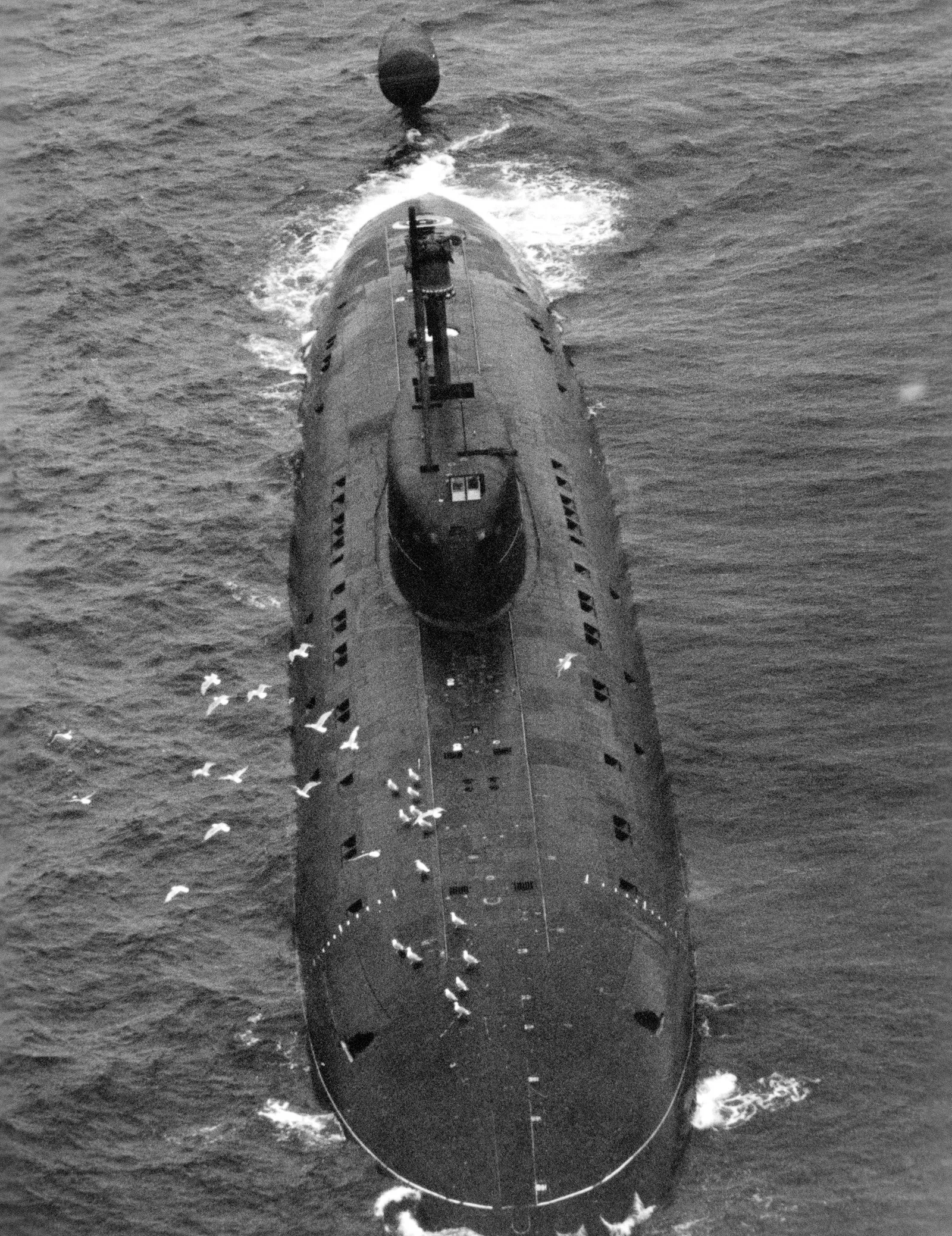
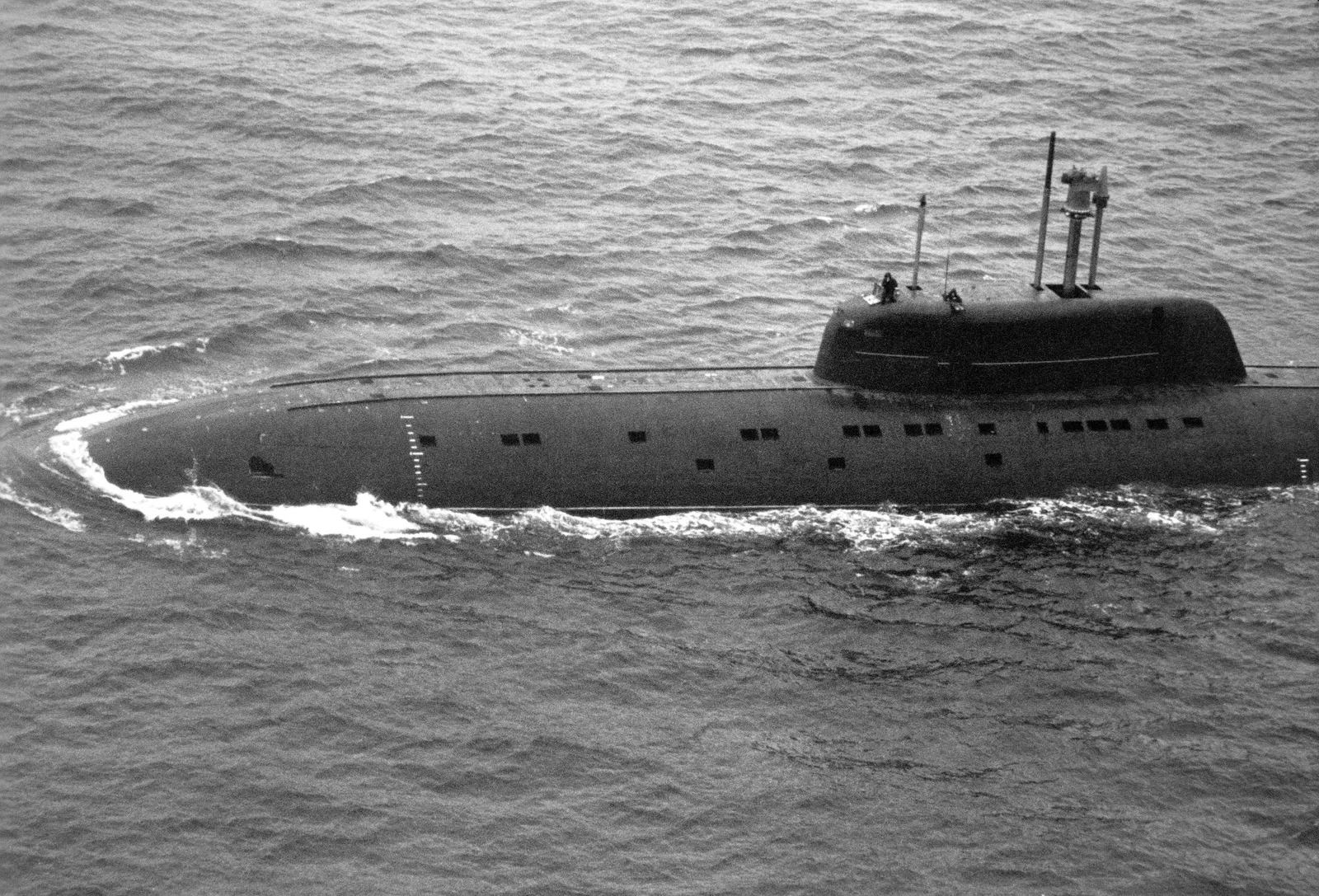
Open-source recognition notes distinguish Sierra II by its enlarged sail and two sail-mounted escape pods, a visible change from the Sierra I layout.
Weapons fit
RussianShips, Deepstorm, and Covert Shores describe the Project 945A armament around six 533 mm bow tubes, with tube-launched missiles and torpedoes rather than the mixed 650 mm/533 mm fit associated with earlier Sierra I boats.
Variants
Project 945A Kondor consisted of two completed Krasnoye Sormovo boats; both changed tactical number or name during service.
| Variant | Configuration | Designation notes |
|---|---|---|
| K-534 / B-534 Nizhny Novgorod | First Project 945A hull | Yard number 3003; laid down 1986-02-15, launched 1989-07-08, accepted 1990-12-26, and renamed from Zubatka to Nizhny Novgorod in 1995. |
| K-336 / B-336 Pskov | Second Project 945A hull | Yard number 3004; laid down in July 1989, launched 1992-07-28, accepted 1993-12-14, and renamed from Okun to Pskov in 1996. Sources: Project 945A Kondor, Pskov Project 945A |
Timeline
Sierra II Key Events
Nizhny Novgorod laid down
Deepstorm and RussianShips list the first Project 945A hull as a Krasnoye Sormovo boat with yard number 3003.
Sources: Project 945A Kondor, Nizhny Novgorod Project 945A
Lead Project 945A accepted
Deepstorm records the acceptance date under the boat's earlier K-534/Zubatka identity.
Sources: Nizhny Novgorod Project 945A
Pskov accepted
The second Project 945A hull gave the class its two completed Sierra II submarines.
Sources: Pskov Project 945A
Nizhny Novgorod returned from Nerpa
The repair history is part of the class's long post-Soviet sustainment pattern.
Sources: Nizhny Novgorod Project 945A
Pskov returned after readiness restoration
Deepstorm and Barents Observer reporting place Pskov back with the Northern Fleet after the repair period.
Sources: Pskov Project 945A, Old titanium submarine sets sail
Norwegian Sea deep-diving work
The exercise activity is the strongest modern operation evidence for the holding-bucket conflict row, but it is not a named combat deployment.
Sources: RIA Novosti Norwegian Sea drills, Barents Observer North Atlantic drill
Barents Sea torpedo exercise
The report identifies both Project 945A submarines and describes exercise firing rather than wartime employment.
Sources: RBC Pskov Nizhny Novgorod exercise
Modernization reported as not started
The item also gives current open-source values for depth, endurance, speed, crew, and the class's cruise-missile and torpedo armament.
Sources: TASS Project 945A modernization
Media
Related Weapon Systems


Sources
SIERRA-IIPublisher: Covert Shores | Note: Supports Sierra II recognition and design context: two titanium-hulled Northern Fleet boats, enlarged sail with two escape pods, enlarged sonar, and the all-533 mm tube distinction from Sierra I. | Accessed: 2026-07-03Project 945 - RussianShips.infoPublisher: RussianShips.info | Note: Supports Project 945A builder, hull list, dimensions, propulsion, armament, sensors, endurance, crew, and operating-depth data. | Accessed: 2026-07-03Project 945A KondorPublisher: Deepstorm | Note: Supports Project 945A class overview, two completed boats, Krasnoye Sormovo build, yard numbers, dates, six 533 mm torpedo tubes, Granat/Vodopad/Igla-family armament notes, titanium-hull design context, and specifications. | Accessed: 2026-07-03Nizhny Novgorod Project 945APublisher: Deepstorm | Note: Supports the K-534/B-534 Nizhny Novgorod hull chronology, naming history, repair history, and 2019/2024 service-status notes. | Accessed: 2026-07-03Pskov Project 945APublisher: Deepstorm | Note: Supports the K-336/B-336 Pskov hull chronology, naming history, 2011-2015 Nerpa readiness restoration, 2019 exercise activity, and 2024 modernization-awaiting status. | Accessed: 2026-07-03TASS Project 945A modernizationPublisher: TASS | Note: Supports 2024 modernization status and specifications: Pskov and Nizhny Novgorod were reported at Nerpa awaiting repair/modernization, with TASS noting no official confirmation; it also lists the Project 945A strike weapons, titanium-hull status, depth, endurance, speed, and crew. | Accessed: 2026-07-03RIA Novosti Norwegian Sea drillsPublisher: RIA Novosti | Note: Supports 2015 Various Conflicts holding-row context: RIA, citing the Northern Fleet press service, reported Pskov and Nizhny Novgorod fielded by the Northern Fleet for deep-diving tasks in the Norwegian Sea with checks of equipment and weapons, but not a named armed-conflict deployment. | Accessed: 2026-07-03RBC Pskov Nizhny Novgorod exercisePublisher: RBC | Note: Supports 2015 Various Conflicts holding-row context: RBC, citing the Northern Fleet press service, reported Project 945A boats Pskov and Nizhny Novgorod fielded by the Northern Fleet for search, pursuit, countermeasure, and torpedo-firing exercise phases in the Barents Sea. | Accessed: 2026-07-03Barents Observer North Atlantic drillPublisher: The Barents Observer | Note: Supports 2015 Various Conflicts holding-row context: Norwegian intelligence reporting placed Pskov and Nizhny Novgorod as fielded by Russia in northern Norwegian Sea training during a major North Atlantic operation, but not in a named armed conflict. | Accessed: 2026-07-03Old titanium submarine sets sailPublisher: The Barents Observer | Note: Supports Pskov's return to Northern Fleet service after repair/restoration work in late 2015. | Accessed: 2026-07-03Lazurit Central Design BureauPublisher: podlodka.info | Note: Supports Lazurit/CKB-112 design-bureau context and identifies Project 945 and 945A as Lazurit submarine projects under chief designer N. I. Kvasha. | Accessed: 2026-07-03Sierra II class SSN.svgPublisher: Wikimedia Commons | Note: Supports image provenance and licensing context for the Sierra II silhouette illustration used as the primary image. | Accessed: 2026-07-03Sierra class submarine 2.jpgPublisher: Wikimedia Commons | Note: Supports public-domain image provenance for a Sierra-class submarine photograph used as class-context gallery media; the Commons description identifies the photographed boat as Project 945 rather than Project 945A. | Accessed: 2026-07-03Sierra class submarine.jpgPublisher: Wikimedia Commons | Note: Supports public-domain image provenance for a Sierra-class submarine photograph used as class-context gallery media; it is retained as contextual media rather than the exact Sierra II primary image. | Accessed: 2026-07-03