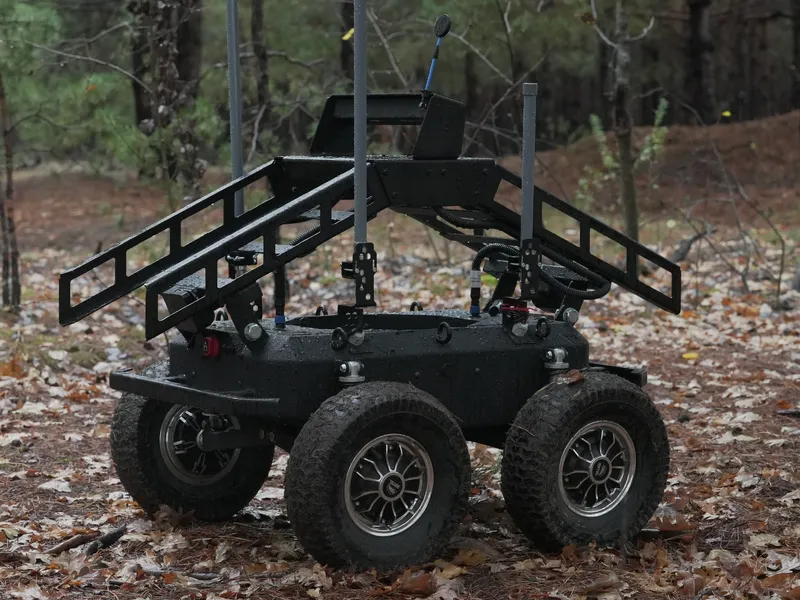
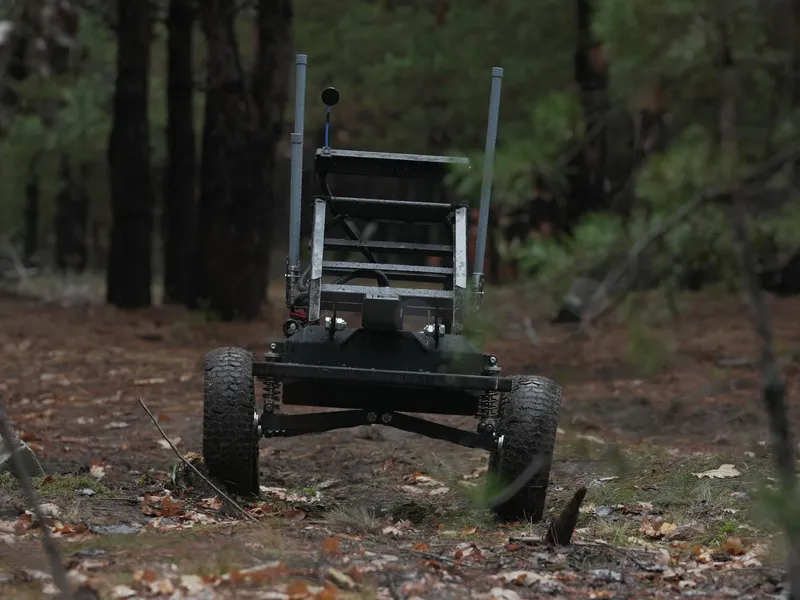
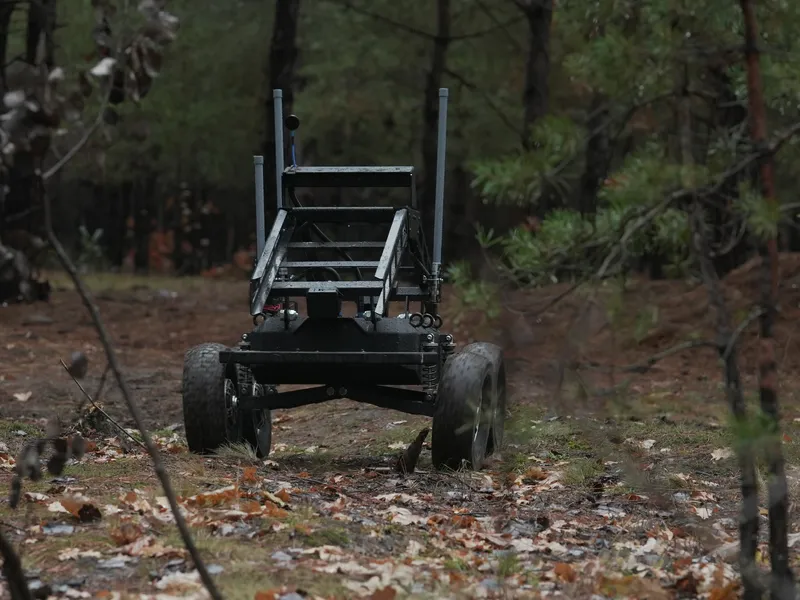
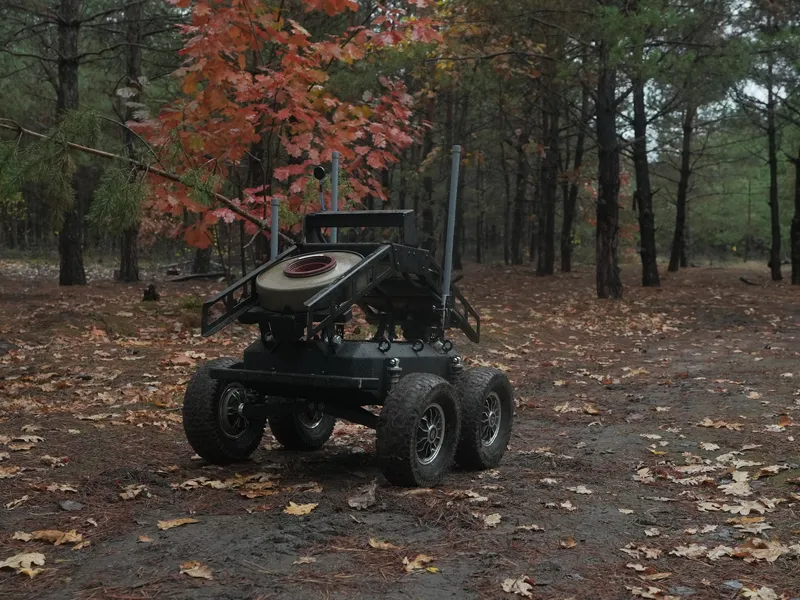
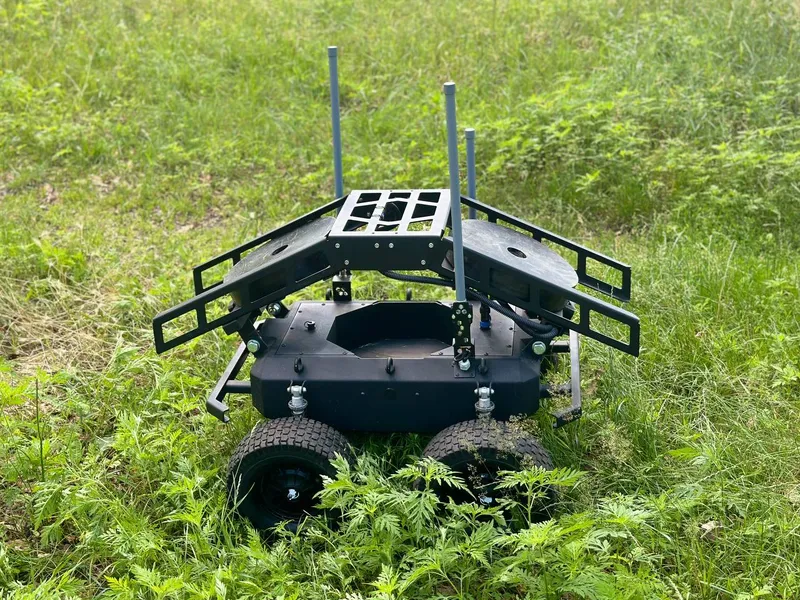
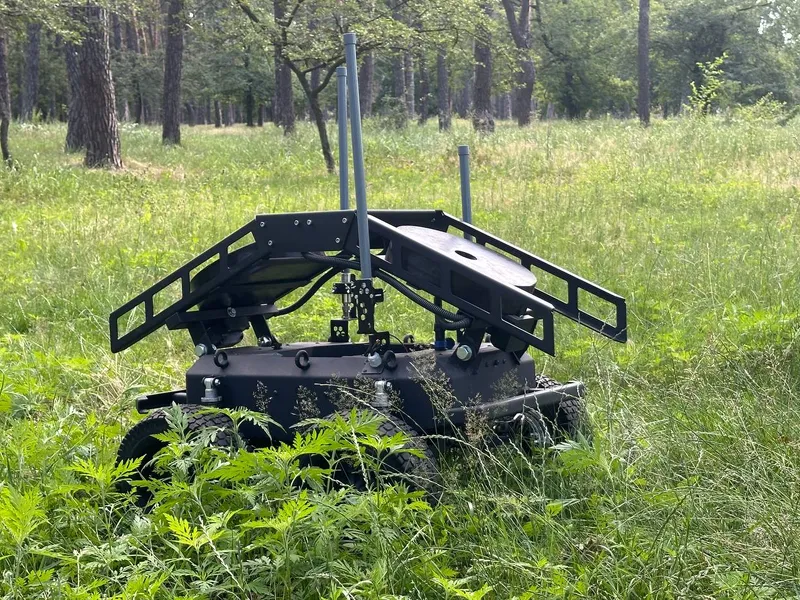
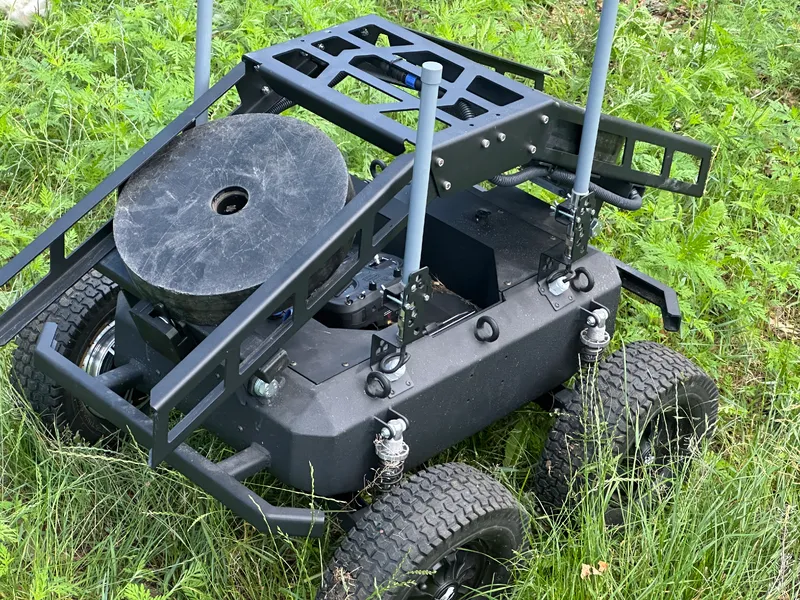
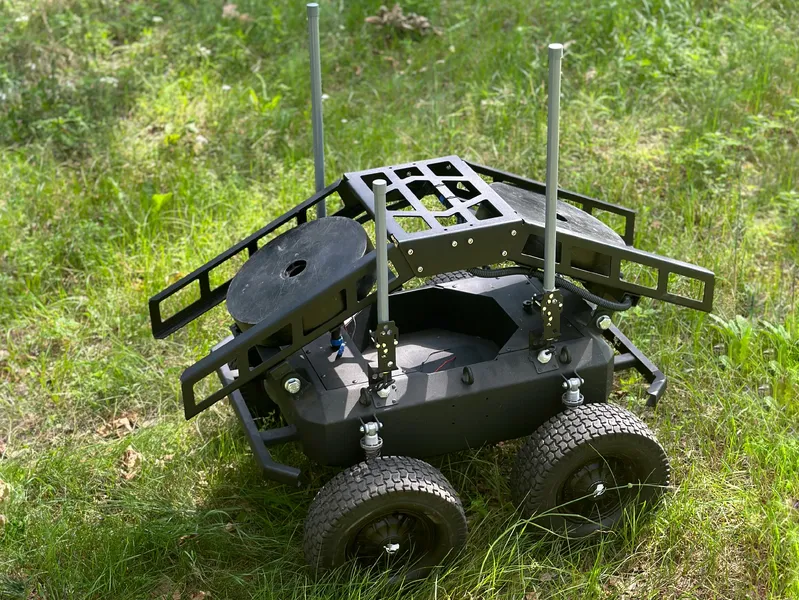
Used by Ukrainian forces as a small remotely operated strike and remote-mining UGV in the 2014 Russia-Ukraine War; Ukrainian military media reported state-test and serial-production claims in October 2023, a bridge strike at Ivanivske in April 2024, and 25th Airborne Brigade use against a Russian-occupied underground passage near Novohrodivka in September 2024.
Role detailsRatel S
- RATEL S
- Ratel S miner
- Ratel S kamikaze robot
- Ratel S suicide UGV-drone
- Ratel S ground drone
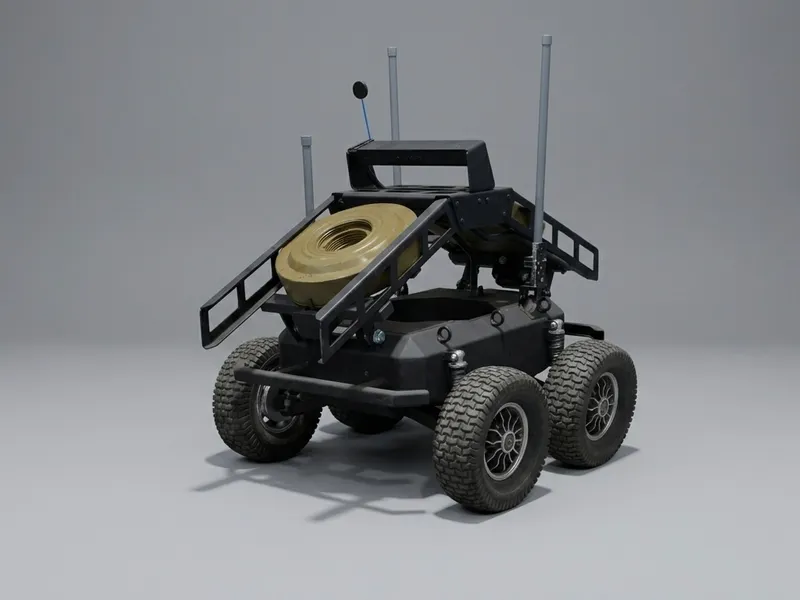
Ratel S is a Ukrainian uncrewed ground vehicle built for remote mining, explosive delivery, observation, and short-range ground attack missions. Developed in Ukraine's wartime robotics ecosystem and publicized through the Brave1 defense-tech cluster, it gives Ukrainian operators a small wheeled platform that can move an explosive or mine payload toward Russian positions while reducing direct exposure; Ukrainian reporting has tied it to bridge, position, and underground-passage attacks in Donetsk Oblast.
Role in Conflicts
Documented Battlefield Roles
Ratel S is best read as a compact ground payload carrier rather than a protected combat vehicle. Public reporting shows the same small chassis used for remote mining, explosive delivery, and short-range attacks on fixed targets.
| Role | Documented detail | Reader context |
|---|---|---|
| Remote mining | The manufacturer describes a removable remote-mining module, servo-driven warhead release, and ground-object observation by day camera. | Explains why the system is cataloged as a mine-warfare and strike UGV rather than as a general logistics robot. |
| Mobile warhead | Ukrainian reporting describes soldiers using Ratel S to carry anti-tank mines or a combat module toward Russian targets. | The platform lets operators keep distance from tanks, dugouts, obstacles, and likely detonation points. |
| Infrastructure attack | April 2024 reporting said Ukrainian defenders used Ratel S to destroy a bridge at Ivanivske in Donetsk Oblast. | Shows a tactical logistics-denial role beyond direct vehicle attacks. |
| Position attack | September 2024 reporting linked Ratel S to a 25th Airborne Brigade attack on an underground passage near Novohrodivka. | Shows Ukrainian use against fixed Russian positions and covered personnel locations. |
| Control envelope | Ratel Robotics lists at least 1,500 m control range without a repeater, at least 3,000 m with a repeater, and at least 20 km/h off-road speed. | Frames the system as a short-range front-line robot whose value depends on standoff control, small size, and payload delivery. |
Profile / Specs
Profile
- Origin
- Ukraine
- Built by
- Ratel Robotics
- Type
- Uncrewed ground vehicle / remote-mining and explosive-delivery robot
- Service note
- Introduced during the full-scale 2014 Russia-Ukraine War
- Designer
- Ukrainian developers associated with Brave1 and Ratel Robotics
- Designed
- Publicly disclosed in 2023
- Unit cost
- Not publicly disclosed for Ratel S; Business Insider reported broader Ratel Robotics UGV prices from about $2,000 to $40,000 depending on model and function
- Produced
- 2023-present
- Number built
- Not publicly disclosed
Specifications
- Crew
- Uncrewed; remotely operated from a ground control station
- Payload
- Official Ratel Robotics page lists at least 35 kg payload and transport load up to 20 kg for the remote-mining module; earlier public reporting described anti-tank mines or mortar shells.
- Dimensions
- 830 x 740 x 1010.5 mm
- Weight
- 75 kg empty; 95 kg with payload
- Control range
- At least 1,500 m without a repeater and at least 3,000 m with a repeater
- Mobility
- Off-road speed at least 20 km/h; hard-surface range at least 10 km and off-road range at least 5.8 km
- Endurance
- At least 5 hours battery life while stationary; earlier public reporting cited up to 2 hours of operation without recharging
- Sensors
- Daytime camera with photo and video recording for observation of ground objects
Variants
Public sources present Ratel S as a small ground-attack platform with remote-mining, mobile-warhead, and possible combat-module configurations rather than a family of separately named model marks.
| Variant | Configuration | Designation notes |
|---|---|---|
| Remote-mining module | Servo-release mine-delivery configuration | The official Ratel Robotics product page describes Ratel S as a remote-mining system with removable remote-mining modules, a servo-driven warhead discharge mechanism, and a 20 kg transport load for the module. Sources: Ratel S Product Page |
| Mobile warhead carrier | Anti-tank mine or explosive payload configuration | Ukrainian military reporting described soldiers using Ratel S as a mobile warhead carrying anti-tank mines, with remote operation letting the operator attack armor, dugouts, or infrastructure from standoff distance. Sources: ArmyInform Ground Kamikaze Robot, ArmyInform Ratel S Bridge Strike |
| Combat-module configuration | Reported but publicly unspecified weapon-station option | Defense Express and Ukrainian reporting noted a possible combat-module configuration, but public sources did not identify the module or weapon station in detail. Sources: Ukrainian Officials Reveal the Ratel S Suicide UGV-Drone, ArmyInform Ground Kamikaze Robot |
Timeline
Ratel S Key Events
Ratel S reported in serial production
Ukrainian military reporting cited Mykhailo Fedorov saying Ratel S had passed field tests and entered serial production after Brave1-linked development.
Sources: ArmyInform Ground Kamikaze Robot, Ukrainian Officials Reveal the Ratel S Suicide UGV-Drone
Bridge strike at Ivanivske reported
ArmyInform and LIGA.net reported that Ukrainian defenders used Ratel S to blow up a bridge in Ivanivske, Donetsk Oblast, disrupting Russian logistics.
Sources: ArmyInform Ratel S Bridge Strike, LIGA.net Ratel S Bridge Strike
25th Airborne Brigade use near Novohrodivka reported
ArmyInform reported that soldiers of Ukraine's 25th Airborne Brigade used a Ratel S platform against an underground passage occupied by Russian personnel near Novohrodivka.
Sources: ArmyInform Ratel S Novohrodivka Shelter Strike
Media
Related Weapon Systems