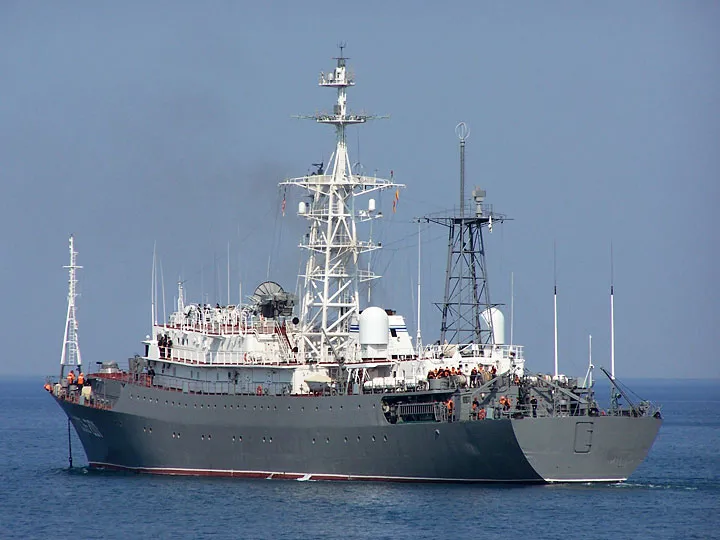

Russian Vishnya-class ships were dispatched to the eastern Mediterranean during Syria-related crises, including Priazovye in 2013 and Vasiliy Tatishchev in 2015, to observe regional air, maritime, and communications activity around Syria.
Role detailsNaval Systems
Vishnya class (Project 864) intelligence ship
Also known as
- Project 864
- Project 864 Meridian class
- Meridian class
- Meridian-class intelligence ship
- Vishnya-class intelligence ship
- SSV-201 Priazovye
- Priazovye
- Vasiliy Tatishchev
- Vasily Tatishchev
- Viktor Leonov
- Kareliya
- Kurily
- Tavriya
- Fedor Golovin
The Vishnya class (Project 864), also known as the Meridian class, is a Soviet-designed signals intelligence collection ship class built in Poland for the Soviet and later Russian Navy. The ships are purpose-built SIGINT and COMINT collectors with satellite-link antennas, sonar, and short-range self-defense weapons; documented wartime employment includes Russian deployments around Syria and Priazovye's 2023 Black Sea pipeline-security mission during the Russia-Ukraine War.
Role in Conflicts
- Side
- Russia

Russia reported that the Black Sea Fleet's Priazovye was attacked by Ukrainian uncrewed boats in June 2023 while monitoring and securing the TurkStream and Blue Stream gas-pipeline routes in the Black Sea.
Role detailsProfile / Specs
Profile
- Origin
- Soviet Union
- Built by
- Stocznia Północna
- Built in
- Poland
- Type
- Signals intelligence collection ship class
- Service note
- 1985-present
- Produced
- 1985-1988
- Number built
- 7
Specifications
- Displacement
- 2,500 t standard / 3,800 t full load
- Length
- 91.5 m
- Beam
- 14.5 m
- Draft
- 5.6 m
- Speed
- 16.5 knots
- Range
- 7,000 nmi
- Complement
- 220
- Propulsion
- 2 x 2,200 hp Sulzer 12AV25/30 diesel engines, 2 x 150 hp electric motors, 2 fixed-pitch propellers
- Sensors
- MR-212/201 Vaygach-U navigation radar, MG-349 Ros-K sonar, MGP-303 sonar, and ELINT suites
- Armament
- 2 x 4 9K38 Igla SAM launchers and 2 x 6 30 mm AK-306 mounts
Class Members And Fleet Context
Project 864 was a small seven-ship family of Soviet intelligence collectors built in Gdansk for fleet-level radio, electronic, sonar, and regional monitoring tasks. Open sources repeatedly describe the class by both the NATO Vishnya name and the Soviet Meridian project name.
| Ship | Common identifier | Documented context |
|---|---|---|
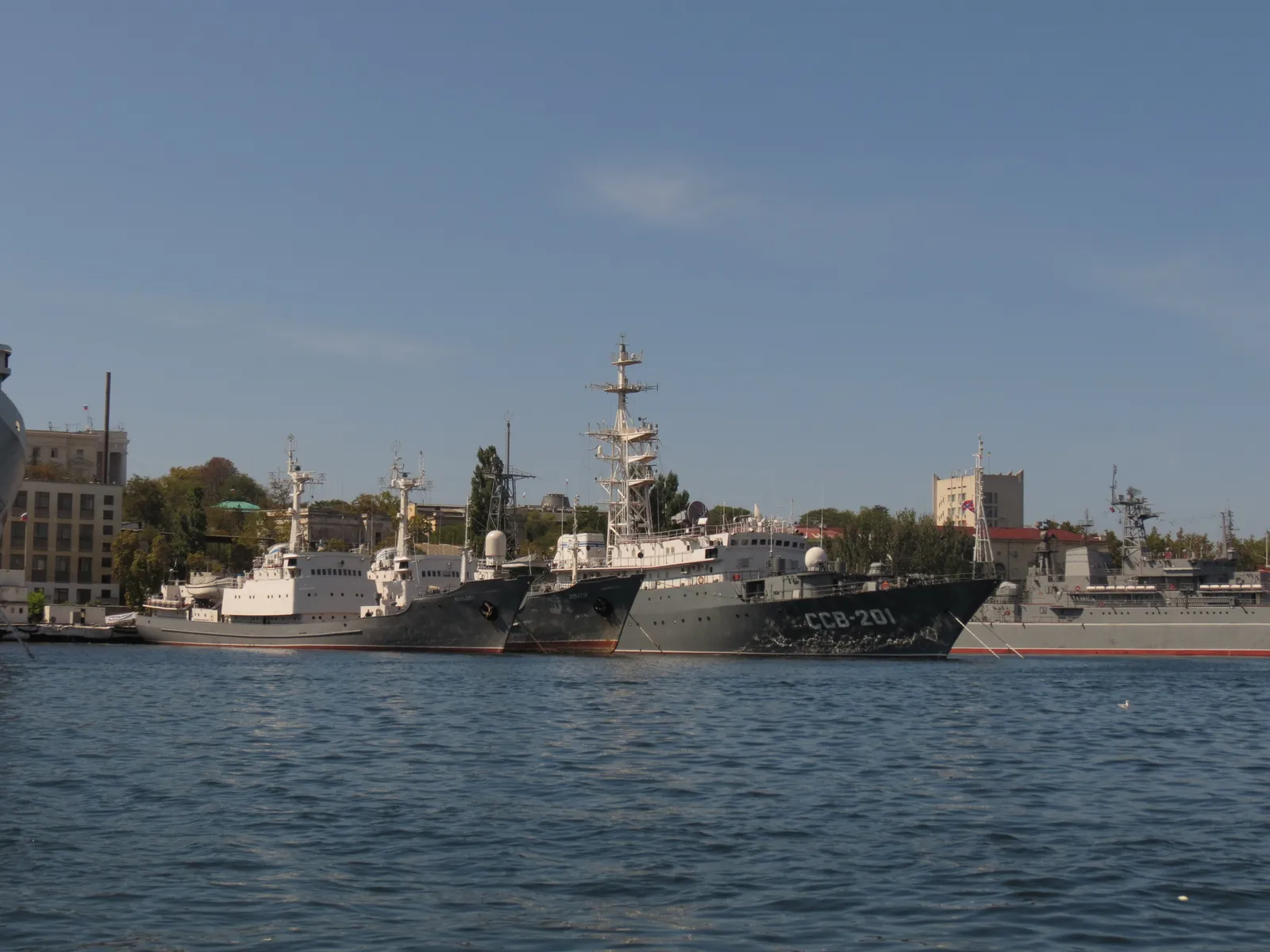
| Priazovye | SSV-201 | Black Sea Fleet ship documented in Syria-related deployments and the June 2023 Black Sea pipeline-security incident. |
| Vasiliy Tatishchev | SSV-231 | Baltic Fleet ship reported sent to the eastern Mediterranean in 2015 to strengthen monitoring around Syria. |
| Viktor Leonov | CCB-175 / SSV-175 | Northern Fleet ship often reported in Atlantic and Caribbean surveillance patrols outside the conflict rows on this page. |
| Kareliya | SSV-535 | Pacific Fleet ship identified by USNI News and the U.S. Coast Guard as operating near Hawaii in 2023. |
| Fedor Golovin, Tavriya, and Kurily | Project 864 hulls | Listed by GlobalSecurity as part of the seven-ship Project 864 force built in Poland for the Soviet and Russian fleets. |
Self-Defense Weapons
The class is built around intelligence collection rather than offensive strike, but KCHF lists a limited point-defense fit.
| Carried item | Item type | Carriage evidence |
|---|---|---|
 | Short-range surface-to-air missile | KCHF lists two four-round 9K38 Igla SAM launchers in Priazovye's armament fit, alongside two AK-306 30 mm close-in mounts. Sources: Intelligence Ship Priazovye - Project 864 / Vishnya class |
Timeline
Vishnya class (Project 864) intelligence ship Key Events
Priazovye laid down
KCHF records Priazovye as being laid down at the Stocznia Polnocna shipyard in Gdansk, Poland.
Sources: Intelligence Ship Priazovye - Project 864 / Vishnya class
Priazovye launched
KCHF records the ship's launch on 30 September 1986.
Sources: Intelligence Ship Priazovye - Project 864 / Vishnya class
Priazovye commissioned
KCHF records Priazovye's commissioning on 18 May 1987.
Sources: Intelligence Ship Priazovye - Project 864 / Vishnya class
Electronic intelligence suite modernized
KCHF states that Priazovye's electronic intelligence equipment was modernized in 2008.
Sources: Intelligence Ship Priazovye - Project 864 / Vishnya class
Deployed toward Syria
The Guardian reported that Russia dispatched Priazovye to the Syrian coast and eastern Mediterranean to keep tabs on the situation during the crisis surrounding possible US strikes.
Sources: Syrian regime continues to redeploy forces away from US missile targets, Russian warships cross Bosphorus, en route to Syria
Vasiliy Tatishchev sent to the Syrian theater
SANA and GlobalSecurity reported that Vasiliy Tatishchev left the Baltic for the eastern Mediterranean to reinforce Russian naval monitoring around Syria.
Sources: Russian military source: Russian surveillance ship en route to Syrian coast, Vishnya class - GlobalSecurity.org
Priazovye attacked in the Black Sea
Reuters and Anadolu reported Russian claims that Ukrainian uncrewed boats attacked Priazovye while the ship was monitoring and securing the TurkStream and Blue Stream pipeline routes.
Sources: Reuters: Russia says Ukraine tried to attack Russian ship near major gas pipelines in Black Sea, Ukraine attacks Russian Black Sea fleet ship, Moscow claims
Media
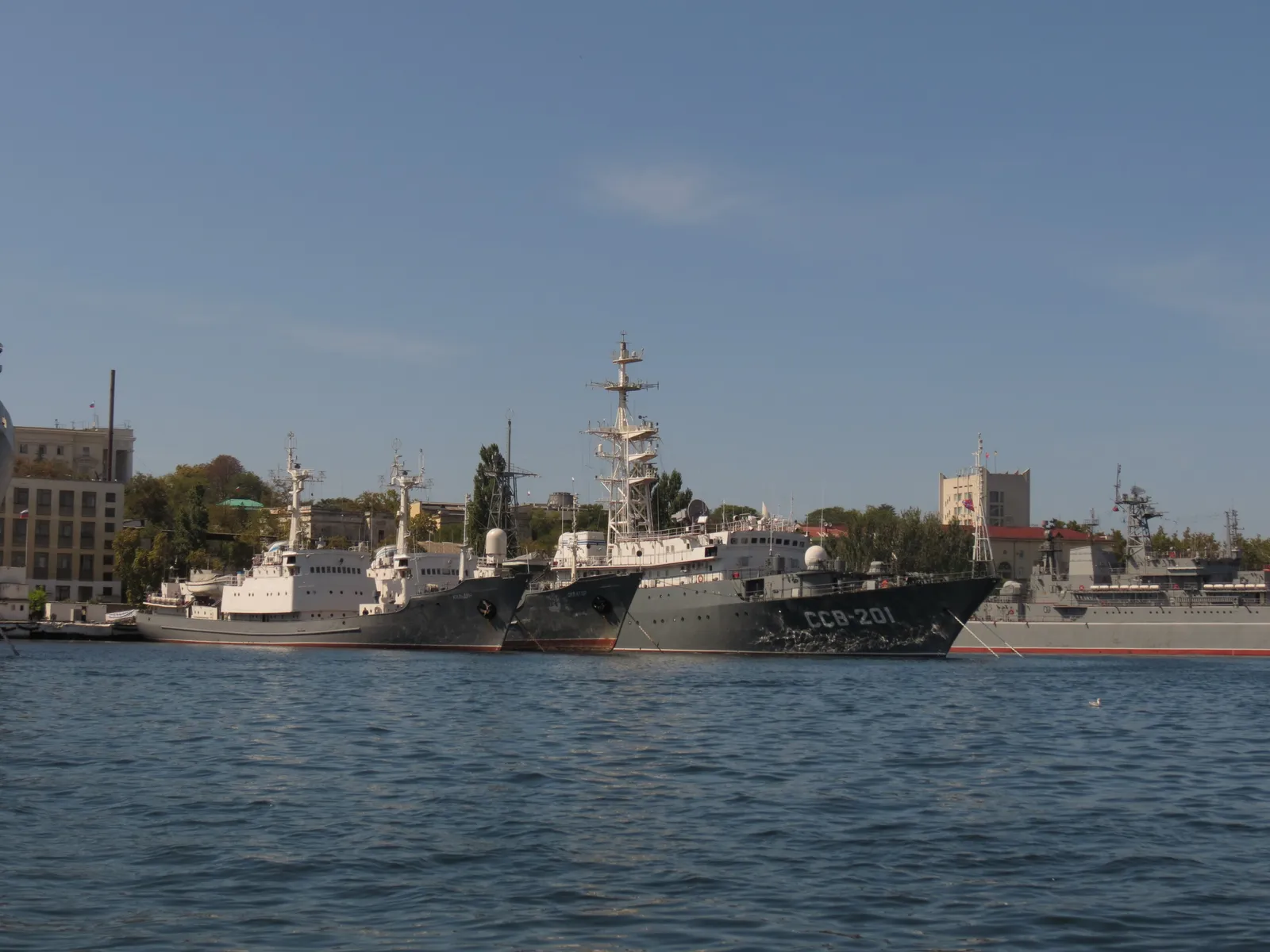
Vishnya class (Project 864) intelligence ship Images
Related Weapon Systems


Sources
Intelligence Ship Priazovye - Project 864 / Vishnya classPublisher: KCHF.RU | Note: Supports the ship class background, Priazovye service history, modernization date, technical specifications, and listed self-defense armament. | Accessed: 2026-07-01Vishnya class - GlobalSecurity.orgPublisher: GlobalSecurity.org | Note: Supports class background, ship list context, SIGINT/COMINT role, self-defense fit, and 2011 Syrian Civil War deployment context for Vasiliy Tatishchev monitoring around Syria. | Accessed: 2026-07-01Syrian regime continues to redeploy forces away from US missile targetsPublisher: The Guardian | Note: Supports 2011 Syrian Civil War deployment context for Priazovye as a Russian reconnaissance ship sent to the Syrian coast and eastern Mediterranean. | Accessed: 2026-07-01Russian warships cross Bosphorus, en route to SyriaPublisher: Hürriyet Daily News | Note: Supports 2011 Syrian Civil War deployment context for Priazovye sailing toward the eastern Mediterranean and Syrian coast during the 2013 crisis. | Accessed: 2026-07-01Russian military source: Russian surveillance ship en route to Syrian coastPublisher: Syrian Arab News Agency | Note: Supports 2011 Syrian Civil War deployment context for Vasiliy Tatishchev sailing to the eastern Mediterranean and Syrian coast to monitor air, regional, and maritime activity. | Accessed: 2026-07-01VIDEO: Coast Guard Tracking Russian Intelligence Ship Off HawaiiPublisher: USNI News | Note: Supports background context identifying Kareliya as a Vishnya-class intelligence ship monitored near Hawaii by the U.S. Coast Guard. | Accessed: 2026-07-01Category:Priazovye (ship, 1987)Publisher: Wikimedia Commons | Note: Supports image provenance and licensing context for the Priazovye gallery images. | Accessed: 2026-07-01File:Разведывательный корабль Приазовье.jpgPublisher: Wikimedia Commons | Note: Supports primary image provenance and licensing context for the main Priazovye photo. | Accessed: 2026-07-01Reuters: Russia says Ukraine tried to attack Russian ship near major gas pipelines in Black SeaPublisher: Reuters | Note: Supports 2014 Russia-Ukraine War direct conflict-use by reporting Priazovye under attack while patrolling near the TurkStream and Blue Stream gas pipelines. | Accessed: 2026-07-01Ukraine attacks Russian Black Sea fleet ship, Moscow claimsPublisher: Anadolu Ajansı | Note: Supports 2014 Russia-Ukraine War direct conflict-use by reporting Russian Defense Ministry claims that Priazovye was attacked while monitoring and ensuring security along TurkStream and Blue Stream routes. | Accessed: 2026-07-01