Profile
- Origin
- France
- Built by
- Merré Shipyard
- Type
- Dive support and mine countermeasures vessel class
- Service note
- 2022-present
- Designer
- Neuman
- Designed
- 2019-2022
- Produced
- 2019-2027 planned
- Number built
- 8 ordered
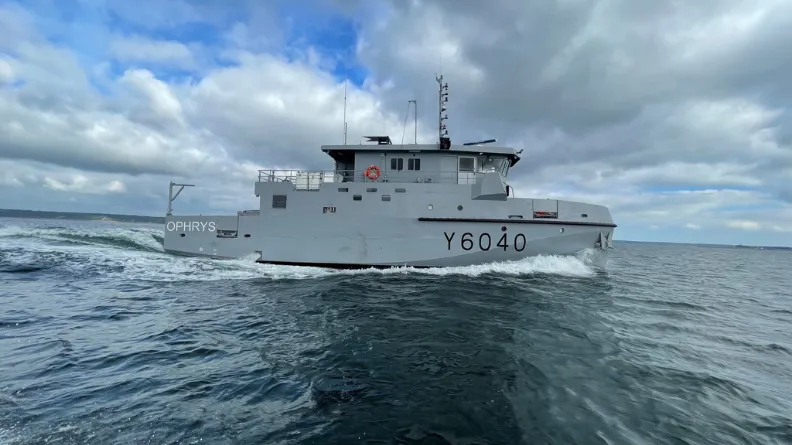
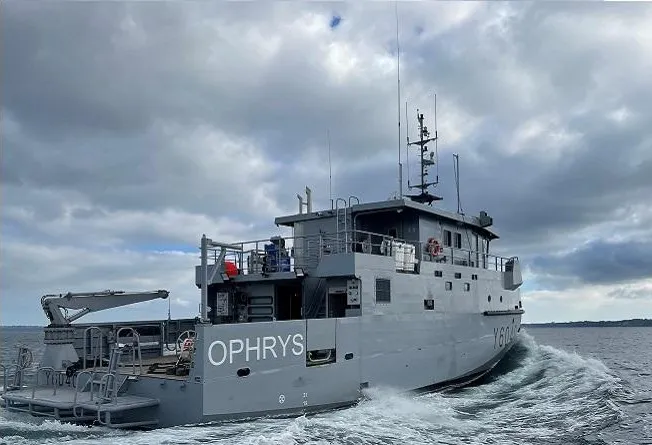
The Ophrys class is an eight-boat French Navy VSP dive-support series built by Merré Shipyard with Neuman design input for shallow-water mine-countermeasures work. The aluminium, low-magnetic boats replace older diver-intervention craft and give clearance-diver groups a compact platform with towed sonar, decompression support, and electric low-speed station-keeping.
The class is a single VSP design procured as a lead boat plus seven follow-on vessels. Public reporting identifies the boats by plant names and Y6040-series hull numbers rather than by major subvariant.
| Variant | Configuration | Designation notes |
|---|---|---|
| Ophrys | Lead boat | First-of-class boat Y6040, delivered for French Navy operational evaluation at Toulon after 2022 acceptance activity. Sources: DGA launches series production of new diving tenders for French Navy, La DGA réceptionne la première vedette de soutien à la plongée |
| Acacia | First series-production boat | Specialist reporting identifies Acacia as the second VSP and first follow-on boat, assigned to Toulon after delivery activity in 2025. Sources: Marine nationale : la nouvelle vedette de support à la plongée Acacia a rejoint Toulon |
| Iris | Third boat | Specialist reporting identifies Iris as the third VSP, built at Brest by CIB within the same Ophrys-class production run. Sources: Marine nationale : CIB met à l'eau à Brest la vedette de soutien à la plongée Iris |
| Yucca and later boats | Follow-on VSP series | Later reporting describes continuing deliveries after Iris, with Yucca and subsequent plant-named boats completing the planned eight-boat distribution. Sources: Merré livre à la Marine nationale une 4ème vedette de support à la plongée |
The class is not designed as a combatant, but published vessel-review data lists a manually operated 7.62 mm machine-gun mount for self-defence.
| Carried item | Item type | Carriage evidence |
|---|---|---|
 | Self-defence gun mount | Baird Maritime describes the Ophrys boat as fitted with a manually operated 7.62 mm general-purpose machine-gun mount for self-defence. Sources: Ophrys – New minehunting dive boat delivered to French Navy |
Ophrys-class boats are small mine-countermeasures support vessels for clearance-diver work, not front-line surface combatants. Their value is the combination of shallow-water access, diver facilities, mine-search equipment, and low-signature station-keeping around underwater hazards.
| Mission element | Documented equipment | Operational purpose |
|---|---|---|
| Shallow-water access | 26.5 m aluminium hull with 1.7 m draught | Lets clearance-diver teams work in areas less accessible to larger mine-warfare vessels. |
| Diver support | Hyperbaric recompression chamber, diver handling gear, rigid inflatable boat, and accommodation for divers | Supports mine-disposal, underwater work-site, and hull-intervention missions from the boat itself. |
| Mine search | Towed sonar and Furuno radar | Provides detection support for underwater hazards before diver intervention. |
| Station keeping | Diesel engines, electric low-speed motors, and bow thruster | Allows slow controlled movement during mine-countermeasures work while reducing magnetic and acoustic disturbance. |
Sources: La DGA réceptionne la première vedette de soutien à la plongée; Ophrys – New minehunting dive boat delivered to French Navy.
The French procurement agency awarded Merré Shipyard the contract for the first VSP boat, launching the class program.
Sources: DGA launches series production of new diving tenders for French Navy, La DGA lance la production des vedettes de soutien à la plongée
The lead boat was handed to the DGA for an operational-use period with French Navy clearance divers in Toulon.
Sources: DGA launches series production of new diving tenders for French Navy, La DGA réceptionne la première vedette de soutien à la plongée
The DGA announced that production of the seven follow-on boats could begin after successful trials of Ophrys.
Sources: La DGA lance la production des vedettes de soutien à la plongée, DGA launches series production of new diving tenders for French Navy
Specialist naval reporting identified Acacia as the first series-production VSP to join the Toulon-based mine-clearance diver group after Ophrys.
Sources: Marine nationale : la nouvelle vedette de support à la plongée Acacia a rejoint Toulon
The third VSP, Iris, was launched at Brest as CIB and Merré continued the follow-on production run.
Sources: Marine nationale : CIB met à l'eau à Brest la vedette de soutien à la plongée Iris
Later reporting described the fourth Ophrys-class VSP delivery and launch activity for the next boat, showing the series moving beyond the Toulon and Brest lead vessels.
Sources: Merré livre à la Marine nationale une 4ème vedette de support à la plongée
The eight-boat program is distributed around French Navy clearance-diver groups and the Saint-Mandrier diving school. Public reporting names the boats after plants and flowers, with Ophrys leading the class and Acacia, Iris, Yucca, and later vessels following through the 2020s.
| Boat or group | Reported role in series | Base or production context |
|---|---|---|
| Ophrys (Y6040) | Lead boat and operational-evaluation vessel | Accepted after trials and used at Toulon by French Navy clearance divers. |
| Acacia | First series-production follow-on boat | Reported joining Toulon after Ophrys. |
| Iris | Third boat | Reported launched at Brest by CIB within the Merré/BMA production arrangement. |
| Yucca and later boats | Follow-on vessels completing the eight-boat plan | Reporting in 2026 described the fourth delivery and continuing production for later plant-named boats. |
Sources: DGA launches series production of new diving tenders for French Navy; Marine nationale : la nouvelle vedette de support à la plongée Acacia a rejoint Toulon; Marine nationale : CIB met à l'eau à Brest la vedette de soutien à la plongée Iris; Merré livre à la Marine nationale une 4ème vedette de support à la plongée.