Naval Systems

INS Mahe

Also known as
  • Mahe-class ASW-SWC lead ship
  • ASW SWC Mahe
  • P80
  • ASW Shallow Water Craft Mahe
  • Anti-Submarine Warfare Shallow Water Craft Mahe
  • Silent Hunters

INS Mahe is the Indian Navy's first Mahe-class anti-submarine warfare shallow-water craft, a Cochin Shipyard-built littoral combatant for coastal ASW, underwater surveillance, mine laying, and low-intensity maritime operations on the Western Seaboard.

Profile / Specs

Profile

Origin
India
Type
Anti-submarine warfare shallow-water craft
Service note
Commissioned in 2025
Designer
Cochin Shipyard Limited
Designed
2019 contract program; lead ship commissioned in 2025
Produced
Construction program under 30 April 2019 Ministry of Defence contract; Mahe delivered on 23 October 2025 and commissioned on 24 November 2025
Number built
Lead ship of eight planned Mahe-class vessels

Specifications

Class
Mahe-class Anti-Submarine Warfare Shallow Water Craft
Role
Anti-submarine operations in coastal and shallow waters
Length
78.0 metres in CSL launch reporting; PIB delivery describes Mahe as approximately 78 metres
Beam
11.36 metres in CSL launch reporting
Draught
About 2.7 metres in CSL launch reporting
Displacement
About 896-900 tons in CSL launch reporting; PIB delivery describes Mahe as around 1,100 tons
Maximum speed
25 knots
Endurance
1,800 nautical miles
Propulsion
Three diesel-engine-powered waterjets in the class fit
Indigenous content
More than 80 percent, according to PIB
Sensors
Hull-mounted sonar and low-frequency variable-depth sonar (LFVDS) identified in ASW-SWC launch reporting
Weapons fit
Torpedoes, anti-submarine rockets, NSG-30 gun, and 12.7 mm stabilized remote-controlled guns identified in ASW-SWC launch reporting
Mission set
Underwater surveillance, coastal ASW, low-intensity maritime operations, search and rescue, and mine laying
Littoral ASW Role

Mahe is a relationship-only naval-platform record because no direct conflict-use source currently ties the ship to a cataloged conflict. Its value here is the sourced relationship between India's ASW-SWC program, coastal submarine prosecution, and the class weapons and sensors identified in official releases.

Operating area

PIB places INS Mahe with Western Naval Command and describes the Mahe-class as a first line of coastal defence integrated with larger surface combatants, submarines, and aviation assets.

Mission set

Official delivery and CSL releases describe coastal ASW, underwater surveillance, low-intensity maritime operations, search and rescue, and mine laying roles.

Combat fit

ASW-SWC launch reporting identifies hull-mounted and low-frequency variable-depth sonar, torpedoes, anti-submarine rockets, NSG-30 gun armament, and 12.7 mm stabilized remote-controlled guns.

Sources: PIB INS Mahe commissioning; PIB Mahe delivery; PIB Magdala ASW SWC launch; CSL ASW SWC eighth keel laying.

Variants

The Mahe-class entries in this record refer to the eight CSL-built ASW-SWC hulls ordered for the Indian Navy; official CSL and PIB releases identify the first five named hulls, Magdala as the sixth vessel, and BY 530 as the eighth and last ship.

VariantConfigurationDesignation notes
MalvanSecond vessel / BY 524

CSL launch reporting says BY 524 would bear the name INS Malvan on commissioning.

Sources: CSL Mahe Malvan Mangrol launch

MangrolThird vessel / BY 525

CSL launch reporting says BY 525 would bear the name INS Mangrol on commissioning.

Sources: CSL Mahe Malvan Mangrol launch

MalpeFourth vessel / BY 526

CSL launch reporting identifies BY 526 as the fourth ship in the series and says it would bear the name INS Malpe on commissioning.

Sources: CSL Malpe Mulki launch

MulkiFifth vessel / BY 527

CSL launch reporting identifies BY 527 as the fifth ship in the series and says it would bear the name INS Mulki on commissioning.

Sources: CSL Malpe Mulki launch

MagdalaSixth vessel / BY 528

Official launch reporting identifies Magdala as the sixth ASW-SWC in the CSL-built eight-vessel series.

Sources: PIB Magdala ASW SWC launch

BY 530Eighth vessel / BY 530

PIB and CSL reported keel laying for BY 530 as the eighth and last ship in the Ministry of Defence contract for eight CSL-built ASW shallow-water craft; CSL identifies the vessel name as Manapad.

Sources: PIB Mahe class last keel, CSL ASW SWC eighth keel laying

Timeline

INS Mahe Key Events

  1. Eight-ship ASW-SWC contract

    CSL says the Ministry of Defence and Cochin Shipyard signed the contract for eight ASW shallow-water craft on 30 April 2019.

    Sources: CSL ASW SWC eighth keel laying

  2. Keel laid for BY 523 Mahe

    PIB reported keel laying for BY 523 Mahe, the first warship in the CSL-built ASW-SWC project.

    Sources: PIB Mahe keel laying

  3. First three CSL hulls launched

    CSL reported the concurrent launch of BY 523, BY 524, and BY 525, to be named INS Mahe, INS Malvan, and INS Mangrol on commissioning.

    Sources: CSL Mahe Malvan Mangrol launch

  4. Eighth CSL hull keel laid

    PIB reported keel laying for BY 530, the eighth and last ASW-SWC in the CSL-built Mahe-class series.

    Sources: PIB Mahe class last keel

  5. Delivered to the Indian Navy

    PIB reported that Mahe, the first of eight CSL-built ASW shallow-water craft, was delivered to the Indian Navy.

    Sources: PIB Mahe delivery

  6. Commissioned into Indian Navy service

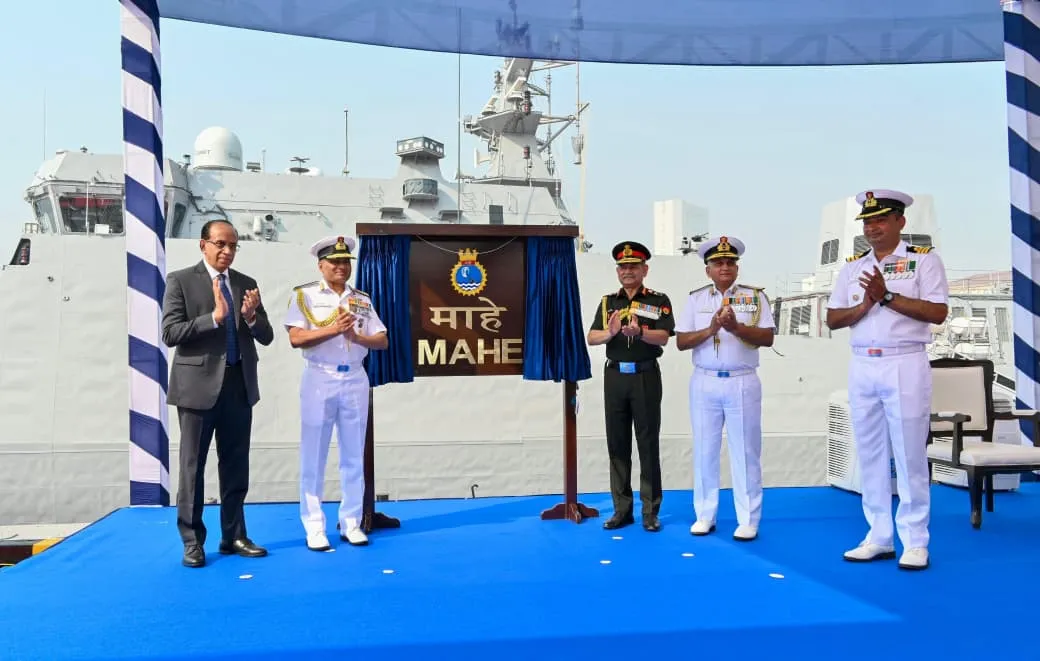
    PIB reported that INS Mahe was commissioned at Naval Dockyard, Mumbai, as the first Mahe-class ASW-SWC.

    Sources: PIB INS Mahe commissioning

Class And Construction Context

The CSL-built Mahe-class line is one half of India's ASW Shallow Water Craft procurement, with this record focused only on the eight-vessel Cochin Shipyard series. Official releases identify the 30 April 2019 MoD-CSL contract, Mahe as the first delivered and commissioned ship, the first five named hulls through CSL launch releases, Magdala as the sixth vessel, and BY 530 as the eighth and last ship.

  • Builder: Cochin Shipyard Limited, Kochi.
  • Design and classification: CSL's delivery release says Mahe was designed and constructed under Det Norske Veritas classification rules.
  • Program role: CSL says the ships replace Abhay-class ASW corvettes in coastal ASW, low-intensity maritime operations, mine laying, and subsurface surveillance roles.

Sources: CSL Mahe delivery; CSL Mahe Malvan Mangrol launch; CSL Malpe Mulki launch; CSL ASW SWC eighth keel laying; PIB Mahe class last keel.
Media
Related Weapon Systems
Iranian naval surface vessels, Naval surface vessels, Naval SystemsNaval SystemsIranian naval surface vesselsNaval surface vesselsIranian naval surface vessels in this catalog cover two overlapping fleets: the regular Islamic Republic of Iran Navy's larger frigates, corvettes, and missile boats, and the IRGC Navy's missile boats, patrol craft, fast-attack craft, small boats, and newer missile catamarans. The fleet is usually described as a Strait of Hormuz and Gulf littoral force, combining anti-ship missiles, swarm tactics, boarding pressure, mine-capable boats, and limited larger-combatant presence rather than a peer blue-water surface fleet.
Iranian small attack boats, Small attack boat / fast attack craft, Naval SystemsNaval SystemsIranian small attack boatsSmall attack boat / fast attack craftIranian small attack boats are a mixed Islamic Revolutionary Guard Corps Navy fast attack craft and fast inshore attack craft force used for swarm harassment, mine laying, anti-ship missile attack, and littoral sea denial around the Persian Gulf and Strait of Hormuz. The family covers domestically produced speedboats and named classes such as Ashura/Ashoora, Tareq, Zolfaghar/Peykaap, Thondor/Houdong, Boghammar-derived craft, and Bladerunner-derived craft rather than a single standardized design.
Iranian submarines, Diesel-electric submarine force, Naval SystemsNaval SystemsIranian submarinesDiesel-electric submarine forceIranian submarines are the Islamic Republic of Iran Navy's mixed diesel-electric submarine force, combining Russian-built Tareq/Kilo boats with domestically built Fateh, Ghadir, and smaller midget-submarine classes. Centered on Bandar Abbas and the Strait of Hormuz, the fleet supports coastal sea denial, mine warfare, and anti-ship strike; during Operation Epic Fury, CENTCOM listed Iranian Navy ships and submarines among vessels damaged or destroyed.

Sources