Artillery

Mark 42 5-inch naval gun

Also known as
  • 127mm Mk 42
  • 127 mm Mk 42
  • Mk 42 5-inch gun
  • Mark 42 5-inch/54-caliber gun
  • 5-inch/54 Mark 42
  • 5"/54 Mark 42
  • 5/54 Mk 42
  • 5-in/54 Mark 18 gun
  • Mk 18 5-inch/54 gun

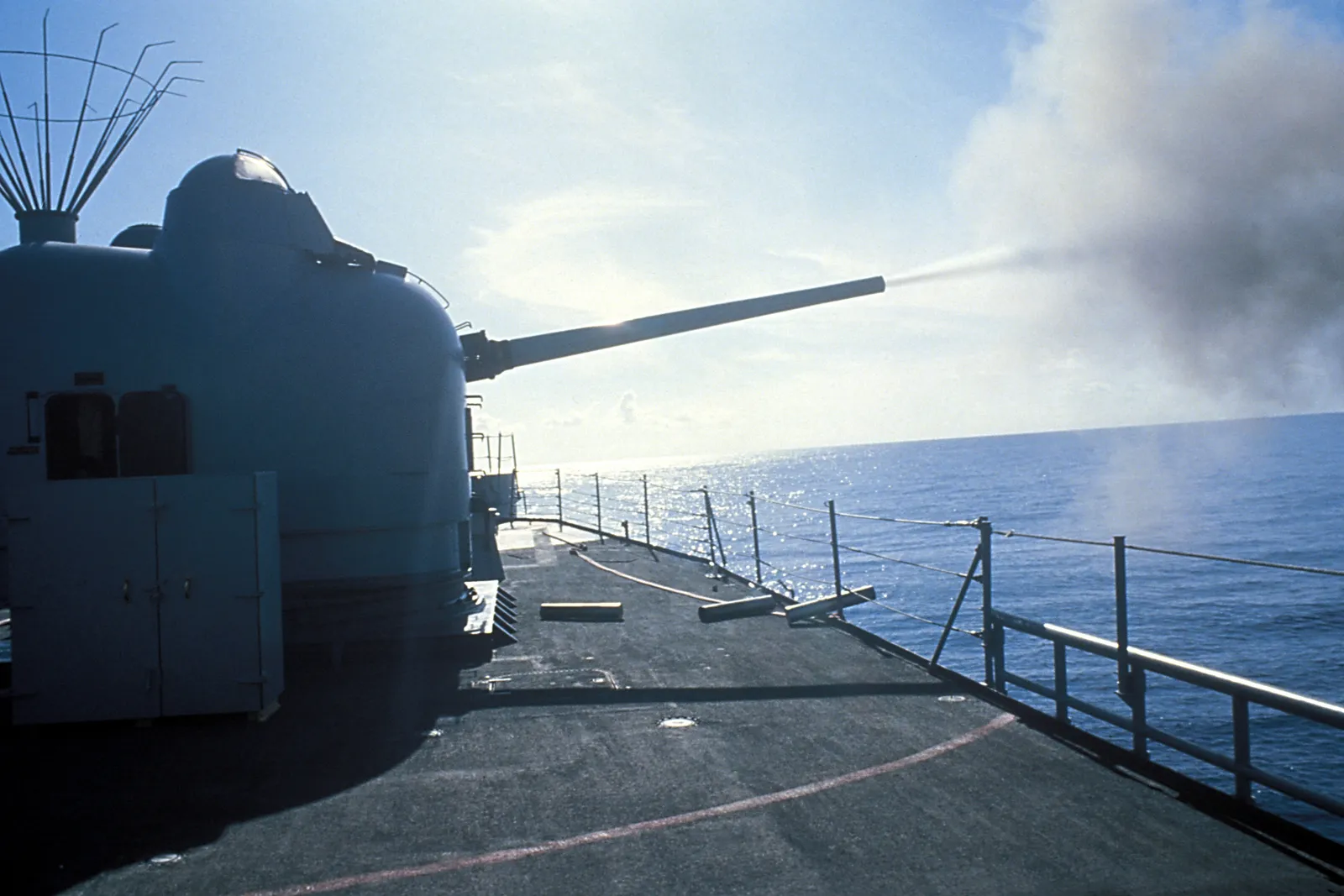
The Mark 42 5-inch naval gun is a U.S.-origin 127 mm automatic shipboard mount that paired a 5-in/54 Mark 18 gun with the Mark 42 mounting. It served on U.S. destroyers, cruisers, frigates, and aircraft carriers and is directly documented firing from U.S. Navy destroyers during the 1955 Vietnam War.

Role in Conflicts

Side
United States and South Vietnam

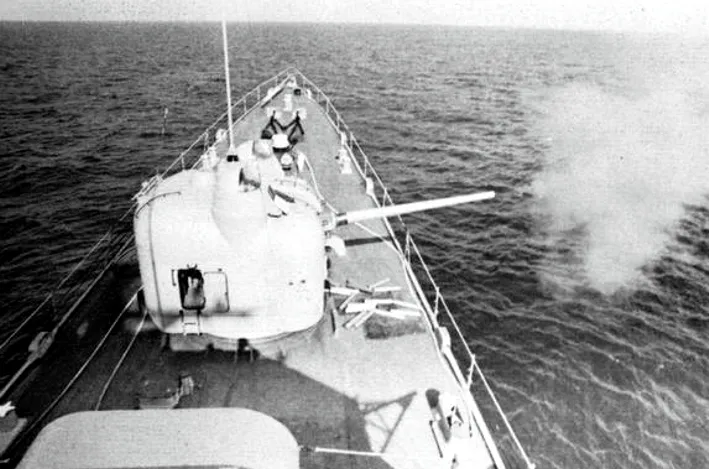
U.S. Navy destroyers used Mark 42-equipped 5-inch guns for Vietnam naval gunfire: Turner Joy was photographed firing a 5/54 Mark 42 mount at an enemy shore position on 20 June 1968, and Buchanan was photographed shelling targets in Vietnam in 1968.

Profile / Specs

Profile

Origin
United States
Built by
FMC
Type
127 mm dual-purpose naval gun mount
Service note
1954 onward
Designed
About 1950
Developed into
Mark 45 5-inch naval gun

Specifications

Caliber
5 in / 127 mm
Barrel length
54 calibers; 270 in (6.858 m)
Gun designation
5-in/54 Mark 18 gun in Mark 42 mount
Projectile
About 70 lb (31.75 kg) semi-fixed ammunition
Muzzle velocity
2,650 ft/s (about 808 m/s)
Rate of fire
34 rounds per minute in later two-side operation; 17 rounds per minute single-side operation; originally designed for 40 rounds per minute
Loading system
Two rotating loaders with projectile and powder-case drums, lower and upper hoists, cradles, transfer trays, and fuze setters
Loader capacity
Two under-mount loaders with independently driven projectile and powder-case drums; each drum held twenty rounds
Maximum range
About 26,000 yd / 25,909 yd surface range depending on source presentation
Ceiling
About 48,000 ft to 48,700 ft
Elevation
-15 degrees to +85 degrees
Train and elevation rates
Train up to 40 degrees per second; elevation up to 25 degrees per second
Control
Remote control normally through Mk 68 GFCS; local One Man Control station available
Mount weight
About 60.4 long tons including below-mount drums
Mount And Loading Layout

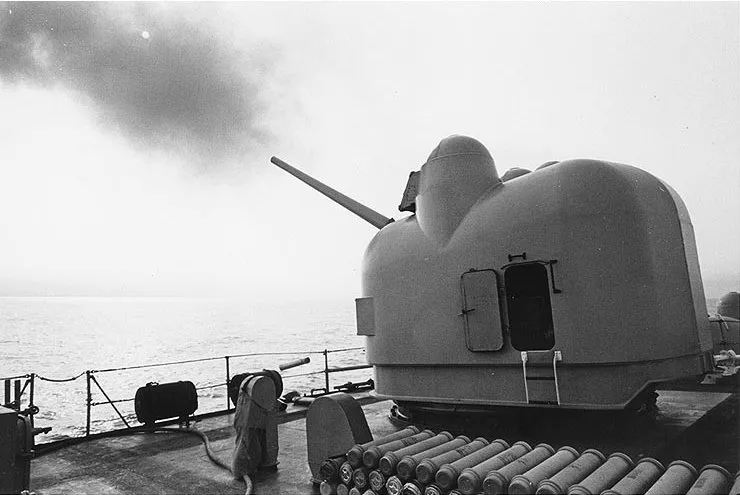
The Mark 42 combined a single 5-inch/54 gun with a complex automatic mount. Its loading path began below deck and alternated rounds through right and left cradles, giving the mount its high two-sided rate of fire while retaining a reduced-rate single-side fallback.

Gun and mount naming

Mark 42 is the mount designation; NavWeaps identifies the gun itself as the 5-in/54 Mark 18.

Source: NavWeaps: USA 5/54 Mark 42.

Control modes

The Navy training text describes remote control through the Mk 68 gun fire-control system as normal, with local control possible from the One Man Control station.

Source: TPub Seaman Manual: 5/54 Mk 42 Gun.

Loading path

Tin Can Sailors describes two rotating loaders, lower hoists, transfer stations, upper hoists, cradles, transfer trays, and fuze setters feeding the single gun.

Source: Tin Can Sailors: 5/54 Single Mount.

Loader capacity

Each rotating loader used projectile and powder-case drums; each drum held twenty rounds and could be replenished through loading doors.

Source: Tin Can Sailors: 5/54 Single Mount.

Two-sided fire

The manual describes two almost separate loading sides; a single side could continue at 17 rounds per minute if the other side was isolated.

Source: TPub Seaman Manual: 5/54 Mk 42 Gun.

Vietnam firing stress

NavWeaps notes a Vietnam-era reputation for jamming during prolonged firing, followed by rate reductions and later upgrades.

Source: NavWeaps: USA 5/54 Mark 42.

Variants

Mark 42 is the mount designation; the barrel itself is the 5-in/54 Mark 18 gun. Later service references distinguish upgraded Mod 9 and Mod 10 mounts from earlier retired versions.

VariantConfigurationDesignation notes
Mark 42 Mod 9Late-service automatic mount

The Navy training text says the Mod 9/10 5-in/54 gun remained in fleet use, could engage surface, shore, and air targets, and fired about 34 rounds per minute.

Sources: TPub Seaman Manual: 5/54 Mk 42 Gun, Archive.org: Combat Systems And Weapons Department Management

Mark 42 Mod 10Late-service automatic mount

GlobalSecurity describes the Mk 42 Mod 10 as a two-part mount with below-deck carrier, hoist, and ammunition-loader drum components feeding the upper hoist, trays, rammer, and firing components.

Sources: GlobalSecurity: 5/54 MK 42 Gun System

Successor Gun Family

The Mark 42 and Mark 45 are separate 5-inch naval gun families, but the later Mark 45 is documented by the U.S. Navy as the lighter replacement path for the Mark 42 mount.

Compatible itemItem typeCompatibility evidence
Mark 45 5-inch naval gun, Naval gun, ArtilleryMark 45 5-inch naval gunSuccessor 5-inch naval gun mount

The Navy Mk 45 fact file identifies the Mark 45 as the replacement developed for easier maintenance and lower weight than the Mark 42.

Sources: U.S. Navy: MK 45 - 5-inch 54/62 Caliber Guns

Timeline

Mark 42 5-inch naval gun Key Events

  1. Postwar design work

    NavWeaps dates the design to about 1950 and describes the Mark 42 as the post-World War II replacement path for older U.S. 5-inch mounts.

    Sources: NavWeaps: USA 5/54 Mark 42

  2. Mark 42 enters service

    NavWeaps lists 1954 as the in-service date and identifies USS Northampton as the first ship class application.

    Sources: NavWeaps: USA 5/54 Mark 42

  3. Turner Joy fires Mark 42 mount in Vietnam

    The Wikimedia/NHHC caption identifies USS Turner Joy firing one of her 5/54 Mark 42 mounts toward an enemy shore position in Vietnam.

    Sources: Wikimedia Commons: Turner Joy Mark 42 firing

  4. Mark 45 replacement path begins

    The U.S. Navy Mk 45 fact file says the Mk 45 was developed as a lighter, easier-maintained replacement for the Mk 42 mount.

    Sources: U.S. Navy: MK 45 - 5-inch 54/62 Caliber Guns

Media
Related Weapon Systems
114 mm Vickers Mark 6, Dual-purpose naval gun turret, Naval SystemsNaval Systems114 mm Vickers Mark 6Dual-purpose naval gun turretThe 114 mm Vickers Mark 6 was the postwar designation for the QF 4.5-inch Mark V gun carried in the Mark VI twin mounting, a British dual-purpose naval turret built around high-angle fire, remote power control, and rapid surface, air, and shore engagement. It entered service in 1947, equipped British and Commonwealth destroyers and frigates, and remained relevant in the 1982 Falklands War as Royal Navy escorts used 4.5-inch naval gunfire for shore support and surface engagements.
114 mm Vickers Mark 8, Single-barrel dual-purpose naval gun, Naval SystemsNaval Systems114 mm Vickers Mark 8Single-barrel dual-purpose naval gunThe 114 mm Vickers Mark 8 is the Royal Navy's post-1970s single-barrel 4.5-inch naval gun, replacing the heavier Mark 6 twin mounting with a 55-calibre automatic system for surface fire, naval gunfire support, and limited air or force-protection roles. It served on Type 21, Type 22, Type 23, Type 42, Type 45, and export warships, with Falklands War use followed by later Mod 1 low-observable gunhouse upgrades and 2011 Libya combat firings by Royal Navy ships.
SH-60B Seahawk helicopter, LAMPS Mk III naval helicopter, Aircraft & UAVsAircraft & UAVsSH-60B Seahawk helicopterLAMPS Mk III naval helicopterThe SH-60B Seahawk is the U.S. Navy's LAMPS Mk III shipboard helicopter, built around a Sikorsky airframe and mission systems for frigate, destroyer, and cruiser detachments. Navy, GAO, and USNI sources frame the aircraft as the helicopter element of an anti-submarine and anti-surface ship system, with Desert Storm surveillance use, later Operation Iraqi Freedom deployments, and torpedoes, Penguin missiles, AGM-114 Hellfire missiles, and crew-served guns documented in the SH-60B record.

Sources