Artillery

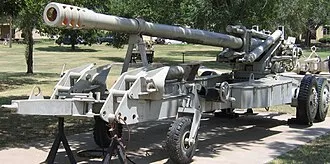
GH N-45 155 mm howitzer

Also known as
  • GHN-45
  • GH N-45
  • Noricum GHN-45
  • Gun-Howitzer Noricum 45
  • GH N-45A1

The GH N-45 is an Austrian Noricum refinement of Gerald Bull's GC-45 long-range 155 mm artillery design, combining a 45-caliber barrel, ERFB ammunition compatibility, and optional auxiliary propulsion. Iraqi GH N-45 batteries made the system a notable long-range artillery threat in the Iran-Iraq War and the 1990-1991 Gulf War.

Role in Conflicts

Profile / Specs

Profile

Origin
Austria
Built by
Noricum
Type
155 mm 45-caliber towed gun-howitzer
Service note
Late Cold War 155 mm artillery design fielded in the 1980s and documented in Iraqi service during the Iran-Iraq War and Gulf War
Designer
Noricum/Voest-Alpine redesign of the Space Research Corporation GC-45 lineage
Designed
Development began in early 1979; initial test firings in 1980
Unit cost
Forecast International listed a 2006 unit price of US$566,200
Produced
Serial production began in late 1981; Voest-Alpine/Noricum production ended in late 1991, while T&T/Noricum later completed Thai follow-on production and kept marketing/support activity active
Number built
Forecast International reported 669 GH N-45 systems produced through 2005
Developed from
GC-45 howitzer

Specifications

Caliber
155 mm
Barrel
45 calibers / 7.046 m
Configuration
Split-trail towed gun-howitzer with optional Porsche auxiliary power unit
Weight
10.07 tonnes without APU; 12.38 tonnes with APU in Forecast International technical data
Crew
Six
Range
39.6 km maximum with ERFB/BB projectile in Forecast International data
Rate of fire
7 rounds/minute maximum; 2 rounds/minute sustained
Mobility
APU-equipped pieces could self-move at up to 30 km/h on paved roads and tow at higher road speeds behind a vehicle
Protection
No shield listed in Forecast International technical data
Variants

Public sources treat the GH N-45 as a Noricum production refinement of the GC-45 family rather than a broad variant family.

VariantConfigurationDesignation notes
GH N-45A1Production-standard refinement

Forecast International identifies the GH N-45A1 as the latest production standard after cut-in improvements such as optional automated ammunition handling tied to the APU.

Sources: Forecast International GH N-45 howitzer

G5 155 mm howitzer, 155 mm towed gun-howitzer, ArtilleryG5 155 mm howitzerSouth African GC-45 family branch

GlobalSecurity traces both the South African G5 and Noricum GHN-45 to the GC-45 design, while Forecast International describes the GH N-45 as a Noricum refinement of Space Research Corporation's GC-45 artillery system and ERFB ammunition.

Sources: GlobalSecurity G5 and GHN-45 background, Forecast International GH N-45 howitzer

Ammunition Fired
AmmunitionAmmunition typeFiring evidence
155 mm NATO ammunition, 155 mm NATO-standard artillery ammunition family for 39-, 45-, and 52-caliber howitzers, Munitions155 mm NATO ammunition155 mm ammunition family

Forecast International states that the GH N-45 is compatible with ERFB/base-bleed projectiles and all NATO-standard 155 mm ammunition.

Sources: Forecast International GH N-45 howitzer

Timeline

GH N-45 155 mm howitzer Key Events

  1. Noricum redesign work begins

    Forecast International says Noricum/Voest-Alpine began redesigning GC-45 components in 1979 to improve handling and performance for the GH N-45.

    Sources: Forecast International GH N-45 howitzer

  2. Serial production starts

    Forecast International's timetable says serial production began in late 1981 and that Voest-Alpine assumed all Space Research Corporation International production.

    Sources: Forecast International GH N-45 howitzer

  3. T&T acquires the GH N-45 program

    Forecast International reports that T&T Technology Trading purchased the Noricum Division with GH N-45 production rights, unsold guns, barrels, and spare parts.

    Sources: Forecast International GH N-45 howitzer

  4. Thai follow-on production and delivery

    T&T's Thailand activity timeline lists production and delivery of 54 GH N-45A1 guns to the Royal Thai Army from 1995 to 1999.

    Sources: T&T Thailand Timeline

Related Weapon Systems
Panter 155 mm howitzer, 155 mm/52-caliber towed howitzer with auxiliary self-propulsion, ArtilleryArtilleryPanter 155 mm howitzer155 mm/52-caliber towed howitzer with auxiliary self-propulsionThe Panter is a Turkish 155 mm/52-caliber howitzer family developed by MKE for long-range NATO-standard artillery fire. The original towed system combines a split-trail carriage, assisted loading, and an auxiliary power unit for local movement, while the T-155 TTA / 8x8 program remounts the modernized Panter weapon system on a BMC wheeled tactical vehicle with ASELSAN fire control. Its public conflict record is narrow and disputed: open reporting ties the type to the July 2022 Zakho shelling attribution, while Turkey denied responsibility.
G6 Rhino 155 mm self-propelled howitzer, 155 mm wheeled self-propelled gun-howitzer, ArtilleryArtilleryG6 Rhino 155 mm self-propelled howitzer155 mm wheeled self-propelled gun-howitzerThe G6 Rhino is a South African 155 mm wheeled self-propelled gun-howitzer related to the G5 artillery family. Public sources identify Denel with the turret, OMC with the hull, and Lyttelton Engineering Works/Denel lineage with the system's development and production background, while conflict-use reporting places South African pre-production G6s in Angola in 1987 and UAE G6 howitzers in Yemen in 2015. Later G6-52 work paired the G6 concept with 52-caliber ordnance, automated ammunition handling, and longer-range V-LAP ammunition.
Heckler & Koch G3, 7.62 mm select-fire battle rifle, Infantry WeaponsInfantry WeaponsHeckler & Koch G37.62 mm select-fire battle rifleThe Heckler & Koch G3 is a roller-delayed 7.62 x 51 mm NATO battle rifle developed in West Germany from the CETME rifle family. Its long service life and licensed production have left G3-pattern rifles in multiple conflict arsenals, including documented Boko Haram small-arms holdings in the Lake Chad basin, RSF-linked evidence in Sudan, Saudi-linked G3 rifles reported in Yemen, and G3/BA64 rifles still circulating in Myanmar's post-2021 war.

Sources