- Side
- United Kingdom

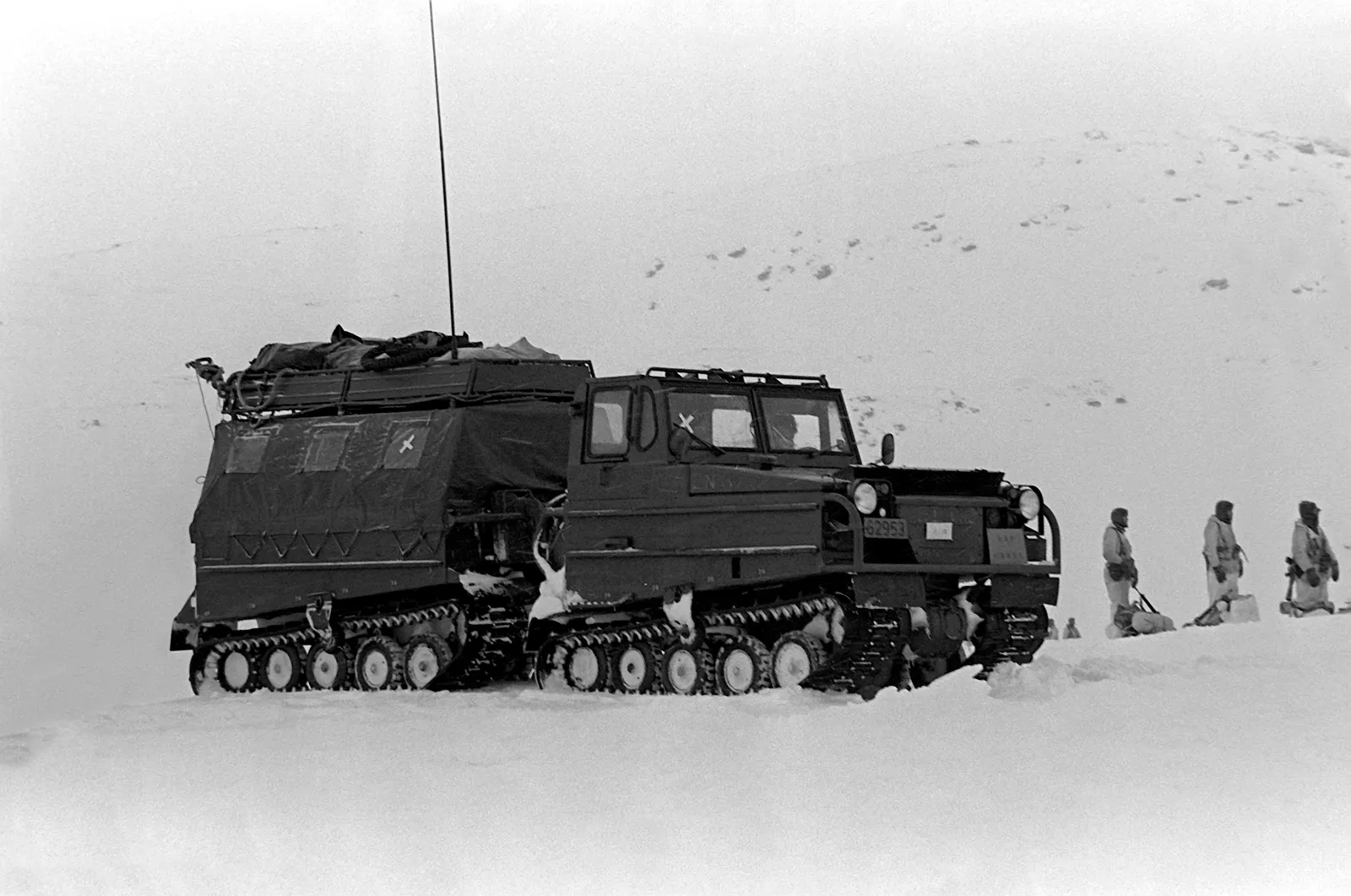
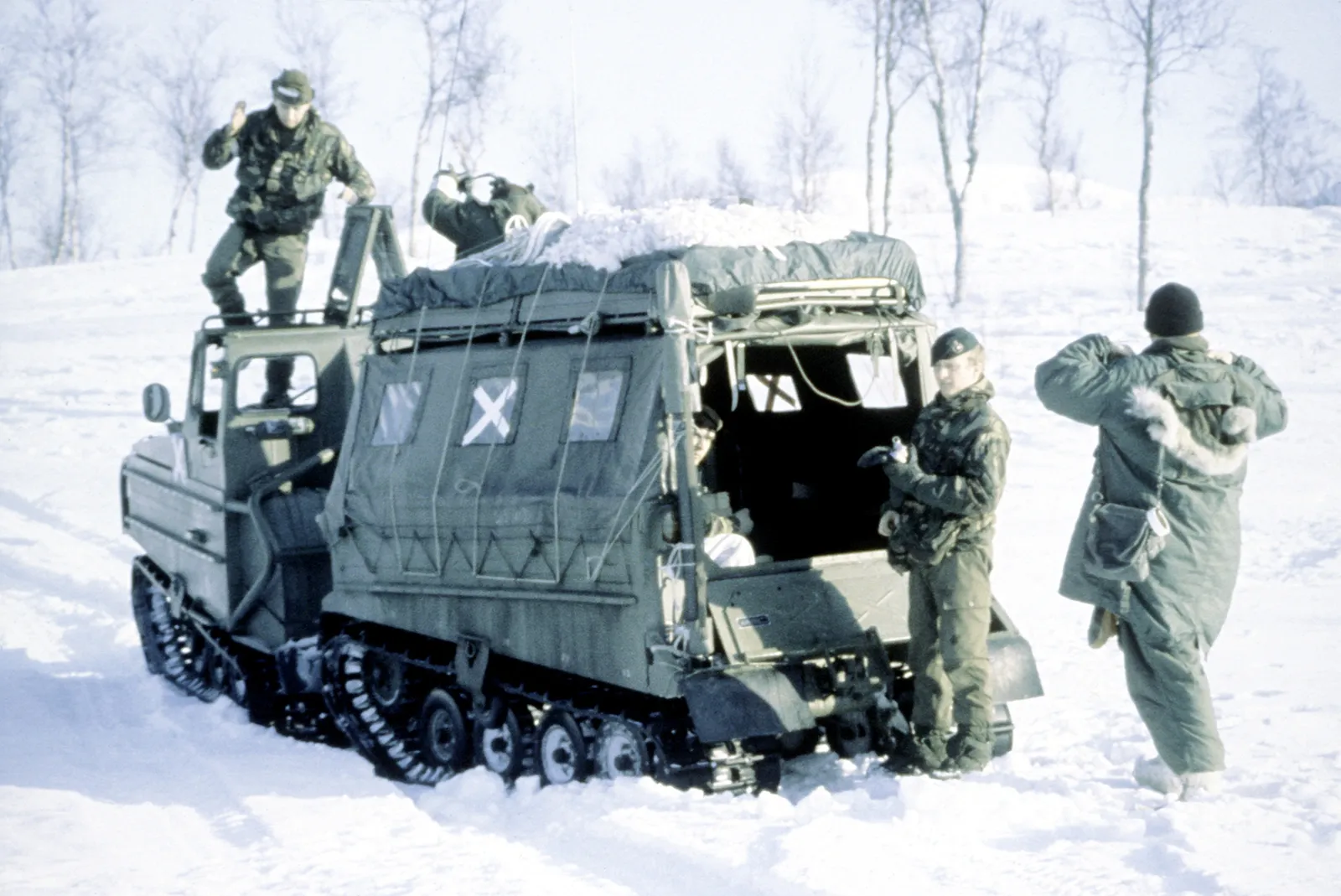
Imperial War Museums documents Royal Marines Volvo BV 202E vehicles supporting the three-day march toward Port Stanley by moving over difficult terrain and rescuing personnel affected by injury and exposure.
The Bv-202 is a Swedish two-unit articulated tracked carrier developed by Bolinder-Munktell and Volvo BM for snow, marsh, and other low-ground-pressure transport. British Royal Marines used Volvo BV 202E vehicles for mobility and rescue support during the 1982 Falklands War, while donated Bandvagn 202 vehicles reached Ukrainian forces during the 2014 Russia-Ukraine War for personnel, cargo, and medical-evacuation tasks.
Imperial War Museums documents Royal Marines Volvo BV 202E vehicles supporting the three-day march toward Port Stanley by moving over difficult terrain and rescuing personnel affected by injury and exposure.
Defense Express reported Bandvagn 202 vehicles shipped for Ukraine's Defense Forces through Ukraine's embassy in Latvia and SOS Aid to the Army of Ukraine, and earlier reported Ukrainian Bv 202 vehicles adapted for wounded evacuation on the front line.
Role detailsBv 202 designations distinguish Swedish body and heating variants, British and Norwegian export Mk II branches, the adjacent Bv 203 radio vehicle, and the later Bandvagn 206 successor rather than one unchanged model line.
| Variant | Configuration | Designation notes |
|---|---|---|
| Bv 202A /T | Base tracked carrier | Kalix Line Museum describes the Bv 202A /T as a tracked all-terrain vehicle with front engine unit, rear personnel compartment, powered tracks, low ground pressure, and amphibious mobility. Sources: Kalix Line Museum Bv 202A |
| Bv 202B | Trailer-interface variant | Mortar Investments lists Bv 202B as a family variant with a 12-pole trailer casing, separating it from the base A model and heated rear-body versions. |
| Bv 202C / Bv 202D | Heated rear-body variants | Mortar Investments describes Bv 202C with water-radiator heating for the rear unit and Bv 202D as an extra-insulated, heated rear-unit version. |
| Bv 202E | British-service export/Mk II branch | The RAF Museum identifies a 1978 British Army BV202E made by Volvo BM AB for over-snow load-carrying service; Mortar Investments describes the 202E Mk II branch as sharing the B20B, Orbitrol steering, rear heat, and ZF gearbox changes also associated with BV202NF1. Sources: RAF Museum Volvo BV202E Snowcat, Mortar Investments Volvo BV-202 Snowcat |
| BV202NF1 | Norwegian-service Mk II branch | Mortar Investments identifies BV202NF1 as a Norwegian branch and groups it with the 202E Mk II upgrade set: B20B engine, Orbitrol steering, rear-unit heat, and ZF gearbox. |
| Bv 202F | Specialized Swedish service variant | Kalix Line Museum lists Bv 202F SJTP /T among the tracked-vehicle variants preserved in its digitized Cold War vehicle collection. Sources: Kalix Line Museum Bv 202A |
| Bv 203B | Radio vehicle variant | Kalix Line Museum lists a Bv 203B radio tracked vehicle alongside Bv 202 variants, supporting the communications-vehicle branch of the family. Sources: Kalix Line Museum Bv 202A |
 | Successor articulated carrier | Defense Express says Bv 202 production continued until 1981, when it was replaced by the Hagglunds Bandvagn 206; HKFW describes a 1974 requirement for greater load capacity and engine power leading to Bv 206 development. Sources: Defense Express Bandvagn 202 Latvia Shipment, HKFW Volvo Bandvagn BV202 |
The Bv-202 family is best read as an articulated carrier line with local body and heating variants, followed by the separate Hagglunds Bandvagn 206 successor rather than a simple renamed Bv 202.
| Related system | Relationship | Source-backed context |
|---|---|---|
| Bv 202E / BV202NF1 | Export Mk II branches | The RAF Museum identifies a British-service BV202E made by Volvo BM AB, while Mortar Investments groups Bv 202E Mk II and BV202NF1 with B20B, Orbitrol steering, rear-heat, and ZF gearbox updates. |
| Bv 203B | Radio branch | Kalix Line Museum lists a Bv 203B radio tracked vehicle alongside its Bv 202 tracked-vehicle pages, supporting the communications-vehicle branch of the same Swedish articulated carrier family. |
| Successor carrier | Defense Express says the Bv 202 was replaced by the Hagglunds Bandvagn 206 after production ended, and HKFW ties the Bv 206 development requirement to higher load capacity and engine power. |
Kalix Line Museum describes a front unit carrying the engine and gearbox, a rear unit for up to eight soldiers, and all four tracks driven through the connection between the units.
Source: Kalix Line Museum Bv 202A.
The same museum ties the design to maintenance and support movement in Norrland's snow, marshes, and difficult terrain.
Source: Kalix Line Museum Bv 202A.
The RAF Museum says the BV202 was developed by Bolinder-Munktell, a Volvo subsidiary, and appeared in prototype form from 1958.
Sources: RAF Museum Volvo BV202E Snowcat
Kalix Line Museum describes the Bv 202 as a 1950s Bolinder-Munktell design for difficult Norrland terrain; Defense Express gives production as starting in 1964.
Sources: Kalix Line Museum Bv 202A, Defense Express Bandvagn 202 Latvia Shipment
Volvo CE's history states that AB Bolinder-Munktell was renamed Volvo BM in 1973, explaining why later sources identify the Bv 202E maker as Volvo BM AB.
Sources: Volvo CE Our History
Imperial War Museums documents Volvo BV 202E vehicles supporting Royal Marines movement and rescue work during the march toward Port Stanley.
Sources: IWM Falklands BV 202E
Defense Express reported Ukrainian receipt of Bandvagn 202 vehicles and said one of the first vehicles had been adapted for front-line medical evacuation.
Sources: Defense Express Ukrainian Army Bandvagn 202
Defense Express reported that Ukraine's embassy in Latvia and SOS Aid to the Army of Ukraine organized a Bandvagn 202 shipment bought in Norway with Chicago Latvian donations.
Sources: Defense Express Bandvagn 202 Latvia Shipment