Support Equipment

GAZ-3344-20 Aleut

Also known as
  • GAZ-3344-20
  • GAZ 3344-20
  • GAZ-3344
  • Aleut
  • ГАЗ-3344-20 Алеут
  • Zavolzhsky GAZ-3344-20

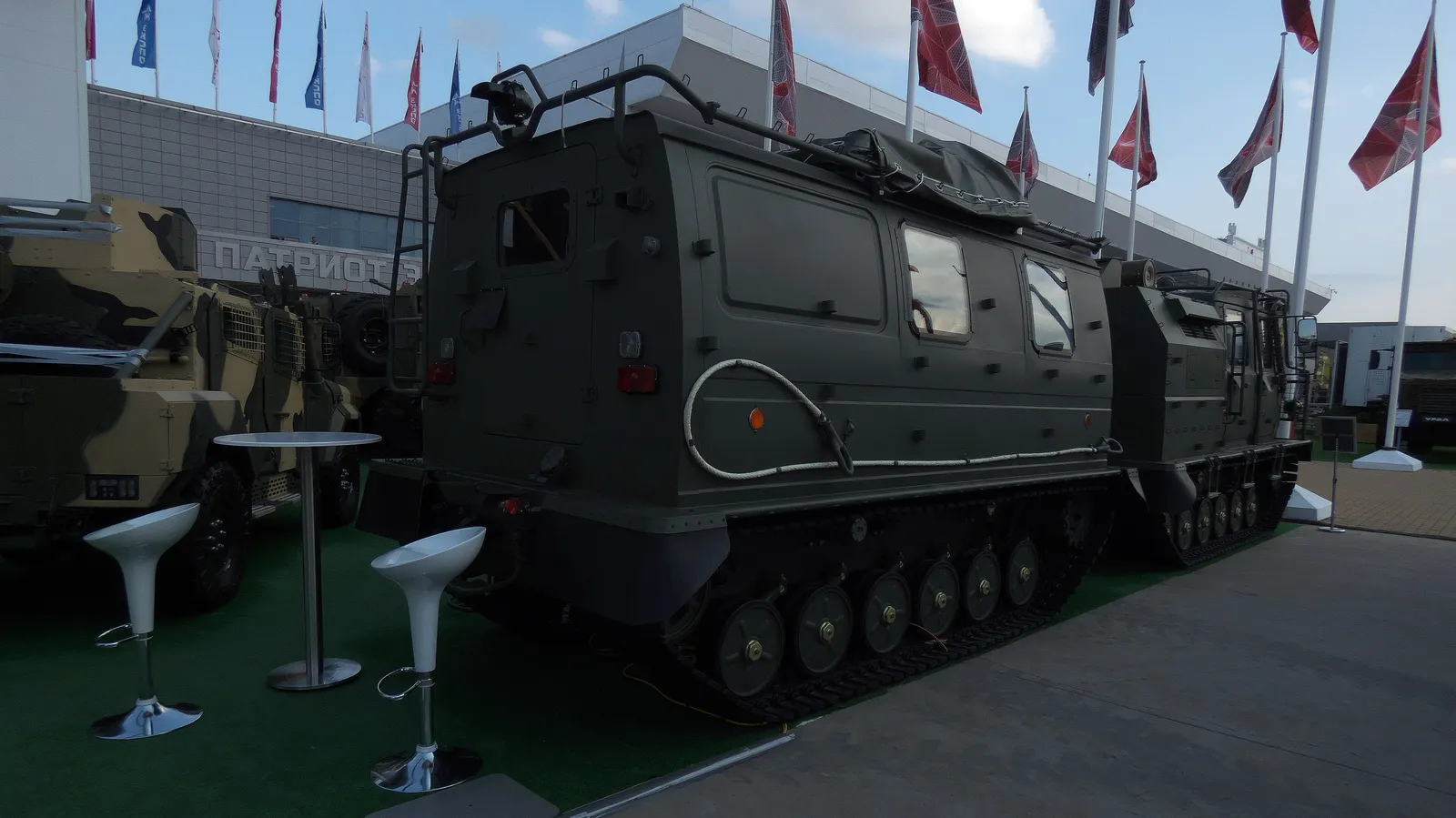
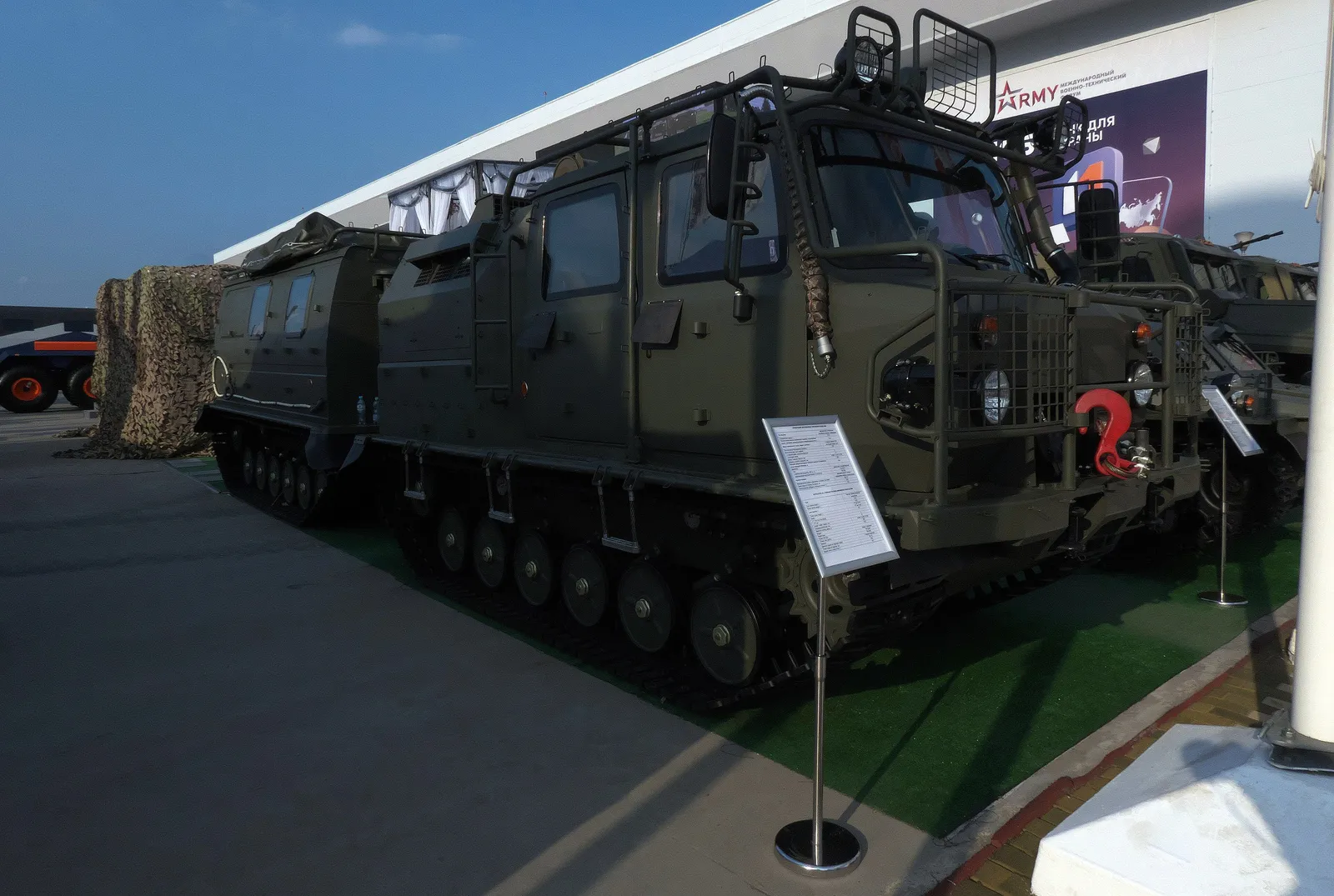
The GAZ-3344-20 Aleut is a Russian two-section tracked amphibious all-terrain carrier built by Zavolzhsky Tracked Tractor Plant for Arctic and difficult-terrain mobility. It is the military GAZ-3344 family configuration, with a crew/power module, configurable rear module, low-ground-pressure tracked articulation, and an unarmored transport role. Public reporting and visual loss trackers document Aleut carriers destroyed after Russia sent Arctic-capable support vehicles to Ukraine.

Role in Conflicts

Side
Russia

Russia fielded the GAZ-3344-20 Aleut in Ukraine after the full-scale invasion, drawing on Arctic-capable transport inventory; reporting and open-source visual-loss records document Aleut carriers destroyed in the Ukrainian theater, including a Kyiv-region example in March 2022.

Role details
Profile / Specs

Profile

Origin
Russia
Type
Articulated tracked all-terrain transport vehicle
Service note
Entered Russian service in 2019 and documented in the 2022 full-scale invasion of Ukraine
Designer
Zavolzhsky Tracked Tractor Plant
Produced
Delivered to Russian forces from 2019
Developed from
GAZ-3344 two-section tracked snow-and-swamp vehicle
Developed into
MTR-G technical reconnaissance vehicle

Specifications

Configuration
Two-section articulated tracked amphibious carrier
Crew and passengers
Front cabin for 5 including driver; rear passenger module can carry up to 15
Payload
About 2.5 tonnes total payload; Janes breaks this down as 500 kg in the front module and 2 tonnes in the rear module
Weight
About 11 to 11.2 tonnes in military-service descriptions
Protection
Unarmored tracked transporter in Army Recognition's military-modification description
Engine
YaMZ-53402-10 diesel, reported by Janes at 240 hp
Maximum road speed
60 km/h
Range
800 km
Ground pressure
Army Recognition reports about 0.2 to 0.21 kg/cm² average specific ground pressure
Articulation
Hydraulic articulation unit controls mutual movement of the two links in two axes
Light-weapon provision
Army Recognition describes a roof hatch with a pivot mount for a normal-caliber machine gun
Operating temperature
ZZGT states the base GAZ-3344 family is intended for operation from -50°C to +40°C
Operating role
Personnel, cargo, and mission-module transport across snow, swamp, water obstacles, and difficult terrain
Module Layout And Role

The Aleut is built as a two-section tracked carrier: a front power module with the crew cabin and engine compartment, and a rear module that can be fitted for passengers, cargo, medical support, command-post work, or other mission kits.

Front module

Driver plus four passengers, engine behind the crew area, and a 500 kg payload figure in the Janes description.

Rear module

Configurable compartment for up to 15 passengers or roughly 2 tonnes of rear payload, with heated compartments for cold-weather use.

Articulation and terrain

A hydraulic joint controls movement between the two tracked links; ZZGT describes the base family as built for severe climate, weak-bearing soils, and off-road transport.

Battlefield context

Its catalog role is support mobility rather than direct fire: sources document transport use, Arctic-force deployment, and destroyed examples in Ukraine.
Variants

The GAZ-3344-20 Aleut is the Russian military configuration in the GAZ-3344 two-section tracked vehicle family. Public sources distinguish the base GAZ-3344 carrier, mission rear-module configurations, and the later MTR-G technical reconnaissance derivative.

VariantConfigurationDesignation notes
GAZ-3344Base two-section snow-and-swamp vehicle

ZZGT describes the GAZ-3344 family as a two-section tracked vehicle for severe climate and off-road personnel/cargo transport, while Army Recognition describes the Aleut as the army-focused GAZ-3344-20 modification.

Sources: ZZGT GAZ-3344 product page, Army Recognition Aleut cold-weather drills

Passenger rear moduleRear compartment configuration

Janes and Army Recognition describe a configurable rear compartment able to carry up to 15 additional personnel.

Sources: Janes Aleut service entry, Army Recognition Aleut cold-weather drills

Command-post rear moduleMission rear-module configuration

Army Recognition says the rear module can be re-equipped as a command-post vehicle.

Sources: Army Recognition Aleut cold-weather drills

Ambulance rear moduleMission rear-module configuration

Army Recognition says the rear module can be re-equipped as an ambulance vehicle.

Sources: Army Recognition Aleut cold-weather drills

MTR-G technical reconnaissance vehicleGAZ-3344-20-based Arctic support derivative

VPK.name reports the MTR-G technical reconnaissance vehicle as a GAZ-3344-20 Aleut-based derivative intended to work with DT-30PM-based REM-GT repair and evacuation vehicles in Arctic units.

Sources: VPK Arctic repair vehicles

Timeline

GAZ-3344-20 Aleut Key Events

  1. First military deliveries reported

    Janes reported that the first of 123 Aleut platforms was delivered to Russian Ground Troops stationed in northern Russia in May 2019.

    Sources: Janes Aleut service entry

  2. Service entry described publicly

    Janes identified the GAZ-3344-20 Aleut as a ZZGT articulated all-terrain vehicle entering Russian service and summarized its payload, speed, range, and modular rear compartment.

    Sources: Janes Aleut service entry

  3. Cold-weather drills reported in Transbaikalia

    Army Recognition reported Eastern Military District drills with GAZ-3344-20 Aleut vehicles in Transbaikalia frost and summarized the army modification's two-module layout, unarmored transport role, and rear-module reconfiguration options.

    Sources: Army Recognition Aleut cold-weather drills

  4. Aleut loss reported near Kyiv

    Defence Blog reported Ukrainian artillery strikes in the Kyiv region that destroyed Russian vehicles including a GAZ-3344-20 Aleut, illustrating the deployment of Arctic-support equipment outside its intended northern operating environment.

    Sources: Defence Blog Kyiv Aleut report

  5. Arctic materiel depletion noted

    High North News described the Aleut among Arctic vehicles sent by Russia to Ukraine and connected those deployments to wider losses in Russia's Arctic formations.

    Sources: High North News Arctic losses

Media
Related Weapon Systems
GAZ-34039 Irbis, Tracked amphibious snow-and-swamp transport vehicle, Support EquipmentSupport EquipmentGAZ-34039 IrbisTracked amphibious snow-and-swamp transport vehicleThe GAZ-34039 Irbis is a Russian tracked amphibious snow-and-swamp vehicle produced by Zavolzhsky Tracked Tractor Plant for passenger and cargo transport in severe off-road and climatic conditions. ZZGT product material describes a 5,000 kg vehicle with a D-245 diesel engine, 12-seat passenger layout, road and afloat mobility, and passenger, cargo-passenger, and cargo configuration rows. Open-source reporting has also documented Irbis vehicles with Indonesian TNI disaster-response units, but direct armed-conflict use remains unsourced.
GAZ-3937 Vodnik, 4x4 amphibious armored mobility and reconnaissance vehicle, Armored VehiclesArmored VehiclesGAZ-3937 Vodnik4x4 amphibious armored mobility and reconnaissance vehicleThe GAZ-3937 Vodnik is a Russian 4x4 amphibious armored vehicle family built around a modular front-and-rear body concept for troop transport, reconnaissance, convoy escort, ambulance, and utility roles. The GAZ-39371 production variant is associated with Military Industrial Company and Arzamas Machine-Building Plant sourcing, can carry mission modules or turreted armament, and appears in the Ukraine-war catalog as rare captured Russian armored mobility equipment.
BTR-MDM Rakushka, Airborne amphibious tracked armored personnel carrier, Armored VehiclesArmored VehiclesBTR-MDM RakushkaAirborne amphibious tracked armored personnel carrierThe BTR-MDM Rakushka is the Russian Rakushka-M airborne amphibious tracked armored personnel carrier, with this entry also covering the earlier BTR-MD Rakushka designation because public sources treat it as the direct predecessor in the same family. It carries a small crew plus an airborne assault party, ammunition, fuel, spares, or casualties, and has been visually documented among Russian equipment destroyed, damaged, abandoned, and captured during the full-scale phase of the 2014 Russia-Ukraine War.

Sources