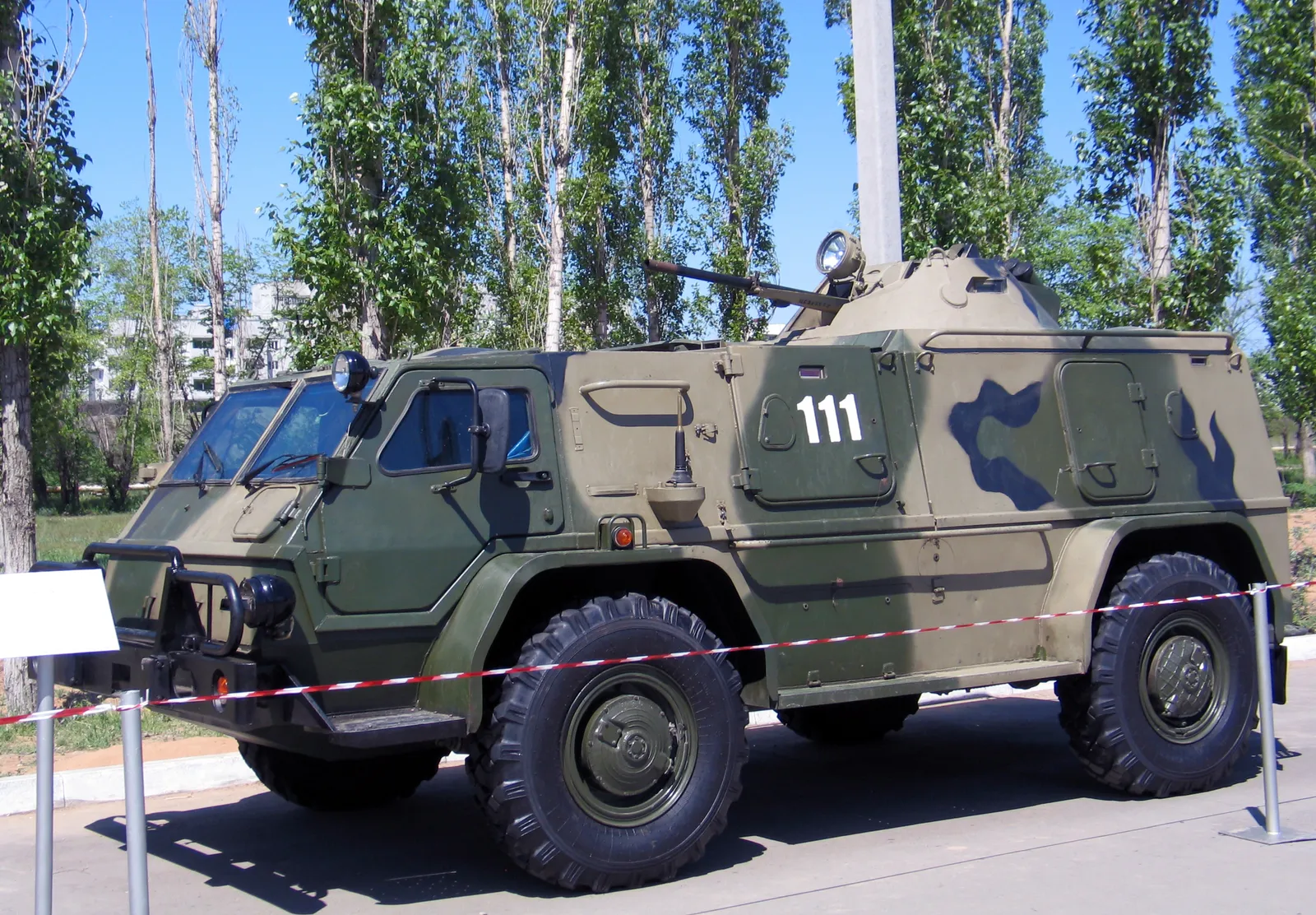


Oryx lists two Russian GAZ-39371 Vodnik vehicles as captured during the full-scale invasion, while Army Recognition reported a captured GAZ-3937 repainted in Ukrainian pixel camouflage and used by Ukrainian soldiers.
Role detailsArmored Vehicles
GAZ-3937 Vodnik
Also known as
- Vodnik
- GAZ-3937
- GAZ-39371
- GAZ-39371 Vodnik
- GAZ-39371-221
- BMM-1
- BMM-2
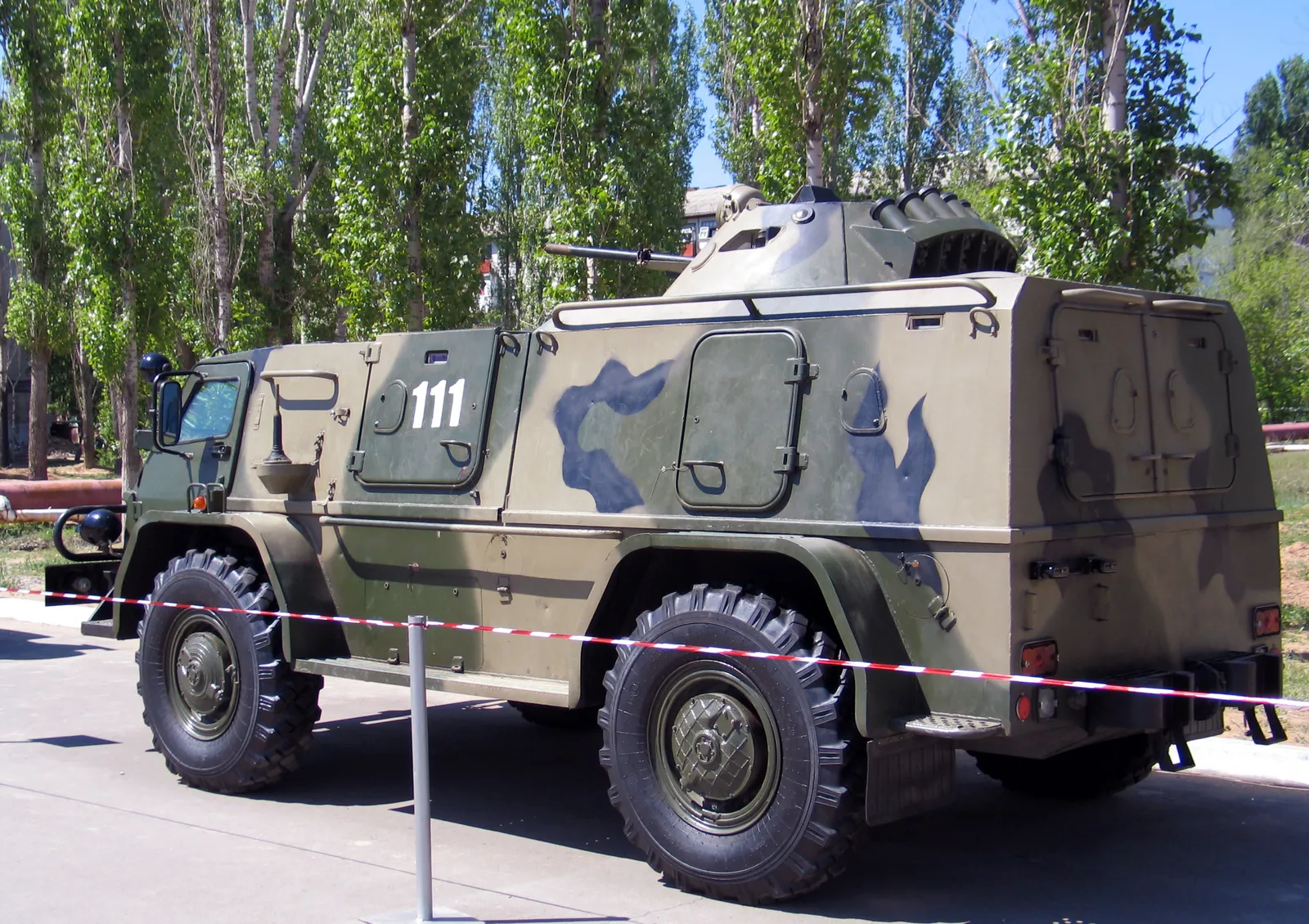
The GAZ-3937 Vodnik is a Russian 4x4 amphibious armored vehicle family built around a modular front-and-rear body concept for troop transport, reconnaissance, convoy escort, ambulance, and utility roles. The GAZ-39371 production variant is associated with Military Industrial Company and Arzamas Machine-Building Plant sourcing, can carry mission modules or turreted armament, and appears in the Ukraine-war catalog as rare captured Russian armored mobility equipment.
Role in Conflicts
Profile / Specs
Profile
- Origin
- Russia
- Type
- 4x4 amphibious armored mobility and reconnaissance vehicle
- Service note
- Early-2000s Russian service; visually documented in the full-scale phase of the 2014 Russia-Ukraine War
- Designer
- Military Industrial Company / GAZ vehicle design lineage
- Designed
- Development testing completed around 2002 according to Deagel; Army Guide describes the GAZ-3937-10 version as developed in 1995 and first seen in 1996
- Produced
- Early 2000s limited production and service entry
- Number built
- Limited public production; Deagel lists Russia and Uruguay as operators and Army Recognition reported approximately 54 supplied to Russian forces
Specifications
- Configuration
- 4x4 amphibious armored vehicle with front control/engine module and replaceable rear mission module
- Crew and passengers
- Army Guide lists 1 crew and 10 troops for the GAZ-39371 data table; Army Recognition describes a two-person crew with up to eight infantrymen depending on configuration
- Combat weight
- Deagel lists 7,000 kg maximum weight; Army Recognition and Wikimedia-derived references commonly place the family around 6.6 to 7.5 tonnes by configuration
- Engine
- 175 hp liquid-cooled turbocharged diesel in Deagel and Army Recognition descriptions; Army Guide also lists YaMZ-460 and YaMZ-534.10 diesel options
- Road speed
- About 110 km/h in Army Guide, Deagel, and Army Recognition; Defence Blog reports 112 km/h for the GAZ-39371
- Range
- Up to 1,000 km according to Army Guide, Deagel, and Army Recognition
- Mobility
- Independent suspension, central tire-pressure system, amphibious hull, and roughly 1 m to 1.2 m water-crossing capability depending on source wording
- Armament options
- BTR-80-style one-person turret with 14.5 mm KPVT and 7.62 mm PKT machine guns; other marketed modules include light weapons, antitank guided weapons, and utility/ambulance modules
- Protection
- Armored hull for small-arms and fragment protection; mine and ballistic protection vary by configuration and are less clearly documented than mobility and mission-module data
Modular Vehicle Layout
The Vodnik family is useful as a catalog entry because it sits between light protected mobility vehicles and heavier wheeled APCs. Army Guide and Deagel both describe a modular rear section that can be changed for troop transport, reconnaissance, escort, medical evacuation, technical-assistance, antitank, or weapons-carrier roles rather than one fixed combat fit.
Baseline mission
Personnel movement, road and off-road patrol, convoy escort, reconnaissance, and special-purpose military tasks.
Weapons fit
Documented options include a BTR-80-style turret with 14.5 mm KPVT and 7.62 mm PKT machine guns, and Army Guide also notes marketed mission modules including antitank and heavier weapons fits.
Catalog relationship
The record is kept separate from GAZ Tigr because the Vodnik uses its own amphibious modular layout and appears as a rarer captured vehicle in Ukraine-war loss reporting.
Sources: Army Guide GAZ-39371 Vodnik; Deagel Vodnik profile; Oryx Russian equipment losses in Ukraine.
Variants
Public references use GAZ-3937 for the original layout and GAZ-39371 for the later nose-forward/main-production configuration; mission modules changed the same basic platform into troop, weapons, ambulance, and support versions.
| Variant | Configuration | Designation notes |
|---|---|---|
| GAZ-3937 | Original two-seat/tandem-cab armored vehicle layout | Army Guide distinguishes the GAZ-3937 APC layout from the later GAZ-39371 front-cab version. Sources: Army Guide GAZ-39371 Vodnik |
| GAZ-39371 | Later Vodnik variant with revised forward cabin | Army Guide describes the GAZ-39371 as a version with commander, driver, and radio-operator seating and optional turret or mission-module fits. |
| GAZ-3937-10 | Armored car with BTR-80-style machine-gun turret | Army Guide describes the GAZ-3937-10 as fitted with a BTR-80 one-person turret armed with 14.5 mm KPVT and 7.62 mm PKT machine guns. Sources: Army Guide GAZ-39371 Vodnik |
| BMM-1 / BMM-2 | Medical evacuation and ambulance variants | Deagel lists BMM-1 and BMM-2 among alternate Vodnik designations for medical evacuation and improved ambulance configurations. Sources: Deagel Vodnik profile |
Timeline
GAZ-3937 Vodnik Key Events
GAZ-3937-10 developed
Army Guide describes the GAZ-3937-10 armored-car version as developed in 1995 and first seen in 1996.
Sources: Army Guide GAZ-39371 Vodnik
Development testing completed
Deagel reports that Russian press described Vodnik development testing as complete in 2002, with the GAZ-39371 Vodnik listed as active from that year.
Sources: Deagel Vodnik profile
Uruguay export context
Deagel lists Uruguay as an operator with 48 Vodnik vehicles, matching later public reporting that the type had a limited export footprint beyond Russia.
Sources: Deagel Vodnik profile
Captured example reported in Ukraine
Army Recognition reported a captured Russian GAZ-3937 Vodnik repainted in Ukrainian pixel camouflage and used by Ukrainian soldiers during the full-scale invasion.
Sources: Army Recognition captured Vodnik
Media
GAZ-3937 Vodnik Images
Related Weapon Systems


Sources
Army Guide GAZ-39371 VodnikPublisher: Army Guide | Note: Supports GAZ-39371 identity, Military Industrial Company manufacturer listing, modular mission-role description, variants, turret options, troop capacity, mobility, and selected specifications. | Accessed: 2026-07-06Deagel Vodnik profilePublisher: Deagel | Note: Supports Vodnik operator, contractor, active-status, IOC, mission-role, module, engine, range, speed, weight, fording, and BMM-1/BMM-2 variant background. | Accessed: 2026-07-06Army Recognition captured VodnikPublisher: Army Recognition | Note: Directly supports 2014 Russia-Ukraine War conflict-use context: a Russian GAZ-3937 Vodnik captured by Ukrainian soldiers, repainted in Ukrainian pixel camouflage, and reported in use by Ukrainian soldiers; also supports limited-production and specification background. | Accessed: 2026-07-06Oryx Russian equipment losses in UkrainePublisher: Oryx | Note: Directly supports 2014 Russia-Ukraine War conflict-use context as visually documented Russian equipment losses: two GAZ-39371 Vodnik vehicles listed as captured during the full-scale invasion. | Accessed: 2026-07-06Defence Blog Vodnik Latakia reportPublisher: Defence Blog | Note: Supports GAZ-39371 amphibious mobility, GAZ-family manufacturing context, module seating, engine, speed, and public reporting of Vodnik vehicles in Latakia; not used as a conflictUsage source because it does not by itself establish a catalog conflict-use row. | Accessed: 2026-07-06Wikimedia Commons Vodnik front imagePublisher: Wikimedia Commons | Note: Supports the primary image: a GAZ-3937 Vodnik photographed at a Kapustin Yar anniversary military-equipment exhibition, licensed under CC BY-SA 3.0 / GFDL. | Accessed: 2026-07-06Wikimedia Commons Vodnik rear imagePublisher: Wikimedia Commons | Note: Supports the rear gallery image for the same GAZ-3937 Vodnik exhibition vehicle, licensed under CC BY-SA 3.0 / GFDL. | Accessed: 2026-07-06