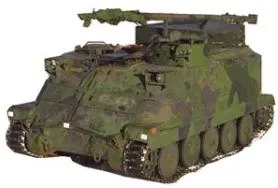
Sweden announced that its PBV 302 stock, spares, maintenance equipment, and ammunition would be donated to Ukraine for new brigades; Ukrainian reporting then described approval for delivery to the armed forces, and Oryx lists visually documented Ukrainian Pbv 302 losses.
Role detailsPbv 302
- Pansarbandvagn 302
- Armoured tracked carrier vehicle 302
The Pbv 302 is a Swedish tracked armored personnel carrier and infantry fighting vehicle developed by Hägglunds for mechanized infantry mobility, amphibious movement, and protected troop transport under 20 mm cannon fire support. Sweden announced the donation of its PBV 302 stock, spares, maintenance equipment, and ammunition to Ukraine in May 2024; Ukrainian approval reporting and visually documented loss records place the vehicle in Ukrainian service during the 2014 Russia-Ukraine War.
Role in Conflicts
Profile / Specs
Profile
- Origin
- Sweden
- Built by
- BAE Systems Hägglunds
- Type
- Tracked armored personnel carrier / infantry fighting vehicle
- Service note
- Cold War Swedish service vehicle reintroduced through 2024 military aid to Ukraine
- Designer
- Hägglund & Söner
- Designed
- 1960s
- Produced
- 1960s-1970s
Specifications
- Crew and passengers
- Crew of 3 plus 8 troops
- Armament
- 20 mm Hispano-Suiza Type 804 cannon
- Weight
- About 14.5 tons
- Dimensions
- Approximately 5.3 m long, 2.85 m wide, 2.6 m high
- Engine
- Volvo Penta diesel, 270 hp
- Top speed
- About 65 km/h on road
- Range
- About 300 km
- Mobility
- Tracked and amphibious, with water movement by tracks
- Protection
- Welded steel armor against small-arms fire and fragments; Ukrainian approval reporting described upgraded vehicles with internal anti-fragmentation and external ceramic elements
Design And Ukraine Delivery Context
The Pbv 302 page is strongest when read as a late-Cold-War Swedish infantry carrier brought back into front-line relevance through the 2024 Ukraine aid pipeline. Its catalog role combines protected mobility, an autocannon turret, and a donor-supplied support package rather than a new-production vehicle program.
Hägglunds developed the vehicle in the 1960s as a tracked carrier for Swedish mechanized infantry, with crew-plus-squad capacity and amphibious movement by tracks.
The vehicle's primary weapon is a 20 mm Hispano-Suiza Type 804 cannon in a traversable turret, giving the carrier an organic autocannon rather than only machine-gun armament.
Sweden's May 2024 package covered the full PBV 302 stock together with spare parts, maintenance equipment, and ammunition for new Ukrainian brigade reconstruction.
Sources: Defense Advancement PBV-302; Swedish Government Package 16; Ukraine MOD Pbv 302 Approval; Kyiv Independent Pbv 302; Oryx Ukrainian Equipment Losses.
Variants
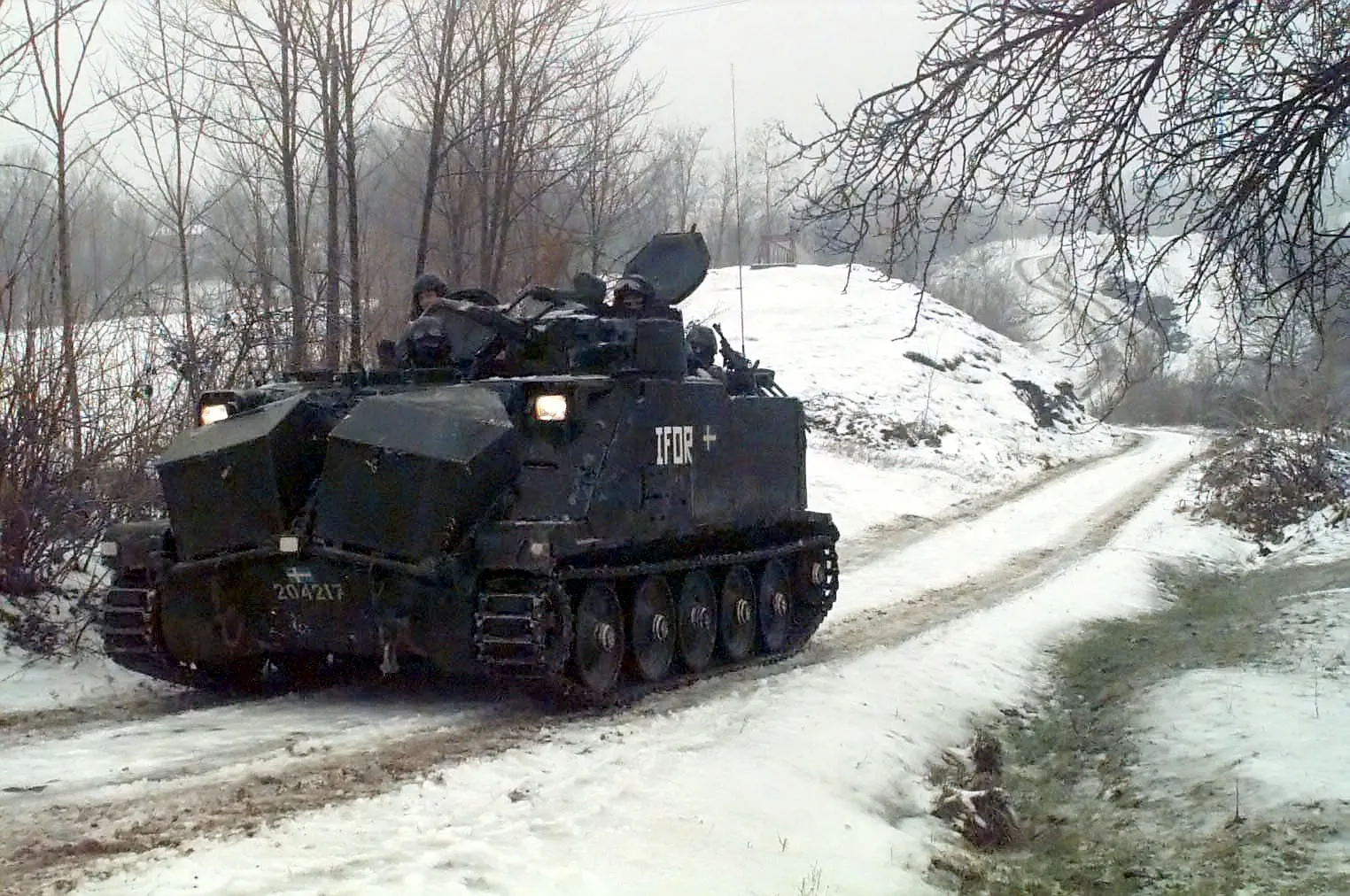
The Pbv 302 family includes the baseline troop carrier, protected B/C upgrade standards, and specialist command, fire-control, communications, reconnaissance, and medical-transport conversions.
| Variant | Configuration | Designation notes |
|---|---|---|
| Pbv 302A | Baseline infantry carrier | SPHF lists 518 Pbv 302A troop-carrier vehicles delivered from 1966 to 1972, with a 20 mm m/47D cannon and Swedish service from 1966. Sources: SPHF Pbv 302 Family |
| Pbv 302B | Internal spall-liner upgrade | SPHF says 50 Pbv 302A vehicles received internal fiberglass liner protection in 1993 and were redesignated Pbv 302B. Sources: SPHF Pbv 302 Family |
| Pbv 302C | Add-on ceramic armor upgrade | SPHF says the same 50 Pbv 302B vehicles later received external ceramic-based armor and were redesignated Pbv 302C. Sources: SPHF Pbv 302 Family |
| Stripbv 3021 / Epbv 3022 / Bplpbv 3023 | Command, fire-control, and battery-position variants | SPHF identifies command, fire-control, and battery-position versions within the Pbv 302 family, reflecting the chassis' use beyond troop transport. Sources: SPHF Pbv 302 Family |
| Ralänkpbv 3024 / Pjrekpbv 3025 / Sjuktppbv 3026 | Communications, gun-reconnaissance, and medical-transport conversions | SPHF lists conversions from Pbv 302A vehicles into radio-link, gun-reconnaissance, and medical-transport configurations. Sources: SPHF Pbv 302 Family |
Ammunition Fired
The Pbv 302's turret armament is a 20 mm Hispano-Suiza Type 804 cannon, tying the vehicle to the cataloged 20x110mm Hispano ammunition family.
| Ammunition | Ammunition type | Firing evidence |
|---|---|---|
![]() | 20x110mm cannon ammunition | Defense Advancement identifies the Pbv 302's primary armament as a 20 mm Hispano-Suiza Type 804 cannon, while the linked ammunition record covers 20x110mm HS404/HS804 projectiles. Sources: Defense Advancement PBV-302 |
Timeline
Pbv 302 Key Events
Hägglunds develops the Pbv 302
The Pbv 302 was developed in the 1960s by Hägglunds, later BAE Systems Hägglunds, as a Swedish tracked carrier for mechanized infantry.
Sources: Defense Advancement PBV-302
Sweden announces PBV 302 donation to Ukraine
The Swedish Government said it would donate its entire PBV 302 stock, including spare parts, maintenance equipment, and ammunition, to support new Ukrainian brigades.
Sources: Swedish Government Package 16
Ukraine approves Pbv 302 for delivery
Ukraine's Ministry of Defence said the Swedish Pbv 302 had been admitted for supply to the Armed Forces of Ukraine.
Sources: Ukraine MOD Pbv 302 Approval
Media
Pbv 302 Videos
Pbv 302 Images
Related Weapon Systems