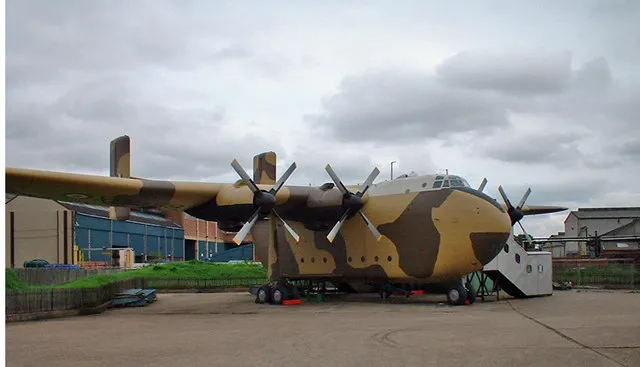
RAF Beverleys supported Commonwealth Borneo logistics during the Confrontation, including parachute and free-drop air supply to forward bases and documented No. 34 Squadron Beverley activity from Labuan and Sabah.
Aircraft & UAVs
Blackburn Beverley
Also known as
- Blackburn B-101 Beverley
- Blackburn Beverley C.1
- Blackburn Beverley C Mk.1
- Beverley C Mk.1
- GAL.60 Universal Freighter
- GAL.65 Universal Freighter
- B-101 Beverley
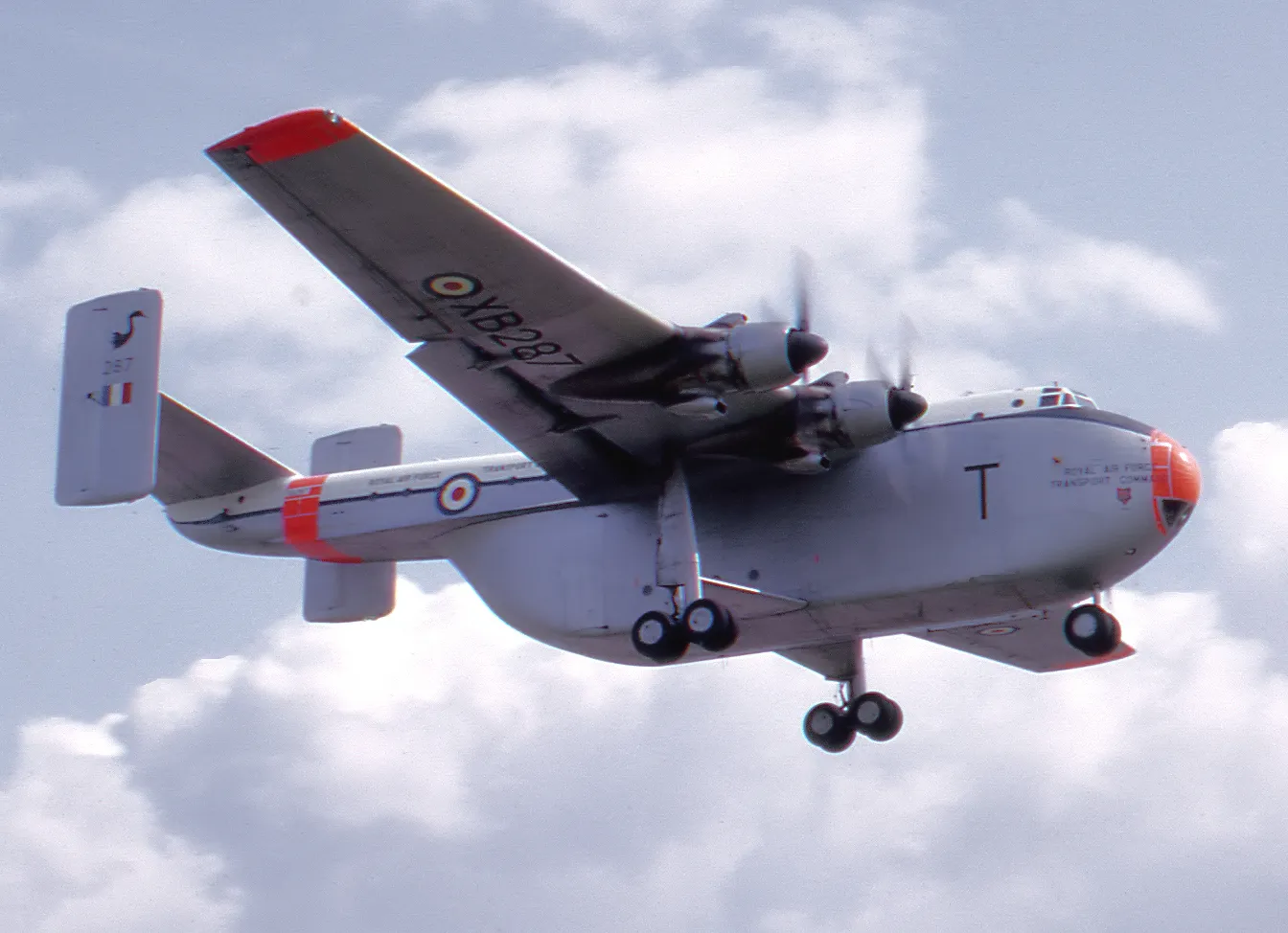
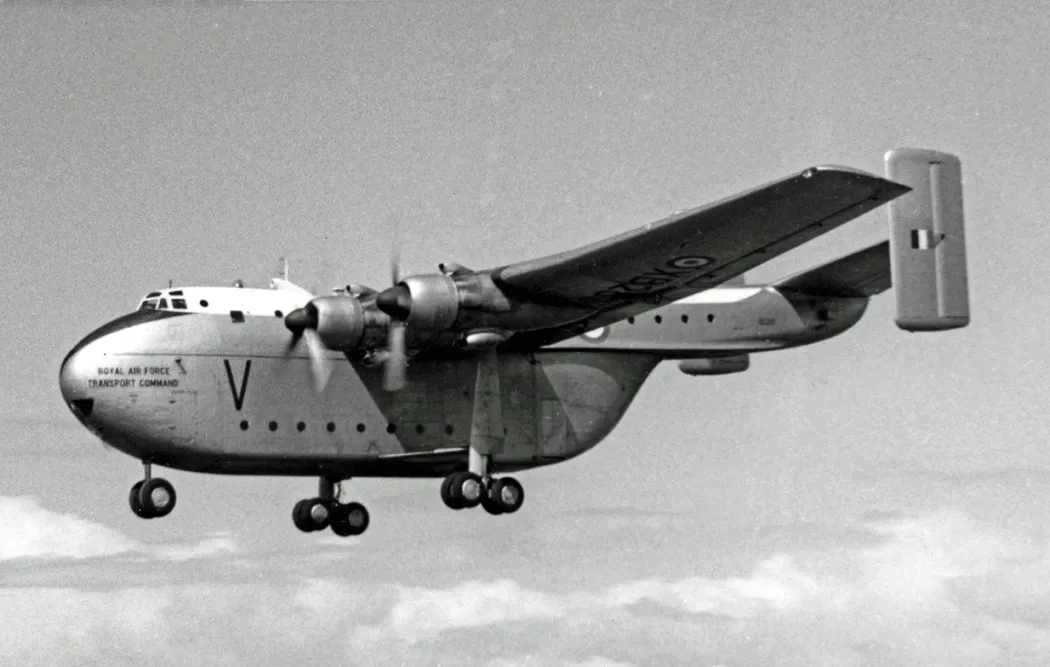
The Blackburn Beverley was a British piston-engined heavy military transport built at Brough for Royal Air Force Transport Command. Developed from the General Aircraft Universal Freighter line, it paired a box-section cargo hold, high wing, fixed undercarriage, clamshell loading doors, and tailboom troop accommodation for bulky freight, paratroop, and rough-strip logistics, including documented Commonwealth air-supply work in Borneo during the Indonesian Confrontation.
Role in Conflicts
Profile / Specs
Profile
- Origin
- United Kingdom
- Built by
- Blackburn Aircraft Company
- Type
- Heavy military transport aircraft
- Service note
- Cold War era
- Designer
- General Aircraft Limited / Blackburn Aircraft Company
- Designed
- 1945 design studies; Specification C.3/46 in 1946; GAL.60 first flight on 1950-06-20
- Produced
- 1954-1958
- Number built
- 49 total aircraft: two prototypes and 47 Beverley C Mk.1 production aircraft
Specifications
- Crew
- Up to six including two pilots, engineer, navigator, signaller, and air quartermaster
- Powerplant
- Four Bristol Centaurus 18-cylinder radial engines, 2,850 hp each
- Wingspan
- 162 ft 0 in (49.38 m)
- Length
- 99 ft 5 in (30.30 m)
- Height
- 38 ft 9 in (11.81 m)
- Maximum takeoff weight
- 143,000 lb (64,864 kg)
- Maximum speed
- 238 mph (208 kn / 383 km/h)
- Range
- 1,300 miles (1,130 nm / 2,092 km) with 29,000 lb payload
- Cargo hold
- About 6,000 cu ft (170 m3)
- Capacity
- 94 troops in the main hold plus 36 in the tailboom; 70 paratroops or 48 stretchers listed for the C Mk.1
- Freight capacity
- Up to 45,000 lb freight, or 29,000 lb for the standard 1,300-mile payload figure
Design Notes
The Beverley was built around load volume, rough-strip access, and airborne supply rather than speed. Its high wing and fixed undercarriage kept the cargo door area clear, while the boxy main hold and raised tailboom let the RAF carry bulky vehicles, troops, paratroops, stretchers, or supply loads from austere airfields.
Cargo Layout
A roughly 6,000 cu ft main hold was backed by a passenger-carrying tailboom, giving the aircraft separate freight and troop spaces.
Rough-Strip Role
Large low-pressure tires, fixed landing gear, and reversible-pitch propellers supported short, imperfect runways and forward logistics work.
Air Supply
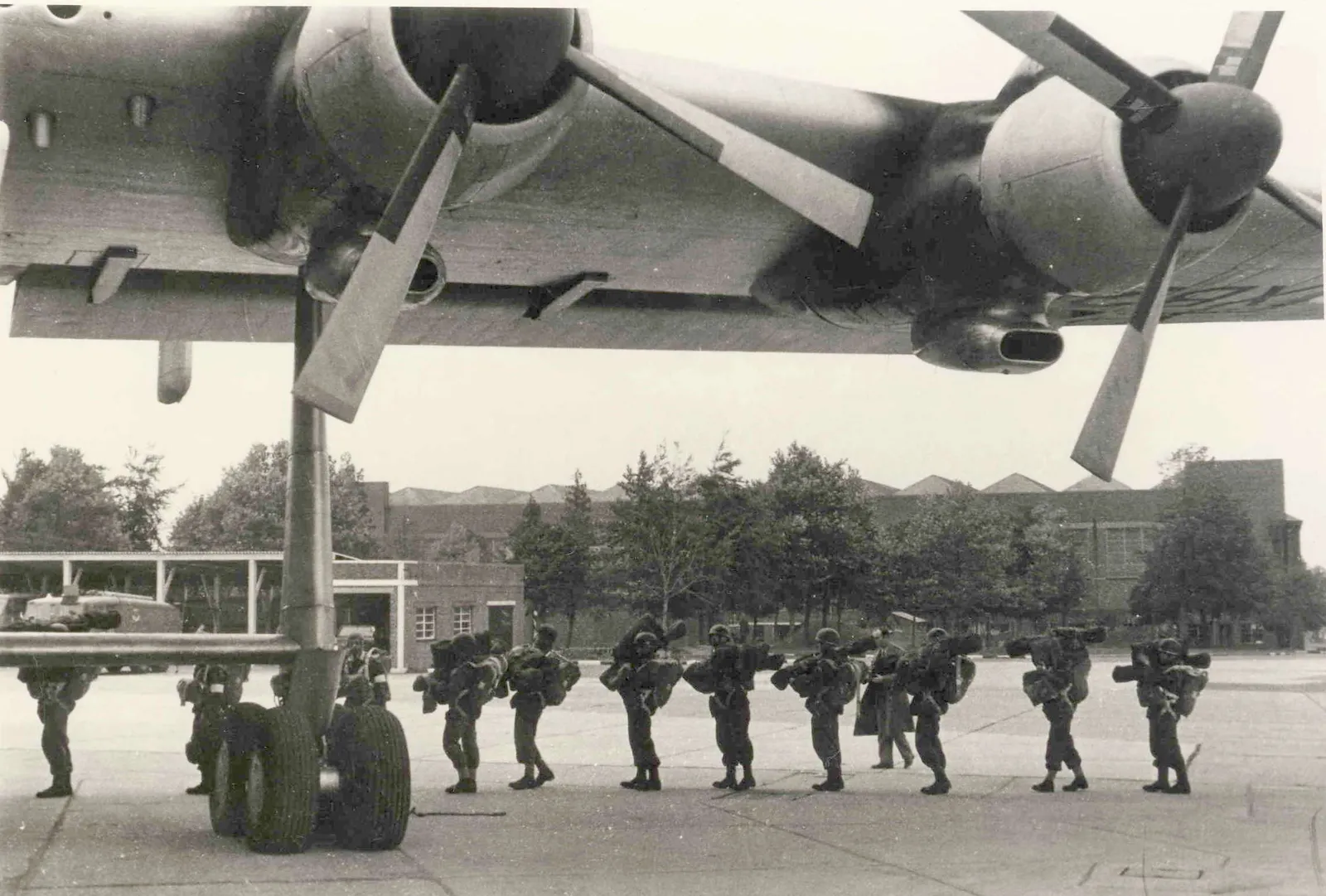
The clamshell rear doors and paratroop exits supported parachute and free-drop supply missions as well as troop movement.
Variants
Beverley designations trace the aircraft from General Aircraft Universal Freighter prototypes to Blackburn production and unbuilt Blackburn development studies.
| Variant | Configuration | Designation notes |
|---|---|---|
| G.A.L.60 Universal Freighter Mk.1 | First prototype | General Aircraft designation for the first prototype, built at Feltham and completed at Brough before its first flight in June 1950. Sources: Blackburn Beverley - BAE Systems Heritage, Blackburn Beverley - Aeroflight |
| G.A.L.65 Universal Freighter Mk.2 / Blackburn B-100 | Second prototype | Redesigned prototype with Centaurus engines, an enlarged passenger-carrying tailboom, revised rear fuselage, and clamshell doors. Sources: Blackburn Beverley - BAE Systems Heritage, Blackburn Beverley - Aeroflight |
| Blackburn Beverley C Mk.1 / B-101 | RAF production transport | Production RAF cargo version; BAE Systems Heritage and Aeroflight identify 47 production aircraft. Sources: Blackburn Beverley - BAE Systems Heritage, Blackburn Beverley - Aeroflight |
| Blackburn B-107 | Unbuilt projected development | Projected Tyne-powered enlarged-capacity development with a new rounded fuselage. Sources: Blackburn Beverley - BAE Systems Heritage, Blackburn Beverley - Aeroflight |
| Blackburn B-107A | Unbuilt projected development | Projected B-107 follow-on with nose cargo doors and rear doors retained for paratroop dropping. Sources: Blackburn Beverley - BAE Systems Heritage, Blackburn Beverley - Aeroflight |
Timeline
Blackburn Beverley Key Events
General Aircraft studies a heavy freighter
General Aircraft studied a large tactical freighter drawing on wartime Hamilcar heavy-glider experience.
Sources: Blackburn Beverley - Aeroflight
General Aircraft merges with Blackburn
General Aircraft merged with Blackburn Aircraft, moving the Universal Freighter program toward Blackburn development and Brough assembly.
Sources: Blackburn Beverley - Aeroflight
GAL.60 first flight
The first prototype flew from Brough after the Universal Freighter project passed into Blackburn's hands.
Sources: Blackburn Beverley - BAE Systems Heritage, Blackburn Beverley - Aeroflight
RAF production order
The RAF placed the initial production order for 20 Beverley C Mk.1 aircraft before the second prototype had flown.
Sources: Blackburn Beverley - BAE Systems Heritage, Blackburn Beverley - Aeroflight
First production Beverley flies
XB259, the first production Beverley C Mk.1, made its first flight from Brough.
Sources: Blackburn Beverley - BAE Systems Heritage, Blackburn Beverley - Aeroflight
RAF service delivery
The first production Beverley was delivered to No. 47 Squadron at RAF Abingdon.
Sources: Blackburn Beverley - BAE Systems Heritage, Blackburn Beverley - Aeroflight
Borneo air-supply use documented
IWM interview metadata places Blackburn Beverley use in Labuan and Sabah during Indonesian Confrontation air-supply operations.
Sources: Borneo Campaign Memories - Imperial War Museums
Final military use at Aden
BAE Systems Heritage places final recorded military use at RAF Khormaksar before replacement by the Hawker Siddeley Andover.
Sources: Blackburn Beverley - BAE Systems Heritage
Media
Blackburn Beverley Videos
Related Weapon Systems


Sources
Blackburn Beverley - BAE Systems HeritagePublisher: BAE Systems Heritage | Note: Supports General Aircraft/Blackburn lineage, Brough production context, cargo-hold and rough-strip design features, RAF service, final recorded military use, variants/designations, and core performance figures. | Accessed: 2026-07-13Blackburn Beverley - AeroflightPublisher: Aeroflight | Note: Supports design-study timeline, GAL.60/GAL.65/B-100/B-101/B-107/B-107A designations, production orders and dates, RAF delivery dates, total production, manufacturing locations, and detailed C Mk.1 specifications. | Accessed: 2026-07-13Confrontation in Borneo - RAF Historical Society Journal 40Publisher: Royal Air Force Historical Society | Note: Supports the Indonesian Confrontation 1962-1966 direct-use claim that Beverleys parachuted and free-dropped supplies for forward bases during the Borneo air-supply campaign. | Accessed: 2026-07-13Borneo Campaign Memories - Imperial War MuseumsPublisher: Imperial War Museums | Note: Supports the Indonesian Confrontation 1962-1966 direct-use claim by identifying Blackburn Beverley use during Labuan and Sabah air-supply operations in the Borneo campaign. | Accessed: 2026-07-13Blackburn Beverley - RAF Seletar and Tengah AssociationPublisher: RAF Seletar and Tengah Association | Note: Supports the Indonesian Confrontation 1962-1966 direct-use claim that No. 34 Squadron used Blackburn Beverleys for transport missions from Seletar, Kuala Lumpur, Butterworth, and Labuan during the Borneo Confrontation, plus Far East Air Force aircraft histories. | Accessed: 2026-07-13The Royal Air Force and Kuwait Part 2 - RAF MuseumPublisher: Royal Air Force Museum | Note: Supports Operation Vantage airlift context, including Beverleys and Valettas available for the move and Beverleys flying troops and heavier equipment into Kuwait; not used as a conflictUsage source because Operation Vantage is not a current target row. | Accessed: 2026-07-13Beverley - geograph.org.uk - 315683.jpgPublisher: Wikimedia Commons | Note: Supports image provenance and the CC BY-SA 2.0 license for the Blackburn Beverley photograph used as the primary image. | Accessed: 2026-07-13Blackburn beverley in 1964 arp.jpgPublisher: Wikimedia Commons | Note: Supports public-domain image provenance for an in-service Blackburn Beverley photographed in 1964. | Accessed: 2026-07-13Blackburn Beverley C.1 XB289 47.V Blackpool 10.06.57 edited-2.jpgPublisher: Wikimedia Commons | Note: Supports CC BY 3.0 image provenance for Blackburn Beverley C.1 XB289 of No. 47 Squadron RAF at Blackpool/Squires Gate on 1957-06-10. | Accessed: 2026-07-13RafAbingdonParachuteTraining.jpgPublisher: Wikimedia Commons | Note: Supports CC BY-SA 2.0 image provenance for RAF Abingdon parachute training with personnel emplaning on a Blackburn Beverley in 1961. | Accessed: 2026-07-13