Naval Systems

AK-100 naval gun

Also known as
  • AK-100
  • 100 mm AK-100
  • A-214
  • ZIF-91
  • АК-100
  • А-214
  • ЗИФ-91
  • 100 mm/70 AK-100
  • 100 mm/70 A-214
  • AK-100-MR-145
  • AK-100-MR-114

The AK-100 is a Soviet 100 mm automatic naval gun mount developed by Arsenal for late Cold War surface combatants. It pairs the water-cooled A-214 cannon with automatic loading, large on-mount ammunition drums, and MR-114/MR-145 or optronic fire-control integration for sea, air, and coastal targets on Udaloy, Krivak-derivative, Neustrashimy, and other ship classes.

Profile / Specs

Profile

Origin
Soviet Union
Built by
Arsenal
Type
100 mm automatic naval gun mount
Service note
Late Cold War and post-Soviet shipboard naval gun
Designer
Arsenal
Designed
1967-1973
Produced
1978 onward
Number built
About 65 turrets in public reference data

Specifications

System designation
AK-100 artillery complex; A-214 gun; ZIF-91 mount/development index
Caliber
100 mm/70
Gun
A-214 100 mm L/70 cannon
Mount weight
About 35.5 tonnes
Rate of fire
About 50-60 rounds per minute
Maximum range
About 20-21 km in public reference data
Elevation
-10 to +85 degrees
Traverse
360 degrees
Traverse rate
About 35 degrees per second
Muzzle velocity
About 880 m/s
Complete round weight
About 26.8 kg
Projectile weight
About 15.6 kg
On-mount ready ammunition
174 rounds in two ammunition drums
Fire control
MR-114/MR-145 radar control, or remote optronic analog control with on-mount sighting backup
Shell types
High-explosive, time-fuzed anti-aircraft, and proximity-fuzed anti-aircraft shells are described in public reference data
Mount And Fire Control

The AK-100 is a complete shipboard artillery complex rather than only a 100 mm barrel. Public references describe the water-cooled A-214 cannon, automatic loading, two ammunition drums in the turret, and fire-control links for remote engagement of surface, air, and coastal targets.

Gun and mount

The A-214 100 mm L/70 cannon sits inside the AK-100/ZIF-91 mount and uses automatic loading to sustain a high naval-gun rate of fire.

Source: Weaponsystems.net AK-100.

Fire control

RussianShips.info ties Project 1155 and Project 11540 AK-100 fits to MR-145 Lev-218-100 fire control, and Project 1135M AK-100 fits to MR-114 Lev-214.

Sources: RussianShips Project 1155; RussianShips Project 1135; RussianShips Project 11540.

Conflict evidence

The catalog record remains relationship-only because available sources support installed ship classes and technical context, not direct AK-100 use in a named conflict.
Variants

Public sources use several designation layers for the same shipboard system: AK-100 for the artillery complex, A-214 for the 100 mm cannon, and ZIF-91 for the turret/mount designation.

VariantConfigurationDesignation notes
A-214Gun designation

Weaponsystems.net identifies the A-214 as the 100 mm L/70 monobloc cannon inside the AK-100 mount.

Sources: Weaponsystems.net AK-100

ZIF-91Mount designation

Weaponsystems.net lists ZIF-91 as an alternate designation associated with the AK-100 shipboard gun mount.

Sources: Weaponsystems.net AK-100

Documented Carrier Classes

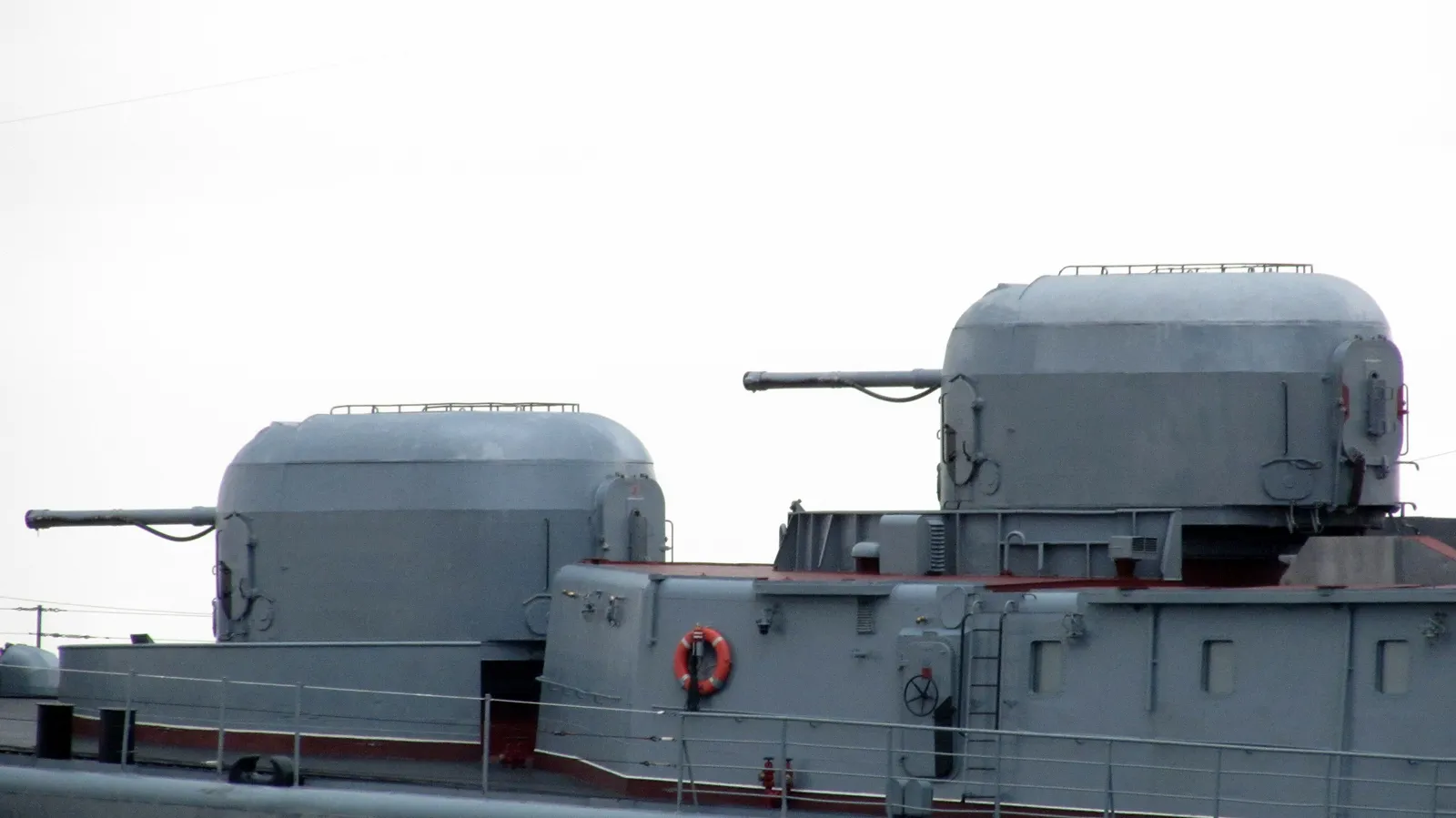
The AK-100 is a shipboard gun mount; public sources tie it to Soviet and Russian surface-combatant classes rather than to a standalone battlefield deployment.

CarrierCarrier typeCarriage evidence
Udaloy-class anti-submarine destroyer, Guided-missile anti-submarine destroyer, Naval SystemsUdaloy-class anti-submarine destroyerAnti-submarine destroyer

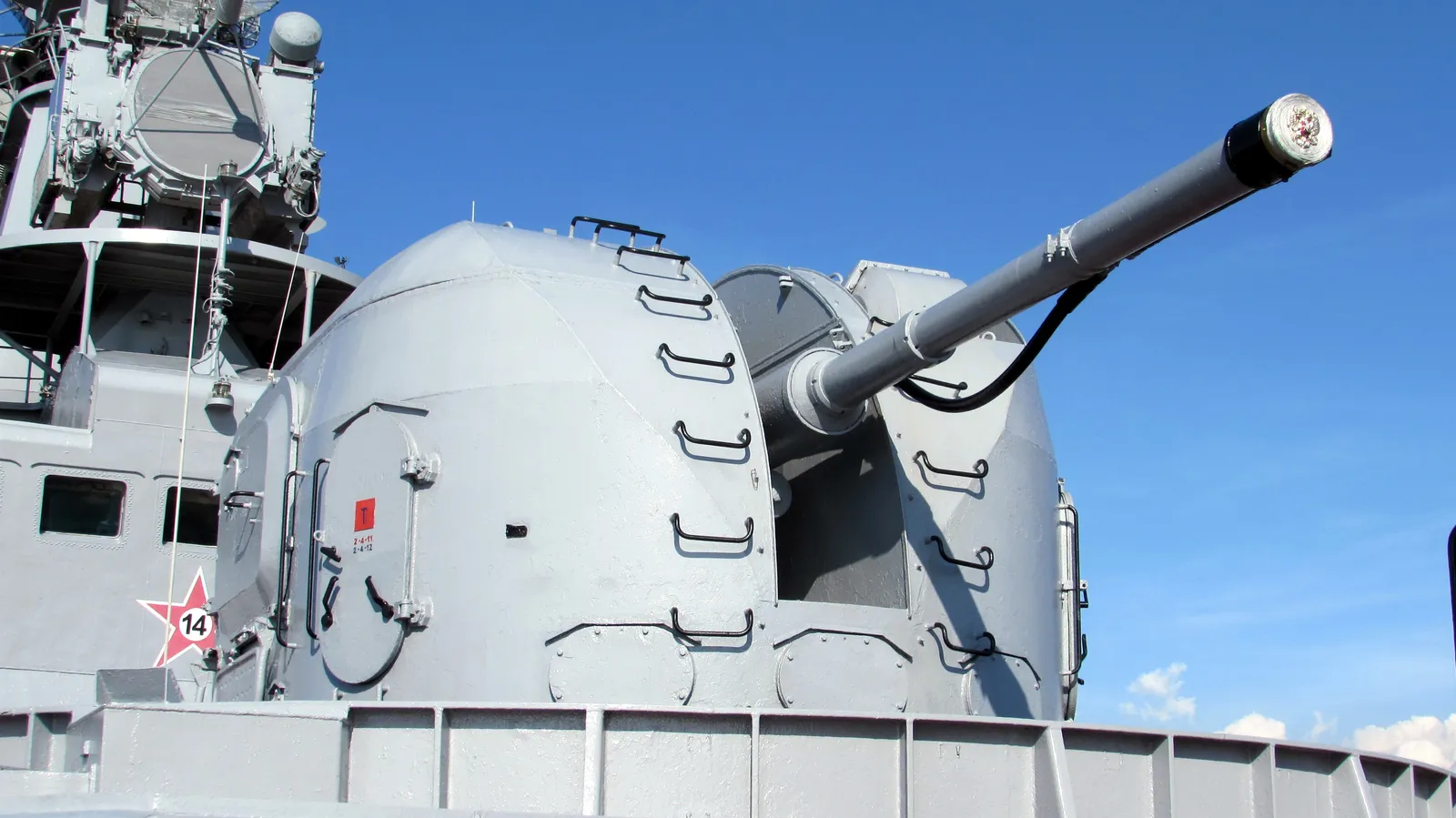
RussianShips.info lists Project 1155 Udaloy with two single AK-100 mounts and MR-145 Lev-218-100 fire control; the gallery image shows the forward AK-100 arrangement on Admiral Tributs.

Sources: RussianShips Project 1155, Admiral Tributs - AK-100 Main Gun.jpg

Project 1135 Burevestnik / Krivak-class frigate and derivatives, Anti-submarine frigate family, Naval SystemsProject 1135 Burevestnik / Krivak-class frigate and derivativesFrigate family

RussianShips.info identifies Project 1135M / Krivak II ships with two single AK-100 mounts and MR-114 Lev-214 fire control; GlobalSecurity separately lists single 100 mm guns on later Project 1135 variants.

Sources: RussianShips Project 1135, GlobalSecurity Project 1135

Neustrashimy-class frigate, Anti-submarine warfare frigate, Naval SystemsNeustrashimy-class frigateAnti-submarine frigate

RussianShips.info lists Project 11540 Neustrashimy with one AK-100 mount, 350 AZ-UZS-58 rounds, and MR-145 Lev-218-100 fire control.

Sources: RussianShips Project 11540

Timeline

AK-100 naval gun Key Events

  1. Development starts

    Public reference data attributes AK-100 development to Arsenal beginning in 1967, with the system intended as a Soviet 100 mm automatic naval artillery complex.

    Sources: Weaponsystems.net AK-100

  2. Shipboard service begins

    Weaponsystems.net places AK-100 service entry in 1978, while Military Periscope describes the mount as fitted to Russian warship classes since the mid-1970s.

    Sources: Weaponsystems.net AK-100, Military Periscope AK-100

Media
Related Weapon Systems
Neustrashimy-class frigate, Anti-submarine warfare frigate, Naval SystemsNaval SystemsNeustrashimy-class frigateAnti-submarine warfare frigateThe Neustrashimy-class frigate is the Soviet Project 11540 Yastreb anti-submarine warfare frigate family, designed through a long Cold War development path and built at Yantar Shipbuilding Plant in Kaliningrad for Russian Baltic Fleet service. Only Neustrashimy and Yaroslav Mudry were completed, but the class combines a 129.8 m hull, helicopter facilities, sonar-centered anti-submarine weapons, 3K95 Kinzhal naval surface-to-air missiles, Kortik close-in defenses, and Kh-35 Uran anti-ship missiles on the second ship. Neustrashimy is directly documented in the 2008 Gulf of Aden counter-piracy campaign.
100 mm KSM-65 coastal defense gun, Towed 100 mm coastal-defense gun, ArtilleryArtillery100 mm KSM-65 coastal defense gunTowed 100 mm coastal-defense gunThe KSM-65 was a Soviet 100 mm coastal-defense gun that adapted the KS-19 anti-aircraft gun family to a KMU-65 coastal platform, off-mount battery fire control, and high-rate fire against surface targets. Developed at Plant No. 8 under L. V. Lyulyev after the Soviet Navy moved away from the earlier S-65 project, it remained a small 116-gun Cold War system with documented Soviet inventory into the 1980s but no direct conflict-use sourcing strong enough for a normal conflict entry.
100 mm Type 79 naval gun, Twin 100 mm shipboard dual-purpose gun mount, Naval SystemsNaval Systems100 mm Type 79 naval gunTwin 100 mm shipboard dual-purpose gun mountThe 100 mm Type 79 is a Chinese twin 100 mm dual-purpose naval gun mount used on late Cold War People's Liberation Army Navy surface combatants and export frigates. Open naval references describe 713th Research Institute development, Soviet B-34 ammunition lineage, radar-directed shipboard fire-control integration, and later Type 79A / H/PJ33A and H/PJ33B variants with more automated loading arrangements on Chinese frigate and destroyer classes.
130 mm SM-2-1, 130 mm/58 twin dual-purpose naval gun mount, Naval SystemsNaval Systems130 mm SM-2-1130 mm/58 twin dual-purpose naval gun mountThe 130 mm SM-2-1 was a Soviet twin 130 mm/58 naval gun mount developed by TsKB-34 for postwar destroyers and treated in open references as a stabilized dual-purpose weapon for surface and air targets. Serial production centered on Bolshevik Plant No. 232, with additional Starokramatorsk-built mounts, and the system armed Project 41 Neustrashimy and Project 56 Kotlin destroyers before informing China's Type 76 twin 130 mm mount. Checked open sources support service, platform, and production context but not a direct combat-use claim for a specific conflict.
100 mm KS-19 anti-aircraft gun, Towed 100 mm anti-aircraft gun, Air DefenseAir Defense100 mm KS-19 anti-aircraft gunTowed 100 mm anti-aircraft gunThe KS-19 is a Soviet 100 mm towed anti-aircraft gun designed for high-altitude, radar-directed air defense with fixed ammunition, a powered carriage, and PUAZO/SON-9 fire-control support. U.S. studies tied the gun to North Vietnam's heavy AAA network and Iraqi inventories retained it into the 1990 Gulf War, while later conflict records show legacy KS-19s displayed in Houthi air-defense equipment and repurposed as long-range ground-fire weapons in Nagorno-Karabakh and Ukraine.

Sources