Naval Systems

130 mm SM-2-1

Also known as
  • 130mm SM-2-1
  • 130 mm/58 SM-2-1
  • 130 mm/58 Pattern 1957
  • SM-2-1 Pattern 1957
  • SM-2-1 mounting
  • Type 76 130 mm naval gun
  • 130 mm/58 Type 76

The 130 mm SM-2-1 was a Soviet twin 130 mm/58 naval gun mount developed by TsKB-34 for postwar destroyers and treated in open references as a stabilized dual-purpose weapon for surface and air targets. Serial production centered on Bolshevik Plant No. 232, with additional Starokramatorsk-built mounts, and the system armed Project 41 Neustrashimy and Project 56 Kotlin destroyers before informing China's Type 76 twin 130 mm mount. Checked open sources support service, platform, and production context but not a direct combat-use claim for a specific conflict.

Profile / Specs

Profile

Origin
Soviet Union
Type
130 mm/58 twin dual-purpose naval gun mount
Service note
Early Cold War shipboard artillery, accepted into Soviet service in 1957 with later Chinese Type 76 derivative service
Designer
TsKB-34
Designed
1943 design start; prototype completed in 1948; accepted into service in 1957
Unit cost
About 6.5 million 1950s rubles per SM-2-1 turret in WeaponSystems.net data
Produced
1950-1957 Soviet serial production; Chinese Type 76 derivative finalized in 1976
Number built
65 SM-2-1 turrets, of which 58 were installed on ships in WeaponSystems.net data

Specifications

Caliber
130 mm / 58 caliber
Configuration
Twin triaxially stabilized dual-purpose naval mount
Developer
TsKB-34
Soviet producers
Plant No. 232 Bolshevik and Starokramatorsk Machine-Building Plant in WeaponSystems.net data
Soviet ship fits
Project 41 Neustrashimy and Project 56 Kotlin destroyers
Chinese derivative
Type 76 twin 130 mm mount on Type 051 Luda destroyers
Gun weight
4.8 tons / 4.99 metric tons per gun in NavWeaps data
Mount weight
57.325 metric tons for the SM-2 mount in NavWeaps data
Projectile weight
About 33 kg for Soviet semi-armor-piercing, high-explosive fragmentation, and anti-aircraft projectiles
Muzzle velocity
950 m/s for Soviet semi-armor-piercing and high-explosive fragmentation rounds
Rate of fire
Up to 15 rounds per minute at low elevation with electrical power loading; lower rates at high elevation or with hand loading
Maximum range
27,760 m with Soviet PB-42 semi-armor-piercing ammunition; 23,775 m with Soviet ZS-42 anti-aircraft ammunition
Elevation
-7.35 to +81.46 degrees for SM-2 in NavWeaps data
Train
+204 to -204 degrees
Crew
19 to 21 personnel, including below-deck loading-room crew in WeaponSystems.net data
Protection
Steel turret with 20 mm front, 10 mm side and roof, and 8 mm rear armor in WeaponSystems.net data
Fire control
Sfera-56 / Yakor-M1 fire control on Project 56; Zenit-41 / Yakor-M on Project 41
Ammunition stowage
400 rounds per gun in NavWeaps data; 800 rounds on Project 41 and 850 rounds on Project 56 in RussianShips.info ship tables
Ship And Coastal Fits

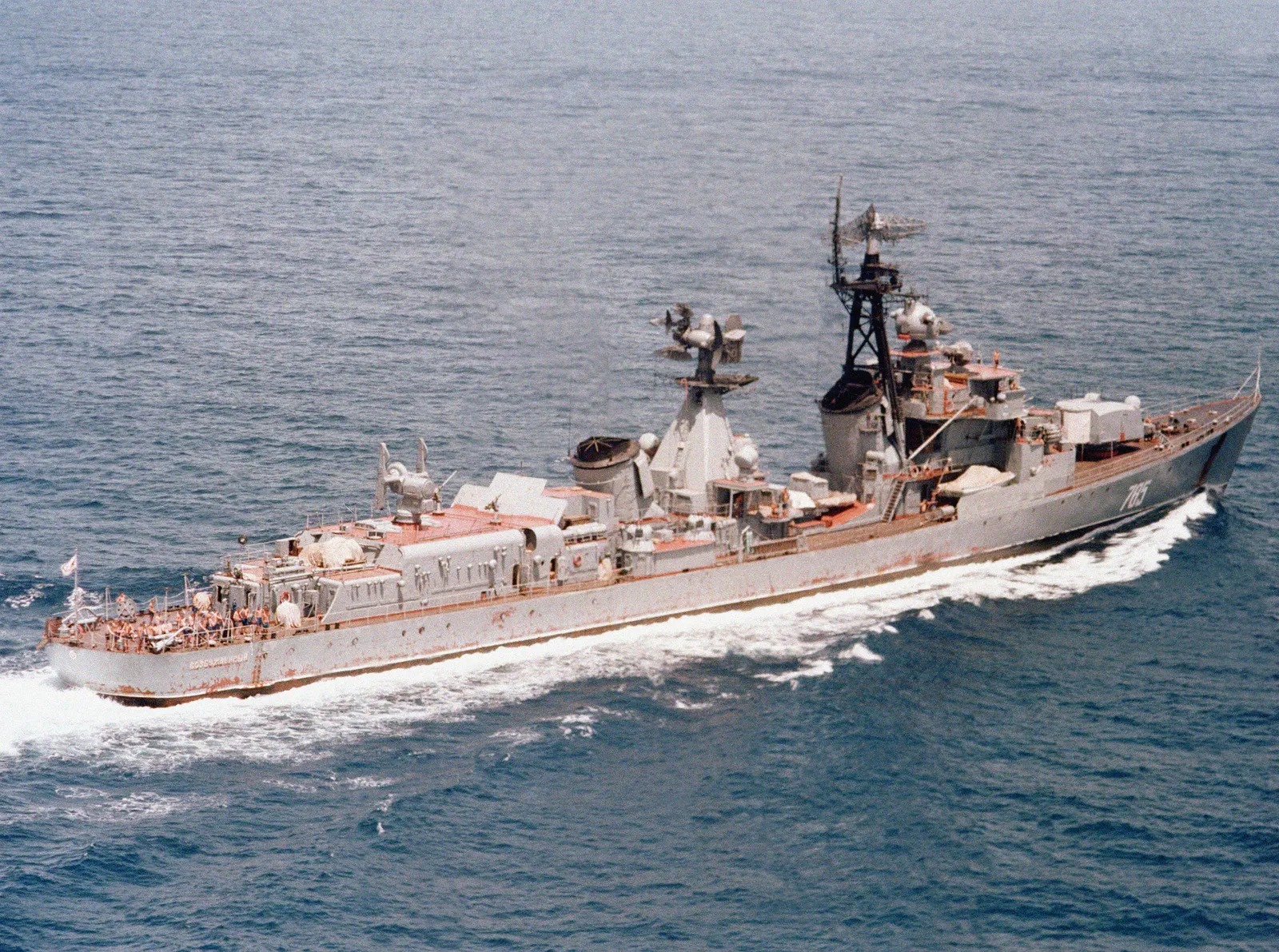
The SM-2-1 was installed as a shipboard twin mount rather than a stand-alone field gun. NavWeaps identifies the Soviet fit on Project 41 Neustrashimy and Project 56 Kotlin destroyers, while RussianShips.info gives the Project 41 and Project 56 armament tables and fire-control associations.

Project 41

Neustrashimy carried two twin 130 mm SM-2-1 mounts with 800 rounds and Zenit-41 / Yakor-M fire-control equipment.

Project 56

Kotlin-class destroyers carried two twin 130 mm SM-2-1 mounts with 850 rounds and Sfera-56 / Yakor-M1 fire control before later missile and ASW modernizations removed aft mounts on some ships.

Chinese Type 76

The Type 76 kept the 130 mm twin-gun role on Type 051 Luda destroyers, but open sources describe differences in stabilization and radar-control fit from the Soviet mounting.

Coastal role

NavWeaps states that both Soviet and Chinese forces also used the gun family in coastal-defense roles.

Production And Mount Layout

WeaponSystems.net identifies TsKB-34 as the Soviet developer and separates SM-2-1 production between Plant No. 232 Bolshevik and Starokramatorsk Machine-Building Plant. Its production total also explains why the mount is useful here as a component page: the documented output is a turret population for ship installations, not a separate field-artillery inventory.

Developer

TsKB-34 developed the Soviet mount during the 1943-1949 development period listed by WeaponSystems.net.

Main producer

Plant No. 232 Bolshevik is credited with 51 of the 65 SM-2-1 turrets in the WeaponSystems.net production summary.

Secondary producer

Starokramatorsk Machine-Building Plant is credited with 14 turrets; no separate catalog builder link was added because the existing Kramatorsk builder profile does not yet identify that exact Soviet-era producer relationship.

Mount crew

The mount required 19 to 21 crew, including below-deck loading-room personnel, in the WeaponSystems.net technical summary.

Sources: WeaponSystems 130mm SM-2-1; NavWeaps SM-2-1 Pattern 1957.

Variants

Open references separate the Soviet SM-2-1 production mounting from experimental Soviet twin mounts and the later Chinese Type 76 derivative.

VariantConfigurationDesignation notes
SM-2-1Soviet production twin mounting

NavWeaps identifies SM-2-1 as the production mount used on Project 41 Neustrashimy and Project 56 Kotlin destroyers.

Sources: NavWeaps SM-2-1 Pattern 1957

Type 76Chinese twin 130 mm derivative

NavWeaps lists the PRC Type 76 with the same 130 mm/58 caliber family and GlobalSecurity describes the Luda-class gun as derived from a coastal-artillery base rather than a direct Soviet turret copy.

Sources: NavWeaps SM-2-1 Pattern 1957, GlobalSecurity Type 051 Luda Weapon Systems

AK-130 naval gun, 130 mm twin-barrel automatic naval gun, Naval SystemsAK-130 naval gunLater Soviet twin 130 mm automatic naval gun

NavWeaps describes AK-130 as a later Soviet twin 130 mm automatic naval gun developed after earlier postwar 130 mm mount generations.

Sources: NavWeaps AK-130

Timeline

130 mm SM-2-1 Key Events

  1. Design work starts

    NavWeaps dates the start of Soviet SM-2-1 gun design to 1943.

    Sources: NavWeaps SM-2-1 Pattern 1957

  2. Prototype completed

    NavWeaps states that the first Soviet prototype was completed in 1948 after wartime design work.

    Sources: NavWeaps SM-2-1 Pattern 1957

  3. Project 41 ship commissioned

    RussianShips.info lists Project 41 Neustrashimy as commissioned on 31 January 1955 with two twin 130 mm SM-2-1 mounts.

    Sources: RussianShips Project 41 Neustrashimy

  4. Accepted into service

    NavWeaps lists the SM-2-1 Pattern 1957 as entering Soviet service in 1957.

    Sources: NavWeaps SM-2-1 Pattern 1957

  5. Chinese Type 76 finalized

    GlobalSecurity reports that China's Luda-class twin 130 mm naval gun was finalized as the Type 76 in 1976.

    Sources: GlobalSecurity Type 051 Luda Weapon Systems

Related Weapon Systems
100 mm Type 79 naval gun, Twin 100 mm shipboard dual-purpose gun mount, Naval SystemsNaval Systems100 mm Type 79 naval gunTwin 100 mm shipboard dual-purpose gun mountThe 100 mm Type 79 is a Chinese twin 100 mm dual-purpose naval gun mount used on late Cold War People's Liberation Army Navy surface combatants and export frigates. Open naval references describe 713th Research Institute development, Soviet B-34 ammunition lineage, radar-directed shipboard fire-control integration, and later Type 79A / H/PJ33A and H/PJ33B variants with more automated loading arrangements on Chinese frigate and destroyer classes.
Neustrashimy-class frigate, Anti-submarine warfare frigate, Naval SystemsNaval SystemsNeustrashimy-class frigateAnti-submarine warfare frigateThe Neustrashimy-class frigate is the Soviet Project 11540 Yastreb anti-submarine warfare frigate family, designed through a long Cold War development path and built at Yantar Shipbuilding Plant in Kaliningrad for Russian Baltic Fleet service. Only Neustrashimy and Yaroslav Mudry were completed, but the class combines a 129.8 m hull, helicopter facilities, sonar-centered anti-submarine weapons, 3K95 Kinzhal naval surface-to-air missiles, Kortik close-in defenses, and Kh-35 Uran anti-ship missiles on the second ship. Neustrashimy is directly documented in the 2008 Gulf of Aden counter-piracy campaign.
MT-LB with 25 mm 2M-3 naval gun, Improvised tracked self-propelled anti-aircraft gun, Air DefenseAir DefenseMT-LB with 25 mm 2M-3 naval gunImprovised tracked self-propelled anti-aircraft gunThe MT-LB with 25 mm 2M-3 naval gun is a Russian improvised weapons carrier that combines the Soviet MT-LB tracked armored tractor with a twin 25 mm 2M-3 or 2M-3M naval anti-aircraft mount. Open-source reporting and Russian loss documentation tie the conversion to the full-scale 2014 Russia-Ukraine War, where it appears as a short-range air-defense and direct-fire adaptation rather than a standardized factory combat vehicle.
114 mm Vickers Mark 6, Dual-purpose naval gun turret, Naval SystemsNaval Systems114 mm Vickers Mark 6Dual-purpose naval gun turretThe 114 mm Vickers Mark 6 was the postwar designation for the QF 4.5-inch Mark V gun carried in the Mark VI twin mounting, a British dual-purpose naval turret built around high-angle fire, remote power control, and rapid surface, air, and shore engagement. It entered service in 1947, equipped British and Commonwealth destroyers and frigates, and remained relevant in the 1982 Falklands War as Royal Navy escorts used 4.5-inch naval gunfire for shore support and surface engagements.

Sources