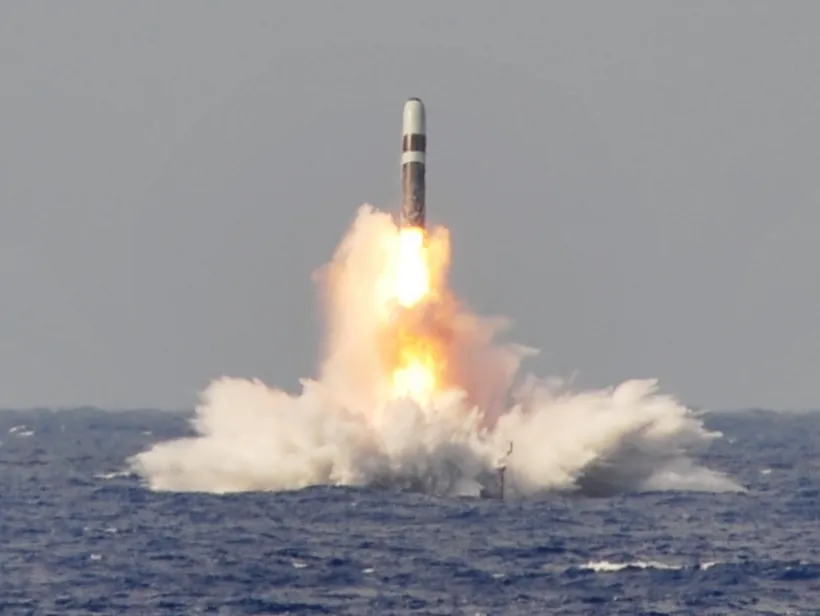
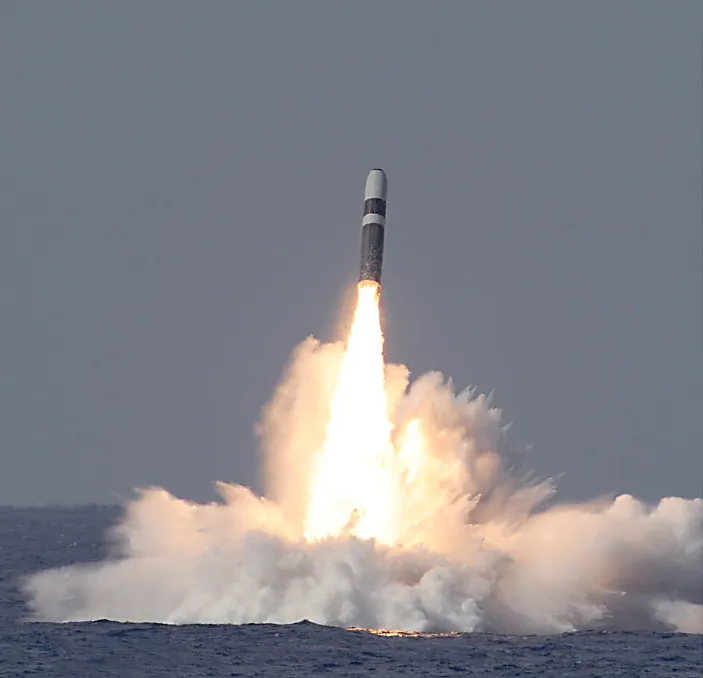
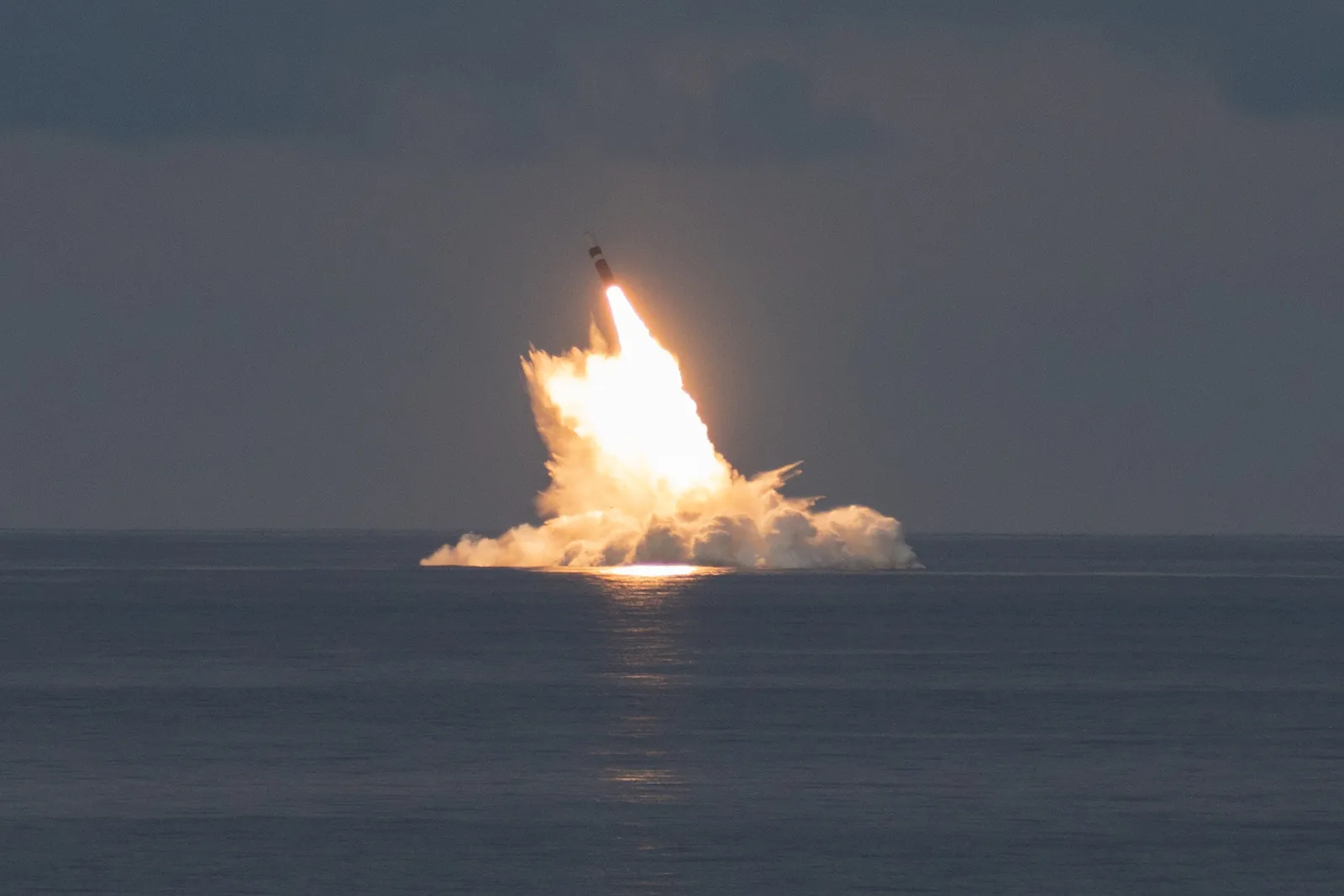
Munitions

Trident II D5 fleet ballistic missile

Also known as
  • UGM-133A
  • UGM-133
  • Trident II
  • Trident II D5
  • Trident II D-5
  • Trident D5
  • UGM 133A
  • Trident 2
  • Trident II D5LE
  • Trident II D5 Life Extension
  • D5 Life Extension
  • Trident II D5LE2
  • Trident II D5 Life Extension 2

The Trident II D5 is a U.S. submarine-launched ballistic missile built for strategic nuclear deterrence aboard Ohio-class and UK Vanguard-class submarines. The Navy describes it as a three-stage, solid-fuel, inertially guided missile with a 4,000 nautical mile range, while the D5LE refresh entered the Fleet in early 2017 to extend service life into the 2040s.

Role in Conflicts

Side
Unconfirmed conflict context

UGM-133A Trident II D5 and D5LE missiles are fielded as submarine-launched strategic deterrent weapons aboard U.S. and UK ballistic-missile submarines; public sources document deterrent patrol, readiness, and test-launch activity rather than armed-conflict firing.

Profile / Specs

Profile

Origin
United States
Type
Submarine-launched ballistic missile
Service note
Deployed in 1990; D5LE missiles entered the Fleet in 2017
Designer
Lockheed Missiles and Space Co.
Designed
1980s
Unit cost
$30.9 million
Produced
1980s-present

Specifications

Primary function
Strategic nuclear deterrence
Propulsion
Three-stage solid-propellant rocket
Guidance
Inertial
Length
44 feet (13.41 meters)
Diameter
83 inches (2.11 meters)
Weight
130,000 pounds (58,500 kg)
Range
4,000 nautical miles (4,600 statute miles / 7,360 km)
Warhead
Nuclear MIRV
Platforms
U.S. Ohio-class and UK Vanguard-class submarines; planned U.S. Columbia-class and UK Dreadnought-class successor submarines
Variants

The Trident II D5 family uses D5/D-5 and UGM-133A designation forms for the baseline missile; the variant rows distinguish the D5 life-extension refresh and the planned D5LE2 follow-on.

VariantConfigurationDesignation notes
Trident II D5 Life Extension (D5LE)Life-extension refresh

Life-extended D5 missiles entered fleet service in early 2017. Navy sources describe D5LE as extending Trident II service into the 2040s and as the initial strategic weapon system for Columbia-class and UK Dreadnought-class submarines.

Sources: Trident II (D5) Missile | U.S. Navy Fact File, D5LE Readiness Launches, SSP Trident II D5LE2 Development

Trident II D5 Life Extension 2 (D5LE2)Second life-extension / modified flight system

Navy SSP identifies D5LE2 as the modified Trident II flight system that follows D5LE as inventory ages. Lockheed Martin says the upgraded missile is being designed for Columbia-class carriage and strategic-deterrent service through 2084.

Sources: SSP Trident II D5LE2 Development, Lockheed Martin D5LE2 Award

Launch Platforms

Official U.S. Navy and Royal Navy sources identify Trident II D5 as a submarine-launched ballistic missile carried by current and successor deterrent submarines.

LauncherLauncher typeLaunch evidence
Ohio-class ballistic missile submarine, Nuclear-powered ballistic missile submarine, Naval SystemsOhio-class ballistic missile submarineNuclear-powered ballistic missile submarine

The U.S. Navy says Ohio-class SSBNs carry Trident II D5 (LE) missiles, with four missile tubes deactivated under New START and a current maximum of 20 missiles.

Sources: Fleet Ballistic Missile Submarines - SSBN, Trident II (D5) Missile | U.S. Navy Fact File

Vanguard-class submarine, Nuclear-powered ballistic missile submarine, Naval SystemsVanguard-class submarineNuclear-powered ballistic missile submarine

The Royal Navy says each Vanguard-class submarine is armed with Trident 2 D5 missiles, and the U.S. Navy fact file lists UK Vanguard-class submarines as a Trident II D5 platform.

Sources: Vanguard Class Nuclear Submarine, Trident II (D5) Missile | U.S. Navy Fact File

Columbia-class submarine, Nuclear-powered ballistic missile submarine, Naval SystemsColumbia-class submarineFuture nuclear-powered ballistic missile submarine

The U.S. Navy identifies Columbia-class SSBNs as the future sea-based strategic deterrent and lists Trident II D5 (LE) armament; Strategic Systems Programs says early Columbia hulls will use D5LE before D5LE2 introduction.

Sources: Fleet Ballistic Missile Submarines - SSBN, SSP Trident II D5LE2 Development

Dreadnought-class submarine, Nuclear-powered ballistic missile submarine, Naval SystemsDreadnought-class submarineFuture nuclear-powered ballistic missile submarine

Royal Navy material says Dreadnought-class submarines will be capable of launching Trident 2 D5 missiles, and U.S. Navy material says D5LE missiles will be initially carried aboard UK Dreadnought-class submarines.

Sources: Royal Navy Dreadnought class, Trident II (D5) Missile | U.S. Navy Fact File

Deterrent Service Context

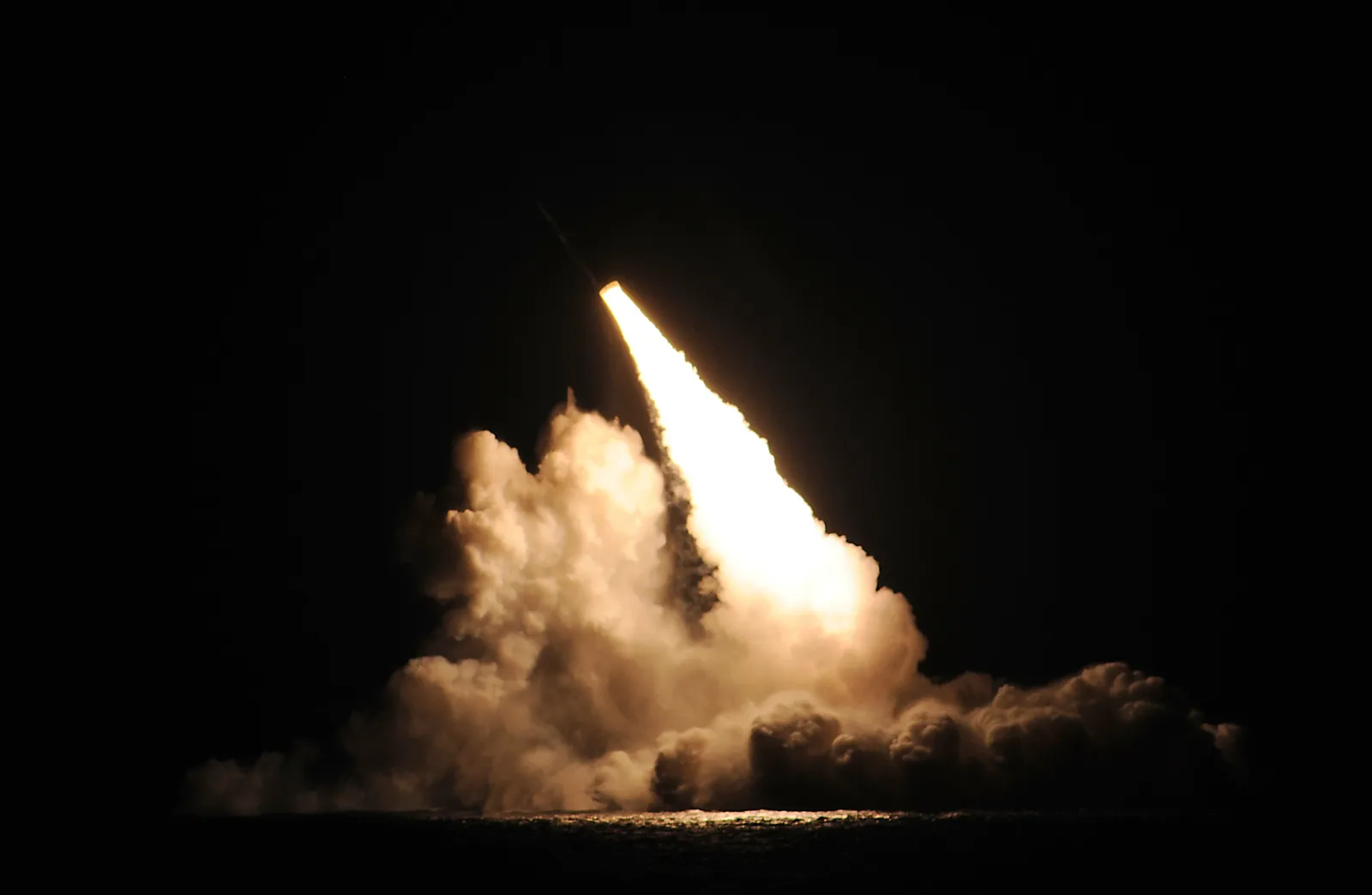
Trident II D5 is documented in public sources as a strategic-deterrent weapon system, not as a weapon fired in an armed conflict. The visible service record is built around submarine patrol availability, unarmed Demonstration and Shakedown Operation launches, Commander Evaluation Tests, and the U.S.-UK transition from Ohio and Vanguard submarines to Columbia and Dreadnought successors.

Current platforms

U.S. Ohio-class SSBNs and UK Vanguard-class submarines carry Trident II D5 or D5LE missiles.

Successor platforms

U.S. Columbia-class and UK Dreadnought-class submarines are planned around D5LE and D5LE2 strategic weapon-system integration.

Open-source limit

The cited record supports deterrent fielding and test launches, not combat firing against an adversary.
Timeline

Trident II D5 fleet ballistic missile Key Events

  1. D5 enters service

    The Navy fact file lists the Trident II (D5) date deployed as 1990, marking the missile's introduction aboard Ohio-class submarines.

    Sources: Trident II (D5) Missile | U.S. Navy Fact File

  2. D5LE missiles enter the Fleet

    Strategic Systems Programs says life-extended D5LE missiles were introduced to the Fleet in early 2017 and will serve through the remaining service life of the U.S. Ohio-class and UK Vanguard-class submarines.

    Sources: D5LE Readiness Launches

  3. D5LE2 development advances

    Lockheed Martin reported a Navy award for the next generation of deterrence at sea, naming the upgraded Trident II D5LE2 missile.

    Sources: Lockheed Martin D5LE2 Award

  4. Planned Columbia D5LE2 loadout

    Strategic Systems Programs describes D5LE2 full boat loadouts beginning in 2039, after D5LE use on early Columbia-class hulls.

    Sources: SSP Trident II D5LE2 Development

Media
Related Weapon Systems
Ohio-class ballistic missile submarine, Nuclear-powered ballistic missile submarine, Naval SystemsNaval SystemsOhio-class ballistic missile submarineNuclear-powered ballistic missile submarineThe Ohio-class ballistic missile submarine is the U.S. Navy's current sea-based strategic-deterrent SSBN class and the launch platform for Trident II D5/D5LE missiles. Four early Ohio hulls were converted to SSGNs, leaving 14 SSBNs in strategic service; Navy sources describe each remaining SSBN as carrying up to 20 missiles after New START tube deactivation and operating on alternating Blue and Gold crews for sustained patrol availability.
Vanguard-class submarine, Nuclear-powered ballistic missile submarine, Naval SystemsNaval SystemsVanguard-class submarineNuclear-powered ballistic missile submarineThe Vanguard-class submarine is the Royal Navy's four-boat nuclear-powered ballistic missile submarine class for the United Kingdom's continuous at-sea nuclear deterrent. Built at Barrow-in-Furness by Vickers Shipbuilding and Engineering, the class carries Trident II D5 missiles, remains in service as the UK's single nuclear delivery platform, and is being sustained until Dreadnought-class submarines replace it in the 2030s.
JL-3 submarine-launched ballistic missile, Submarine-launched ballistic missile, MunitionsMunitionsJL-3 submarine-launched ballistic missileSubmarine-launched ballistic missileThe JL-3 is a Chinese solid-fueled submarine-launched ballistic missile reported as the CSS-N-20 and as a longer-range follow-on to the JL-2 for China's sea-based nuclear deterrent. U.S. Department of Defense reporting says China probably fielded the missile on Jin-class Type 094 submarines, while specialist assessments caution that the pace of JL-2 replacement and exact payload details remain publicly uncertain.
Delta IV-class submarine, Nuclear-powered ballistic missile submarine class, Naval SystemsNaval SystemsDelta IV-class submarineNuclear-powered ballistic missile submarine classThe Delta IV-class submarine is the Soviet Project 667BDRM Delfin nuclear-powered ballistic-missile submarine, built by Sevmash for the Northern Fleet and retained by Russia as an aging but still visible sea-based nuclear deterrent. The class carries a D-9RM missile system with 16 R-29RM-family SLBMs, four 533 mm torpedo tubes, and modernized Sineva/Layner-era missiles; public sources distinguish the seven boats built from smaller operational counts as individual hulls cycle through overhaul or replacement by Borei-class SSBNs.
Ohio-class guided-missile submarine, Guided-missile submarine, Naval SystemsNaval SystemsOhio-class guided-missile submarineGuided-missile submarineThe Ohio-class guided-missile submarine is the U.S. Navy's converted SSGN platform for large Tomahawk strike loads, clandestine command-and-control, and special-operations support. Four former Ohio ballistic-missile submarines were refueled and converted in the 2000s, giving each boat up to 154 Tomahawk land-attack missiles plus space for SOF teams and equipment. The class has documented strike use in Libya in 2011 and in the 2020 United States-Iran Conflict during Operation Midnight Hammer.

Sources