Aircraft & UAVs

SAMJET

Also known as
  • Samjet
  • SAMJET-L
  • SAMJET-M

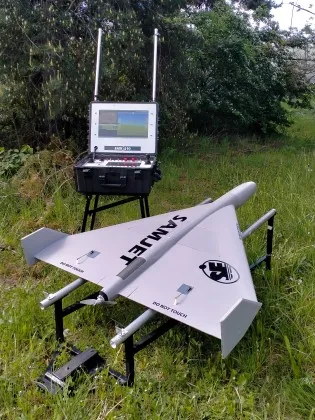
SAMJET is a Bulgarian loitering munition and one-way attack UAV produced by Samel-90. Official material describes an electric, rocket-launched family with SAMJET-L camera/datalink control and SAMJET-M coordinate-attack modes, while Janes reported its HEMUS 2024 debut as Samel-90's Bulgarian-designed one-way attack UAV proposal.

Profile / Specs

Profile

Origin
Bulgaria
Built by
Samel-90
Type
Loitering munition / one-way attack UAV
Service note
Unveiled publicly in 2024
Designer
Samel-90
Designed
Publicly unveiled in 2024
Produced
Reported in production by 2025

Specifications

Role
Loitering munition / one-way attack UAV
Launch method
Rocket motor assisted takeoff
Propulsion
Electric propulsion
Wingspan
1,700 mm
Length
1,700 mm
Maximum takeoff weight
10 kg
Warhead
2 kg anti-armor warhead in the official SAMJET-L/SAMJET-M brochure; Janes reported shaped-charge options from 2 kg to 5 kg
Operational range
Up to 100 km in official brochure; Janes reported up to several hundred kilometres for the HEMUS 2024 proposal
Endurance
60 minutes in official brochure; Janes reported 60 to 120 minutes depending on conditions and manoeuvring
Maximum speed
300 km/h in official brochure
Cruise speed
100 km/h in official brochure
Control
Portable ground-control station with mission planning and up to 40 km video stream for the camera-equipped version
Reported production rate
RFE/RL reported in October 2025 that Samel-90 personnel described about 50 Samjet drones per month with capacity to triple output
Control And Mission Modes

SAMJET's public material describes a compact electric attack UAV built around rocket-assisted launch, a portable ground-control station, and two published mission-control modes rather than a single fixed guidance fit.

Reusable control station

The official brochure lists mission planning, dual monitors, hardware joystick control, a safety switch, external-monitor output, up to four hours of battery life, and up to 40 km video stream for the camera-equipped version.

Source: Samel-90 SAMJET Brochure.

Human-in-the-loop branch

SAMJET-L uses a zoom camera with tilt control so the operator can observe below the aircraft and continue controlling direction until impact.

Source: Samel-90 SAMJET Brochure.

Autonomous coordinate branch

SAMJET-M is presented as a missile-mode configuration without long-distance datalink or front camera, using target coordinates and a flight plan to reach targets by autonomous GPS guidance.

Source: Samel-90 SAMJET Brochure.

Variants

Samel-90's brochure uses SAMJET-L and SAMJET-M for two control-mode configurations of the same compact electric loitering-munition family.

VariantConfigurationDesignation notes
SAMJET-LCamera and datalink version

The L version uses a zoom camera with tilt control and a video link so the operator can monitor the area below and steer during the terminal attack.

Sources: Samel-90 SAMJET Brochure

SAMJET-MCoordinate-attack missile mode

The M version omits the long-distance datalink and front camera; the operator inputs target coordinates and a flight plan through the same ground-control station.

Sources: Samel-90 SAMJET Brochure

Timeline

SAMJET Key Events

  1. HEMUS 2024 unveiling reported

    Janes reported that Samel-90 unveiled SAMJET at HEMUS 2024 in Sofia as a Bulgarian one-way attack UAV proposal.

    Sources: Janes SAMJET at HEMUS 2024

  2. Factory production reported

    RFE/RL reported from Samel-90's Samokov factory that Samjet drones were under production and that factory personnel described current output and expansion capacity.

    Sources: RFE/RL Inside Bulgaria's Kamikaze Drone Factory

Production And Operator Context

Open sources support production and export-market context, but they do not identify a public operator or a named conflict where SAMJET has been used. Janes reported Samel-90's statement that the UAV was already in service abroad without naming the country or operator; RFE/RL later documented Samjet airframes in production at the Samokov factory.

Factory output

RFE/RL reported that Samel-90's drone-production head described about 50 drones per month and said the line had capacity to triple that figure.

Source: RFE/RL Inside Bulgaria's Kamikaze Drone Factory.

Unidentified foreign service

Janes reported Samel-90 saying SAMJET was already in service abroad, but the report did not identify the operator, country, conflict, or delivered quantity.

Source: Janes SAMJET at HEMUS 2024.

Media
Related Weapon Systems
Banshee Jet-80, Twin-jet aerial target drone adapted or reported as a one-way attack UAV, Aircraft & UAVsAircraft & UAVsBanshee Jet-80Twin-jet aerial target drone adapted or reported as a one-way attack UAVThe Banshee Jet-80 is a British twin-jet member of the Banshee aerial-target family, built for realistic threat representation against air-defense and air-to-air weapon systems. QinetiQ markets the Jet 80 and Jet 80+ as land- and sea-launchable targets with plug-in augmentation, optional payloads, digital navigation and telemetry, and parachute recovery; Ukraine-war reporting in 2024 identified a Banshee Jet 80+/closely related airframe in Ukrainian one-way attack drone use, and IISS later listed the Banshee Jet 80+ in Ukraine's selected one-way-attack UAV inventory.
Garpiya-A1, Long-range one-way attack UAV / loitering munition, Aircraft & UAVsAircraft & UAVsGarpiya-A1Long-range one-way attack UAV / loitering munitionGarpiya-A1 is a Russian long-range one-way attack UAV attributed in Reuters reporting to Izhevsk Electromechanical Plant (IEMZ) Kupol and a Chinese engine/component supply chain. Public reporting describes it as Shahed-like, powered by Xiamen Limbach L-550E engines, produced from 2023, and used by Russian forces in Ukraine; U.S. and EU sanctions material plus Reuters-syndicated reporting place it inside a wider production network that kept expanding after sanctions.
V2U, Autonomous loitering munition, Aircraft & UAVsAircraft & UAVsV2UAutonomous loitering munitionV2U is a Russian electric loitering munition documented by Ukraine's Defence Intelligence during the 2014 Russia-Ukraine War. Public intelligence material describes a small catapult-launched UAV with a 1.2 m wingspan, LTE control option, computer-vision-assisted navigation, and onboard AI hardware that may allow automatic target detection and engagement when communications or satellite navigation are degraded; the full system manufacturer remains publicly unidentified.
Shahed-101, Small one-way attack UAV / loitering munition, Aircraft & UAVsAircraft & UAVsShahed-101Small one-way attack UAV / loitering munitionThe Shahed-101 is a smaller Iranian one-way attack UAV in the wider Shahed loitering-munition family, publicly documented through recovered Iraqi material, Hezbollah launches toward Israel, Houthi use in Yemen, and Russian fielding against Ukraine. Open sources describe piston and electric-motor configurations, a compact warhead, satellite/inertial navigation, and a battlefield-to-mid-range strike role below the larger Shahed-131 and Shahed-136 classes. June 2025 Israel-Iran debris records identify a Shahed-101/107 series, but do not isolate the Shahed-101 submodel.
Garpiya-3, Long-range one-way attack UAV / loitering munition, Aircraft & UAVsAircraft & UAVsGarpiya-3Long-range one-way attack UAV / loitering munitionGarpiya-3 is the reported G3 model in Russia's Garpiya family of long-range one-way attack UAVs tied to IEMZ Kupol and a China-based supplier network. Reuters reporting describes the G3 as developed and flight-tested in China, with approximately 2,000 km range and 50 kg payload figures. Official sanctions material and later reporting place it inside a broader Garpiya production chain supporting Russian strikes against Ukraine, while confirmed public evidence remains stronger for the family than for recovered G3 examples.
Ratel S, Uncrewed ground vehicle / remote-mining and explosive-delivery robot, Support EquipmentSupport EquipmentRatel SUncrewed ground vehicle / remote-mining and explosive-delivery robotRatel S is a Ukrainian uncrewed ground vehicle built for remote mining, explosive delivery, observation, and short-range ground attack missions. Developed in Ukraine's wartime robotics ecosystem and publicized through the Brave1 defense-tech cluster, it gives Ukrainian operators a small wheeled platform that can move an explosive or mine payload toward Russian positions while reducing direct exposure; Ukrainian reporting has tied it to bridge, position, and underground-passage attacks in Donetsk Oblast.

Sources