Naval Systems

Manned Combat Submersible

Also known as
  • Dry Combat Submersible
  • DCS
  • DCS Block 1
  • S351 Nemesis
  • UOES2
  • Manned Combat Submersible Underwater Combat Vehicle

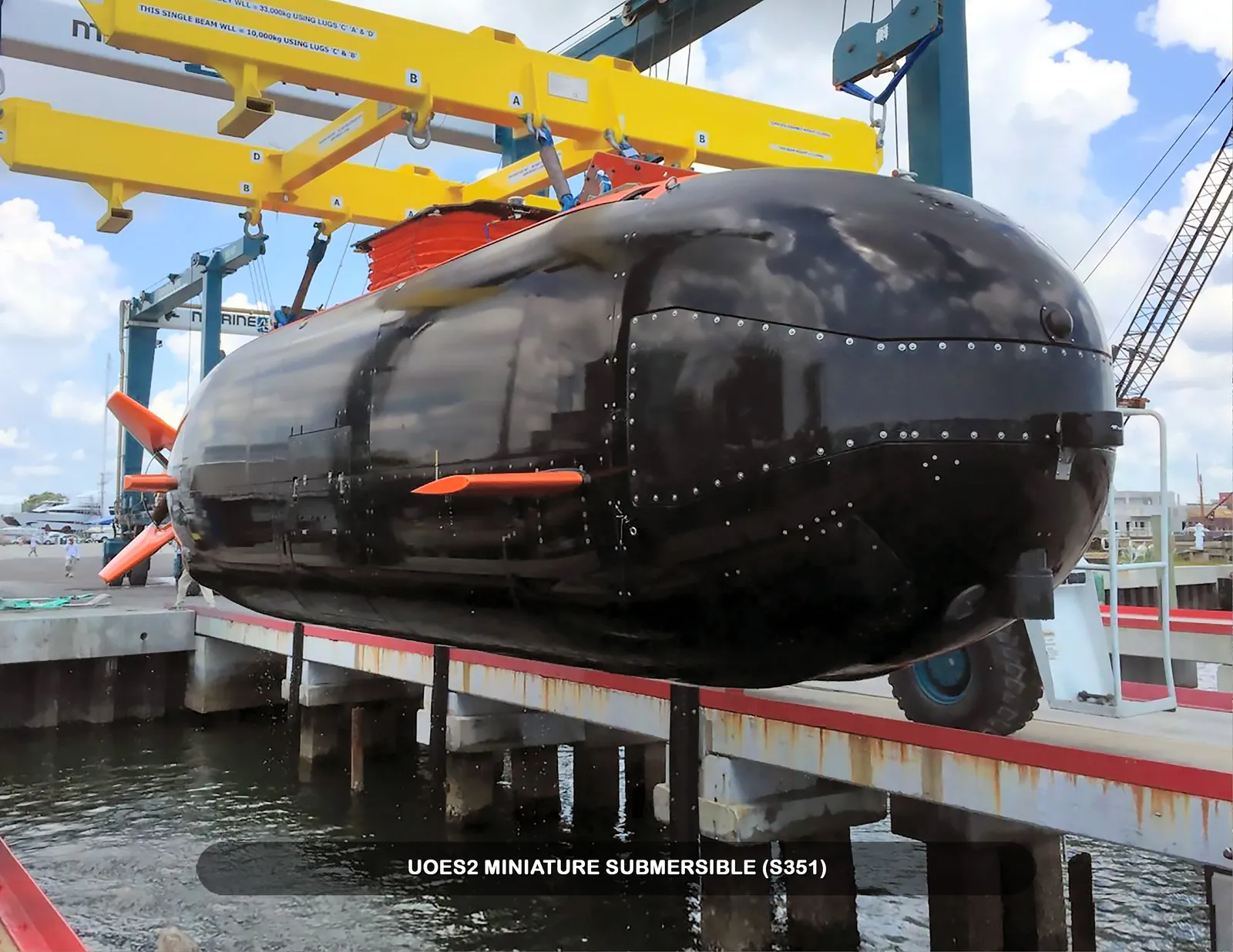
The Lockheed Martin Manned Combat Submersible is the public product-line name associated with USSOCOM's Dry Combat Submersible Block 1, a dry, battery-powered swimmer-delivery vehicle derived from the S351 Nemesis family. Open sources document contract award, testing, IOC, FOC, and follow-on Block 2 planning rather than confirmed use in a named armed conflict, so this entry is maintained as a relationship-only system profile.

Profile / Specs

Profile

Origin
United States
Type
Dry special-operations submersible
Service note
2016-present
Designer
Lockheed Martin / Submergence Group / MSubs
Designed
2016
Produced
2016-2024
Number built
Three DCS Block 1 vehicles fielded, per specialist reporting

Specifications

Crew and passengers
2 crew plus up to 6 swimmers
Environment
Dry, one-atmosphere cabin with lock-in/lock-out capability
Length
12 m (39 ft)
Beam
2.4 m (7.9 ft)
Displacement
28 tonnes
Speed
5 knots
Range
60 nautical miles
Endurance
24 hours
Test depth
100 m
Propulsion
Electric motors with lithium-ion batteries
Navigation and communications
INS, Doppler velocity log, underwater telephone, and UHF radio listed for the S302 product line
Launch and recovery
Block 1 requires surface-ship launch and recovery; Block 2 is planned for submarine carriage
Documented Capability Limits

Public DCS reporting separates the vehicle's special-operations insertion role from any confirmed conflict employment. The most useful open-source context is therefore the fielded Block 1 capability, its launch constraints, and the planned Block 2 correction.

AreaOpen-source context
Mission profileLockheed Martin describes a dry, clandestine swimmer-delivery vehicle that keeps occupants in a one-atmosphere cabin until they lock out underwater near the exit point.
Block 1 constraintSeaPower and European Security & Defence describe the first DCS block as too large for existing submarine dry deck shelter launch and recovery, leaving surface-ship support as the public launch mode.
Block 2 objectiveOpen reporting describes Block 2 as the follow-on intended to regain submarine carriage and launch while retaining the longer-range dry transport concept.
Variants

Public sources describe the USSOCOM DCS as a Block 1 dry combat submersible derived from MSubs/Submergence Group designs, while Block 2 is the planned submarine-launchable follow-on.

VariantConfigurationDesignation notes
S301iEarlier dry manned submersible

Lockheed Martin states that it teamed with Submergence Group to develop the S301i as a commercially classified dry manned submersible carrying two operators and up to six swimmers.

Sources: Manned Combat Submersible | Lockheed Martin

S302Next-generation predecessor vehicle

Lockheed Martin describes the S302 as drawing on S301i hardware with improved hydrodynamics, propulsion, and a navigation/communications/sensor fit for dry special-operations transport.

Sources: Manned Combat Submersible | Lockheed Martin

DCS Block 1 / S351 NemesisUSSOCOM dry combat submersible

European Security & Defence identifies the DCS as a Lockheed Martin-led S351 Nemesis-derived vehicle modified for U.S. Naval Special Warfare requirements and reported it had reached full operational capability in 2024.

Sources: Current and next-gen submersible vessel programmes - European Security & Defence, USSOCOM Declares Initial Operational Capability for Lockheed Martin's New Dry Combat Submersible

DCS Block 2Planned submarine-launchable follow-on

SeaPower and European Security & Defence describe Block 2 as intended to resolve Block 1 launch-and-recovery limits by enabling carriage and launch from a host submarine.

Sources: New SEAL Dry Combat Submersible Set for Operational Test in Late 2021, Current and next-gen submersible vessel programmes - European Security & Defence

Timeline

Manned Combat Submersible Key Events

  1. Dry Combat Submersible contract awarded

    The U.S. Department of Defense announced a $166 million Lockheed Martin Mission Systems and Training contract to design, develop, construct, test, produce, and sustain the dry combat submersible system for USSOCOM.

    Sources: Contracts For Jul. 13, 2016

  2. First vehicle delivered for integration

    SeaPower reported that the first Dry Combat Submersible had been delivered to U.S. Special Operations Command in 2020 for integration and checkout before planned operational testing.

    Sources: New SEAL Dry Combat Submersible Set for Operational Test in Late 2021

  3. IOC publicly announced

    Lockheed Martin announced that USSOCOM had declared initial operational capability for the Dry Combat Submersible and said the program was still moving toward delivery of the third vehicle and full operating capability.

    Sources: USSOCOM Declares Initial Operational Capability for Lockheed Martin's New Dry Combat Submersible

  4. Block 1 reported at full operational capability

    European Security & Defence reported that the DCS Block 1 program had reached full operational capability in 2024, while noting that its size limited it to surface-ship launch and recovery rather than dry-deck-shelter launch from a submarine.

    Sources: Current and next-gen submersible vessel programmes - European Security & Defence

  5. GAO flags continuing acquisition risk

    GAO's 2026 weapon-systems assessment discussed the Dry Combat Submersible program as an acquisition item with continuing cost, schedule, and performance tracking, reinforcing that public reporting centers on fielding and testing rather than disclosed combat employment.

    Sources: Weapon Systems Annual Assessment: Challenges to Fielding Capabilities Faster Persist

Design Lineage

The DCS page is best read as a program and design-lineage page rather than a conflict-use page. Lockheed Martin's product material links the manned-combat-submersible line to the S301i and S302 dry submersibles; later reporting identifies USSOCOM's Block 1 DCS with the larger S351 Nemesis-derived configuration.

DesignationRole in the lineage
S301iCommercially classified dry manned submersible baseline developed with Submergence Group.
S302Improved dry submersible with upgraded hydrodynamics, propulsion, navigation aids, communications, and obstacle-avoidance sensors.
DCS Block 1 / S351 NemesisUSSOCOM dry combat submersible fielded for Naval Special Warfare use, with surface launch and recovery as the public support model.
DCS Block 2Planned follow-on intended to provide submarine-launched dry transport for special-operations teams.
Media

Manned Combat Submersible Images

Related Weapon Systems
LampreyMMAUV, Multi-mission autonomous undersea vehicle, Naval SystemsNaval SystemsLampreyMMAUVMulti-mission autonomous undersea vehicleLockheed Martin's LampreyMMAUV is a plug-and-play autonomous undersea vehicle publicly unveiled in 2026 for covert access, sea denial, ISR, and seabed-warfare missions. Official material describes a 24 cubic foot internal payload bay, host-ship or submarine attachment, battery recharge while attached, optional UAV launch tubes, and mission kits for torpedoes, decoys, sensors, or other payloads; public sources reviewed for this entry document development and exercise activity rather than confirmed armed-conflict use.
Next Generation Interceptor (NGI), Ground-launched ballistic missile interceptor, Air DefenseAir DefenseNext Generation Interceptor (NGI)Ground-launched ballistic missile interceptorNext Generation Interceptor (NGI) is Lockheed Martin's planned homeland ballistic missile interceptor for the U.S. Missile Defense Agency's Ground-based Midcourse Defense system. The program moved from competing 2021 development awards to a 2024 Lockheed Martin downselect and a 2026 Courtland production facility, with public sources emphasizing multiple kill vehicles, solid-rocket propulsion, in-flight communications upgrades, and schedule risk around the original 2028 fielding target.
Lockheed Martin QuadStar (NGSRI), Developmental short-range air-defense interceptor, Air DefenseAir DefenseLockheed Martin QuadStar (NGSRI)Developmental short-range air-defense interceptorLockheed Martin's QuadStar is a U.S. Army Next-Generation Short-Range Interceptor candidate for M-SHORAD Increment 3, the program intended to replace the FIM-92 Stinger with a soldier-portable fire-and-forget short-range air-defense missile. Public sources place the missile in competitive development and flight testing, with Army budget documents and production-planning reporting tying NGSRI to SGT STOUT compatibility, dismounted air-defense use, and future procurement planning rather than confirmed combat fielding.
Global Positioning System III / GPS Block III, Military navigation satellite family, Support EquipmentSupport EquipmentGlobal Positioning System III / GPS Block IIIMilitary navigation satellite familyGlobal Positioning System III / GPS Block III is the Lockheed Martin-built U.S. military navigation-satellite block that modernized the GPS constellation with M-code, the L1C civil signal, higher accuracy, and stronger anti-jamming performance. The ten-space-vehicle series launched from 2018 through 2026, reached full operational acceptance in May 2026, and is treated here as a relationship-only precision position, navigation, and timing space system rather than a direct battlefield weapon.
MORFIUS, Reusable high-power microwave counter-UAS interceptor, Air DefenseAir DefenseMORFIUSReusable high-power microwave counter-UAS interceptorMORFIUS is Lockheed Martin's reusable, tube-launched counter-UAS interceptor built around a high-power microwave payload and an ALTIUS-derived airframe. Public sources identify it as a developmental and demonstration system: Lockheed describes land, air, and sea launch integration, The War Zone reported DARPA Mobile Force Protection testing, and DefenseScoop reported a Joint Counter-small UAS Office evaluation at Yuma Proving Ground.

Sources