Armored Vehicles

M3 Cavalry Fighting Vehicle

Also known as
  • M3 Bradley
  • M3 Bradley CFV
  • M3 CFV

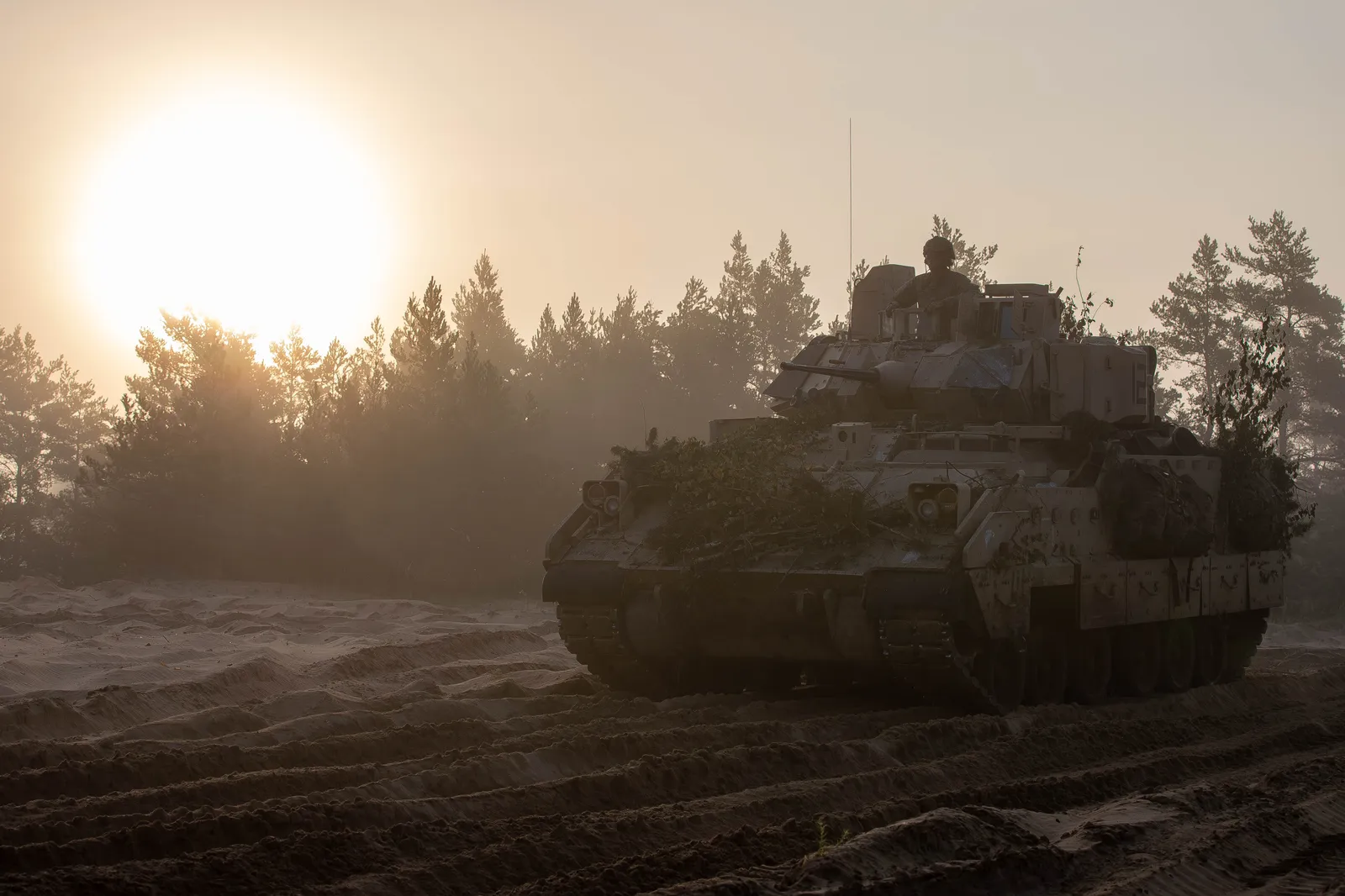
The M3 Cavalry Fighting Vehicle is the Bradley family's cavalry scout variant, built to move scouts under armor while carrying a 25 mm chain gun and twin TOW missiles. Entering U.S. Army service in 1981, it remained visible in 2024 NATO training and in 2026 CENTCOM operations.

Role in Conflicts

Role in conflict
Armored reconnaissance and security overwatch

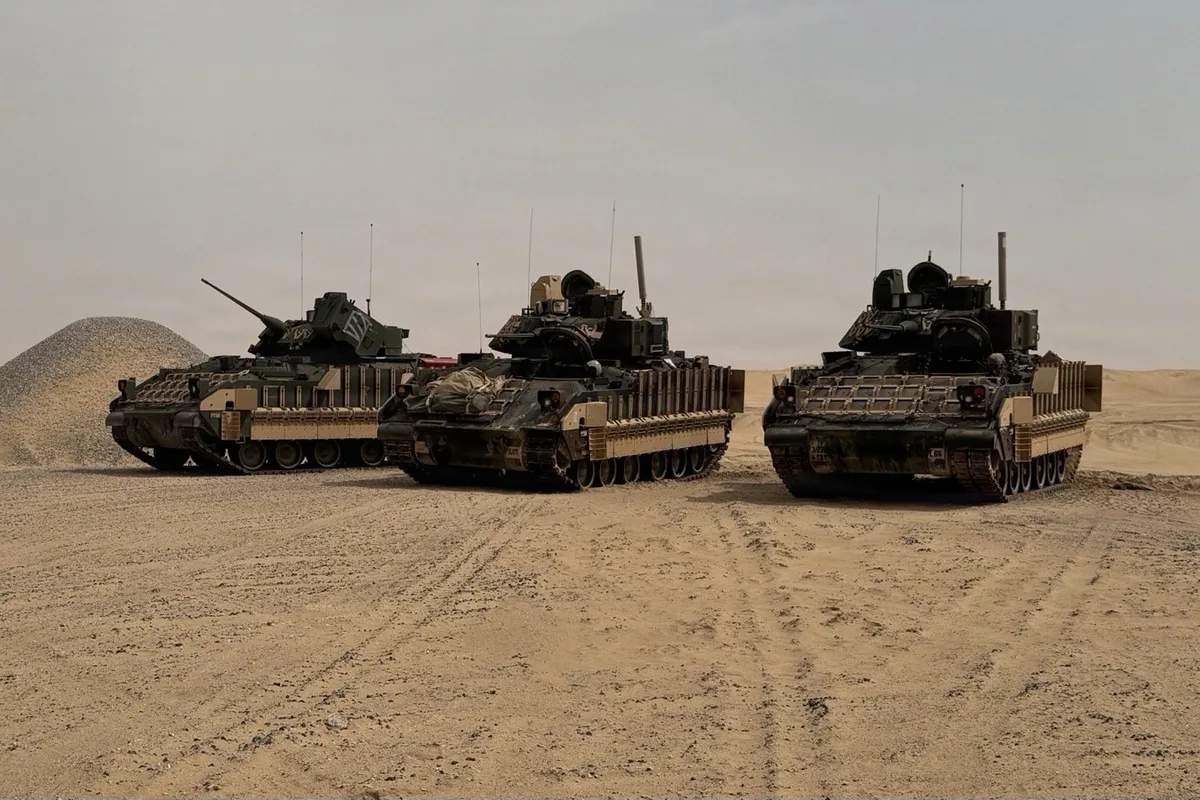
U.S. Army M3 Cavalry Fighting Vehicles operated in the U.S. Central Command area of responsibility during Operation Epic Fury in the 2020 United States-Iran Conflict.

Bradley Family Split

The M3 keeps the Bradley chassis but trades infantry lift space for scouts, radios, extra ammunition, and anti-armor missiles.

FeatureM3 CFVSource-backed note
Service entry1981The Army article says the first Bradley arrived at Fort Knox in 1981.
Production run2,083 M3 variants by 1994FAS records the end-of-1994 production total for the M3 cavalry configuration.
Armament25 mm chain gun, 7.62 mm coaxial machine gun, twin TOW launcherFAS describes the M3's shared Bradley firepower and anti-armor missile fit.
RoleArmored reconnaissance and screeningThe 2024 V Corps article says the M3 is used by U.S. armored cavalry units for armed reconnaissance.
Profile / Specs

Profile

Origin
United States
Built by
BAE Systems
Type
Tracked cavalry fighting vehicle
Service note
Cold War design still in U.S. Army service
Designer
United Defense
Designed
1970s
Unit cost
Average BFVS unit cost (TY$): $3.166 million
Produced
1981-1994
Number built
2,083 M3 variants by the end of 1994
Developed from
M2 Bradley

Specifications

Crew
3 crew + 2 scouts
Armament
25mm M242 chain gun, 7.62mm M240C coaxial machine gun, twin TOW missile launcher
Weight
50,000 lb
Mobility
600 hp Cummins VTA-903T diesel; road speed 45 mph; amphibious
Range
300 miles
Protection
Welded aluminum hull with spaced laminate armor
Variants
  • M3A1
  • M3A2
  • M3A3
Ammunition Fired

The M3's anti-armor punch comes from its twin-tube TOW launcher and ready missile stowage.

AmmunitionAmmunition typeFiring evidence
BGM-71 TOW, Heavy anti-tank guided missile, Infantry WeaponsBGM-71 TOWAnti-tank missile

FAS says the M3 carries TOW missile rounds in a collapsible armored launch rack and relies on the TOW anti-tank missile when facing heavier enemy armor.

Sources: M2A3 and M3A3 Bradley Fighting Vehicle Systems (BFVS)

Timeline

M3 Cavalry Fighting Vehicle Key Events

  1. Bradley fielding begins

    The Army article says the first Bradley arrived at Fort Knox in 1981, marking the family's entry into U.S. Army service.

    Sources: Armor School's first Bradleys reach Fort Benning

  2. M3 production total is documented

    FAS says the Army had produced 2,083 M3 Cavalry configurations by the end of 1994.

    Sources: M2A3 and M3A3 Bradley Fighting Vehicle Systems (BFVS)

  3. Paladin Strike shows the M3 in NATO training

    V Corps captioned an M3 Bradley CFV assigned to 2-12 Cavalry Regiment during exercise Paladin Strike at Camp Adazi Training Area, Latvia.

    Sources: NATO exercise highlights international operability

  4. CENTCOM photo shows deployed M3s

    DVIDS published a photo of a team of M3 Cavalry Fighting Vehicles in the U.S. Central Command area of responsibility during Operation Epic Fury.

    Sources: U.S. Army Soldiers Conduct Operations in the Middle East

Media
Related Weapon Systems
M901A1 Improved TOW Vehicle, Tracked TOW missile carrier vehicle, Armored VehiclesArmored VehiclesM901A1 Improved TOW VehicleTracked TOW missile carrier vehicleThe M901A1 Improved TOW Vehicle is a U.S. tracked anti-armor carrier built around an M113-family chassis, an M27 cupola, and a raised twin TOW launcher. United Defense, LP built the vehicle for Army service beginning in the late 1970s, and the M901A1 configuration added TOW 2 compatibility while retaining internal missile stowage and armored reload protection. U.S. Army Redstone history documents M901 ITVs in Operation Desert Storm, where they were credited with confirmed kills during the 1991 ground campaign.
BGM-71 TOW, Heavy anti-tank guided missile, Infantry WeaponsInfantry WeaponsBGM-71 TOWHeavy anti-tank guided missileThe BGM-71 TOW is a U.S. heavy anti-tank guided missile built around tube launch, optical tracking, and command guidance through a wire or later radio-frequency link. Developed by Hughes and now produced and upgraded by Raytheon, the family spans dismounted launchers, HMMWVs, Bradley and Stryker vehicles, light armored vehicles, and helicopters. Its record runs from helicopter launches in the Vietnam War through Gulf War, Iraq, Afghanistan, Syria, Yemen, and Ukrainian service or transfer evidence.
Stryker, 8x8 armored fighting vehicle family, Armored VehiclesArmored VehiclesStryker8x8 armored fighting vehicle familyThe Stryker is a U.S.-designed eight-wheeled armored fighting vehicle family built around a common chassis, modular mission kits, and rapid road movement. Army reporting says the first production vehicle rolled off the line in April 2002, and the family later logged combat rotations in Iraq and Afghanistan before Double-V Hull upgrades improved blast protection. Modern branches include 30 mm Dragoon infantry carriers, SGT STOUT air-defense vehicles, and U.S.-supplied APCs for Ukraine.
CV90, Tracked infantry fighting vehicle, Armored VehiclesArmored VehiclesCV90Tracked infantry fighting vehicleThe CV90 is a Swedish tracked infantry fighting vehicle family built by BAE Systems Hägglunds for protected troop movement, direct-fire support, and configurable combat-vehicle roles. Its Mk IV generation adds a higher-power drivetrain, upgraded digital architecture, D-series turret options, and active-protection integration, while Ukraine's documented wartime fleet is tied to Swedish-donated CV90s and later new CV9035 MkIIIC procurement rather than confirmed Mk IV deliveries.
Panhard M3 armored personnel carrier, 4x4 amphibious armored personnel carrier, Armored VehiclesArmored VehiclesPanhard M3 armored personnel carrier4x4 amphibious armored personnel carrierThe Panhard M3 is a French 4x4 amphibious armored personnel carrier developed as an export troop carrier around the Panhard AML armored-car family. The design shared most AML automotive components but moved the powerpack behind the driver to free a rear troop compartment for two crew and up to ten infantry. In 2014 Yemen Civil War sourcing it appears as a legacy Yemeni Army M3 VTT inventory type rather than a newly supplied or incident-specific system, so the conflict row stays limited to protected troop-movement context where serviceable vehicles remained available.

Sources