Aircraft & UAVs

K-8 Karakorum trainer aircraft

Also known as
  • Hongdu K-8
  • K-8 Karakorum
  • JL-8
  • Karakorum-8
  • Karakoram-8
  • Nanchang JL-8
  • JiaoLian-8
  • K-8W
  • K-8P
  • K-8E

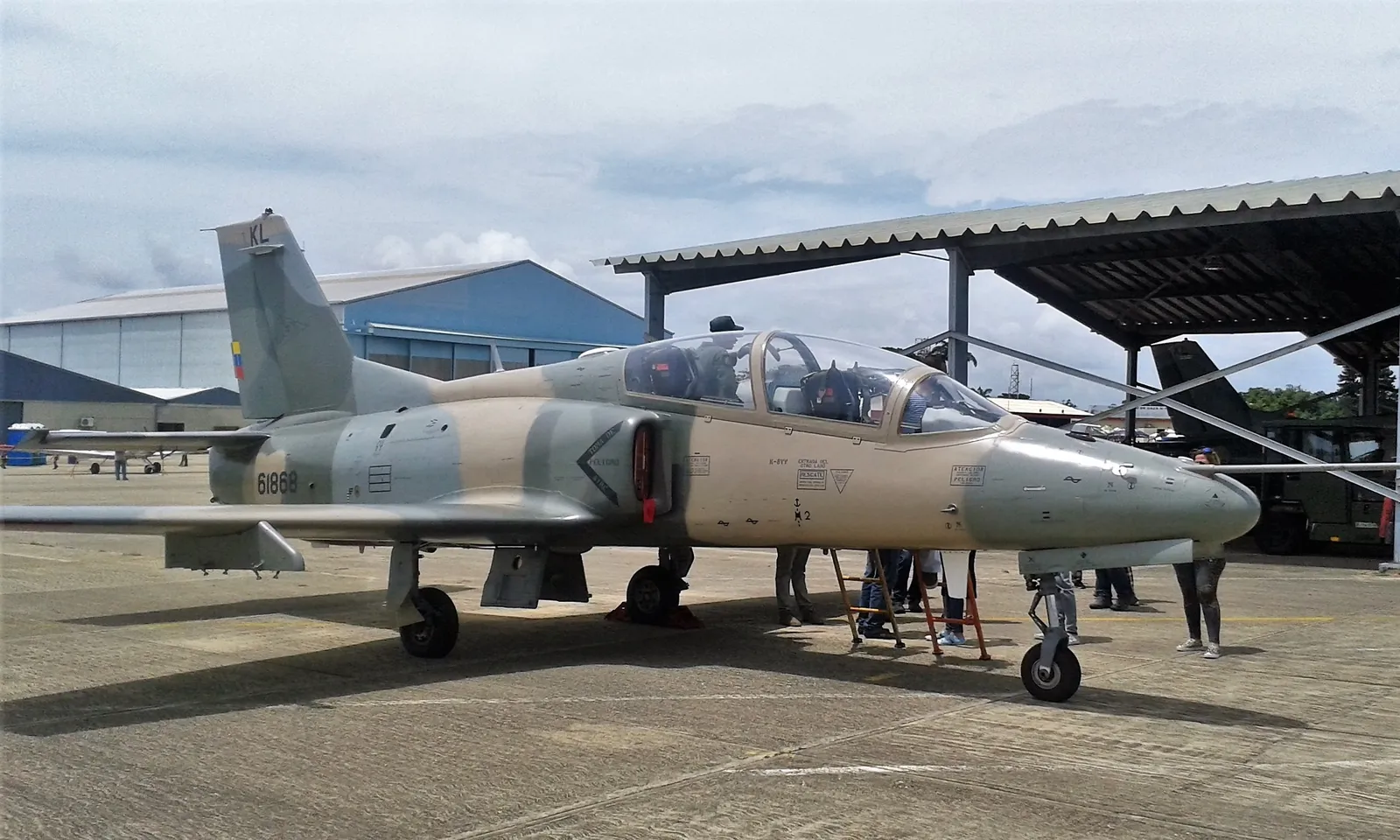
The K-8 Karakorum is a Chinese-Pakistani two-seat jet trainer built around a low-cost advanced-training role but wired for light-attack stores. In Myanmar service, open-source investigators documented locally assembled K-8Ws, underbelly cannon-pod carriage, and repeated post-coup strike sorties with rockets, bombs, and cannon fire.

Role in Conflicts

Side
State Administration Council and allied forces

Myanmar Witness documented K-8 aircraft firing rockets, aerial bombs, and 23 mm cannon rounds in Kayah and Karen states, while #Airbusted recorded K-8 rocket and cannon attacks in Karenni, Karen, and Shan states in 2023.

Profile / Specs

Specifications

Crew
2
Max level speed
About 800 km/h
Maximum speed
Mach 0.75 / about 950 km/h
Built-in range
About 1,560 km
Ferry range with drop tanks
About 2,140 km
Payload
Up to 943 kg
Hardpoints
5 total: four under-wing stations plus an underbelly cannon-pod station
Armament options
23 mm belly-mounted cannon pod, bombs, rockets, and short-range air-to-air missiles depending on configuration
Design And Export Context

CATIC markets the K-8W as a tandem-seat basic and advanced jet trainer that can also perform light-attack missions. The family spread through customer-specific variants rather than a single uniform standard, so speed, engine, cockpit, and stores details should be read against the operator and batch being described.

Training baseline

The aircraft keeps a tandem cockpit, turbofan power, side air inlets, and stadium seating for instructor visibility.

Source: CATIC K-8W trainer product page.

Light-attack fit

Technical sources describe a 23 mm belly cannon-pod option, four under-wing hardpoints, and compatibility with bombs, rockets, or short-range air-to-air missiles.

Sources: K-8 Karakorum GlobalSecurity specifications; Myanmar Witness K-8 profile.

Export model

CATIC history and GlobalSecurity material describe the K-8 as a multinational export program, including Egyptian K-8E production-line transfer and later customer-specific variants.

Sources: CATIC history; K-8E Karakoram-8 Egypt profile.
Variants

Public references use JL-8 for the Chinese trainer line and K-8 designations for export or customer-specific variants, with avionics, engine, and local-assembly differences depending on operator.

VariantConfigurationDesignation notes
JL-8Chinese service trainer

The Chinese-market JL-8 is the domestic trainer branch of the same Hongdu/PAC family.

Sources: K-8 Karakorum project profile

K-8PPakistan-specific trainer variant

Airforce Technology describes the K-8P as a Pakistan-specific version upgraded with a glass cockpit and related avionics changes.

Sources: K-8 Karakorum project profile

K-8EEgyptian export and license-production variant

Airforce Technology identifies the K-8E as the Egyptian variant with airframe and avionics modifications and local assembly from Chinese-supplied kits.

Sources: K-8 Karakorum project profile

K-8WMyanmar and export variant

Myanmar Witness identifies K-8W aircraft commissioned in Myanmar service and describes later examples as locally assembled under CATIC license.

Sources: Myanmar Witness K-8 profile

K-8VFlight-test simulation aircraft

Airforce Technology lists K-8V as an integrated flight-test simulation aircraft used to test aircraft-design characteristics.

Sources: K-8 Karakorum project profile

L-11Chinese WS-11-powered development

GlobalSecurity describes L-11 as a further development variant powered by the indigenous WS-11 turbofan.

Sources: K-8 Karakorum program developments

K-8VBBolivian export variant

Airforce Technology identifies K-8VB as a Bolivian export variant in the K-8 family.

Sources: K-8 Karakorum project profile

Timeline

K-8 Karakorum trainer aircraft Key Events

  1. Joint development starts

    FAS says China and Pakistan agreed to jointly develop the K-8, with prototype manufacture starting in January 1989 before U.S. content restrictions reshaped the program.

    Sources: K-8 Karakorum FAS profile

  2. First flight test

    FAS records the first K-8 flight test on 21 November 1990.

    Sources: K-8 Karakorum FAS profile

  3. Initial production batch delivered

    FAS says 12 aircraft had been delivered by the end of 1996, split evenly between China and Pakistan, and notes that Pakistan had decided against domestic series production in 1994.

    Sources: K-8 Karakorum FAS profile

  4. JL-8 and L-11 paths diverge

    GlobalSecurity says the PLAAF JL-8 first flew in December 1994 and that the WS-11-powered L-11 development variant was first tested in December 1998.

    Sources: K-8 Karakorum program developments

  5. Myanmar receives its first K-8s

    Myanmar Witness says the Myanmar Air Force first received K-8 aircraft in 1998/1999, creating the fleet that later absorbed local assembly and combat upgrades.

    Sources: Myanmar Witness K-8 profile

  6. Egyptian K-8E production contract signed

    GlobalSecurity says CATIC signed a December 1999 contract with Egypt to export 80 K-8 aircraft and the associated production line.

    Sources: K-8E Karakoram-8 Egypt profile

  7. Kayah State strike footage appears

    Myanmar Witness says KNDF footage showed a K-8 over Demoso on 31 December 2021, with reports claiming two aircraft carried out strikes in the area.

    Sources: Myanmar Witness K-8 profile

  8. Loikaw firing footage is verified

    Myanmar Witness says it verified a K-8 flying and firing over the Pan Kan area of Loikaw on 8 January 2022, shortly after the Demoso strike footage.

    Sources: Myanmar Witness K-8 profile

  9. Cannon fire is filmed in Kayah State

    Myanmar Witness says at least one K-8 was seen firing its underbelly 23 mm gun pod in the Demoso area, with casualties reported.

    Sources: Myanmar Witness K-8 profile

  10. Bombing and strafing reported in Shan State

    #Airbusted says K-8 aircraft were spotted dropping bombs and strafing civilian infrastructure in Nam Neint village, Pinlaung Township.

    Sources: #Airbusted report

  11. Cannon fire is recorded in Karen State

    #Airbusted cites Myanmar Witness information that K-8 aircraft were recorded firing 23 mm cannons on ground targets in Karen State.

    Sources: #Airbusted report

  12. Rocket fire is recorded in Karenni State

    #Airbusted says K-8 aircraft were recorded on video firing 57 mm rockets in Karenni State on 25 June 2023.

    Sources: #Airbusted report

  13. Airstrikes in Karenni State are reported

    #Airbusted says the Myanmar Air Force carried out airstrikes using FTC-2000G and K-8 aircraft in Karenni State on 8 September 2023.

    Sources: #Airbusted report

Myanmar Service Snapshot

Myanmar Witness describes the K-8 as a trainer that became the Myanmar Air Force's workhorse light-attack jet before Yak-130 deployments absorbed more of the strike load from April 2022.

Arrival

The fleet first arrived in Myanmar in 1998/1999.

Source: Myanmar Witness K-8 profile.

Local assembly

Later K-8Ws were assembled locally under CATIC license, with Chinese and Myanmar engineers involved.

Sources: Myanmar Witness K-8 profile; #Airbusted report.

Combat stores

Verified and reported post-coup footage shows K-8s using 57 mm rockets, aerial bombs, and a 23 mm cannon pod.

Sources: Myanmar Witness K-8 profile; #Airbusted report.

Media
Related Weapon Systems
Yakovlev Yak-130, Combat trainer / light attack aircraft, Aircraft & UAVsAircraft & UAVsYakovlev Yak-130Combat trainer / light attack aircraftThe Yakovlev Yak-130 is a Russian two-seat combat trainer and light-attack aircraft designed by Yakovlev and built through the Irkut/Yakovlev line inside United Aircraft Corporation. Official Russian sources frame it as a training aircraft able to simulate modern fighter employment and carry up to 3,000 kg of stores, while conflict records document Myanmar ground-attack sorties and an Iranian Yak-130 shot down during the 2026 Iran War.
Aero L-29 Delfin, Jet trainer and light attack aircraft, Aircraft & UAVsAircraft & UAVsAero L-29 DelfinJet trainer and light attack aircraftThe Aero L-29 Delfin is a Czechoslovak two-seat jet trainer built by Aero Vodochody and Let Kunovice for Warsaw Pact and export air forces. Its simple, rugged design was optimized for basic, intermediate, and weapons training, with underwing stores for gun pods, light bombs, or unguided rockets. Azerbaijani forces pressed L-29s into ground-attack service during the 1988 First Nagorno-Karabakh War, where the lightly protected trainers suffered repeated losses to Armenian air defenses.
Turkish Aerospace Hürjet, Supersonic advanced jet trainer and light-attack aircraft, Aircraft & UAVsAircraft & UAVsTurkish Aerospace HürjetSupersonic advanced jet trainer and light-attack aircraftTurkish Aerospace Hürjet is Turkey's single-engine, tandem-seat supersonic advanced jet trainer and light-attack aircraft, developed under SSB coordination for indigenous jet-training capacity. The aircraft first flew in April 2023, is in serial-production and flight-test work for Turkish Air Force service, and now anchors Spain's Airbus-led SAETA II combat-training system while GE Aerospace supplies F404 propulsion support for the program.

Sources