Support Equipment

Germina URCM-3000

Also known as
  • Germina
  • GERMINA URCM-3000
  • KZVV Germina
  • URCM-3000
  • Герміна

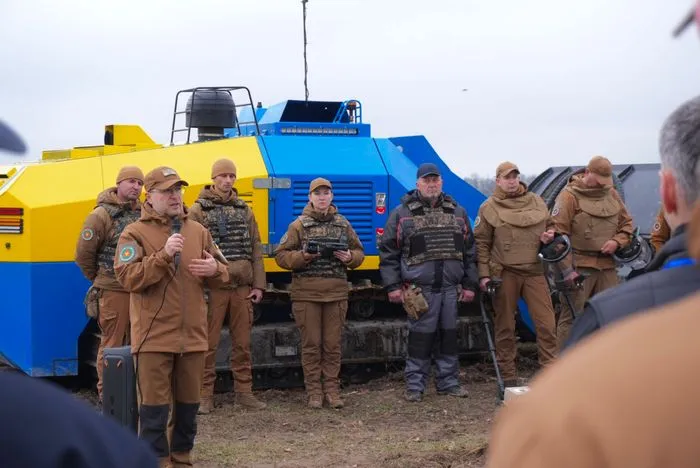
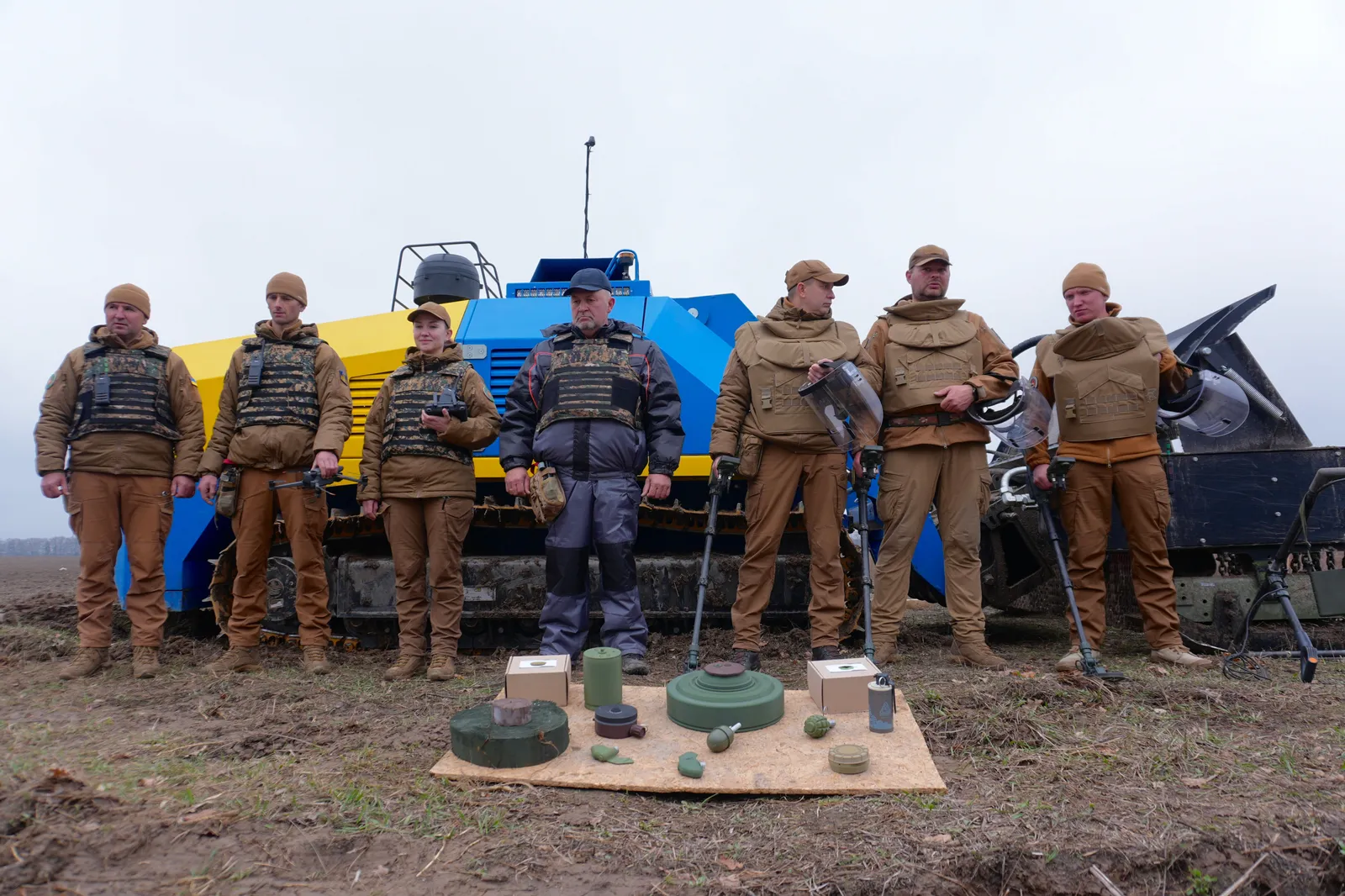
The Germina URCM-3000 is a Ukrainian remote-controlled heavy demining vehicle developed by KZVV with Ukrainian Demining Services input for humanitarian mine-clearance work. Public sources describe a 16-ton tracked machine with chain, cutter, manipulator, and bucket tools for contaminated fields, forest belts, trenches, buildings, and other Ukrainian terrain.

Humanitarian Demining Role

Public sources identify KZVV as developer and producer of Germina and describe the vehicle in humanitarian demining, pilot-operation, and demonstration contexts. Those sources support support-equipment coverage, but they do not directly document Germina being fielded in a named armed conflict.

Remote operation

UDS and UA Demining report remote control up to 1 km, reducing operator exposure during mine-clearance work.

Tool set

Public reporting describes chains with hammers, a milling cutter, manipulator, and multifunctional bucket for varied terrain and clearance tasks.

Local servicing

UDS reported Ukrainian servicing and restoration support, with chains, hammers, and cutters made in Ukraine.

Operating envelope

UDS reported adjustable treatment depths of 5-35 cm and operation from -20 C to +45 C.

Sources: UDS Germina report; UDS Germina pilot contract; Army Recognition Germina trials; UA Demining Future of Demining.

Profile / Specs

Profile

Origin
Ukraine
Type
Remote-controlled humanitarian demining vehicle
Service note
Prototype and field testing publicly reported in 2025
Designer
PJSC Kramatorsk Heavy Duty Machine Tool Building Plant, with humanitarian demining operator input from Ukrainian Demining Services
Designed
Pilot-operation contract and public demonstration reported in March 2025
Unit cost
Ukraine's Ministry of Economy and Oboronka reported a base configuration cost of about EUR 500,000 in 2025.
Produced
Prototype operational testing and planned initial deliveries reported in 2025; updated-machine testing reported in April 2026
Number built
UDS planned to receive five machines from KZVV in the first half of 2025; Oboronka reported in April 2026 that UDS had previously purchased seven Germina machines.

Specifications

Role
Remote-controlled humanitarian demining and mine-clearance vehicle
Weight
Approximately 16,000-16,500 kg, depending on source
Engine
Caterpillar diesel engine rated at 280 kW / 380 hp; Oboronka reported a 9.3-liter Caterpillar engine on the updated machine
Chassis and hydraulics
Track One tracked chassis with Danfoss hydraulic components
Remote-control range
Baseline public sources report up to 1 km; Oboronka reported an updated Germina communication system with range increased to 7 km
Blast resistance
Reported up to 9-10 kg TNT equivalent
Working tools
Detonating chains with hammers, milling cutter, manipulator, and multifunctional bucket
Processing depth
Adjustable soil-treatment depth reported at 5, 15, 25, and 35 cm; UA Demining summarized the range as 5-35 cm
Clearance productivity
UDS reported up to 10,000 sq m per hour and up to 5 hectares per shift; Army Recognition and UA Demining reported up to 5,000 sq m per hour.
Working width
About 2.7 m during UDS demonstration reporting
Operating endurance
Up to 10 hours continuous operation reported by UDS and Army Recognition, with servicing every two hours in Army Recognition reporting
Operating temperature
UDS reported year-round operation from -20 C to +45 C
Service and consumables
UDS reported Ukrainian servicing and restoration support, with chains, hammers, and cutters of Ukrainian manufacture
Warranty
Three-year warranty reported by UDS and Ukraine's Ministry of Economy
Engine Component
Compatible itemItem typeCompatibility evidence
Vehicle engine, Military vehicle powerplant component, Support EquipmentVehicle engineVehicle powerplant

UDS and Army Recognition describe Germina as powered by a Caterpillar diesel engine rated around 380 hp; Army Recognition also names a Track One chassis and Danfoss hydraulic components as part of the same vehicle package.

Sources: UDS Germina pilot contract, Army Recognition Germina trials

Timeline

Germina URCM-3000 Key Events

  1. UDS signs pilot-operation contract

    Ukrainian Demining Services reported a contract for pilot operation of Germina, with KZVV engineers and a UDS specialist commission involved in testing the Ukrainian-made system.

    Sources: UDS Germina pilot contract

  2. UDS demonstrates Germina

    Ukrainian Demining Services reported a Kyiv-region demonstration of the Germina system and said the first prototype was undergoing operational testing under a KZVV-UDS contract.

    Sources: UDS Germina report

  3. Ministry reports domestic trials

    Ukraine's Ministry of Economy reported Germina URCM-3000 trials, planned certification, five planned UDS machines, demonstration performance, a three-year warranty, and an estimated EUR 500,000 base price.

    Sources: Ministry of Economy Germina trials

  4. Defense reporting details field trials

    Army Recognition described Germina as a KZVV-designed and produced unmanned demining vehicle, with reported field-trial performance, subsystem, cost, and planned five-unit UDS delivery context.

    Sources: Army Recognition Germina trials

  5. Future of Demining demonstration

    Ukrainian Demining Agency reporting listed GERMINA URCM-3000 among equipment demonstrated at the Future of Demining: Ukraine in Action event and published a compact set of technical characteristics.

    Sources: UA Demining Future of Demining

  6. Updated Germina testing reported

    Oboronka reported UDS testing of an updated Germina with redesigned communications extending remote-control range to 7 km, a revised working-body mount, floating mode, added front protection, and an internal fire-extinguishing system.

    Sources: Oboronka updated Germina testing

Media
Related Weapon Systems
RATEL DEMINER, Remote-controlled robotic demining complex, Support EquipmentSupport EquipmentRATEL DEMINERRemote-controlled robotic demining complexRATEL DEMINER is a Ukrainian remote-controlled demining complex from Ratel Robotics, built on the Ratel M logistics and evacuation UGV. The system combines a wheeled robotic platform, rotary mine trawl, daylight camera, control station, repeater, and charging equipment for anti-personnel mine clearance at standoff range, with 2024 Ukrainian reporting documenting real-condition humanitarian demining use near Sviatohirsk in Donetsk region.
GMZ-3, Tracked armored minelayer, Armored VehiclesArmored VehiclesGMZ-3Tracked armored minelayerThe GMZ-3 is a Soviet tracked armored minelayer built for engineer troops to emplace anti-tank minefields during maneuver or defensive preparation. Developed from the GMZ family and associated with Uraltransmash production, it carries a large mine load, uses a conveyor and plough assembly to lay mines on the surface or bury them, and has been documented in Ukrainian government-controlled areas as well as among Russian engineering vehicles lost or captured during the 2014 Russia-Ukraine War.
Weaponized civilian bulldozer or front loader, Combat engineering bulldozer/front loader, Armored VehiclesArmored VehiclesWeaponized civilian bulldozer or front loaderCombat engineering bulldozer/front loaderWeaponized civilian bulldozers and front loaders are heavy construction machines adapted for combat engineering, barrier breaching, demolition, and protected route work. The Israeli Caterpillar D9 family is the best-documented armored example, appearing in Gaza operations in 2008, 2014, and 2023 and in the July 2023 Jenin operation, while Hamas-led attackers also used construction equipment for barrier breaching on October 7. Remote-control and autonomous conversions such as Panda and RobDozer reduce crew exposure during IED, obstacle, berm, and demolition tasks.
M1150 Assault Breacher Vehicle, Armored combat-engineering breaching vehicle, Support EquipmentSupport EquipmentM1150 Assault Breacher VehicleArmored combat-engineering breaching vehicleThe M1150 Assault Breacher Vehicle is a U.S. armored combat-engineering vehicle built around an M1 Abrams-derived hull, two linear demolition-charge launchers, a lane-marking system, and interchangeable mine-plow or dozer-blade breaching gear. U.S. Marine Corps use in Afghanistan showed the vehicle clearing routes through IED and obstacle belts under armor, while Ukrainian service in the Russia-Ukraine War made the system part of the Western mine-clearing aid lane for armored maneuver.
Man-transportable robotic system, Tracked robotic system, Support EquipmentSupport EquipmentMan-transportable robotic systemTracked robotic systemThe man-transportable robotic system is the U.S. Army's medium tracked unmanned ground robot program represented by MTRS Increment II, the Teledyne FLIR Centaur platform. Army and manufacturer sources describe it as a roughly 160-pound, IOP-compliant robot for standoff EOD, route-clearance, reconnaissance, and CBRN tasks, with modular payloads, a handheld controller, a dexterous manipulator arm, and fielding across U.S. Army, Navy, Air Force, and Marine Corps EOD units.
Sandown class, Single-role minehunter, Naval SystemsNaval SystemsSandown classSingle-role minehunterThe Sandown class is a British single-role minehunter family built by Vosper Thornycroft around a low-signature hull, Type 2093 sonar, remote mine-disposal vehicles, and light self-defense armament. Royal Navy and export ships have served in mine-countermeasures roles with the United Kingdom, Saudi Arabia, Estonia, Ukraine, and Romania; a 2025 House of Commons Library briefing described HMS Bangor as the last Sandown-class vessel in Royal Navy service. Direct conflict sourcing places HMS Sandown in NATO Adriatic ordnance clearance after Operation Allied Force and Sandown-class vessels in coalition route-clearance work around Umm Qasr during the 2003 Iraq War.

Sources