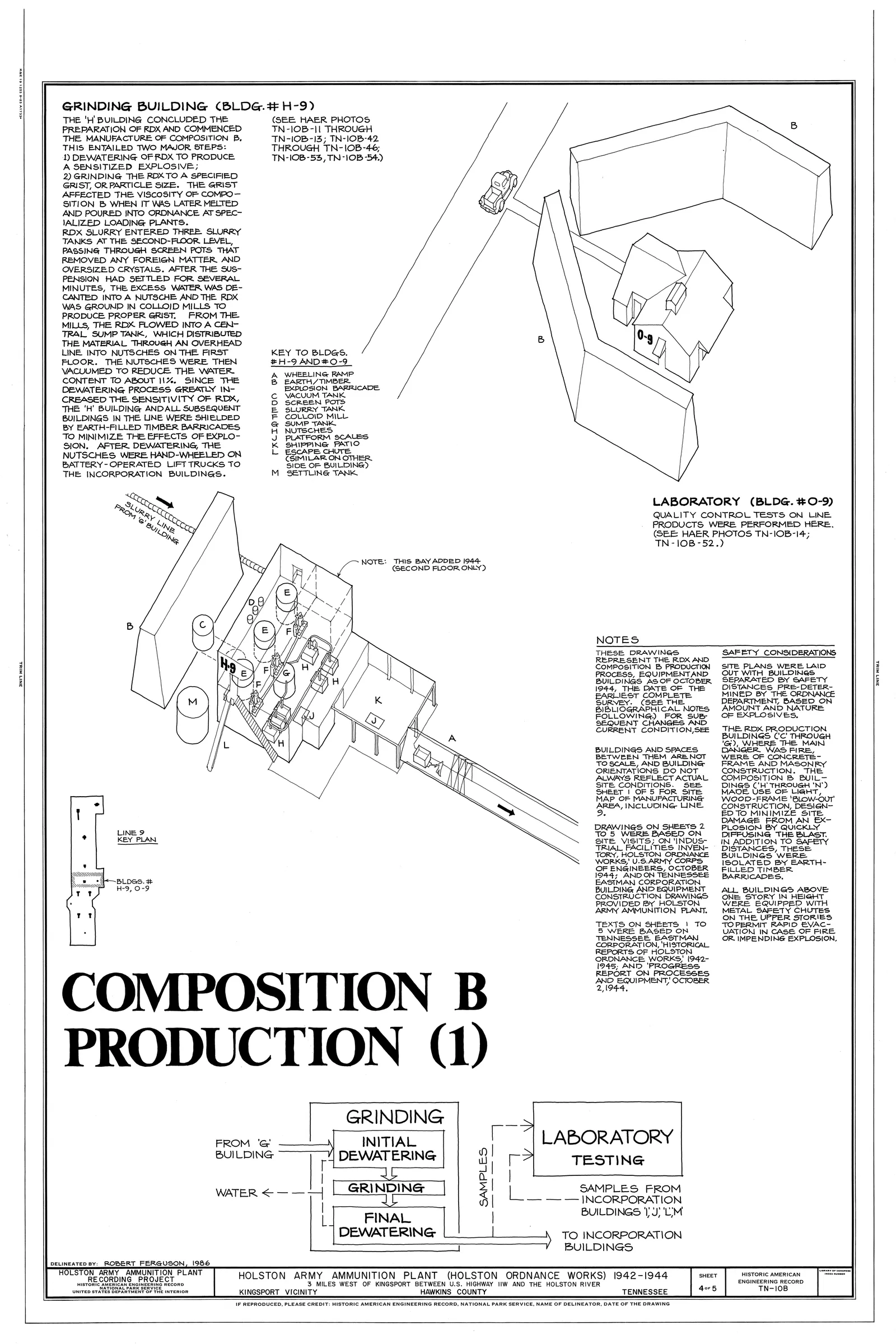
- Composition
- Army technical material lists Composition B at about 59.5 percent RDX and 39.5 percent TNT with tolerances; GAO rounds the inventory description to 60 percent RDX and 40 percent TNT.
- Function
- Used as a high-explosive filler in military munitions rather than as a standalone fired weapon.
- Development path
- Army technical material says the British formula was provided to the United States in 1940, followed by U.S. wartime development and large-scale production work.
- Processing
- Army technical material describes melting TNT at about 100 C, adding water-wet RDX with stirring, driving off moisture, adding wax where applicable, and then casting directly into munitions or solidifying chips for storage and shipment.
- Grades
- Army technical material separates standard Composition B from grade-specific formulations, including Composition B3 with Class F RDX and separate sensitivity-test discussion.
- Detonation velocity
- Army technical material lists Composition B at 1.68 g/cm3 with a detonation rate of 7,840 m/s, and lists Composition B2 at 1.72 g/cm3 with a detonation rate of 7,900 m/s.
- Handling
- Army technical material describes Composition B sensitivity as generally between TNT and RDX, with cast material more sensitive than powdered material.
- Representative filled munitions
- Source-backed catalog links include M107 155 mm projectiles, M933A1 120 mm mortar cartridges, M888 60 mm mortar cartridges, M106 203 mm projectiles, and 76mm HE-T M330 rounds.
- Authorized Canadian listing
- A Canadian authorized-explosives list names Composition B under Expro Chemical Products / Produits Chimiques Expro of Valleyfield, Quebec.