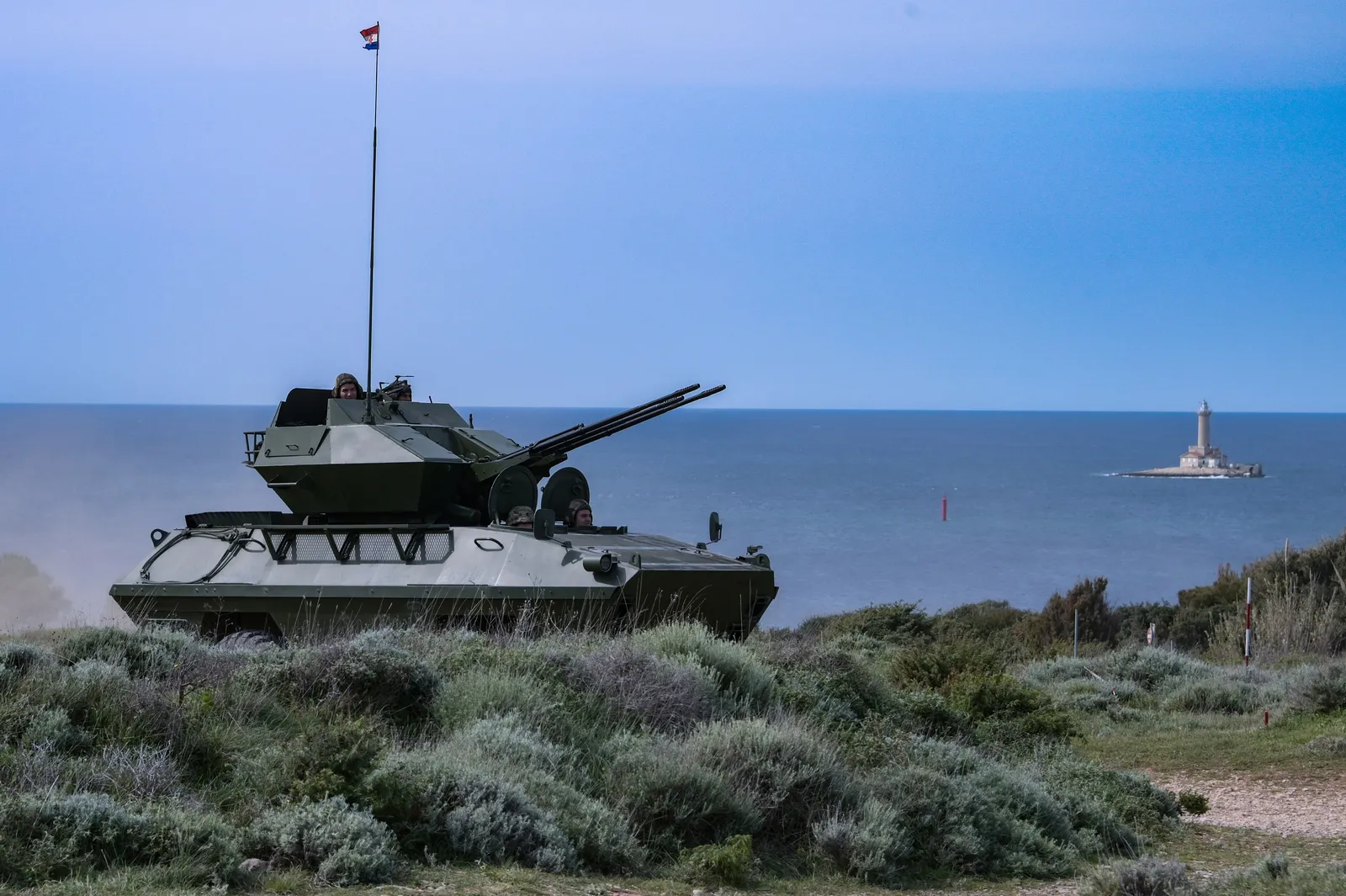

UK Parliament and CSIS Kosovo campaign references listed the BOV-3 among Yugoslav Army anti-aircraft guns or start-of-war equipment and described its triple-20 mm SPAAG configuration as also used effectively in the ground role.
Air Defense
BOV-3
Also known as
- BOV 3
- BOV-3 SPAAG
- BOV 3x20 mm
- BOV-3 20 mm
- BOV M-83 air-defense variant
BOV-3 is a Yugoslav 4x4 self-propelled anti-aircraft gun that mounts three 20 mm M55 cannon on the BOV armored-vehicle chassis. Its open-topped turret, optical fire-control arrangement, and short effective anti-aircraft range made it a close-range air-defense and ground-fire system in Yugoslav service; later reporting placed small numbers in the 1999 Kosovo War inventory and, after Slovenia's 2024 transfer, in Ukraine's wartime inventory.
Role in Conflicts
- Side
- Ukraine

Slovenian reporting said Ukraine received six BOV vehicles armed with 3x20 mm guns in 2024; Ukrainian defense reporting connected the transfer to Ukraine's Defense Forces and possible mobile fire-group use.
Role detailsUkraine Transfer Context
Open reporting points to a small Slovenian transfer rather than a large standardized fleet. 24ur reported six 3x20 mm BOV vehicles in the shipment; Defense Express separately reported three BOV vehicles with three-barreled M55 anti-aircraft guns and noted that maintenance and employment details were still unclear, with mobile fire groups as one plausible use case.
Profile / Specs
Profile
- Origin
- Yugoslavia
- Built by
- Yugoslav defense industry
- Type
- Wheeled self-propelled anti-aircraft gun
- Service note
- Cold War Yugoslav design; documented in Kosovo War inventories and Ukrainian service after Slovenia's 2024 transfer
- Designer
- Yugoslav military-technical design and production network
- Produced
- 1980s-1990s
Specifications
- Crew
- 4
- Chassis
- BOV-M 4x4 wheeled armored chassis
- Primary armament
- Three 20 mm M55A4B1 cannon in an open-topped turret
- Combat weight
- About 9,400 kg
- Engine
- Deutz F6L-413-F six-cylinder diesel, about 148-150 hp
- Road speed
- About 93-95 km/h
- Road range
- About 500 km
- Armor
- Light armor; GlobalSecurity lists 8 mm
- Fire control
- Optical sighting; J-171 sight described in open reporting
- Effective anti-aircraft range
- About 1,000-1,500 m; maximum vertical reach about 2,000 m
Gun System And Engagement Envelope
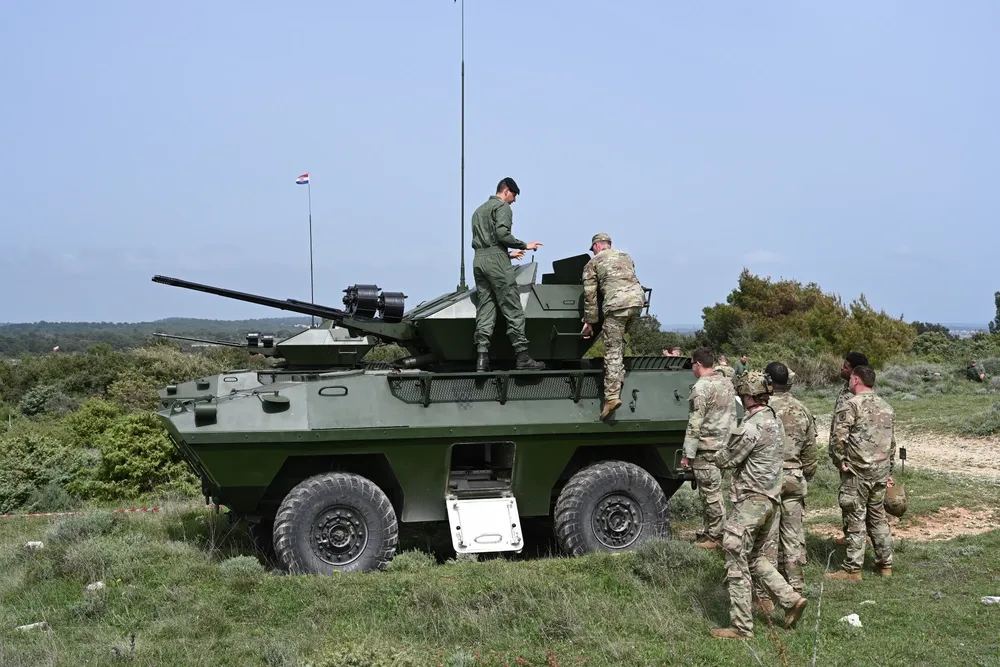
The BOV-3 is best understood as a close-range gun air-defense vehicle. Its three 20 mm cannon sit in an open-topped turret on a light 4x4 armored hull, giving it rapid traverse and high elevation but limited protection and a short engagement envelope.
Air-defense reach
RAND assessed the BOV-3's maximum vertical reach at about 2,000 m and its likely effective anti-aircraft range at about 1,000-1,500 m.
Gun layout
Army Recognition describes three 20 mm cannon with 60-round drum magazines and 1,500 rounds carried on the vehicle.
Fire-control limits
GlobalSecurity and Army Recognition both describe optical sighting rather than a radar-guided fire-control system.
Variants
The BOV family used the same wheeled armored-vehicle base for anti-tank, air-defense, police, command, and modernization roles.
| Variant | Configuration | Designation notes |
|---|---|---|
| BOV-1 | Anti-tank guided-missile carrier | GlobalSecurity describes BOV-1, also known as Polo M-83, as the anti-tank version armed with 9M113/AT-3 missiles. Sources: GlobalSecurity BOV-M BOV-3 BOV-30 |
| BOV-30 | Twin-30 mm anti-aircraft prototype or variant | GlobalSecurity identifies BOV-30 as a related air-defense version with two 30 mm cannon and an optical sight. Sources: GlobalSecurity BOV-M BOV-3 BOV-30 |
Timeline
BOV-3 Key Events
BOV-3 production and service period begins
WarWheels lists 1980 as the first production or service date for the BOV-3 self-propelled anti-aircraft gun vehicle.
Sources: WarWheels BOV 3 SPAAG Index
BOV-3 documented in Kosovo War Yugoslav equipment
UK Parliament and CSIS Kosovo campaign references listed the BOV-3 as a Yugoslav Army SPAAG with a triple 20 mm turret, while RAND described its place in Yugoslav low-level air defense.
Sources: UK Parliament Kosovo Military Action, CSIS Kosovo Air and Missile Campaign, RAND Disjointed War Kosovo
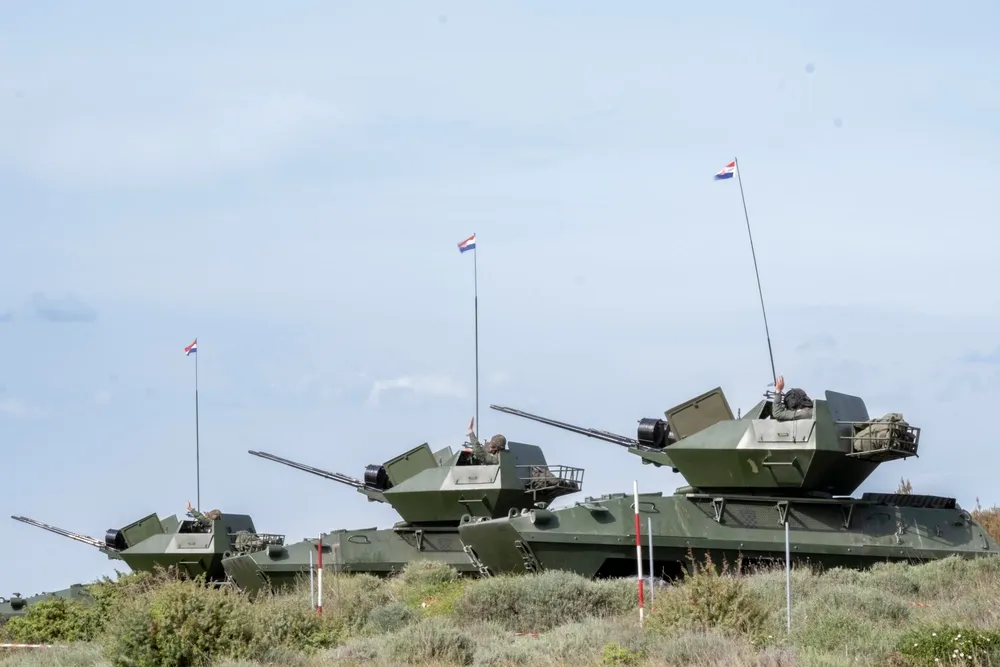
Croatia demonstrates BOV-3 during Exercise Shield 24
Croatian Army BOV-3 vehicles appeared during the Shield 24 air-defense exercise near Pula, providing a recent open-source view of the system's gun layout and training role.
Sources: Army Recognition Shield 24 BOV-3, Wikimedia Commons Croatian Army BOV-3 image
Slovenian BOV-3 vehicles reported delivered to Ukraine
24ur reported that Slovenia sent Ukraine 20 BOV vehicles with 12.7 mm armament and six BOV vehicles with 3x20 mm guns, placing the BOV-3 configuration in the Russia-Ukraine War.
Sources: 24ur BOV Ukraine transfer
Related Weapon Systems


Sources
24ur BOV Ukraine transferPublisher: 24ur.com | Note: Supports 2014 Russia-Ukraine War direct transfer context: reported that Slovenia sent Ukraine 20 BOV vehicles with 12.7 mm armament, six BOV vehicles with 3x20 mm guns, three additional BVP vehicles, and drones; also supports TAM/Yugoimport background as reported by the outlet. | Accessed: 2026-07-13Defense Express Slovenian BOVs to UkrainePublisher: Defense Express | Note: Supports 2014 Russia-Ukraine War direct transfer context for Slovenian BOV vehicles in Ukraine, including the three-barreled M55 Zastava gun configuration and a cautious mobile-fire-group use possibility. | Accessed: 2026-07-13UK Parliament Kosovo Military ActionPublisher: UK House of Commons Library | Note: Supports 1999 Kosovo War / Operation Allied Force direct-use context by listing BOV-3 among Yugoslav Army anti-aircraft guns in Kosovo-era force equipment and describing the triple 20 mm SPAAG as used in the ground role. | Accessed: 2026-07-13CSIS Kosovo Air and Missile CampaignPublisher: Center for Strategic and International Studies | Note: Supports 1999 Kosovo War / Operation Allied Force direct-use context by listing BOV-3 in Yugoslav start-of-war equipment for the Kosovo campaign and describing its ground-role use. | Accessed: 2026-07-13GlobalSecurity BOV-M BOV-3 BOV-30Publisher: GlobalSecurity.org | Note: Supports BOV-3 identity as a SPAAG on the BOV-M 4x4 chassis, its triple M55 20 mm cannon, optical sighting, key dimensions, weight, engine, speed, range, armor, and related BOV-1/BOV-30 variants. | Accessed: 2026-07-13RAND Disjointed War KosovoPublisher: RAND Corporation | Note: Supports BOV-3 technical and historical context in Yugoslav low-level air defense, including the triple 20 mm open-topped turret, infrared night-vision equipment, maximum vertical reach, and likely effective anti-aircraft range. | Accessed: 2026-07-13Army Recognition Shield 24 BOV-3Publisher: Army Recognition | Note: Supports recent Croatian BOV-3 exercise context, triple 20 mm gun layout, turret configuration, traverse/elevation details, drum magazines, ammunition carried, range claims, J-171 sight, and selected YouTube video metadata. | Accessed: 2026-07-13WarWheels BOV 3 SPAAG IndexPublisher: WarWheels.Net | Note: Supports BOV-3 as a Yugoslav/Slovenian self-propelled anti-aircraft gun vehicle, first production or service date, crew count, M55 20 mm cannon armament, and later Slovenian production context. | Accessed: 2026-07-13Wikimedia Commons Croatian Army BOV-3 imagePublisher: Wikimedia Commons | Note: Supports the reusable CC BY 4.0 image provenance for a Croatian Army BOV-3 photographed by MORH/F. Klen during the Shield 24 exercise. | Accessed: 2026-07-13DVIDS Exercise Shield 2024 BOV-3 imagePublisher: DVIDS | Note: Supports public-domain gallery image provenance for a Croatian Army BOV-3 demonstrated during Exercise Shield 24 in Pula, Croatia, on April 9, 2024. | Accessed: 2026-07-13DVIDS Operation Shield BOV-3 imagePublisher: DVIDS | Note: Supports public-domain gallery image provenance for Croatian soldiers operating BOV-3 short-range air-defense systems during Operation Shield on April 11, 2024. | Accessed: 2026-07-13