- Caliber
- 40 mm
- Weapon family
- Bofors 40 mm anti-aircraft gun family; this page does not merge later 40 x 365 mm L/70 ammunition records
- Projectile role
- Projectile or shell component for fixed 40 mm anti-aircraft ammunition
- Example U.S. wartime round
- HE-T (SD) Mk II with Mk 27 point-detonating fuze for 40 mm AA guns
- Authorized M1 gun ammunition classes
- High-explosive, high-explosive tracer, armor-piercing tracer, target-practice tracer, and drill rounds
- Projectile weight range
- About 1.93-2.06 lb for representative U.S. service HE/HE-T/AP-T rounds in TM 9-252
- Complete round weight
- 4.70 lb for the U.S. HE-T (SD) Mk II example in TM 9-1901
- Complete round length
- 17.60 in
- Fuzed projectile length
- 7.64 in
- Case length
- 12.24 in
- Projectile construction
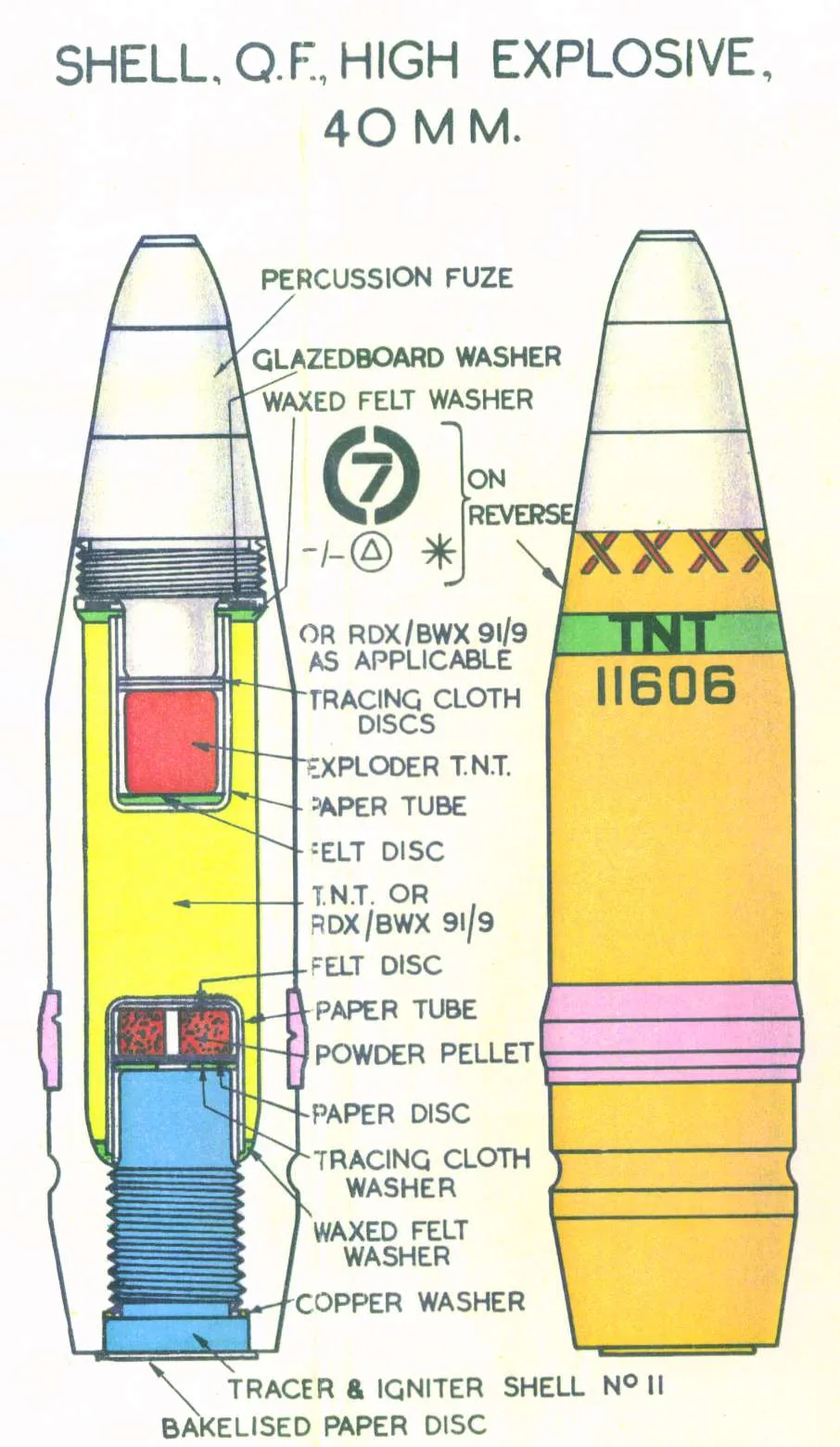
- Hollow steel high-explosive shell with pressed TNT bursting charge, point-detonating fuze, boat-tailed base, and shell-destroying tracer
- Tracer/self-destroy action
- Visible tracer burn of about 9-12 seconds in the U.S. manual, with tracer burnout intended to detonate the shell if impact fuze action had not occurred
- Muzzle velocity
- 2,870 ft/s for the U.S. HE-T (SD) Mk II example
- Documented Hoffman production
- Poughkeepsie plant produced projectiles for 40 mm Bofors shells during World War II
- Documented output
- Marist archive states almost 15 million projectiles shipped in a little over three years
- Primary image type
- British high-explosive shell diagram used as a rights-clear representative 40 mm Bofors projectile image